
Ever wonder why you might have your mum's eyes but... Meer weergeven
 Agricultural Science46 weergaven·Bijgewerkt May 19, 2026·7 pagina's
Understanding Mendel's Laws with Simple Examples
1 / 7
1
of 7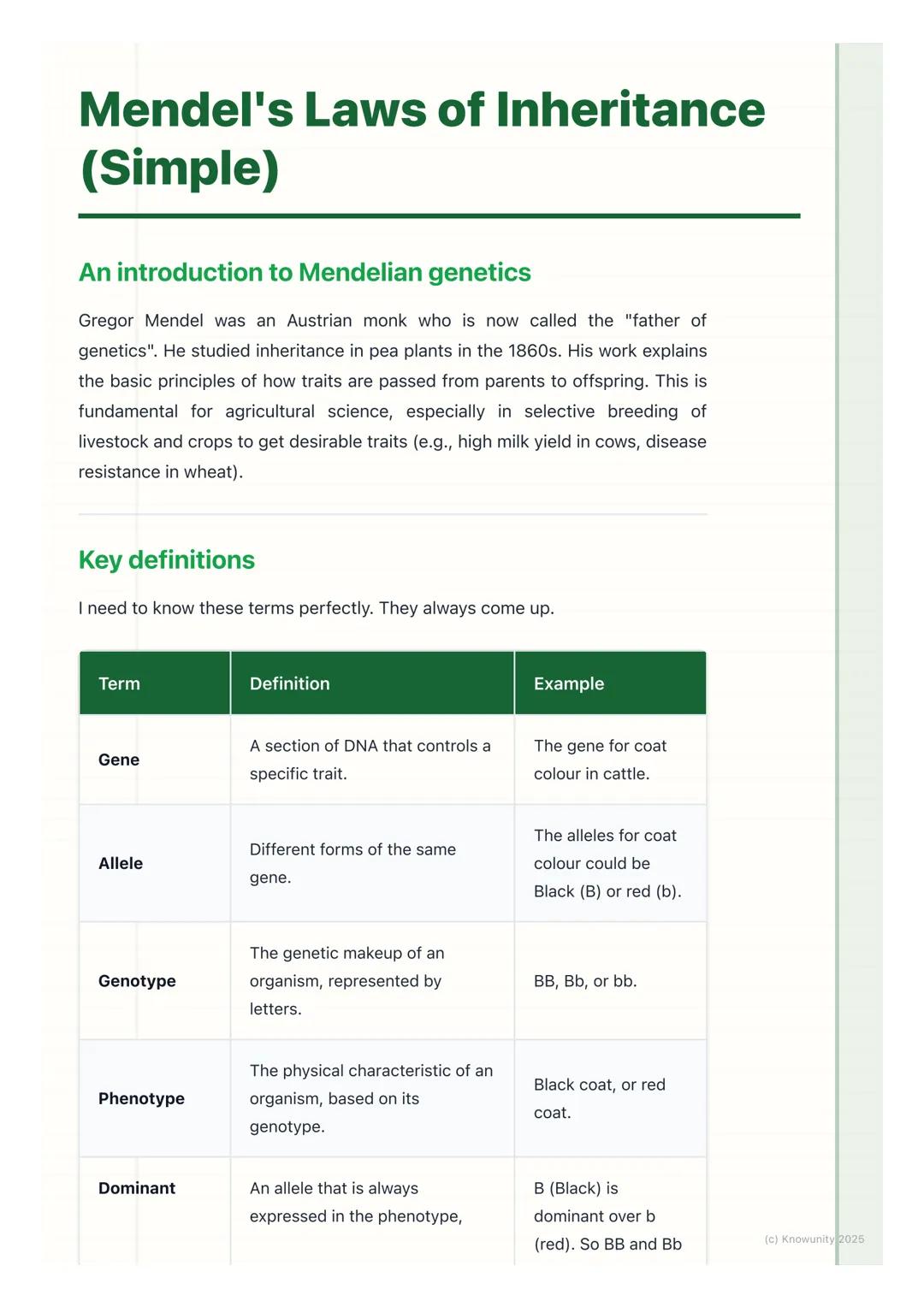
Mendel's Laws of Inheritance - Introduction & Key Terms
Meet Gregor Mendel, the "father of genetics" who figured out how traits pass from parents to offspring. His work with pea plants in the 1860s gives us the foundation for understanding inheritance - something that's crucial in agriculture today for breeding high-yield crops and healthy livestock.
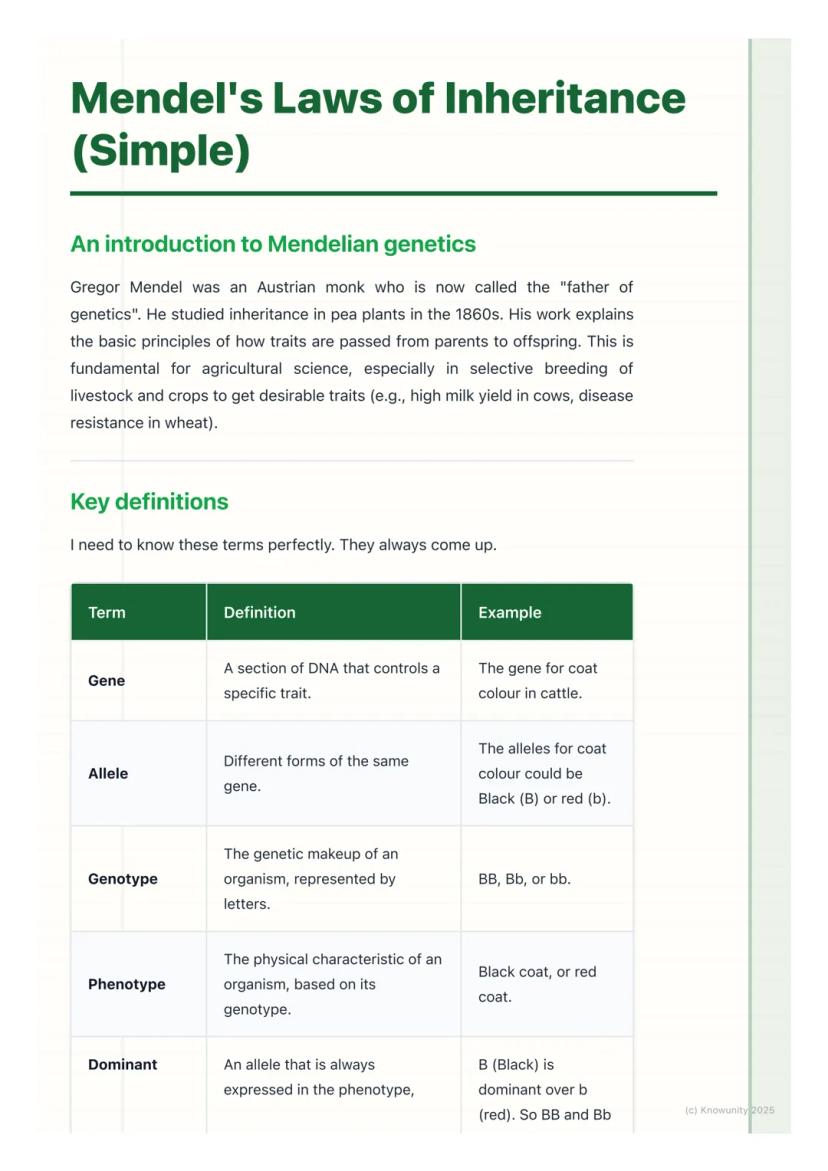
You absolutely need to nail these key genetic terms because they show up in every exam. A gene is a section of DNA controlling a specific trait (like coat colour in cattle), while alleles are different versions of the same gene (like black or red coat colour). Your genotype is your genetic makeup written in letters (BB, Bb, or bb), and your phenotype is what you actually look like based on those genes (black coat or red coat).
Dominant alleles (written as capital letters like B) always show up in your appearance even if you only have one copy. Recessive alleles (lowercase letters like b) only appear when you have two copies - so an animal needs bb to have a red coat, while both BB and Bb give you a black coat.
Quick Tip: Think of dominant alleles as the "bossy" ones - they always get their way when they're present!
2
of 7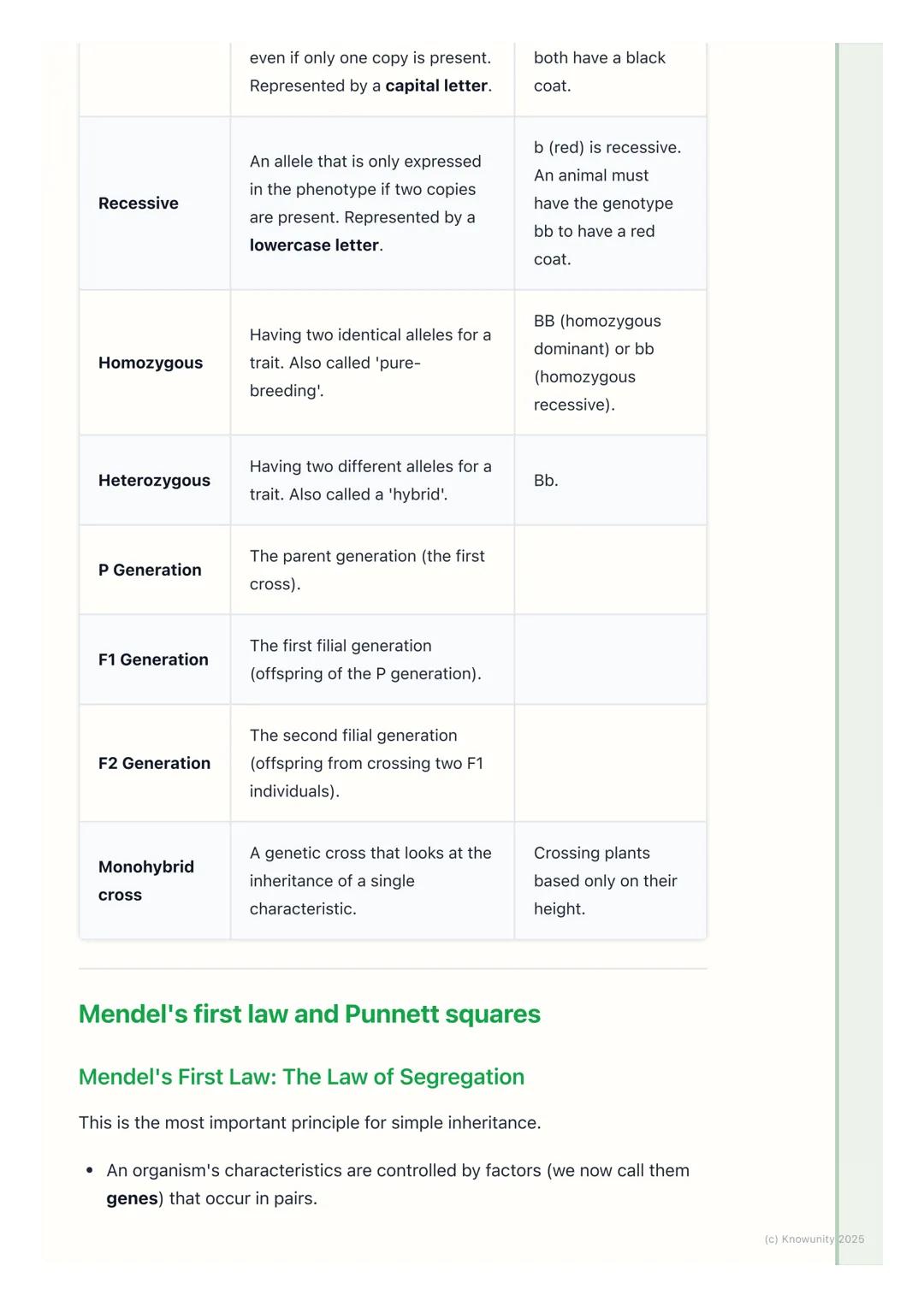
More Essential Terms & Generations
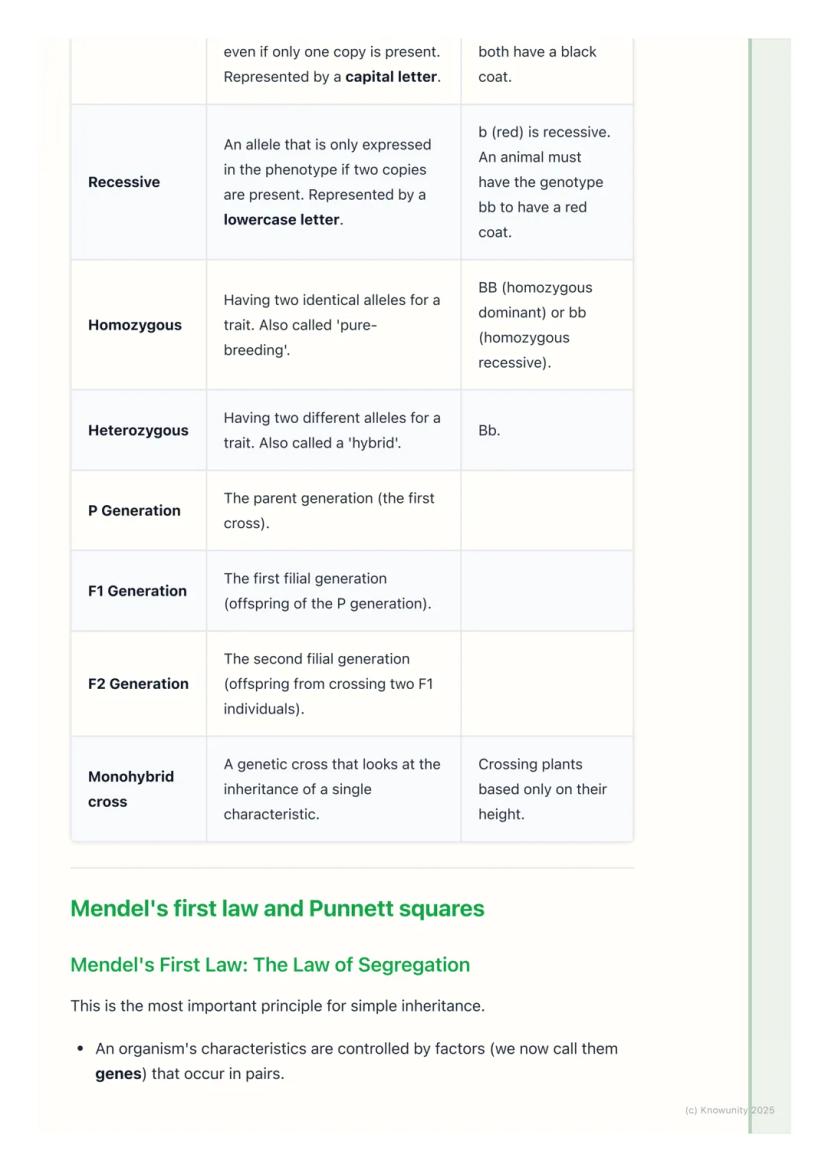
Understanding homozygous and heterozygous is crucial for your exams. Homozygous means having two identical alleles (BB or bb) - these are also called "pure-breeding" because they always produce the same type of offspring. Heterozygous means having two different alleles (Bb) - these are "hybrids" that can produce different types of offspring.
Scientists use specific labels for different generations in breeding experiments. The P generation is the original parent cross, the F1 generation is their immediate offspring, and the F2 generation comes from crossing two F1 individuals together. A monohybrid cross focuses on tracking just one characteristic, like plant height or coat colour.
These terms aren't just academic - they're used every day in agriculture and animal breeding. When farmers want to predict what traits their livestock will have, they're using exactly these principles that Mendel discovered over 150 years ago.
Remember: F1 stands for "first filial" and F2 means "second filial" - filial just means "offspring"!
3
of 7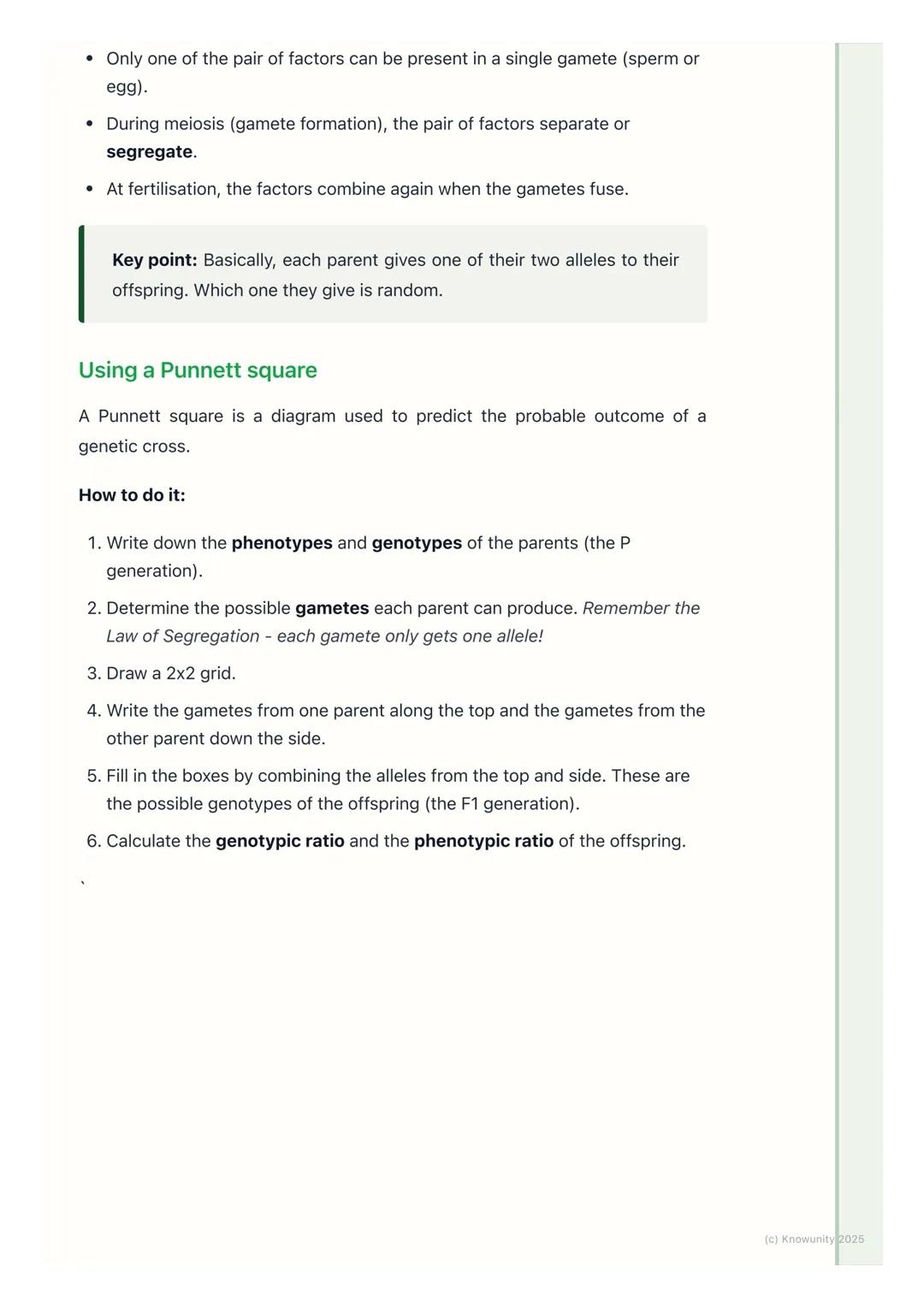
Mendel's First Law: The Law of Segregation
This is the most important concept you need to understand for simple inheritance. Mendel's Law of Segregation states that each organism has paired factors (genes) for every trait, but only one factor from each pair ends up in each gamete (sperm or egg cell).
Here's how it works: during meiosis (when gametes form), the paired alleles separate completely. Each sperm or egg only gets one allele from each pair, not both. Then during fertilisation, when sperm meets egg, the pairs form again as the offspring gets one allele from each parent.
Think of it like this - if you're heterozygous (Bb) for eye colour, your gametes will either carry the B allele OR the b allele, never both. Which one each gamete gets is completely random, like flipping a coin.
This separation during meiosis is why Punnett squares work so well for predicting inheritance patterns. They're basically showing you all the possible ways these separated alleles can recombine in the next generation.
Key Insight: The Law of Segregation explains why you're a unique mix of your parents' traits rather than an exact copy of either one!
4
of 7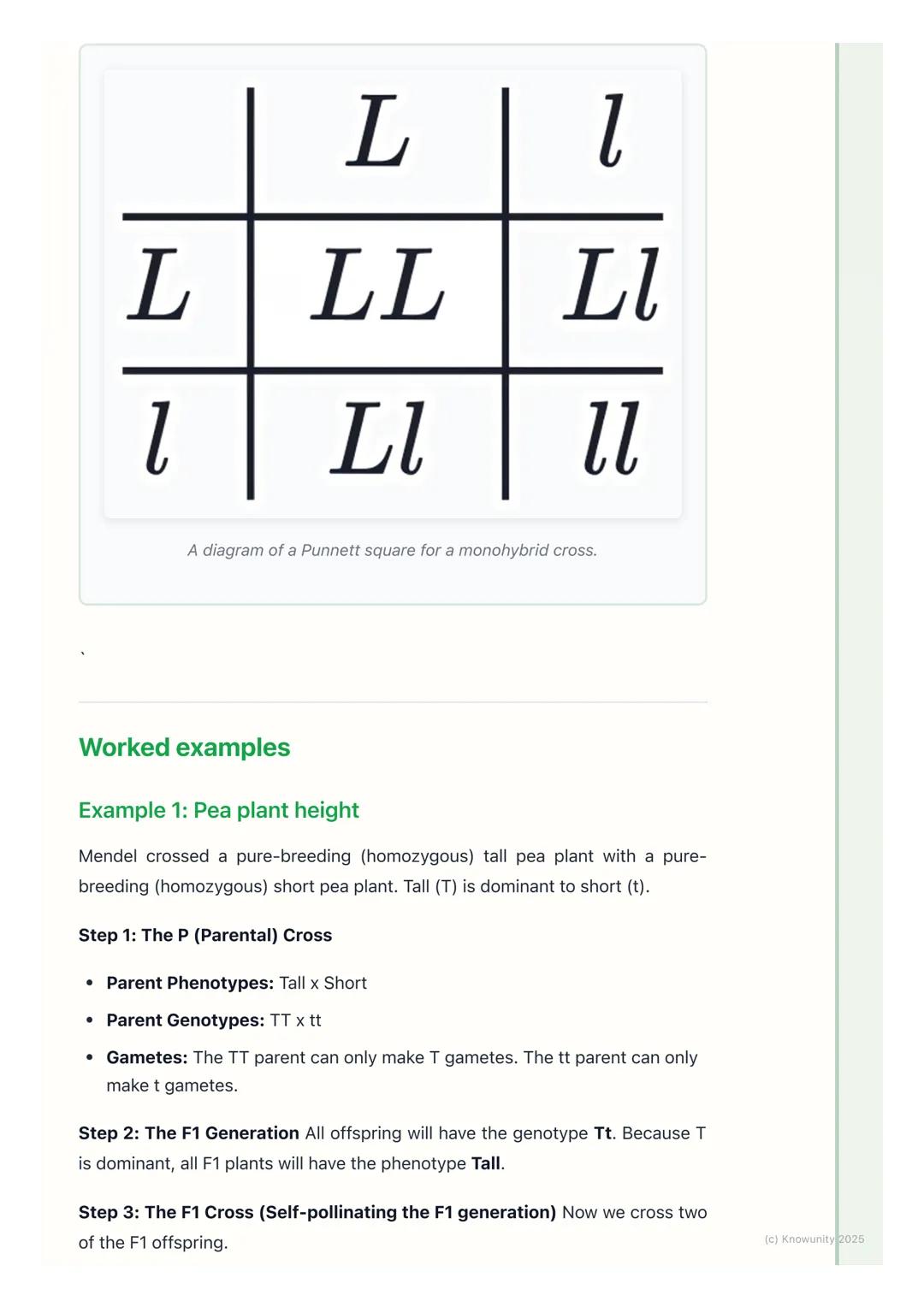
Using Punnett Squares - The Method
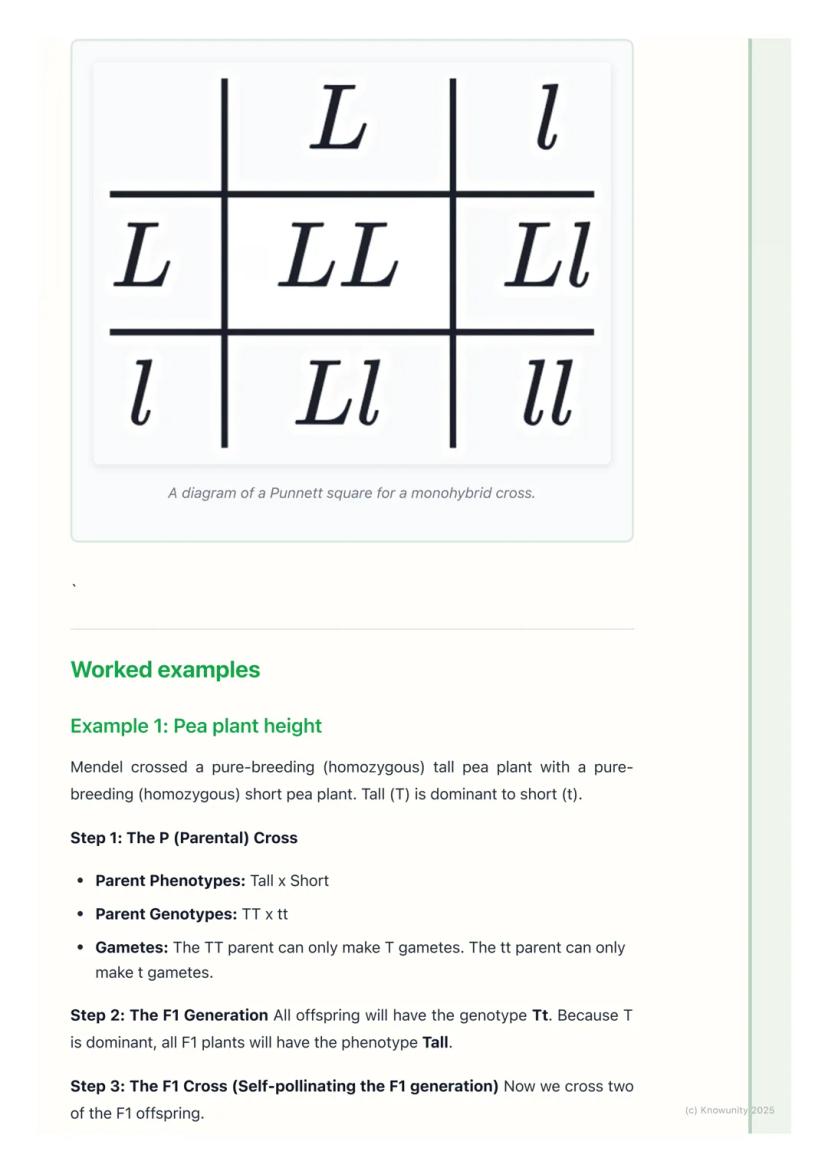
Punnett squares are your best tool for predicting genetic crosses, and mastering them is essential for exam success. They're essentially grids that show all possible combinations when alleles from two parents come together.
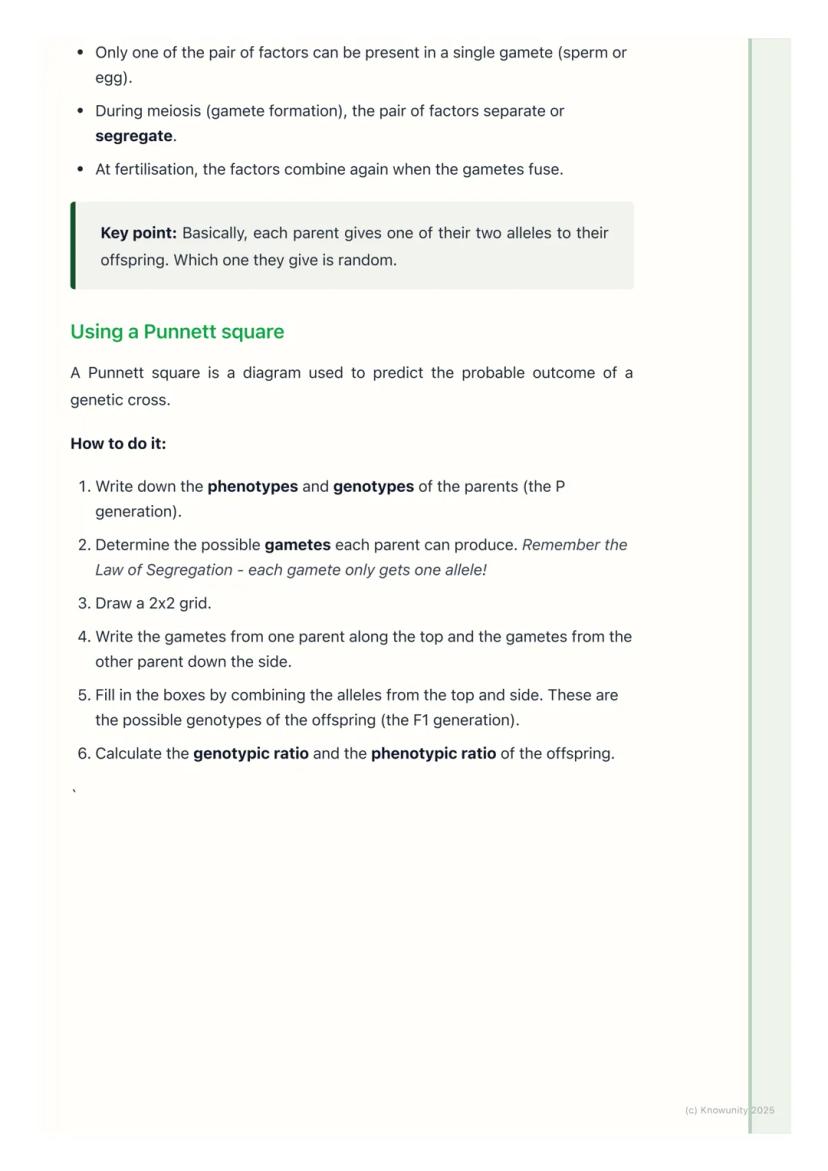
Here's the step-by-step method: First, identify the phenotypes and genotypes of both parents. Next, work out what gametes each parent can produce (remember, each gamete only gets one allele from each pair). Draw your 2×2 grid, write one parent's gametes across the top and the other parent's down the side.
Fill in each box by combining the allele from the top with the allele from the side. These combinations show you all possible genotypes for the offspring. Finally, count up the results to get your genotypic ratio (the genetic combinations) and phenotypic ratio (what the offspring actually look like).
Let's look at a real example with pea plant height, where tall (T) is dominant over short (t). When Mendel crossed a pure-breeding tall plant (TT) with a pure-breeding short plant (tt), every F1 offspring was Tt - and since T is dominant, they all looked tall.
Pro Tip: Always double-check that your ratios add up correctly - it's an easy way to spot mistakes!
5
of 7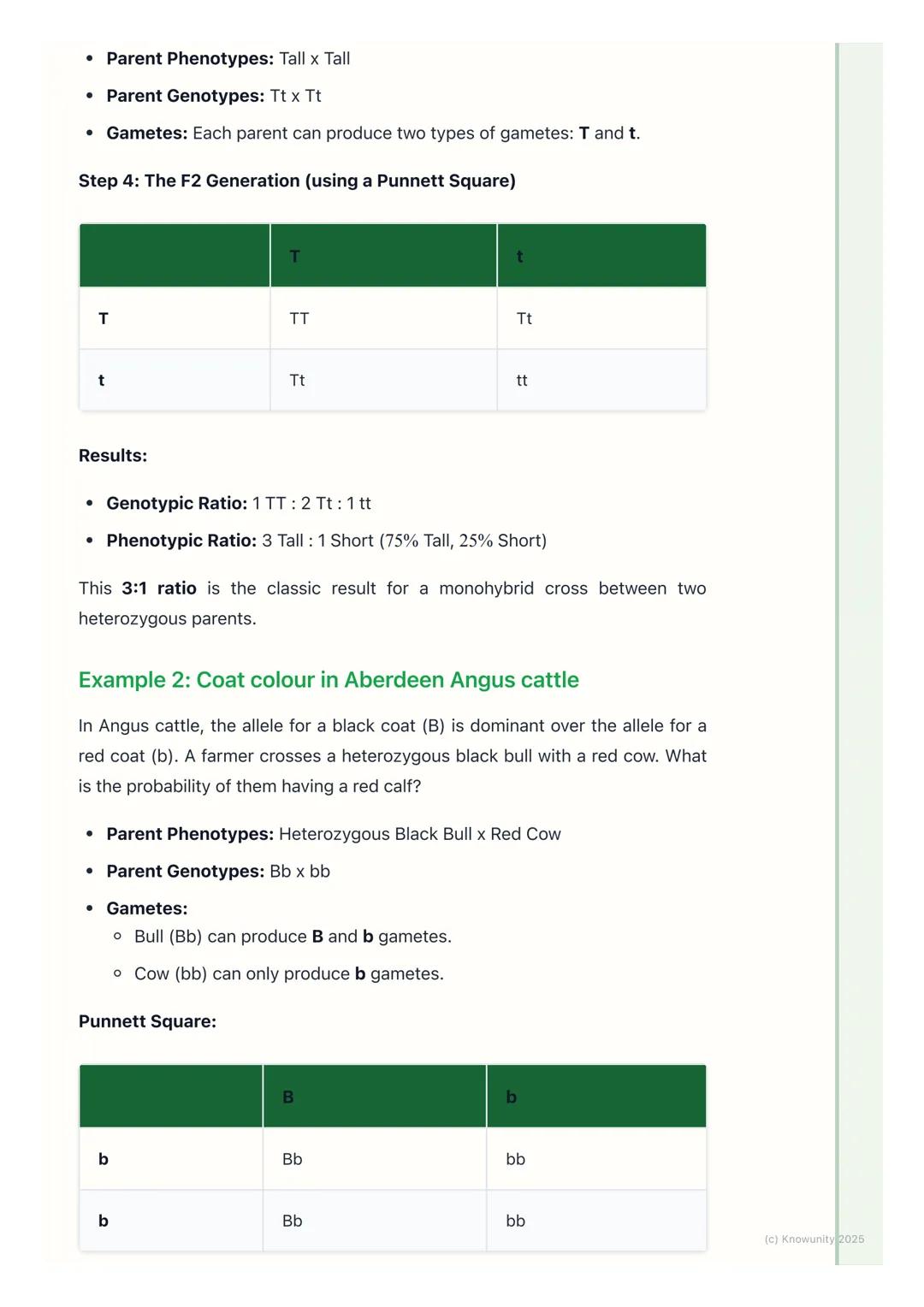
Worked Examples - The Classic 3:1 Ratio
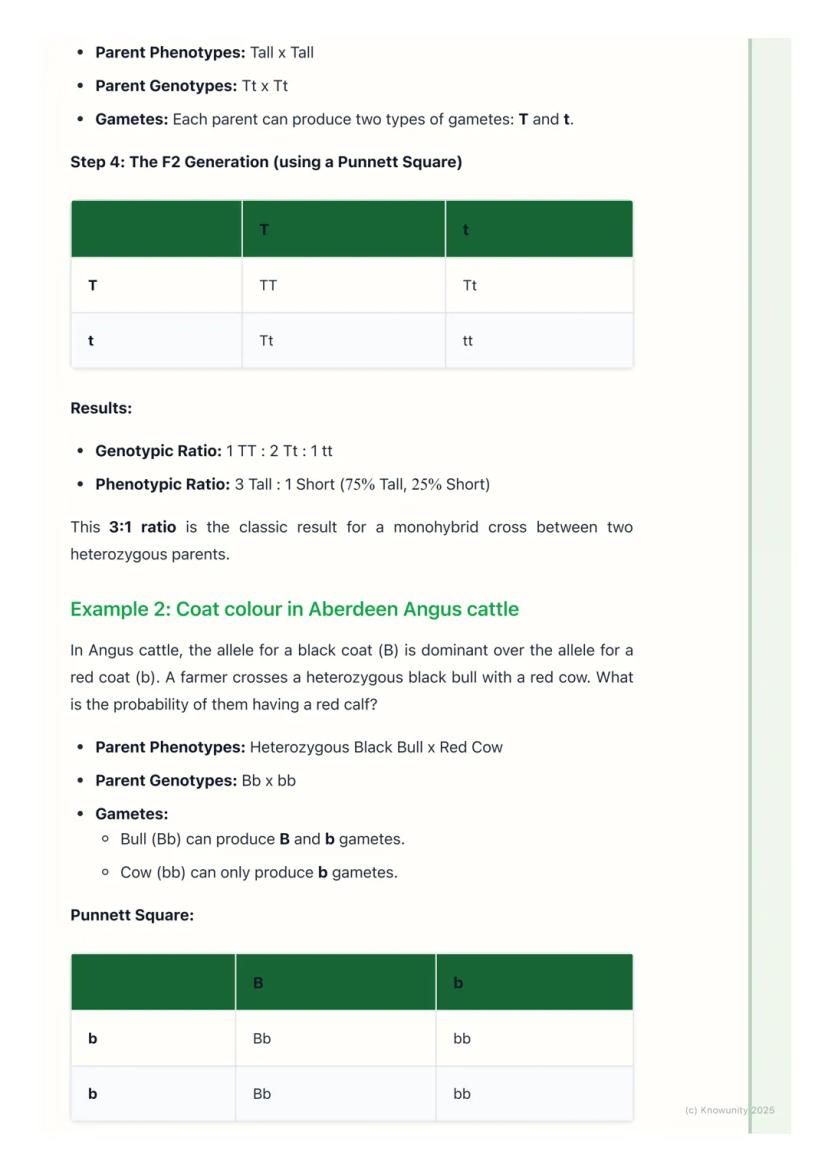
When Mendel crossed two F1 heterozygous plants (Tt × Tt), he discovered the famous 3:1 phenotypic ratio. Using a Punnett square, the cross produces TT, Tt, Tt, and tt offspring - giving you a genotypic ratio of 1:2:1 but a phenotypic ratio of 3 tall : 1 short.
This happens because both TT and Tt plants look tall (since T is dominant), while only tt plants look short. So out of four possible combinations, three appear tall and one appears short - hence the classic 3:1 ratio you'll see repeatedly in genetics problems.
Here's a practical example with Aberdeen Angus cattle: black coat (B) is dominant over red coat (b). If you cross a heterozygous black bull (Bb) with a red cow (bb), the Punnett square gives you Bb, bb, Bb, bb. This means a 1:1 phenotypic ratio of black to red calves, so there's a 50% chance of getting a red calf.
Remember, these are probability predictions, not guarantees. Just like flipping a coin doesn't guarantee exactly 5 heads in 10 flips, genetic ratios show likelihood rather than certainty.
Exam Alert: The 3:1 ratio only appears when crossing two heterozygous parents - make sure you can spot this pattern!
6
of 7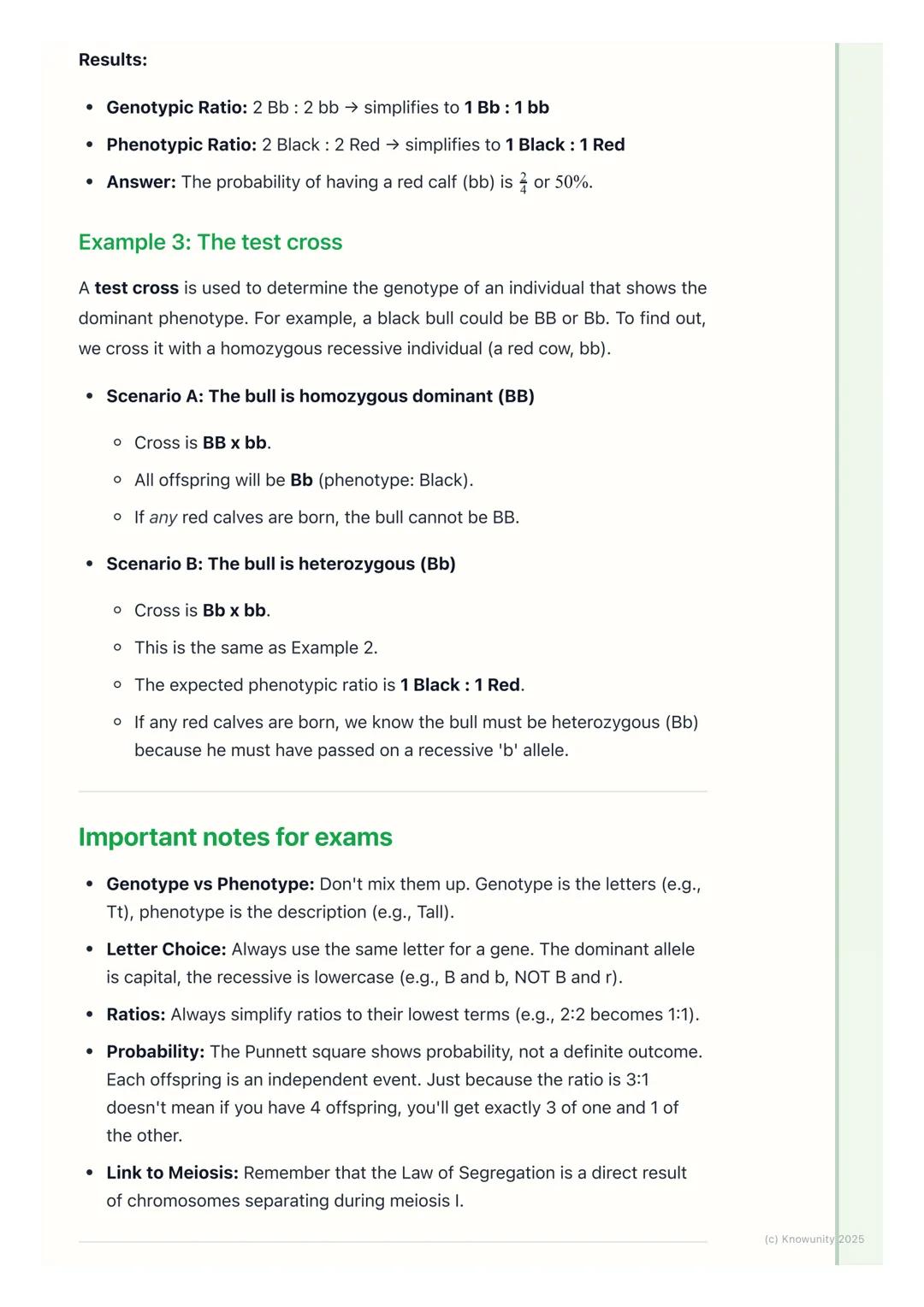
Test Crosses and Practical Applications
Sometimes you need to figure out an animal's genotype when you only know its phenotype. This is where test crosses become invaluable - you cross the unknown individual with a homozygous recessive partner and analyse the offspring.
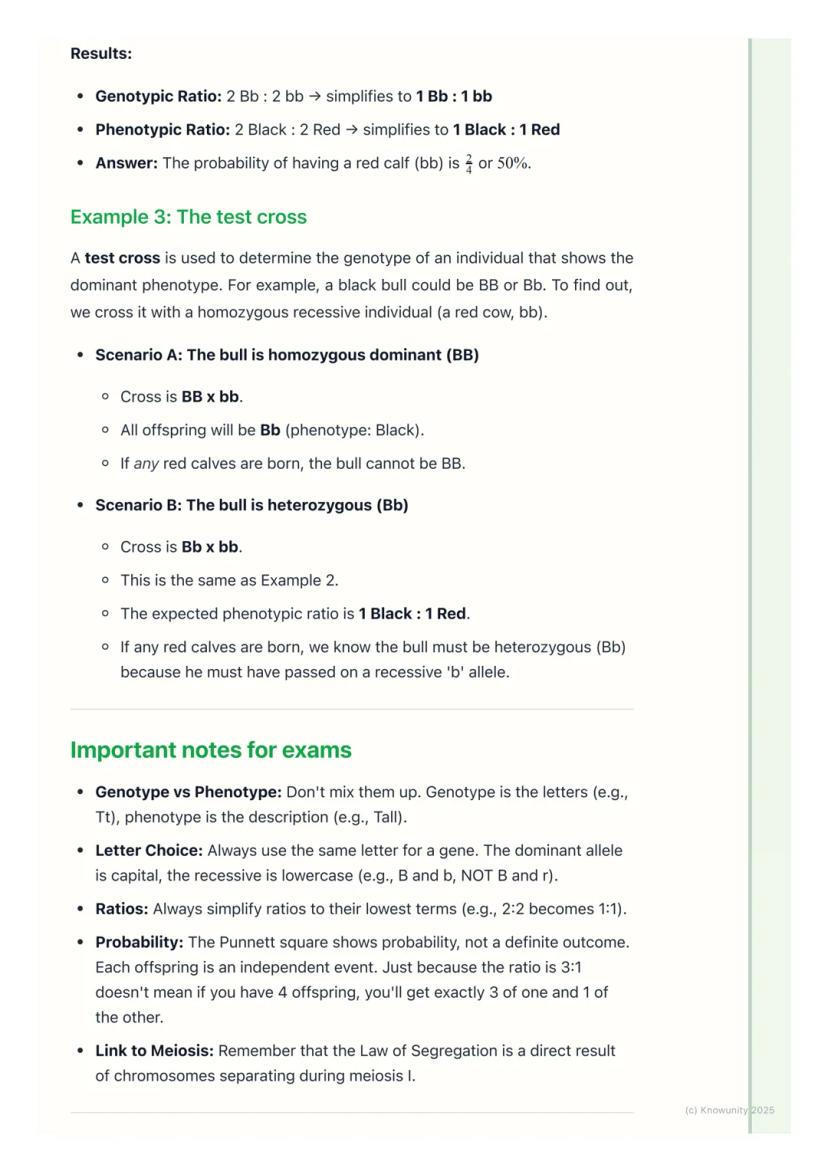
For example, if you have a black bull that could be either BB or Bb, cross him with a red cow (bb). If he's BB, all calves will be black (Bb). If he's Bb, you'll get approximately half black and half red calves. The appearance of even one red calf proves the bull must be heterozygous.
Here are crucial exam tips to avoid common mistakes: Never mix up genotype (the letters like Tt) with phenotype (the appearance like "tall"). Always use the same letter for related alleles - dominant gets capitals, recessive gets lowercase. Simplify all ratios to lowest terms, and remember that Punnett squares show probability, not definite outcomes.
The Law of Segregation links directly to meiosis - when chromosomes separate during meiosis I, that's exactly when alleles segregate into different gametes. This connection between cell biology and inheritance patterns shows how beautifully integrated biology really is.
Real-world Connection: Farmers use test crosses regularly to identify the best breeding animals for their herds!
7
of 7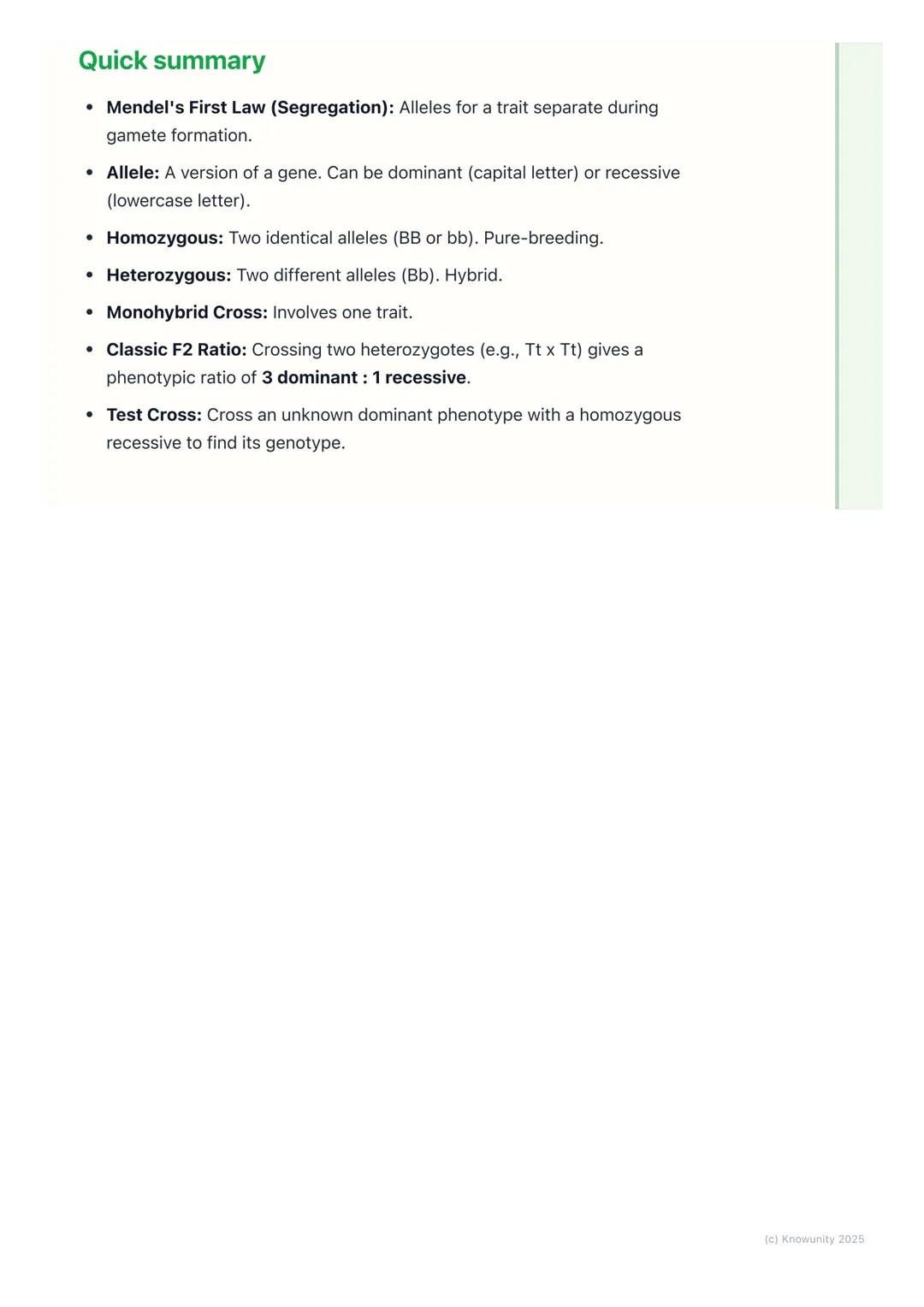
Quick Summary - Essential Points
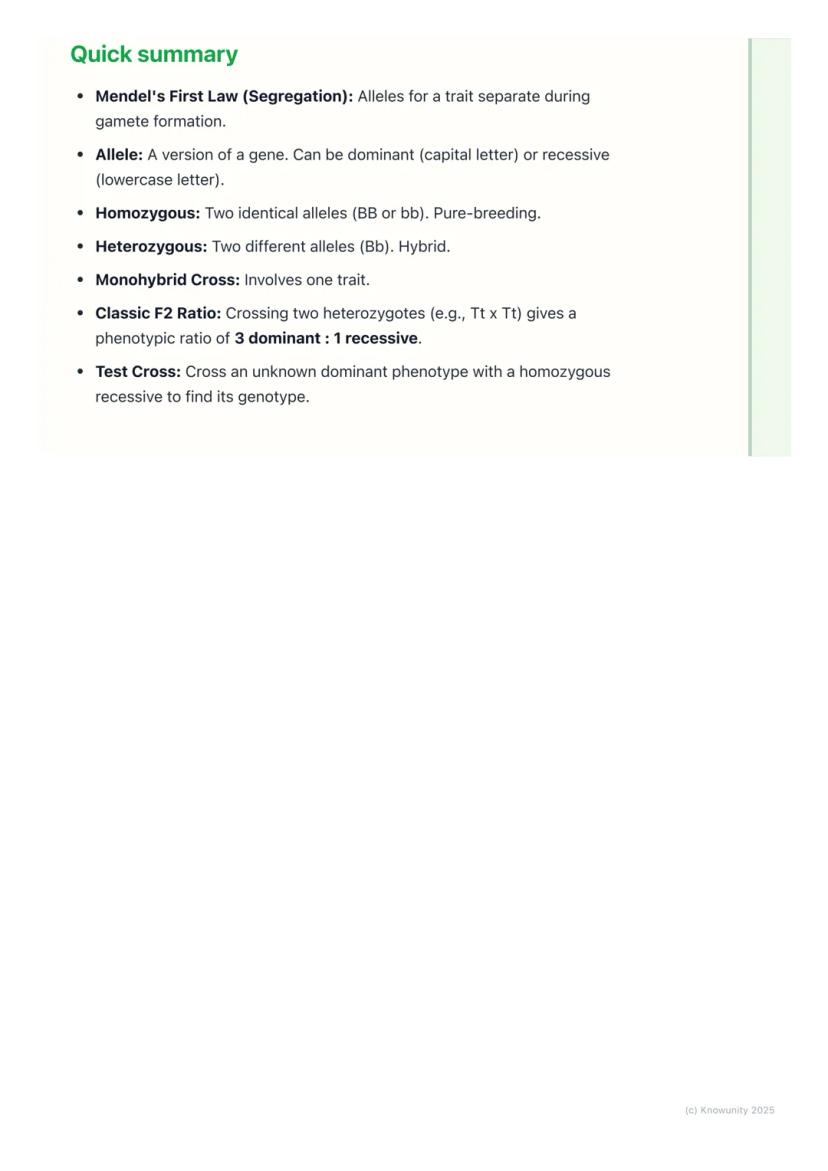
Here's what you absolutely must remember about Mendelian genetics: Alleles separate during gamete formation (Law of Segregation), with dominant alleles (capitals) masking recessive alleles (lowercase) in the phenotype. Homozygous individuals have identical alleles and breed true, while heterozygous individuals have different alleles.
The classic monohybrid cross between two heterozygotes always gives a 3:1 phenotypic ratio in the F2 generation. Test crosses help determine unknown genotypes by crossing with homozygous recessive individuals.
These principles aren't just academic - they're used daily in agriculture, animal breeding, and understanding human inheritance. Whether you're predicting crop yields or understanding why certain traits run in families, you're using Mendel's discoveries.
Remember that genetics is fundamentally about probability and patterns. Once you understand the basic rules of how alleles behave during reproduction, you can predict inheritance for any single-gene trait.
Final Thought: Mendel's work with simple pea plants unlocked the secrets of inheritance that we still use today - pretty amazing for a 19th-century monk!
We dachten al dat je dit zou vragen...
Wat is de Knowunity AI companion?
Onze AI Companion is een studentgerichte AI-tool die meer biedt dan alleen antwoorden. Gebouwd op miljoenen Knowunity bronnen, biedt het relevante informatie, gepersonaliseerde studieplannen, quizzes en inhoud direct in de chat, aangepast aan jouw individuele leertraject.
Waar kan ik de Knowunity-app downloaden?
Je kunt de app downloaden via Google Play Store en Apple App Store.
Is Knowunity echt gratis?
Dat klopt! Geniet van gratis toegang tot leerinhoud, maak contact met medestudenten en krijg directe hulp – alles binnen handbereik.
Populairste studiemateriaal
9 Irish
IrishIrish oral questions and answers
Questions and answers for the leaving cert oral
5th Year4254
IrishIrish oral questions
Outline of oral questions
5th Year2055
IrishGaeilge Grammar Office
All the basics you need to know on Irish grammar.
6th Year863
 English
Key Quotes : Sive
Key Quotes and explanations: Sive
6th Year2161
IrishAn Gaeilge Aiste
Irish Language essay
6th Year1250
IrishIrish poetry 2027
Iníon + Dínit an Bhróin
5th Year1133
IrishMé Féin & Mo Chlann (Myself & My Family)
Students will learn vocabulary to describe themselves, their family members, and daily routines. This helps in personal introductions and discussions.
TY291
IrishLC HL notes- Iníon (poem)
Includes poem in English and Irish, theme, key words & phrases
5th Year2274
 Geography
Territory, economic activities in Paris basin
essay
6th Year80
Kan je niet vinden wat je zoekt? Ontdek andere vakken.
Studenten zijn dol op ons — en jij ook.
4.6/5App Store
4.7/5Google Play
De app is heel makkelijk te gebruiken en goed ontworpen. Ik heb tot nu toe alles kunnen vinden waar ik naar zocht en heb veel kunnen leren van de presentaties! Ik ga de app zeker gebruiken voor een schoolopdracht! En natuurlijk helpt het ook veel als inspiratie.
Stefan SiOS gebruiker
Deze app is echt geweldig. Er zijn zoveel aantekeningen en hulpmiddelen [...]. Mijn probleemvak is bijvoorbeeld Frans, en de app heeft zoveel opties voor hulp. Dankzij deze app ben ik beter geworden in Frans. Ik zou het iedereen aanraden.
Samantha KlichAndroid gebruiker
Wow, ik ben echt onder de indruk. Ik probeerde de app gewoon omdat ik hem vaak geadverteerd had gezien en was absoluut verbaasd. Deze app is DE HULP die je wilt voor school en bovenal biedt hij zoveel dingen, zoals oefeningen en factsheets, die mij persoonlijk HEEL erg hebben geholpen.
AnnaiOS gebruiker
Agricultural Science46 weergaven·Bijgewerkt May 19, 2026·7 pagina'sUnderstanding Mendel's Laws with Simple Examples
Ever wonder why you might have your mum's eyes but your dad's height? It all comes down to genetics! Gregor Mendel, an Austrian monk from the 1860s, cracked the code of inheritance by studying pea plants, and his discoveries still... Meer weergeven
1
of 7Meld je aan om de inhoud te zien. Het is gratis!
- Toegang tot alle documenten
- Verbeter je cijfers
- Sluit je aan bij miljoenen studenten
Mendel's Laws of Inheritance - Introduction & Key Terms
Meet Gregor Mendel, the "father of genetics" who figured out how traits pass from parents to offspring. His work with pea plants in the 1860s gives us the foundation for understanding inheritance - something that's crucial in agriculture today for breeding high-yield crops and healthy livestock.
You absolutely need to nail these key genetic terms because they show up in every exam. A gene is a section of DNA controlling a specific trait (like coat colour in cattle), while alleles are different versions of the same gene (like black or red coat colour). Your genotype is your genetic makeup written in letters (BB, Bb, or bb), and your phenotype is what you actually look like based on those genes (black coat or red coat).
Dominant alleles (written as capital letters like B) always show up in your appearance even if you only have one copy. Recessive alleles (lowercase letters like b) only appear when you have two copies - so an animal needs bb to have a red coat, while both BB and Bb give you a black coat.
Quick Tip: Think of dominant alleles as the "bossy" ones - they always get their way when they're present!
2
of 7Meld je aan om de inhoud te zien. Het is gratis!
- Toegang tot alle documenten
- Verbeter je cijfers
- Sluit je aan bij miljoenen studenten
More Essential Terms & Generations
Understanding homozygous and heterozygous is crucial for your exams. Homozygous means having two identical alleles (BB or bb) - these are also called "pure-breeding" because they always produce the same type of offspring. Heterozygous means having two different alleles (Bb) - these are "hybrids" that can produce different types of offspring.
Scientists use specific labels for different generations in breeding experiments. The P generation is the original parent cross, the F1 generation is their immediate offspring, and the F2 generation comes from crossing two F1 individuals together. A monohybrid cross focuses on tracking just one characteristic, like plant height or coat colour.
These terms aren't just academic - they're used every day in agriculture and animal breeding. When farmers want to predict what traits their livestock will have, they're using exactly these principles that Mendel discovered over 150 years ago.
Remember: F1 stands for "first filial" and F2 means "second filial" - filial just means "offspring"!
3
of 7Meld je aan om de inhoud te zien. Het is gratis!
- Toegang tot alle documenten
- Verbeter je cijfers
- Sluit je aan bij miljoenen studenten
Mendel's First Law: The Law of Segregation
This is the most important concept you need to understand for simple inheritance. Mendel's Law of Segregation states that each organism has paired factors (genes) for every trait, but only one factor from each pair ends up in each gamete (sperm or egg cell).
Here's how it works: during meiosis (when gametes form), the paired alleles separate completely. Each sperm or egg only gets one allele from each pair, not both. Then during fertilisation, when sperm meets egg, the pairs form again as the offspring gets one allele from each parent.
Think of it like this - if you're heterozygous (Bb) for eye colour, your gametes will either carry the B allele OR the b allele, never both. Which one each gamete gets is completely random, like flipping a coin.
This separation during meiosis is why Punnett squares work so well for predicting inheritance patterns. They're basically showing you all the possible ways these separated alleles can recombine in the next generation.
Key Insight: The Law of Segregation explains why you're a unique mix of your parents' traits rather than an exact copy of either one!
4
of 7Meld je aan om de inhoud te zien. Het is gratis!
- Toegang tot alle documenten
- Verbeter je cijfers
- Sluit je aan bij miljoenen studenten
Using Punnett Squares - The Method
Punnett squares are your best tool for predicting genetic crosses, and mastering them is essential for exam success. They're essentially grids that show all possible combinations when alleles from two parents come together.
Here's the step-by-step method: First, identify the phenotypes and genotypes of both parents. Next, work out what gametes each parent can produce (remember, each gamete only gets one allele from each pair). Draw your 2×2 grid, write one parent's gametes across the top and the other parent's down the side.
Fill in each box by combining the allele from the top with the allele from the side. These combinations show you all possible genotypes for the offspring. Finally, count up the results to get your genotypic ratio (the genetic combinations) and phenotypic ratio (what the offspring actually look like).
Let's look at a real example with pea plant height, where tall (T) is dominant over short (t). When Mendel crossed a pure-breeding tall plant (TT) with a pure-breeding short plant (tt), every F1 offspring was Tt - and since T is dominant, they all looked tall.
Pro Tip: Always double-check that your ratios add up correctly - it's an easy way to spot mistakes!
5
of 7Meld je aan om de inhoud te zien. Het is gratis!
- Toegang tot alle documenten
- Verbeter je cijfers
- Sluit je aan bij miljoenen studenten
Worked Examples - The Classic 3:1 Ratio
When Mendel crossed two F1 heterozygous plants (Tt × Tt), he discovered the famous 3:1 phenotypic ratio. Using a Punnett square, the cross produces TT, Tt, Tt, and tt offspring - giving you a genotypic ratio of 1:2:1 but a phenotypic ratio of 3 tall : 1 short.
This happens because both TT and Tt plants look tall (since T is dominant), while only tt plants look short. So out of four possible combinations, three appear tall and one appears short - hence the classic 3:1 ratio you'll see repeatedly in genetics problems.
Here's a practical example with Aberdeen Angus cattle: black coat (B) is dominant over red coat (b). If you cross a heterozygous black bull (Bb) with a red cow (bb), the Punnett square gives you Bb, bb, Bb, bb. This means a 1:1 phenotypic ratio of black to red calves, so there's a 50% chance of getting a red calf.
Remember, these are probability predictions, not guarantees. Just like flipping a coin doesn't guarantee exactly 5 heads in 10 flips, genetic ratios show likelihood rather than certainty.
Exam Alert: The 3:1 ratio only appears when crossing two heterozygous parents - make sure you can spot this pattern!
6
of 7Meld je aan om de inhoud te zien. Het is gratis!
- Toegang tot alle documenten
- Verbeter je cijfers
- Sluit je aan bij miljoenen studenten
Test Crosses and Practical Applications
Sometimes you need to figure out an animal's genotype when you only know its phenotype. This is where test crosses become invaluable - you cross the unknown individual with a homozygous recessive partner and analyse the offspring.
For example, if you have a black bull that could be either BB or Bb, cross him with a red cow (bb). If he's BB, all calves will be black (Bb). If he's Bb, you'll get approximately half black and half red calves. The appearance of even one red calf proves the bull must be heterozygous.
Here are crucial exam tips to avoid common mistakes: Never mix up genotype (the letters like Tt) with phenotype (the appearance like "tall"). Always use the same letter for related alleles - dominant gets capitals, recessive gets lowercase. Simplify all ratios to lowest terms, and remember that Punnett squares show probability, not definite outcomes.
The Law of Segregation links directly to meiosis - when chromosomes separate during meiosis I, that's exactly when alleles segregate into different gametes. This connection between cell biology and inheritance patterns shows how beautifully integrated biology really is.
Real-world Connection: Farmers use test crosses regularly to identify the best breeding animals for their herds!
7
of 7Meld je aan om de inhoud te zien. Het is gratis!
- Toegang tot alle documenten
- Verbeter je cijfers
- Sluit je aan bij miljoenen studenten
Quick Summary - Essential Points
Here's what you absolutely must remember about Mendelian genetics: Alleles separate during gamete formation (Law of Segregation), with dominant alleles (capitals) masking recessive alleles (lowercase) in the phenotype. Homozygous individuals have identical alleles and breed true, while heterozygous individuals have different alleles.
The classic monohybrid cross between two heterozygotes always gives a 3:1 phenotypic ratio in the F2 generation. Test crosses help determine unknown genotypes by crossing with homozygous recessive individuals.
These principles aren't just academic - they're used daily in agriculture, animal breeding, and understanding human inheritance. Whether you're predicting crop yields or understanding why certain traits run in families, you're using Mendel's discoveries.
Remember that genetics is fundamentally about probability and patterns. Once you understand the basic rules of how alleles behave during reproduction, you can predict inheritance for any single-gene trait.
Final Thought: Mendel's work with simple pea plants unlocked the secrets of inheritance that we still use today - pretty amazing for a 19th-century monk!
We dachten al dat je dit zou vragen...
Wat is de Knowunity AI companion?
Onze AI Companion is een studentgerichte AI-tool die meer biedt dan alleen antwoorden. Gebouwd op miljoenen Knowunity bronnen, biedt het relevante informatie, gepersonaliseerde studieplannen, quizzes en inhoud direct in de chat, aangepast aan jouw individuele leertraject.
Waar kan ik de Knowunity-app downloaden?
Je kunt de app downloaden via Google Play Store en Apple App Store.
Is Knowunity echt gratis?
Dat klopt! Geniet van gratis toegang tot leerinhoud, maak contact met medestudenten en krijg directe hulp – alles binnen handbereik.
Populairste studiemateriaal
9IrishIrish oral questions and answers
Questions and answers for the leaving cert oral
5th Year4254
IrishIrish oral questions
Outline of oral questions
5th Year2055
IrishGaeilge Grammar Office
All the basics you need to know on Irish grammar.
6th Year863
EnglishKey Quotes : Sive
Key Quotes and explanations: Sive
6th Year2161
IrishAn Gaeilge Aiste
Irish Language essay
6th Year1250
IrishIrish poetry 2027
Iníon + Dínit an Bhróin
5th Year1133
IrishMé Féin & Mo Chlann (Myself & My Family)
Students will learn vocabulary to describe themselves, their family members, and daily routines. This helps in personal introductions and discussions.
TY291
IrishLC HL notes- Iníon (poem)
Includes poem in English and Irish, theme, key words & phrases
5th Year2274
GeographyTerritory, economic activities in Paris basin
essay
6th Year80
Kan je niet vinden wat je zoekt? Ontdek andere vakken.
Studenten zijn dol op ons — en jij ook.
4.6/5App Store
4.7/5Google Play
De app is heel makkelijk te gebruiken en goed ontworpen. Ik heb tot nu toe alles kunnen vinden waar ik naar zocht en heb veel kunnen leren van de presentaties! Ik ga de app zeker gebruiken voor een schoolopdracht! En natuurlijk helpt het ook veel als inspiratie.
Stefan SiOS gebruiker
Deze app is echt geweldig. Er zijn zoveel aantekeningen en hulpmiddelen [...]. Mijn probleemvak is bijvoorbeeld Frans, en de app heeft zoveel opties voor hulp. Dankzij deze app ben ik beter geworden in Frans. Ik zou het iedereen aanraden.
Samantha KlichAndroid gebruiker
Wow, ik ben echt onder de indruk. Ik probeerde de app gewoon omdat ik hem vaak geadverteerd had gezien en was absoluut verbaasd. Deze app is DE HULP die je wilt voor school en bovenal biedt hij zoveel dingen, zoals oefeningen en factsheets, die mij persoonlijk HEEL erg hebben geholpen.
AnnaiOS gebruiker