
Ever wondered how chemists know exactly how strong a solution... Meer weergeven
 Irish
Irish English
Meld je aan om de inhoud te zienHet is gratis!
Toegang tot alle documenten
Verbeter je cijfers
Sluit je aan bij miljoenen studenten
Knowunity AI
Vakken
Triangle Congruence and Similarity Theorems
Triangle Properties and Classification
Linear Equations and Graphs
Geometric Angle Relationships
Trigonometric Functions and Identities
Equation Solving Techniques
Circle Geometry Fundamentals
Division Operations and Methods
Basic Differentiation Rules
Exponent and Logarithm Properties
Alle onderwerpen weergeven
Human Organ Systems
Reproductive Cell Cycles
Biological Sciences Subdisciplines
Cellular Energy Metabolism
Autotrophic Energy Processes
Inheritance Patterns and Principles
Biomolecular Structure and Organization
Cell Cycle and Division Mechanics
Cellular Organization and Development
Biological Structural Organization
Alle onderwerpen weergeven
Chemical Sciences and Applications
Atomic Structure and Composition
Molecular Electron Structure Representation
Atomic Electron Behavior
Matter Properties and Water
Mole Concept and Calculations
Gas Laws and Behavior
Periodic Table Organization
Chemical Thermodynamics Fundamentals
Chemical Bond Types and Properties
Alle onderwerpen weergeven
European Renaissance and Enlightenment
European Cultural Movements 800-1920
American Revolution Era 1763-1797
American Civil War 1861-1865
Global Imperial Systems
Mongol and Chinese Dynasties
U.S. Presidents and World Leaders
Historical Sources and Documentation
World Wars Era and Impact
World Religious Systems
Alle onderwerpen weergeven
Classic and Contemporary Novels
Literary Character Analysis
Rhetorical Theory and Practice
Classic Literary Narratives
Reading Analysis and Interpretation
Narrative Structure and Techniques
English Language Components
Influential English-Language Authors
Basic Sentence Structure
Narrative Voice and Perspective
Alle onderwerpen weergeven
12
•
Bijgewerkt May 8, 2026
•
Ever wondered how chemists know exactly how strong a solution... Meer weergeven
Think of concentration like making squash - the more cordial you add to water, the stronger it tastes. In chemistry, we're measuring how much solute (the thing being dissolved) is packed into a solvent (usually water).
When you mix them together, you get a solution. The concentration tells you exactly how strong that solution is, which determines how it'll behave in chemical reactions.
There are two main ways to measure concentration: Molarity (for most lab work) and Parts Per Million (for really dilute solutions like pollutants in water). You'll also need to know how to make standard solutions - these are solutions where you know the concentration precisely.
Quick Tip: Molarity uses mol/L, whilst ppm uses mg/L - don't mix up your units!
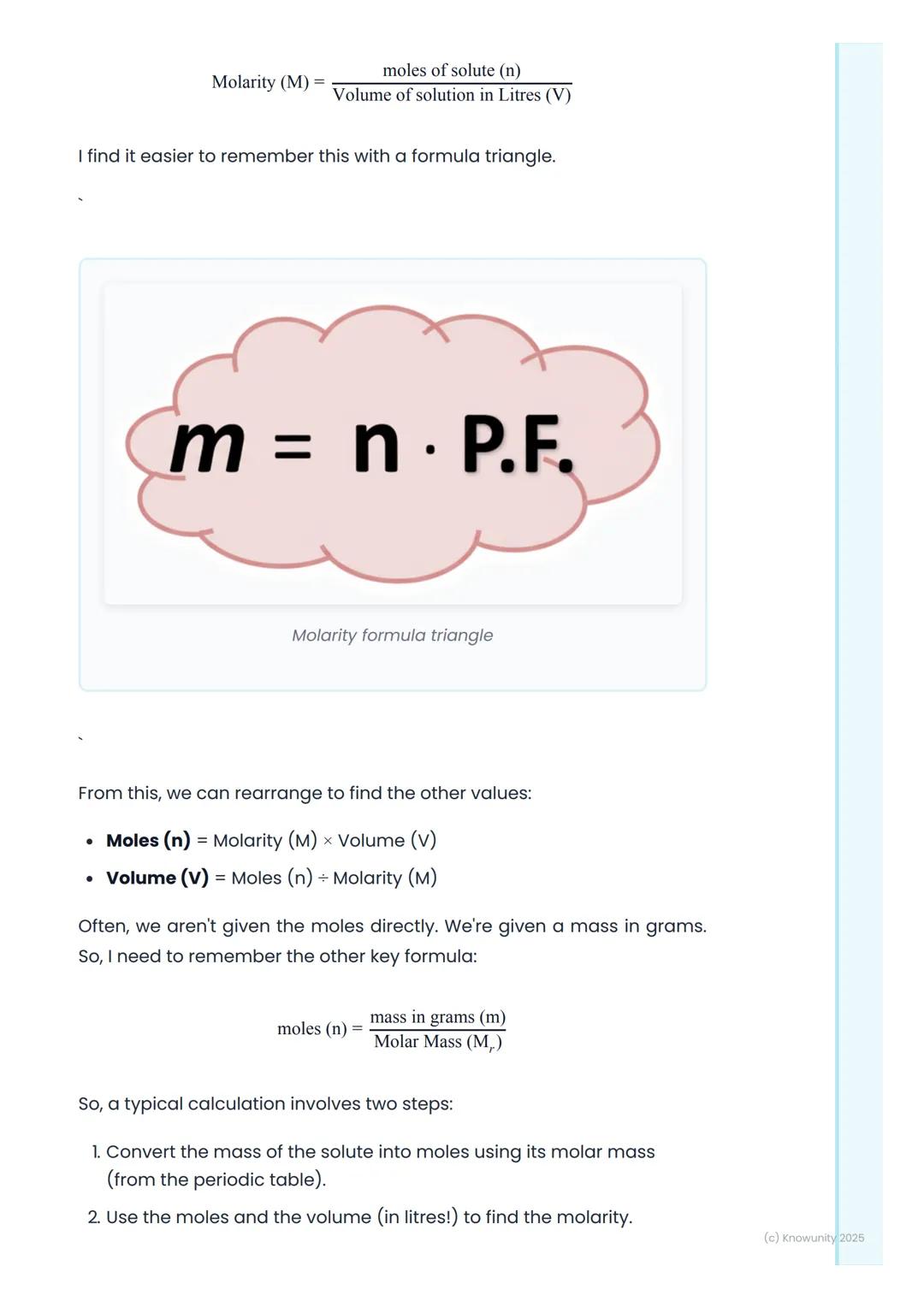
Molarity is your go-to concentration unit. It's simply moles of solute per litre of solution, and the formula is dead easy: M = n/V.
The tricky bit is when you're given mass instead of moles. Then you need two steps: first convert mass to moles using n = m/Mr, then use those moles to find molarity.
Here's the classic setup: you've got some solid chemical, you dissolve it in water, and you need to find the concentration. Convert cm³ to litres (divide by 1000), work out the moles, then divide moles by volume.
Memory Trick: Use the formula triangle - cover what you want to find, and the triangle shows you what to do with the other two values!
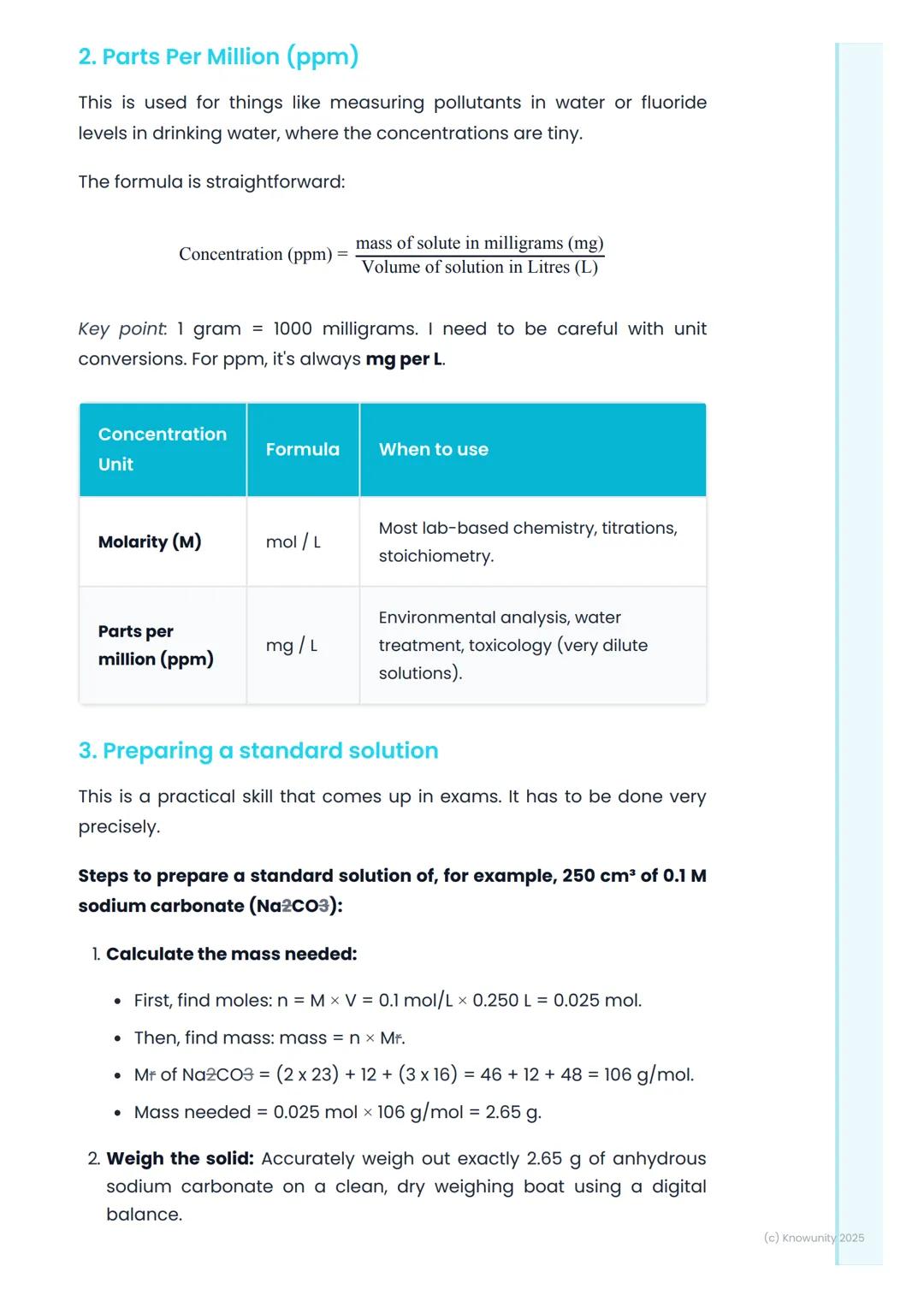
When concentrations are absolutely tiny - think fluoride in drinking water or pollutants - we use Parts Per Million (ppm). It's much simpler than molarity: just mg of solute per litre of solution.
The formula is straightforward: ppm = mass (mg) / Volume (L). Just remember that 1 gram equals 1000 milligrams, so you might need to convert.
You'll see ppm in environmental chemistry, water treatment, and anywhere we're dealing with trace amounts. It's basically saying "out of a million parts of solution, how many parts are my solute?"
Real World: The WHO recommends fluoride levels in drinking water should be between 0.5-1.5 ppm for dental health.
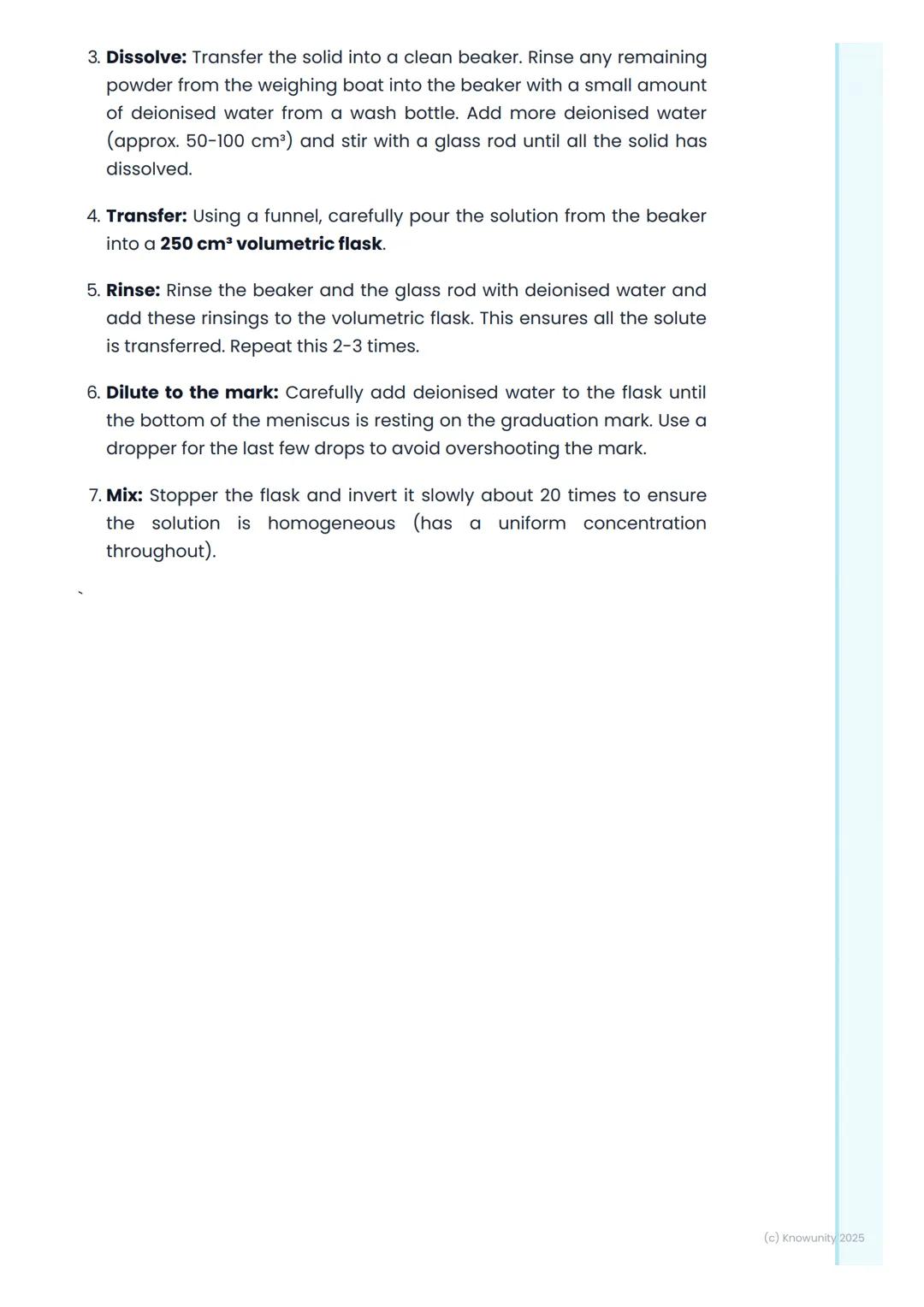
Making a standard solution is a practical skill that'll definitely come up in exams. You need to be absolutely precise because the whole point is knowing the exact concentration.
Here's the method: calculate the mass you need (using M × V to get moles, then moles × Mr to get mass). Weigh it accurately, dissolve it in a beaker with some distilled water, then transfer everything to a volumetric flask.
The key bits are rinsing the beaker multiple times (so you don't lose any solute) and filling to the graduation mark carefully. Use a dropper for the last few drops - you can't go back if you overshoot!
Exam Alert: Always use a volumetric flask, not a measuring cylinder or beaker - they're calibrated to be super accurate for one specific volume.
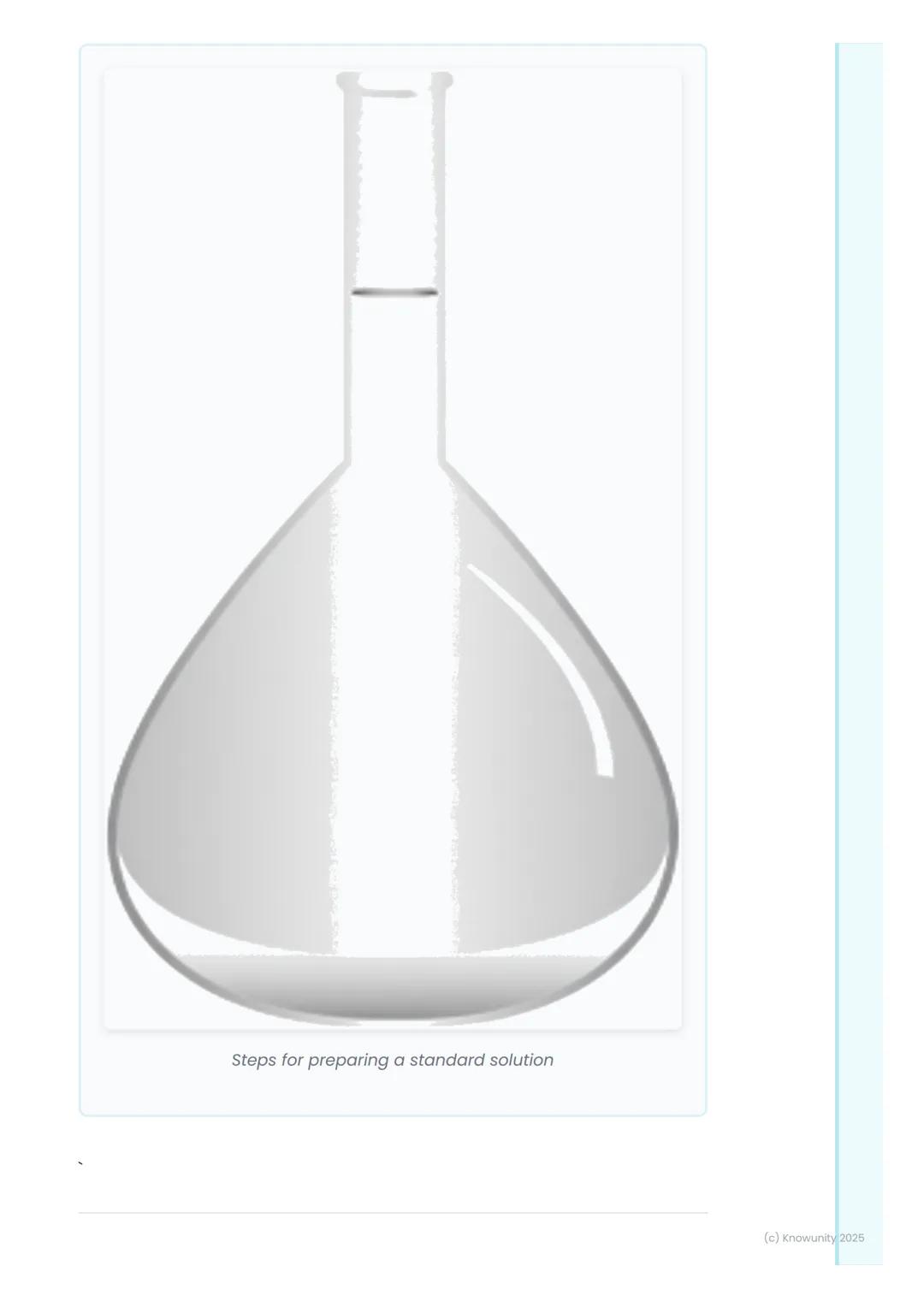
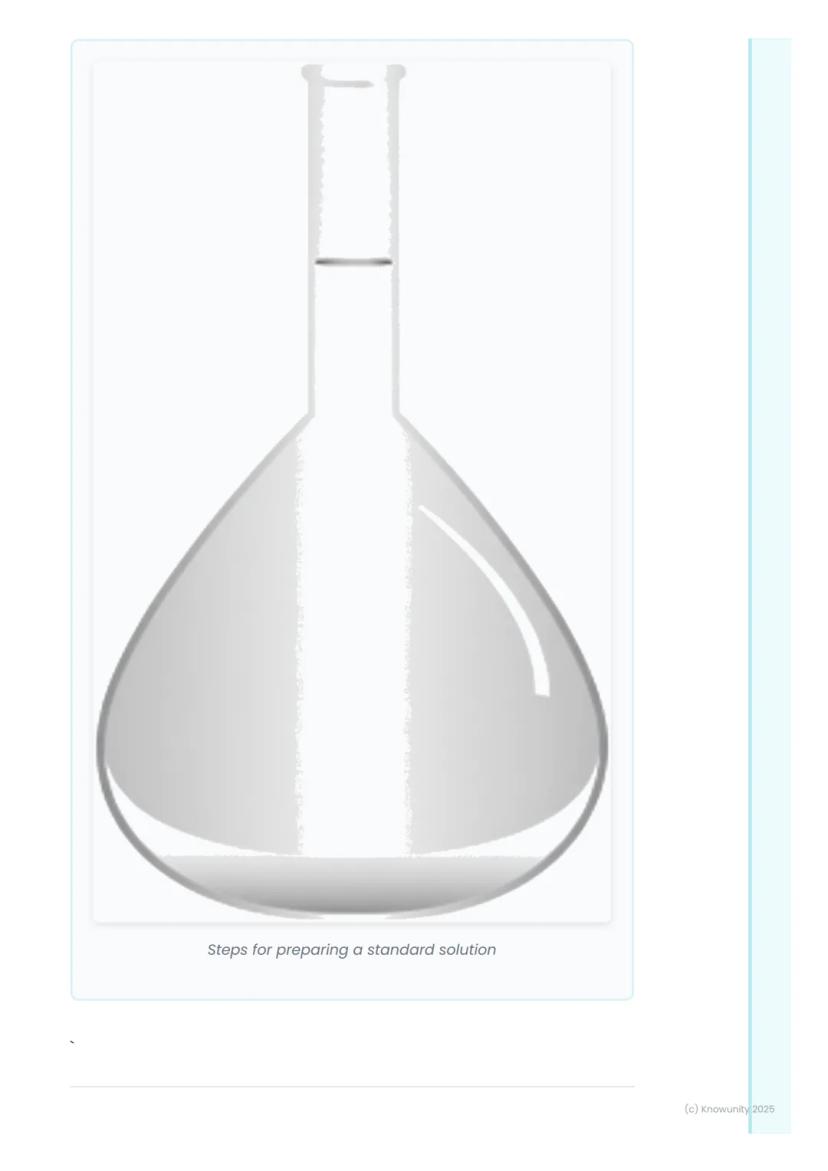
The diagram shows each step clearly: weigh your solid, dissolve it in a beaker, transfer to the volumetric flask with plenty of rinsing, then top up to the mark.
Notice how you rinse the beaker and glass rod multiple times - this ensures every bit of your solute makes it into the final solution. Missing this step will mess up your concentration.
The final step is inverting the stoppered flask about 20 times to mix thoroughly. You want a homogeneous solution - same concentration throughout.
Pro Tip: When reading the meniscus, get your eye level with the graduation mark and read from the bottom of the curve.
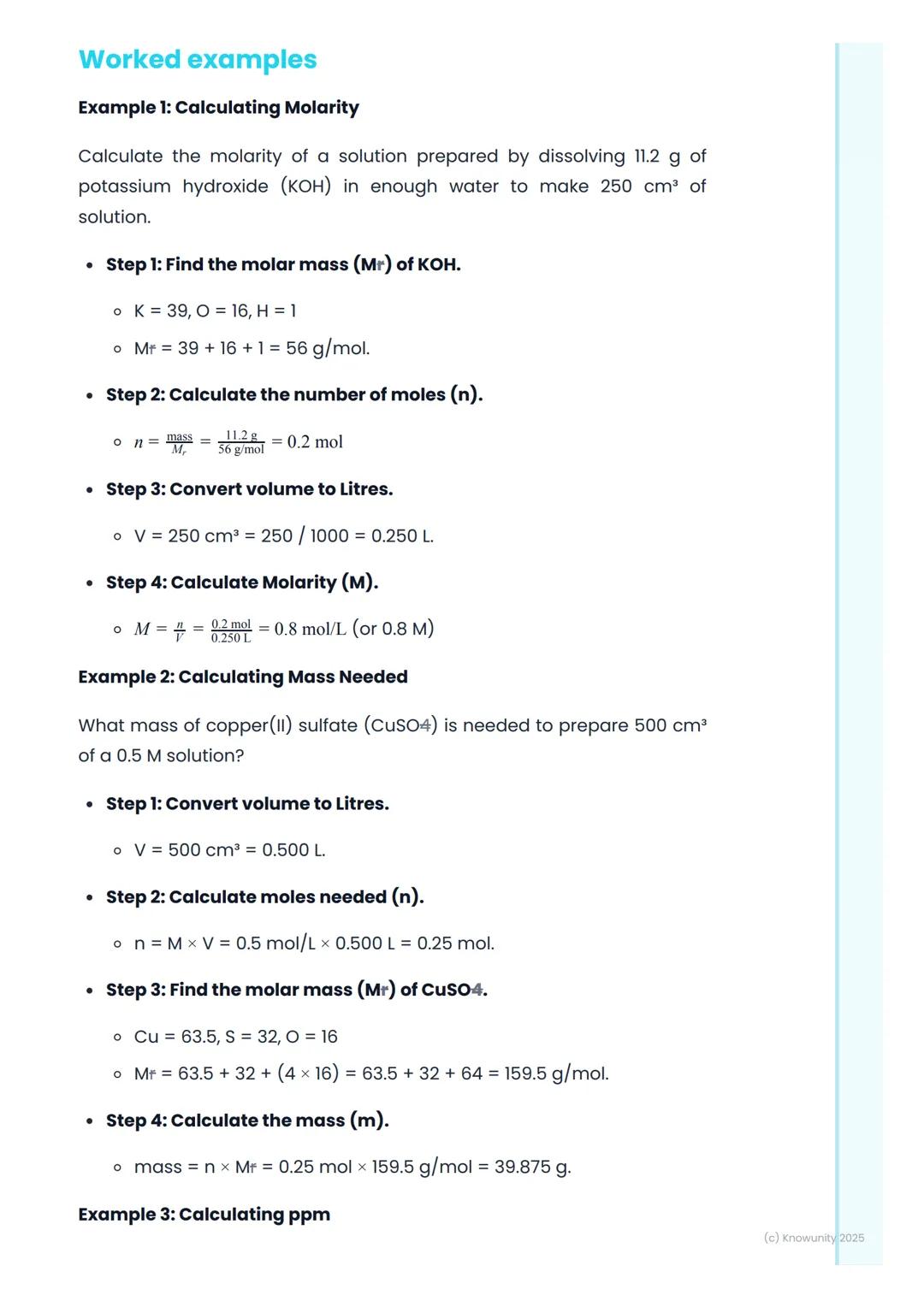
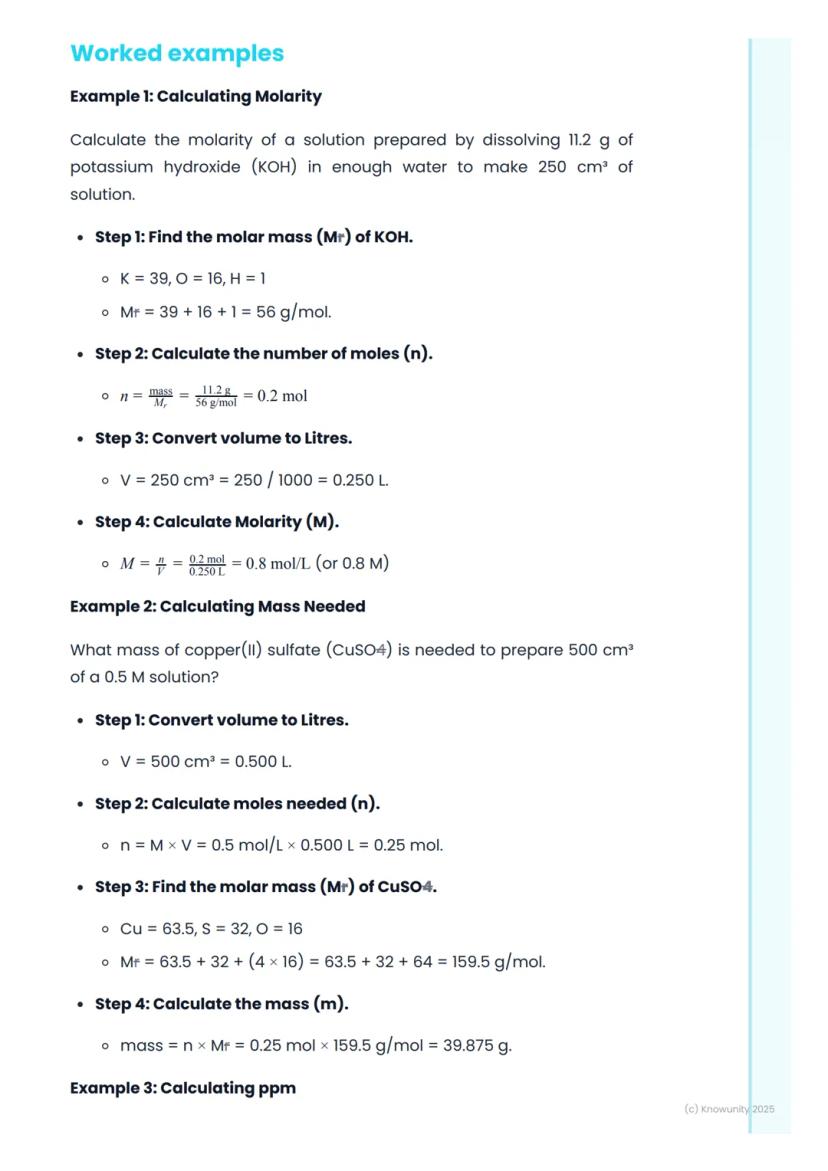
These examples show the step-by-step approach you need for exam success. Notice how every calculation starts by finding the molar mass from the periodic table - get this wrong and everything else falls apart.
For calculating molarity: mass → moles → molarity. Don't forget to convert cm³ to litres! For calculating mass needed: molarity × volume → moles → mass.
The copper sulfate example is typical of what you'll see - they give you a volume in cm³, so immediately convert to litres. Then it's just plugging numbers into formulas.
Common Error: Students often forget the volume conversion. 500 cm³ = 0.500 L, not 0.05 L!
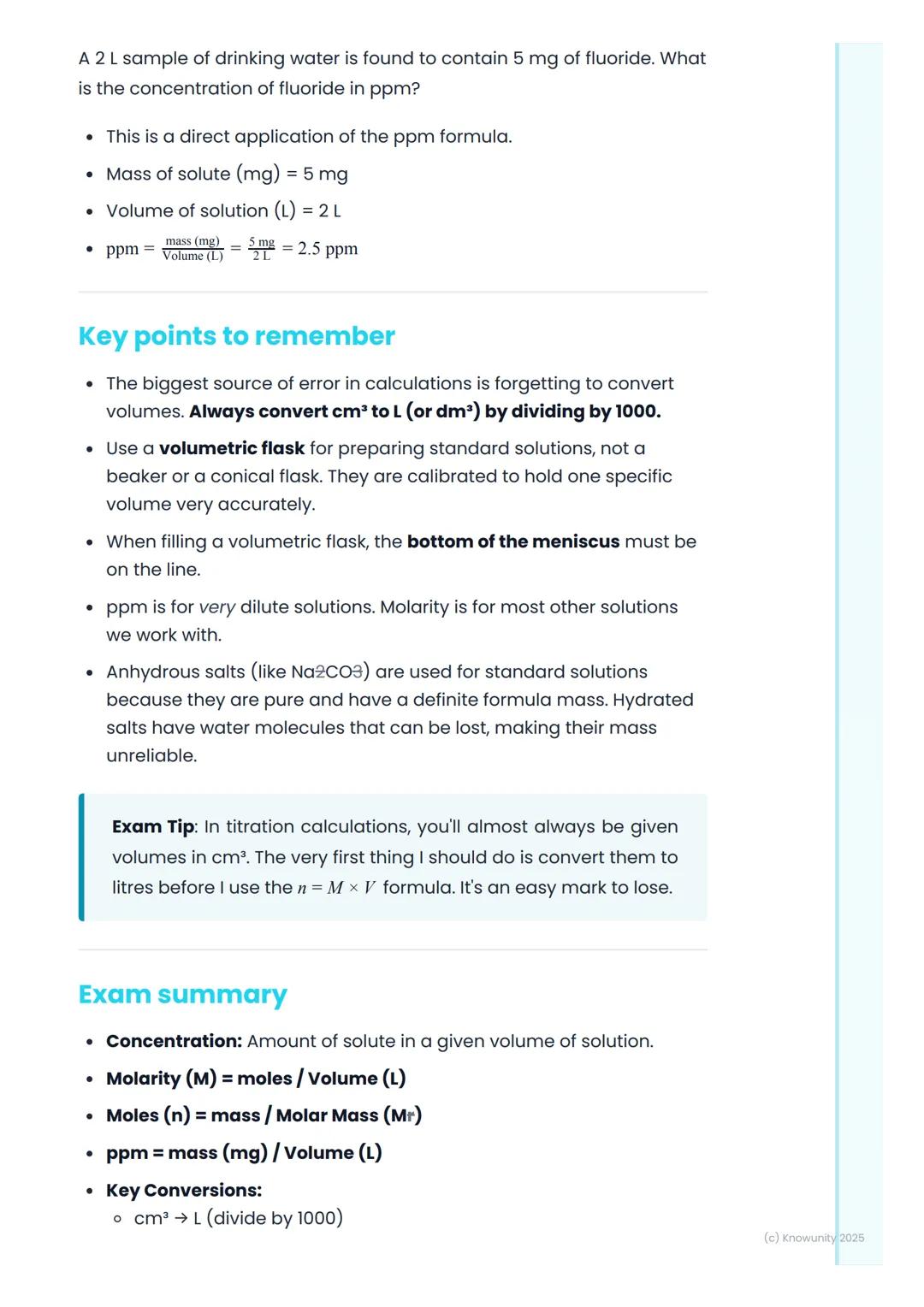
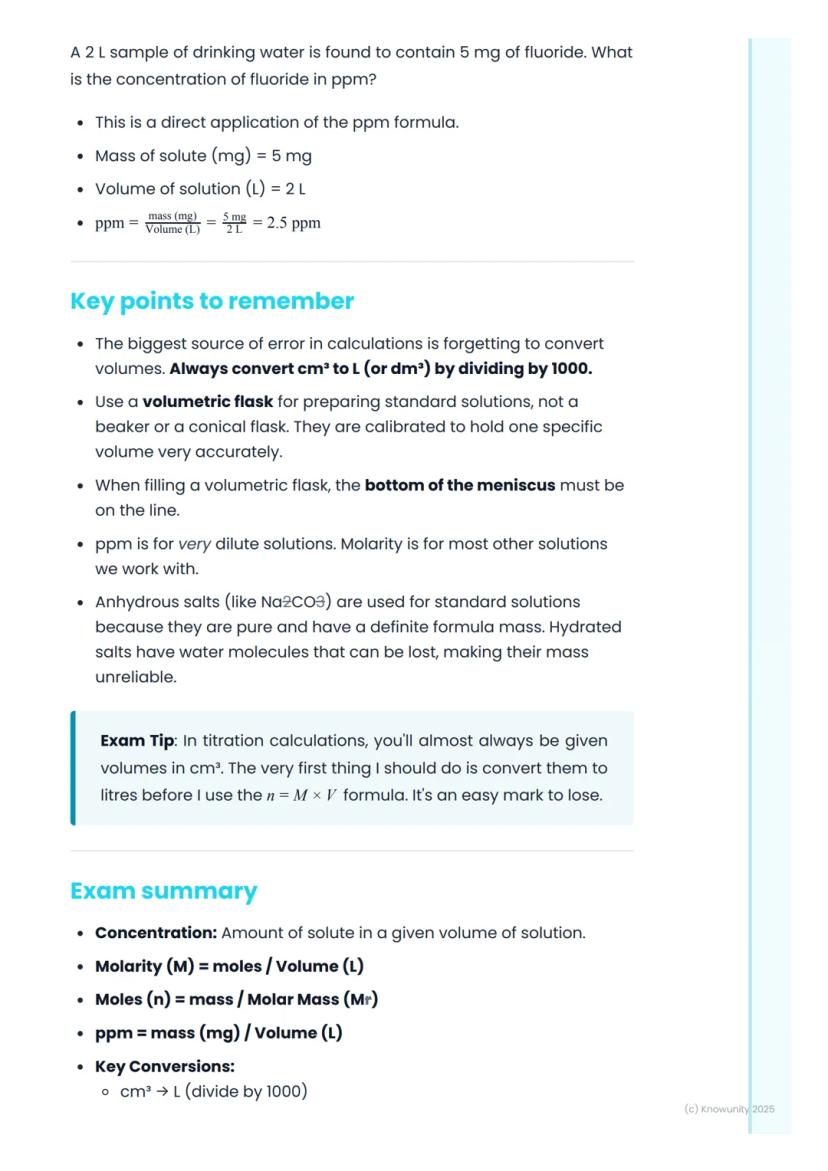
The fluoride example shows how simple ppm calculations can be - just divide mg by litres. No moles or molar masses to worry about.
The key points section highlights the biggest exam traps. Volume conversion trips up loads of students - always convert cm³ to L first thing. Volumetric flasks are essential for accurate standard solutions.
Remember that anhydrous salts are used for standard solutions because they don't have unpredictable water molecules attached. Hydrated salts can lose water, making their mass unreliable.
Exam Strategy: In titration questions, volumes are usually in cm³. Convert to litres before you do anything else - it's an easy mark to lose.
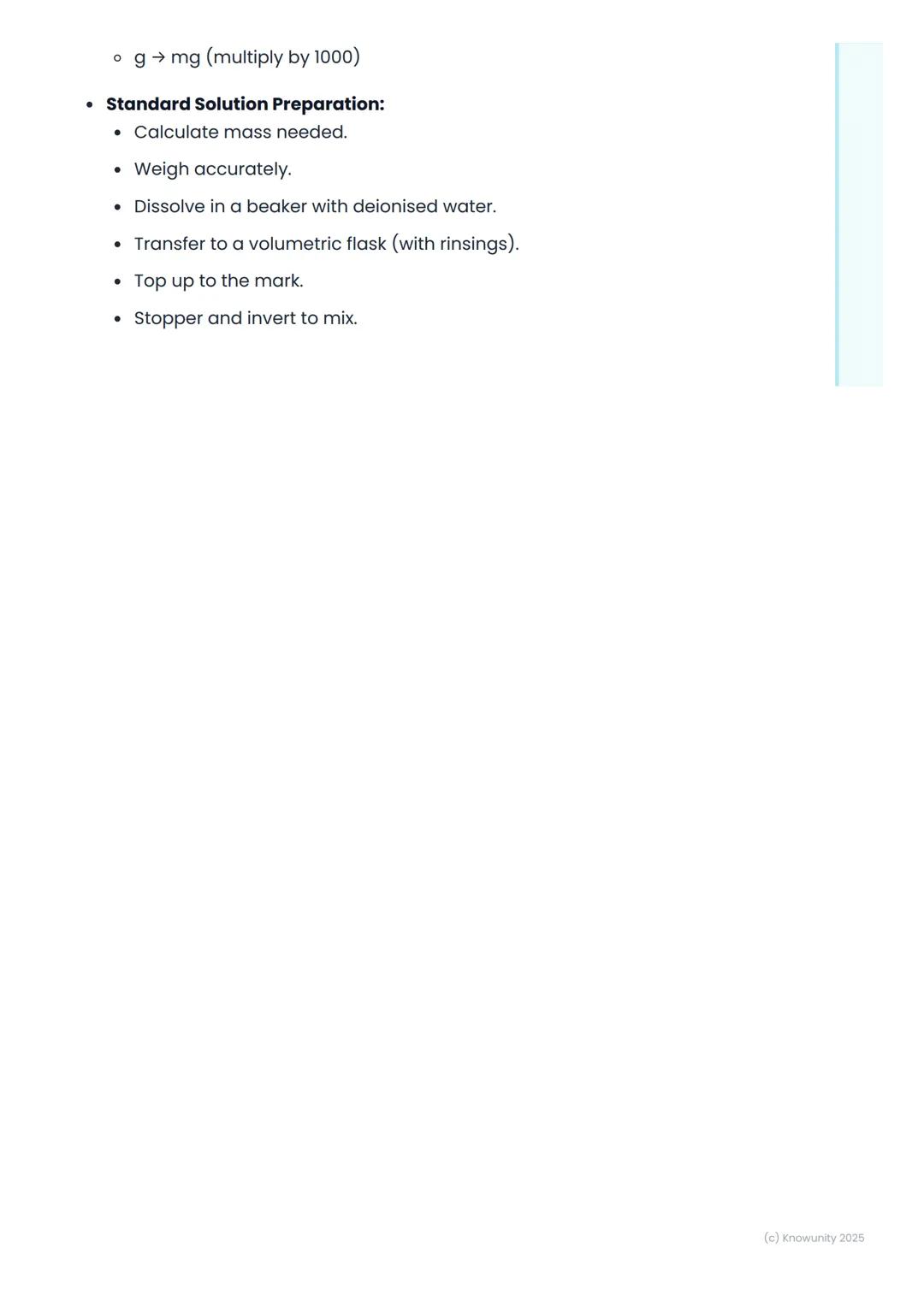
This final summary gives you everything you need for quick revision. The key formulas are M = n/V and n = m/Mr - master these and you can handle any concentration calculation.
The conversion reminders are crucial: cm³ to L (÷1000) and g to mg (×1000). Get these wrong and your whole answer is off.
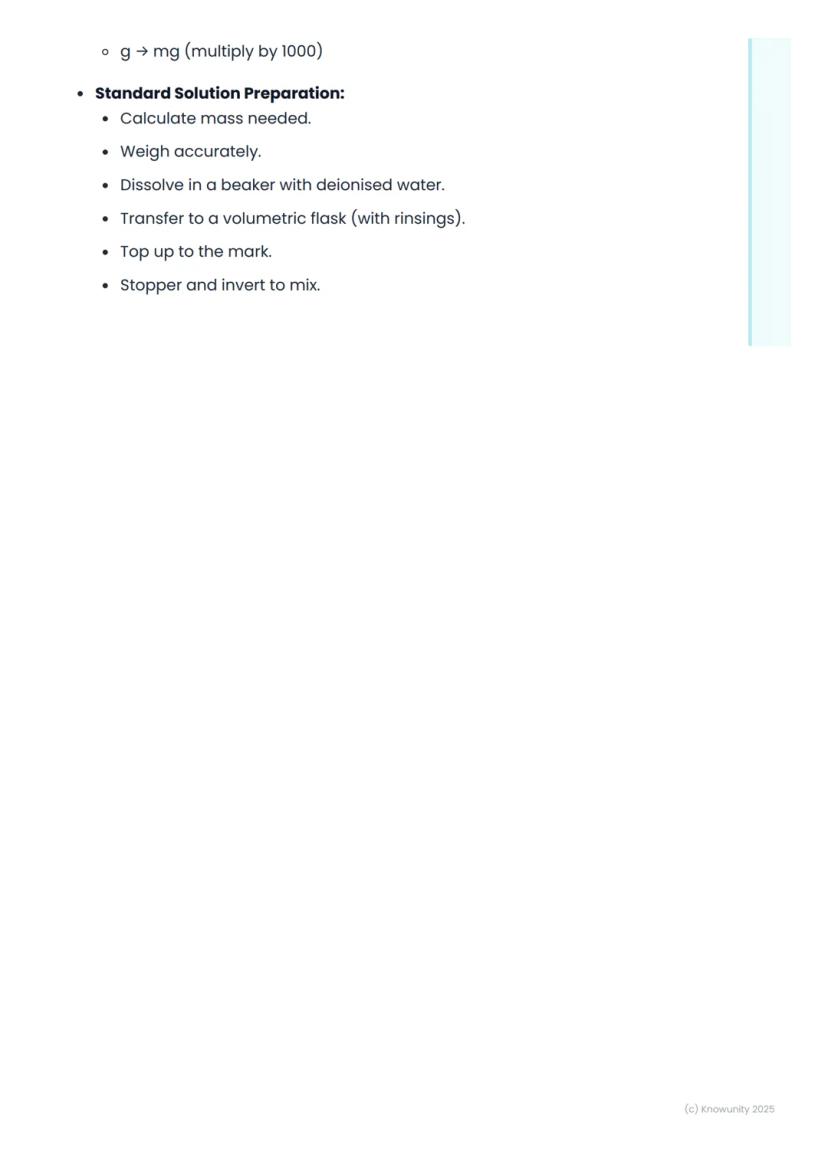
The standard solution steps are always the same: calculate, weigh, dissolve, transfer with rinsings, top up to mark, mix. Learn this sequence and you'll nail any practical question.
Final Tip: Practice switching between mass, moles, and molarity until it's automatic - these calculations come up everywhere in chemistry!
Onze AI Companion is een studentgerichte AI-tool die meer biedt dan alleen antwoorden. Gebouwd op miljoenen Knowunity bronnen, biedt het relevante informatie, gepersonaliseerde studieplannen, quizzes en inhoud direct in de chat, aangepast aan jouw individuele leertraject.
Je kunt de app downloaden via Google Play Store en Apple App Store.
Dat klopt! Geniet van gratis toegang tot leerinhoud, maak contact met medestudenten en krijg directe hulp – alles binnen handbereik.
App Store
Google Play
De app is heel makkelijk te gebruiken en goed ontworpen. Ik heb tot nu toe alles kunnen vinden waar ik naar zocht en heb veel kunnen leren van de presentaties! Ik ga de app zeker gebruiken voor een schoolopdracht! En natuurlijk helpt het ook veel als inspiratie.
Stefan S
iOS gebruiker
Deze app is echt geweldig. Er zijn zoveel aantekeningen en hulpmiddelen [...]. Mijn probleemvak is bijvoorbeeld Frans, en de app heeft zoveel opties voor hulp. Dankzij deze app ben ik beter geworden in Frans. Ik zou het iedereen aanraden.
Samantha Klich
Android gebruiker
Wow, ik ben echt onder de indruk. Ik probeerde de app gewoon omdat ik hem vaak geadverteerd had gezien en was absoluut verbaasd. Deze app is DE HULP die je wilt voor school en bovenal biedt hij zoveel dingen, zoals oefeningen en factsheets, die mij persoonlijk HEEL erg hebben geholpen.
Anna
iOS gebruiker
Beste app ter wereld! geen woorden want het is te goed
Thomas R
iOS gebruiker
Gewoon geweldig. Laat me 10x beter leren, deze app is een vlotte 10/10. Ik raad het iedereen aan. Ik kan aantekeningen bekijken en zoeken. Ik kan ze opslaan in de vakmap. Ik kan ze altijd herhalen als ik terugkom. Als je deze app nog niet hebt geprobeerd, mis je echt iets.
Basil
Android gebruiker
Deze app heeft me zoveel zekerder gemaakt over mijn examenvoorbereiding, niet alleen door mijn zelfvertrouwen te boosten met functies waarmee je contact kunt maken met anderen en je minder alleen voelt, maar ook door de manier waarop de app zelf erop gericht is je beter te laten voelen. Het is makkelijk om doorheen te navigeren, leuk om te gebruiken, en nuttig voor iedereen die op welke manier dan ook worstelt.
David K
iOS gebruiker
De app is gewoon geweldig! Ik hoef alleen maar het onderwerp in de zoekbalk in te voeren en ik krijg supersnel antwoord. Ik hoef geen 10 YouTube-video's te kijken om iets te begrijpen, dus ik bespaar tijd. Zeer aanbevolen!
Sudenaz Ocak
Android gebruiker
Op school was ik echt slecht in wiskunde, maar dankzij de app gaat het nu veel beter. Ik ben zo dankbaar dat jullie de app hebben gemaakt.
Greenlight Bonnie
Android gebruiker
zeer betrouwbare app om je ideeën over wiskunde, Engels en andere gerelateerde onderwerpen in je werk te helpen en te ontwikkelen. gebruik deze app alsjeblieft als je ergens moeite mee hebt, deze app is essentieel daarvoor. had ik maar eerder een review geschreven. en het is ook gratis dus maak je daar geen zorgen over.
Rohan U
Android gebruiker
Ik weet dat veel apps nepaccounts gebruiken om hun reviews op te krikken maar deze app verdient het allemaal. Eerst haalde ik een 4 voor mijn Engels examens en deze keer kreeg ik een 7. Ik wist niet eens van deze app tot drie dagen voor het examen en het heeft ENORM geholpen. Vertrouw me alsjeblieft en gebruik het want ik weet zeker dat jij ook vooruitgang zult zien.
Xander S
iOS gebruiker
DE QUIZZES EN FLASHCARDS ZIJN ZO HANDIG EN IK HOU VAN Knowunity AI. HET IS OOK LETTERLIJK ZOALS CHATGPT MAAR SLIMMER!! HEEFT ME GEHOLPEN MET MIJN MASCARA PROBLEMEN OOK!! EN MET MIJN ECHTE VAKKEN! NATUURLIJK 😍😁😲🤑💗✨🎀😮
Elisha
iOS gebruiker
Deze app is echt de beste. Ik vind herhaling zo saai maar deze app maakt het zo makkelijk om alles te organiseren en dan kun je de gratis AI vragen om jezelf te testen, zo goed en je kunt makkelijk je eigen spullen uploaden. raad het zeker aan als iemand die nu proefexamens doet
Paul T
iOS gebruiker
De app is heel makkelijk te gebruiken en goed ontworpen. Ik heb tot nu toe alles kunnen vinden waar ik naar zocht en heb veel kunnen leren van de presentaties! Ik ga de app zeker gebruiken voor een schoolopdracht! En natuurlijk helpt het ook veel als inspiratie.
Stefan S
iOS gebruiker
Deze app is echt geweldig. Er zijn zoveel aantekeningen en hulpmiddelen [...]. Mijn probleemvak is bijvoorbeeld Frans, en de app heeft zoveel opties voor hulp. Dankzij deze app ben ik beter geworden in Frans. Ik zou het iedereen aanraden.
Samantha Klich
Android gebruiker
Wow, ik ben echt onder de indruk. Ik probeerde de app gewoon omdat ik hem vaak geadverteerd had gezien en was absoluut verbaasd. Deze app is DE HULP die je wilt voor school en bovenal biedt hij zoveel dingen, zoals oefeningen en factsheets, die mij persoonlijk HEEL erg hebben geholpen.
Anna
iOS gebruiker
Beste app ter wereld! geen woorden want het is te goed
Thomas R
iOS gebruiker
Gewoon geweldig. Laat me 10x beter leren, deze app is een vlotte 10/10. Ik raad het iedereen aan. Ik kan aantekeningen bekijken en zoeken. Ik kan ze opslaan in de vakmap. Ik kan ze altijd herhalen als ik terugkom. Als je deze app nog niet hebt geprobeerd, mis je echt iets.
Basil
Android gebruiker
Deze app heeft me zoveel zekerder gemaakt over mijn examenvoorbereiding, niet alleen door mijn zelfvertrouwen te boosten met functies waarmee je contact kunt maken met anderen en je minder alleen voelt, maar ook door de manier waarop de app zelf erop gericht is je beter te laten voelen. Het is makkelijk om doorheen te navigeren, leuk om te gebruiken, en nuttig voor iedereen die op welke manier dan ook worstelt.
David K
iOS gebruiker
De app is gewoon geweldig! Ik hoef alleen maar het onderwerp in de zoekbalk in te voeren en ik krijg supersnel antwoord. Ik hoef geen 10 YouTube-video's te kijken om iets te begrijpen, dus ik bespaar tijd. Zeer aanbevolen!
Sudenaz Ocak
Android gebruiker
Op school was ik echt slecht in wiskunde, maar dankzij de app gaat het nu veel beter. Ik ben zo dankbaar dat jullie de app hebben gemaakt.
Greenlight Bonnie
Android gebruiker
zeer betrouwbare app om je ideeën over wiskunde, Engels en andere gerelateerde onderwerpen in je werk te helpen en te ontwikkelen. gebruik deze app alsjeblieft als je ergens moeite mee hebt, deze app is essentieel daarvoor. had ik maar eerder een review geschreven. en het is ook gratis dus maak je daar geen zorgen over.
Rohan U
Android gebruiker
Ik weet dat veel apps nepaccounts gebruiken om hun reviews op te krikken maar deze app verdient het allemaal. Eerst haalde ik een 4 voor mijn Engels examens en deze keer kreeg ik een 7. Ik wist niet eens van deze app tot drie dagen voor het examen en het heeft ENORM geholpen. Vertrouw me alsjeblieft en gebruik het want ik weet zeker dat jij ook vooruitgang zult zien.
Xander S
iOS gebruiker
DE QUIZZES EN FLASHCARDS ZIJN ZO HANDIG EN IK HOU VAN Knowunity AI. HET IS OOK LETTERLIJK ZOALS CHATGPT MAAR SLIMMER!! HEEFT ME GEHOLPEN MET MIJN MASCARA PROBLEMEN OOK!! EN MET MIJN ECHTE VAKKEN! NATUURLIJK 😍😁😲🤑💗✨🎀😮
Elisha
iOS gebruiker
Deze app is echt de beste. Ik vind herhaling zo saai maar deze app maakt het zo makkelijk om alles te organiseren en dan kun je de gratis AI vragen om jezelf te testen, zo goed en je kunt makkelijk je eigen spullen uploaden. raad het zeker aan als iemand die nu proefexamens doet
Paul T
iOS gebruiker
Ever wondered how chemists know exactly how strong a solution is? Concentrationis basically measuring how much stuff is dissolved in your solution - and it's crucial for everything from titrations to understanding reaction rates. Master this, and you'll ace... Meer weergeven
Toegang tot alle documenten
Verbeter je cijfers
Sluit je aan bij miljoenen studenten
Think of concentration like making squash - the more cordial you add to water, the stronger it tastes. In chemistry, we're measuring how much solute (the thing being dissolved) is packed into a solvent (usually water).
When you mix them together, you get a solution. The concentration tells you exactly how strong that solution is, which determines how it'll behave in chemical reactions.
There are two main ways to measure concentration: Molarity (for most lab work) and Parts Per Million (for really dilute solutions like pollutants in water). You'll also need to know how to make standard solutions - these are solutions where you know the concentration precisely.
Quick Tip: Molarity uses mol/L, whilst ppm uses mg/L - don't mix up your units!
Toegang tot alle documenten
Verbeter je cijfers
Sluit je aan bij miljoenen studenten
Molarity is your go-to concentration unit. It's simply moles of solute per litre of solution, and the formula is dead easy: M = n/V.
The tricky bit is when you're given mass instead of moles. Then you need two steps: first convert mass to moles using n = m/Mr, then use those moles to find molarity.
Here's the classic setup: you've got some solid chemical, you dissolve it in water, and you need to find the concentration. Convert cm³ to litres (divide by 1000), work out the moles, then divide moles by volume.
Memory Trick: Use the formula triangle - cover what you want to find, and the triangle shows you what to do with the other two values!
Toegang tot alle documenten
Verbeter je cijfers
Sluit je aan bij miljoenen studenten
When concentrations are absolutely tiny - think fluoride in drinking water or pollutants - we use Parts Per Million (ppm). It's much simpler than molarity: just mg of solute per litre of solution.
The formula is straightforward: ppm = mass (mg) / Volume (L). Just remember that 1 gram equals 1000 milligrams, so you might need to convert.
You'll see ppm in environmental chemistry, water treatment, and anywhere we're dealing with trace amounts. It's basically saying "out of a million parts of solution, how many parts are my solute?"
Real World: The WHO recommends fluoride levels in drinking water should be between 0.5-1.5 ppm for dental health.
Toegang tot alle documenten
Verbeter je cijfers
Sluit je aan bij miljoenen studenten
Making a standard solution is a practical skill that'll definitely come up in exams. You need to be absolutely precise because the whole point is knowing the exact concentration.
Here's the method: calculate the mass you need (using M × V to get moles, then moles × Mr to get mass). Weigh it accurately, dissolve it in a beaker with some distilled water, then transfer everything to a volumetric flask.
The key bits are rinsing the beaker multiple times (so you don't lose any solute) and filling to the graduation mark carefully. Use a dropper for the last few drops - you can't go back if you overshoot!
Exam Alert: Always use a volumetric flask, not a measuring cylinder or beaker - they're calibrated to be super accurate for one specific volume.
Toegang tot alle documenten
Verbeter je cijfers
Sluit je aan bij miljoenen studenten
The diagram shows each step clearly: weigh your solid, dissolve it in a beaker, transfer to the volumetric flask with plenty of rinsing, then top up to the mark.
Notice how you rinse the beaker and glass rod multiple times - this ensures every bit of your solute makes it into the final solution. Missing this step will mess up your concentration.
The final step is inverting the stoppered flask about 20 times to mix thoroughly. You want a homogeneous solution - same concentration throughout.
Pro Tip: When reading the meniscus, get your eye level with the graduation mark and read from the bottom of the curve.
Toegang tot alle documenten
Verbeter je cijfers
Sluit je aan bij miljoenen studenten
These examples show the step-by-step approach you need for exam success. Notice how every calculation starts by finding the molar mass from the periodic table - get this wrong and everything else falls apart.
For calculating molarity: mass → moles → molarity. Don't forget to convert cm³ to litres! For calculating mass needed: molarity × volume → moles → mass.
The copper sulfate example is typical of what you'll see - they give you a volume in cm³, so immediately convert to litres. Then it's just plugging numbers into formulas.
Common Error: Students often forget the volume conversion. 500 cm³ = 0.500 L, not 0.05 L!
Toegang tot alle documenten
Verbeter je cijfers
Sluit je aan bij miljoenen studenten
The fluoride example shows how simple ppm calculations can be - just divide mg by litres. No moles or molar masses to worry about.
The key points section highlights the biggest exam traps. Volume conversion trips up loads of students - always convert cm³ to L first thing. Volumetric flasks are essential for accurate standard solutions.
Remember that anhydrous salts are used for standard solutions because they don't have unpredictable water molecules attached. Hydrated salts can lose water, making their mass unreliable.
Exam Strategy: In titration questions, volumes are usually in cm³. Convert to litres before you do anything else - it's an easy mark to lose.
Toegang tot alle documenten
Verbeter je cijfers
Sluit je aan bij miljoenen studenten
This final summary gives you everything you need for quick revision. The key formulas are M = n/V and n = m/Mr - master these and you can handle any concentration calculation.
The conversion reminders are crucial: cm³ to L (÷1000) and g to mg (×1000). Get these wrong and your whole answer is off.
The standard solution steps are always the same: calculate, weigh, dissolve, transfer with rinsings, top up to mark, mix. Learn this sequence and you'll nail any practical question.
Final Tip: Practice switching between mass, moles, and molarity until it's automatic - these calculations come up everywhere in chemistry!
Onze AI Companion is een studentgerichte AI-tool die meer biedt dan alleen antwoorden. Gebouwd op miljoenen Knowunity bronnen, biedt het relevante informatie, gepersonaliseerde studieplannen, quizzes en inhoud direct in de chat, aangepast aan jouw individuele leertraject.
Je kunt de app downloaden via Google Play Store en Apple App Store.
Dat klopt! Geniet van gratis toegang tot leerinhoud, maak contact met medestudenten en krijg directe hulp – alles binnen handbereik.
1
Slimme Tools NIEUW
Zet deze aantekening om in: ✓ 50+ Oefenvragen ✓ Interactieve Flashcards ✓ Volledig proefexamen ✓ Essay Outlines
App Store
Google Play
De app is heel makkelijk te gebruiken en goed ontworpen. Ik heb tot nu toe alles kunnen vinden waar ik naar zocht en heb veel kunnen leren van de presentaties! Ik ga de app zeker gebruiken voor een schoolopdracht! En natuurlijk helpt het ook veel als inspiratie.
Stefan S
iOS gebruiker
Deze app is echt geweldig. Er zijn zoveel aantekeningen en hulpmiddelen [...]. Mijn probleemvak is bijvoorbeeld Frans, en de app heeft zoveel opties voor hulp. Dankzij deze app ben ik beter geworden in Frans. Ik zou het iedereen aanraden.
Samantha Klich
Android gebruiker
Wow, ik ben echt onder de indruk. Ik probeerde de app gewoon omdat ik hem vaak geadverteerd had gezien en was absoluut verbaasd. Deze app is DE HULP die je wilt voor school en bovenal biedt hij zoveel dingen, zoals oefeningen en factsheets, die mij persoonlijk HEEL erg hebben geholpen.
Anna
iOS gebruiker
Beste app ter wereld! geen woorden want het is te goed
Thomas R
iOS gebruiker
Gewoon geweldig. Laat me 10x beter leren, deze app is een vlotte 10/10. Ik raad het iedereen aan. Ik kan aantekeningen bekijken en zoeken. Ik kan ze opslaan in de vakmap. Ik kan ze altijd herhalen als ik terugkom. Als je deze app nog niet hebt geprobeerd, mis je echt iets.
Basil
Android gebruiker
Deze app heeft me zoveel zekerder gemaakt over mijn examenvoorbereiding, niet alleen door mijn zelfvertrouwen te boosten met functies waarmee je contact kunt maken met anderen en je minder alleen voelt, maar ook door de manier waarop de app zelf erop gericht is je beter te laten voelen. Het is makkelijk om doorheen te navigeren, leuk om te gebruiken, en nuttig voor iedereen die op welke manier dan ook worstelt.
David K
iOS gebruiker
De app is gewoon geweldig! Ik hoef alleen maar het onderwerp in de zoekbalk in te voeren en ik krijg supersnel antwoord. Ik hoef geen 10 YouTube-video's te kijken om iets te begrijpen, dus ik bespaar tijd. Zeer aanbevolen!
Sudenaz Ocak
Android gebruiker
Op school was ik echt slecht in wiskunde, maar dankzij de app gaat het nu veel beter. Ik ben zo dankbaar dat jullie de app hebben gemaakt.
Greenlight Bonnie
Android gebruiker
zeer betrouwbare app om je ideeën over wiskunde, Engels en andere gerelateerde onderwerpen in je werk te helpen en te ontwikkelen. gebruik deze app alsjeblieft als je ergens moeite mee hebt, deze app is essentieel daarvoor. had ik maar eerder een review geschreven. en het is ook gratis dus maak je daar geen zorgen over.
Rohan U
Android gebruiker
Ik weet dat veel apps nepaccounts gebruiken om hun reviews op te krikken maar deze app verdient het allemaal. Eerst haalde ik een 4 voor mijn Engels examens en deze keer kreeg ik een 7. Ik wist niet eens van deze app tot drie dagen voor het examen en het heeft ENORM geholpen. Vertrouw me alsjeblieft en gebruik het want ik weet zeker dat jij ook vooruitgang zult zien.
Xander S
iOS gebruiker
DE QUIZZES EN FLASHCARDS ZIJN ZO HANDIG EN IK HOU VAN Knowunity AI. HET IS OOK LETTERLIJK ZOALS CHATGPT MAAR SLIMMER!! HEEFT ME GEHOLPEN MET MIJN MASCARA PROBLEMEN OOK!! EN MET MIJN ECHTE VAKKEN! NATUURLIJK 😍😁😲🤑💗✨🎀😮
Elisha
iOS gebruiker
Deze app is echt de beste. Ik vind herhaling zo saai maar deze app maakt het zo makkelijk om alles te organiseren en dan kun je de gratis AI vragen om jezelf te testen, zo goed en je kunt makkelijk je eigen spullen uploaden. raad het zeker aan als iemand die nu proefexamens doet
Paul T
iOS gebruiker
De app is heel makkelijk te gebruiken en goed ontworpen. Ik heb tot nu toe alles kunnen vinden waar ik naar zocht en heb veel kunnen leren van de presentaties! Ik ga de app zeker gebruiken voor een schoolopdracht! En natuurlijk helpt het ook veel als inspiratie.
Stefan S
iOS gebruiker
Deze app is echt geweldig. Er zijn zoveel aantekeningen en hulpmiddelen [...]. Mijn probleemvak is bijvoorbeeld Frans, en de app heeft zoveel opties voor hulp. Dankzij deze app ben ik beter geworden in Frans. Ik zou het iedereen aanraden.
Samantha Klich
Android gebruiker
Wow, ik ben echt onder de indruk. Ik probeerde de app gewoon omdat ik hem vaak geadverteerd had gezien en was absoluut verbaasd. Deze app is DE HULP die je wilt voor school en bovenal biedt hij zoveel dingen, zoals oefeningen en factsheets, die mij persoonlijk HEEL erg hebben geholpen.
Anna
iOS gebruiker
Beste app ter wereld! geen woorden want het is te goed
Thomas R
iOS gebruiker
Gewoon geweldig. Laat me 10x beter leren, deze app is een vlotte 10/10. Ik raad het iedereen aan. Ik kan aantekeningen bekijken en zoeken. Ik kan ze opslaan in de vakmap. Ik kan ze altijd herhalen als ik terugkom. Als je deze app nog niet hebt geprobeerd, mis je echt iets.
Basil
Android gebruiker
Deze app heeft me zoveel zekerder gemaakt over mijn examenvoorbereiding, niet alleen door mijn zelfvertrouwen te boosten met functies waarmee je contact kunt maken met anderen en je minder alleen voelt, maar ook door de manier waarop de app zelf erop gericht is je beter te laten voelen. Het is makkelijk om doorheen te navigeren, leuk om te gebruiken, en nuttig voor iedereen die op welke manier dan ook worstelt.
David K
iOS gebruiker
De app is gewoon geweldig! Ik hoef alleen maar het onderwerp in de zoekbalk in te voeren en ik krijg supersnel antwoord. Ik hoef geen 10 YouTube-video's te kijken om iets te begrijpen, dus ik bespaar tijd. Zeer aanbevolen!
Sudenaz Ocak
Android gebruiker
Op school was ik echt slecht in wiskunde, maar dankzij de app gaat het nu veel beter. Ik ben zo dankbaar dat jullie de app hebben gemaakt.
Greenlight Bonnie
Android gebruiker
zeer betrouwbare app om je ideeën over wiskunde, Engels en andere gerelateerde onderwerpen in je werk te helpen en te ontwikkelen. gebruik deze app alsjeblieft als je ergens moeite mee hebt, deze app is essentieel daarvoor. had ik maar eerder een review geschreven. en het is ook gratis dus maak je daar geen zorgen over.
Rohan U
Android gebruiker
Ik weet dat veel apps nepaccounts gebruiken om hun reviews op te krikken maar deze app verdient het allemaal. Eerst haalde ik een 4 voor mijn Engels examens en deze keer kreeg ik een 7. Ik wist niet eens van deze app tot drie dagen voor het examen en het heeft ENORM geholpen. Vertrouw me alsjeblieft en gebruik het want ik weet zeker dat jij ook vooruitgang zult zien.
Xander S
iOS gebruiker
DE QUIZZES EN FLASHCARDS ZIJN ZO HANDIG EN IK HOU VAN Knowunity AI. HET IS OOK LETTERLIJK ZOALS CHATGPT MAAR SLIMMER!! HEEFT ME GEHOLPEN MET MIJN MASCARA PROBLEMEN OOK!! EN MET MIJN ECHTE VAKKEN! NATUURLIJK 😍😁😲🤑💗✨🎀😮
Elisha
iOS gebruiker
Deze app is echt de beste. Ik vind herhaling zo saai maar deze app maakt het zo makkelijk om alles te organiseren en dan kun je de gratis AI vragen om jezelf te testen, zo goed en je kunt makkelijk je eigen spullen uploaden. raad het zeker aan als iemand die nu proefexamens doet
Paul T
iOS gebruiker