
Ever wondered why the annual Budget matters so much? Fiscal... Meer weergeven
 Economics4 weergaven·Bijgewerkt May 14, 2026·8 pagina's
Understanding Fiscal Policy: Government Spending and Taxes Explained

1 / 8
1
of 8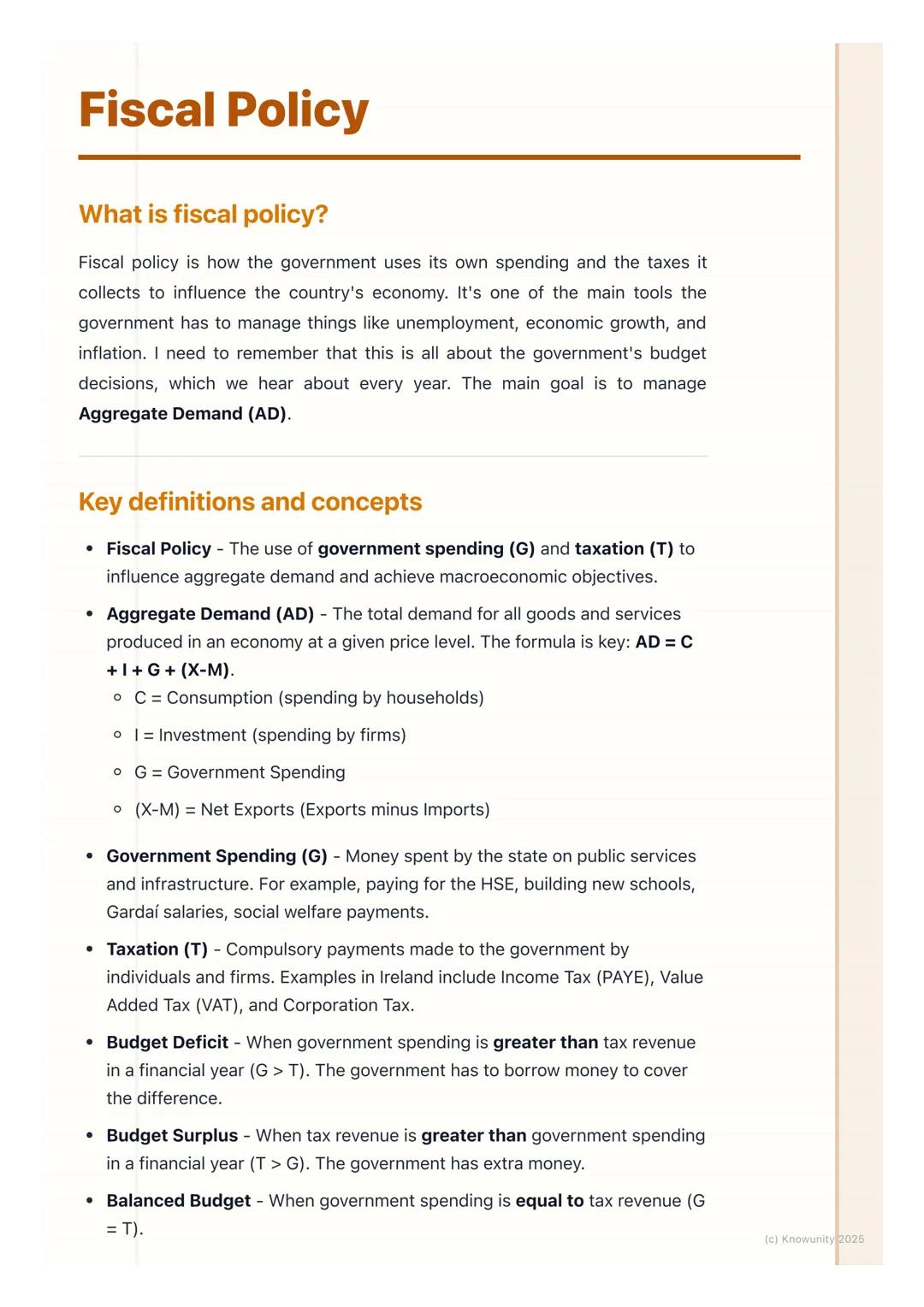
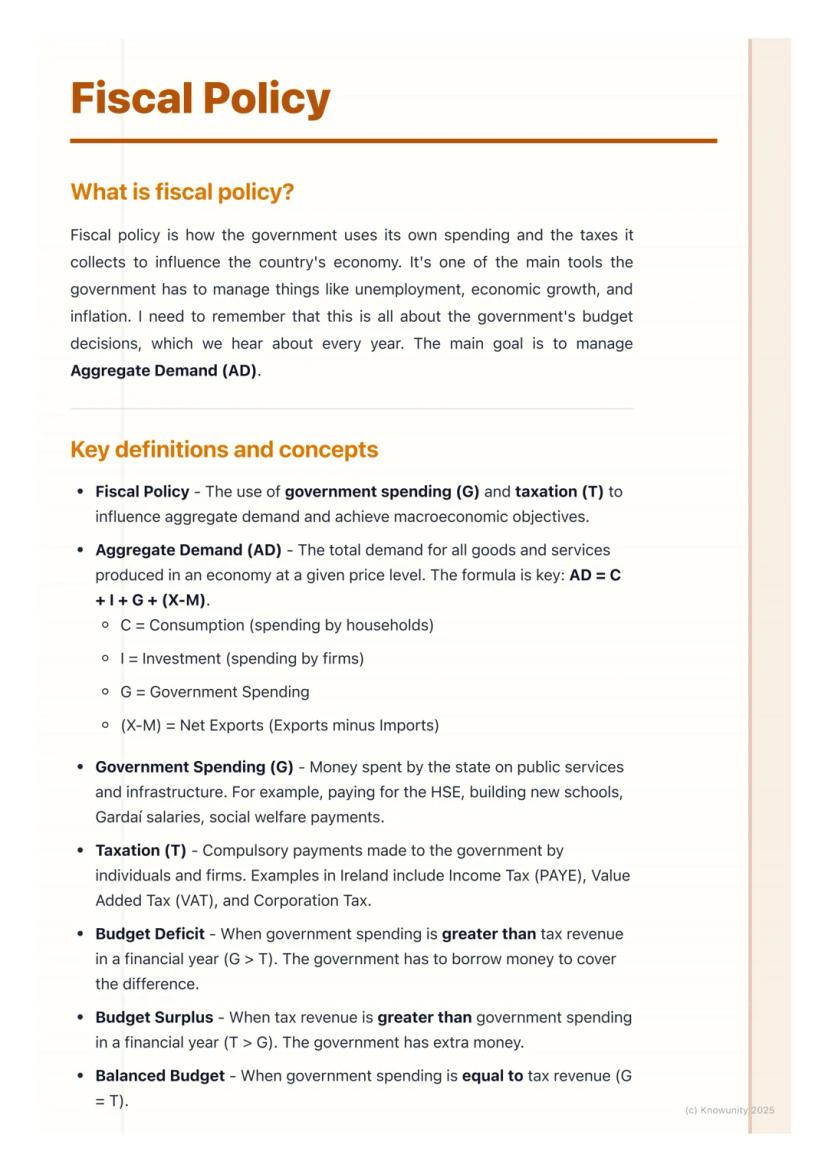
What is Fiscal Policy?
Think of fiscal policy as the government's economic steering wheel. When unemployment's high or the economy's sluggish, they can press the accelerator by spending more or cutting taxes. When inflation's getting out of hand, they hit the brakes.
The whole point is managing Aggregate Demand (AD) - that's the total amount everyone in Ireland wants to buy. The formula you need to know is AD = C + I + G + , where C is what households spend, I is business investment, G is government spending, and is our trade balance.
Government spending covers everything from HSE salaries to building new schools, while taxation includes all the money flowing back through income tax, VAT, and corporation tax. The relationship between these two creates either a budget deficit (spending more than we collect), surplus (collecting more than we spend), or a balanced budget.
Remember: Every year's Budget announcement is essentially the government revealing its fiscal policy strategy for the next 12 months.
2
of 8
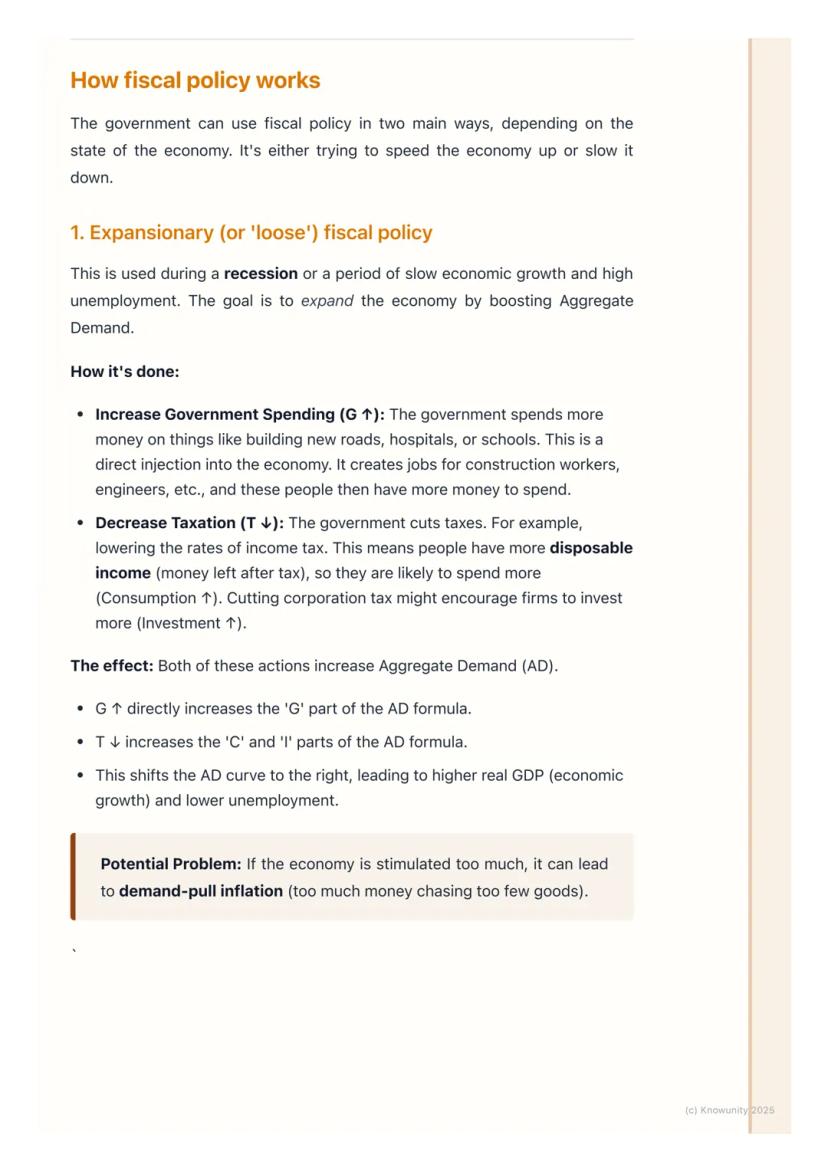
Expansionary Fiscal Policy - Boosting the Economy
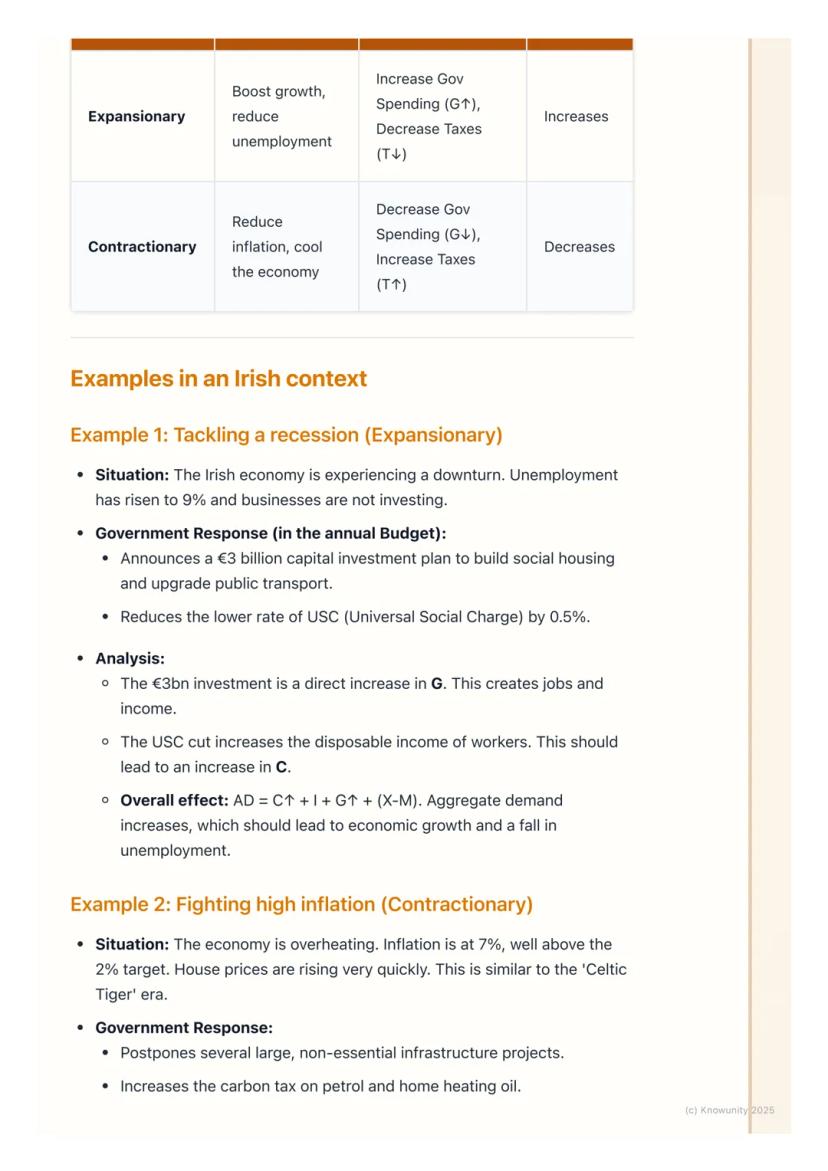
When Ireland's economy needs a kick-start - think high unemployment or slow growth - the government goes expansionary. This is like giving the economy a shot of adrenaline to get things moving again.
Increasing government spending directly pumps money into the economy. New road projects create jobs for construction workers, who then spend their wages in local shops, creating a ripple effect. Meanwhile, cutting taxes leaves people with more disposable income - lower income tax means bigger paychecks, whilst reduced corporation tax might encourage businesses to invest more.
Both strategies shift the AD curve to the right, meaning higher economic growth and fewer people signing on. However, there's a catch - pump too much money into the economy and you risk demand-pull inflation, where too much money chases too few goods.
Key Point: Expansionary policy directly increases the 'G' in your AD formula, whilst also boosting 'C' and 'I' through tax cuts.
3
of 8
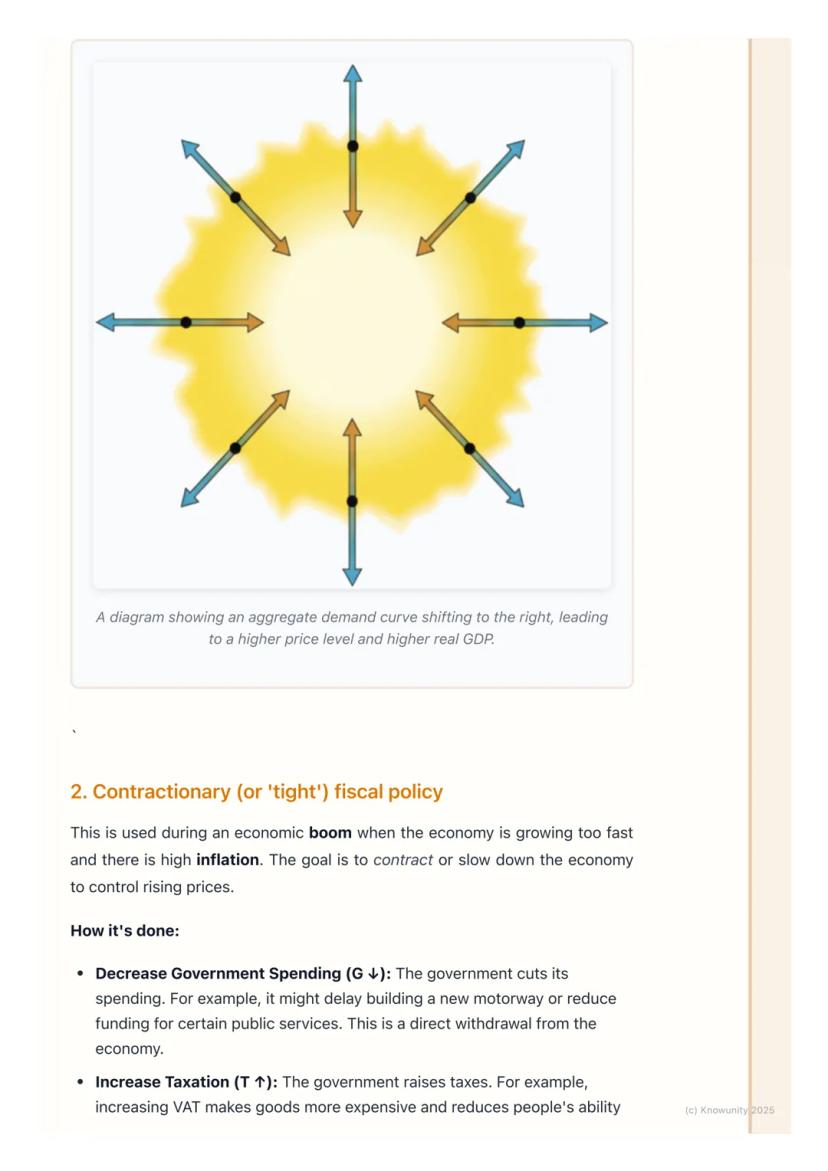
Contractionary Fiscal Policy - Cooling Things Down
Sometimes the economy gets a bit too excited - think Celtic Tiger-style house price bubbles or inflation spiralling beyond the 2% target. That's when contractionary fiscal policy steps in to cool things down.
Cutting government spending takes money out of circulation - delaying that new motorway or reducing public service funding. Raising taxes has a similar effect, as higher VAT makes everything more expensive whilst increased income tax leaves people with less spending money.
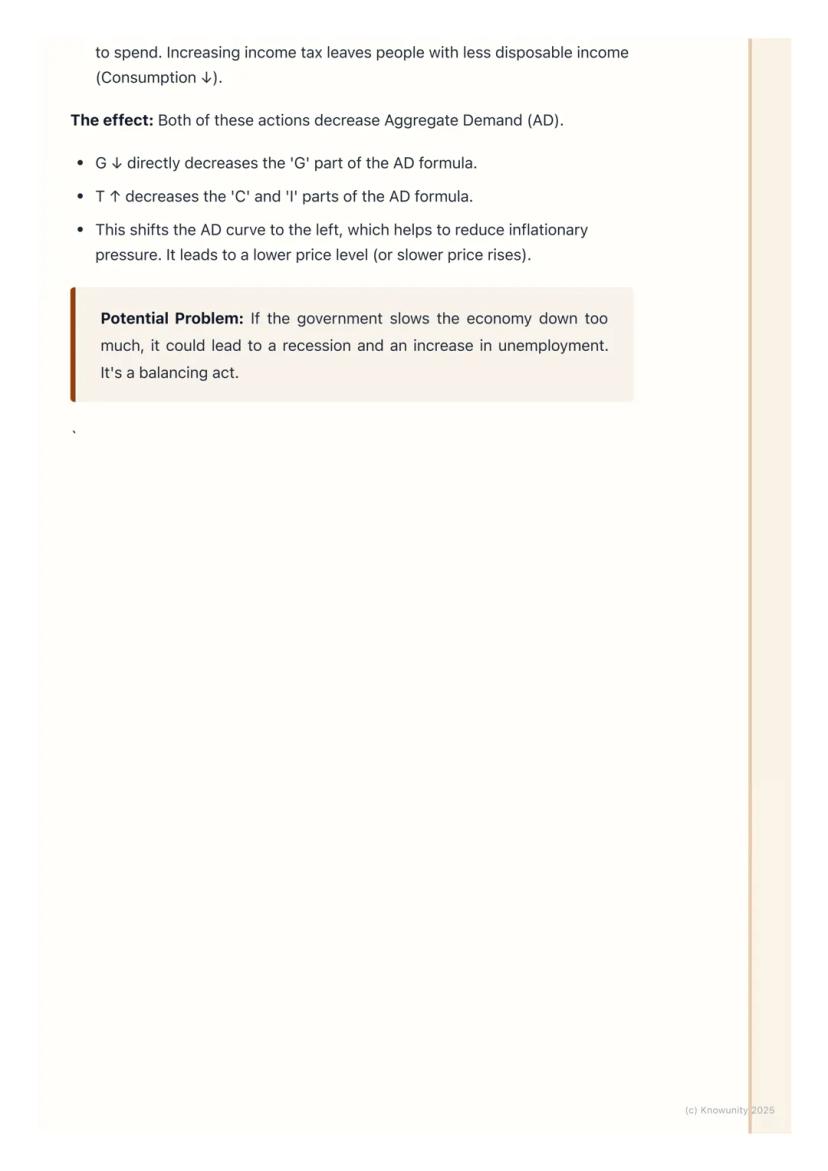
This shifts the AD curve to the left, helping reduce inflationary pressure and bringing prices under control. The trade-off? Push too hard and you risk triggering a recession with rising unemployment.
Reality Check: Contractionary policy is politically toxic - nobody votes for higher taxes or spending cuts, making it incredibly difficult to implement even when economically necessary.
4
of 8
Real Irish Examples You Can Use
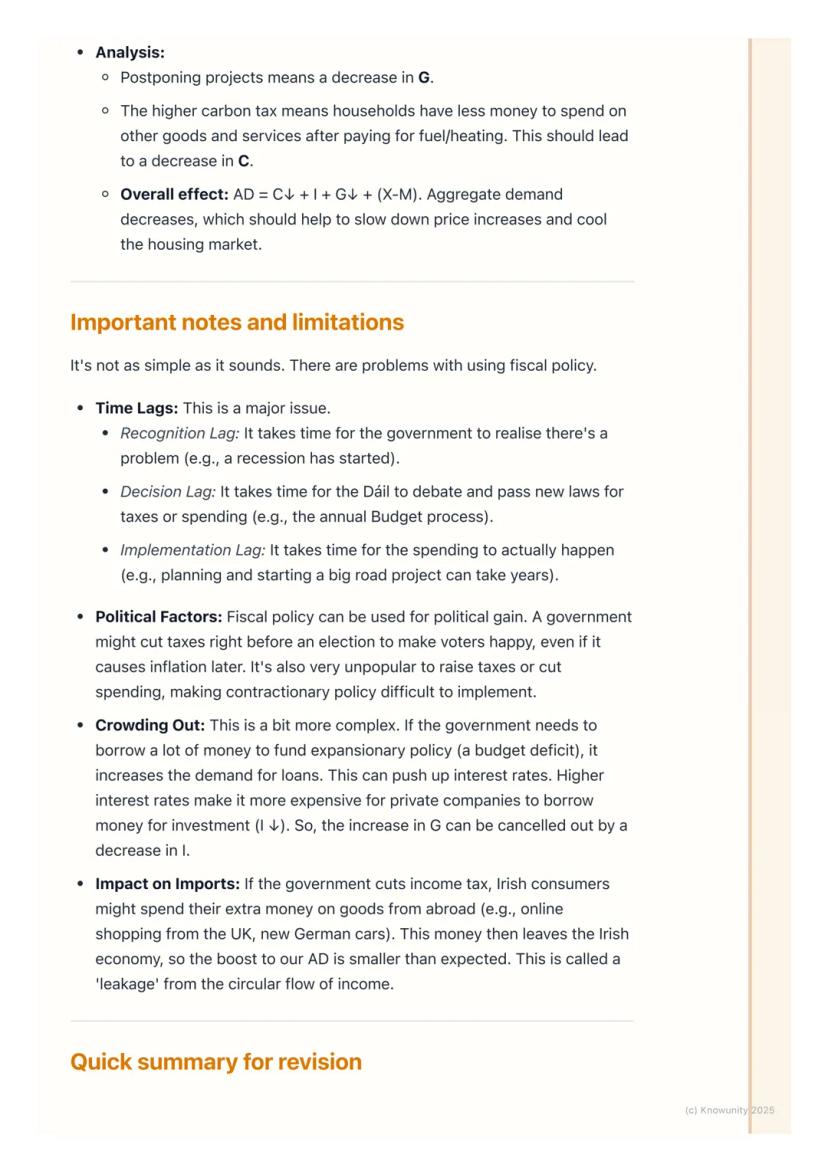
Fighting a recession might look like this: unemployment hits 9%, so the government announces €3 billion for social housing and public transport whilst cutting USC rates. The infrastructure spending directly boosts jobs, whilst lower USC gives workers more spending power - classic expansionary moves.
Tackling inflation requires the opposite approach. With prices rising at 7% annually, the government might postpone major projects and increase carbon taxes. Less government spending plus higher fuel costs means less money circulating, helping cool the overheated economy.
These aren't just theoretical examples - Ireland's used both approaches in recent decades. The key is timing and getting the balance right between economic needs and political realities.
Exam Tip: Always explain fiscal policy changes in terms of their impact on the AD formula components - it shows you understand the economic mechanics.
5
of 8
Why Fiscal Policy Isn't Perfect
Time lags are fiscal policy's biggest enemy. By the time the government recognises a problem, debates solutions, and actually implements changes, the economic situation might have completely shifted. Building that new hospital takes years from announcement to completion.
Political pressures constantly interfere with good economics. Governments love cutting taxes before elections but hate raising them when inflation strikes. It's much easier to promise spending increases than explain why belt-tightening is sometimes necessary.
Crowding out happens when government borrowing pushes up interest rates, making it more expensive for businesses to invest. Meanwhile, if tax cuts just lead to more spending on German cars or online shopping from abroad, much of the economic benefit leaks out of Ireland entirely.
Bottom Line: Fiscal policy is a powerful but blunt instrument - like trying to perform surgery with a sledgehammer rather than a scalpel.
6
of 8
Quick Revision Summary
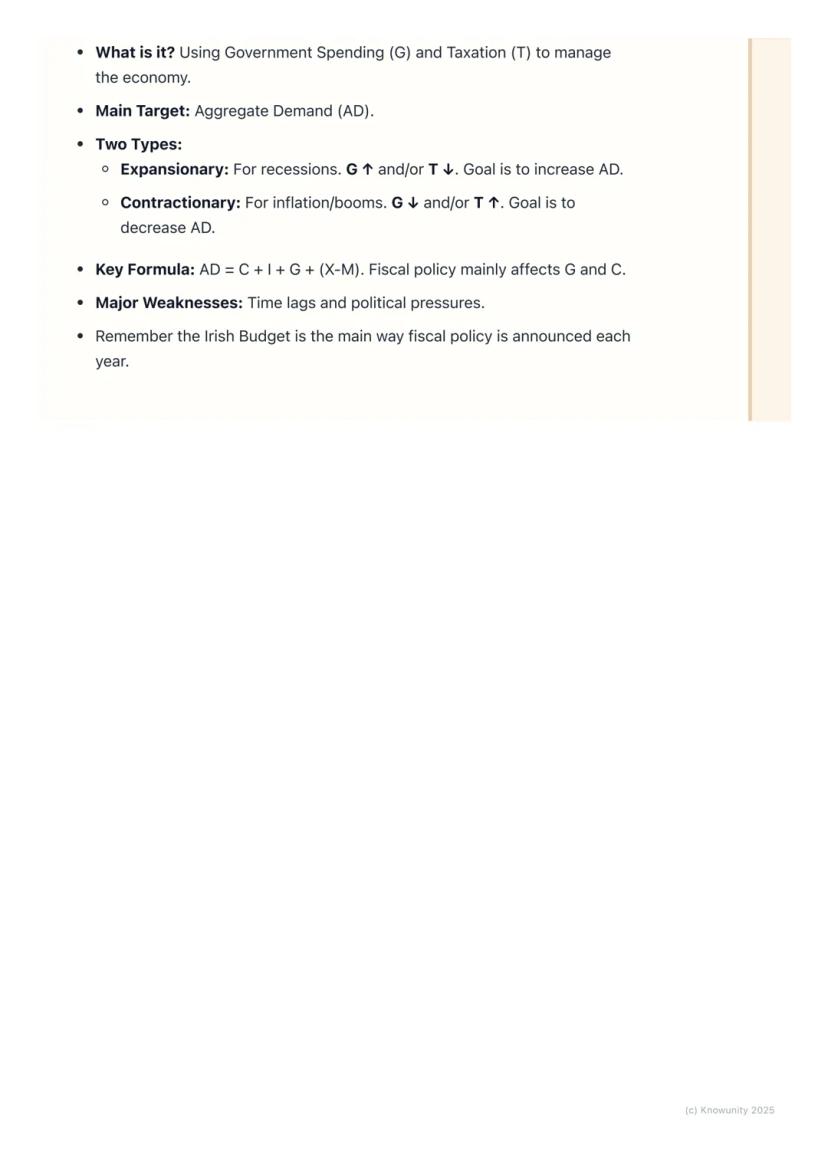
Fiscal policy uses government spending and taxation to manage aggregate demand and hit economic targets. Expansionary policy (more spending, lower taxes) fights recessions by boosting AD, whilst contractionary policy (less spending, higher taxes) tackles inflation by reducing AD.
The annual Irish Budget is where fiscal policy gets announced each year. Remember the AD formula: C + I + G + - fiscal policy mainly targets G directly and C indirectly through tax changes.
Major limitations include time lags between decisions and results, political reluctance to implement unpopular but necessary measures, and various ways the benefits can leak out of the domestic economy. Understanding these trade-offs is crucial for any serious discussion of economic policy.
Exam Success: Always link fiscal policy changes back to specific components of aggregate demand - it demonstrates you understand the underlying economic relationships.
7
of 8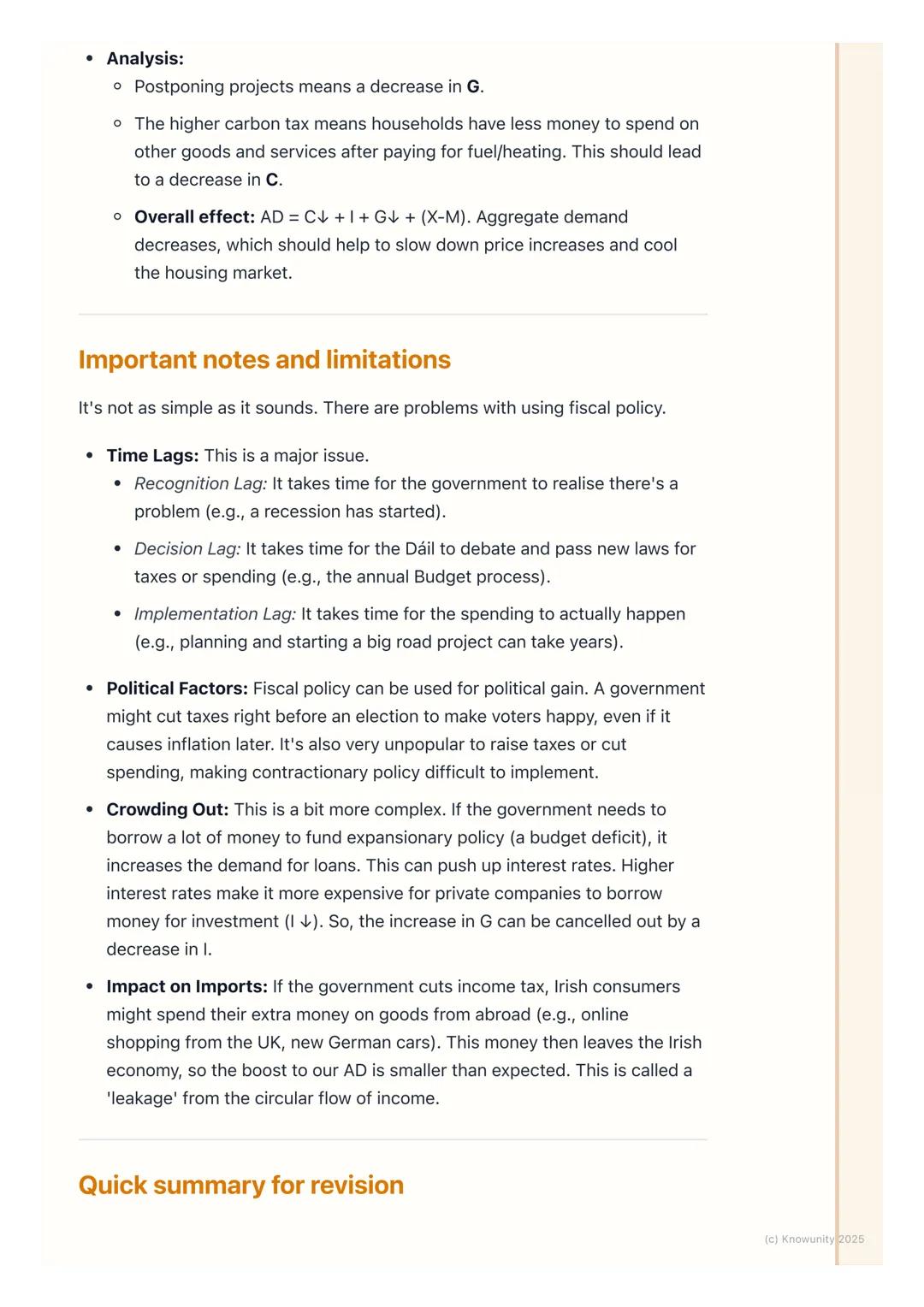
8
of 8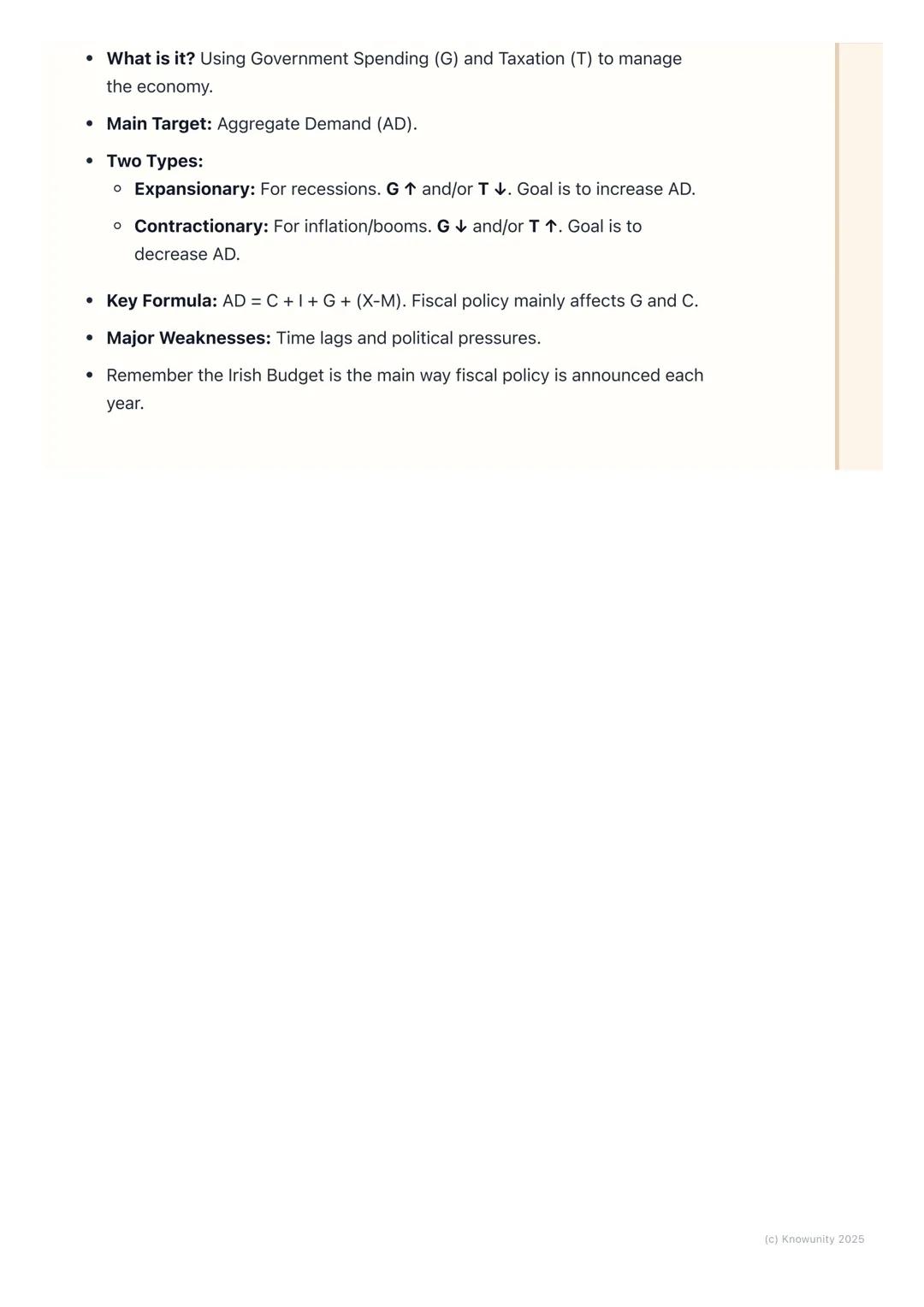
We dachten al dat je dit zou vragen...
Wat is de Knowunity AI companion?
Onze AI Companion is een studentgerichte AI-tool die meer biedt dan alleen antwoorden. Gebouwd op miljoenen Knowunity bronnen, biedt het relevante informatie, gepersonaliseerde studieplannen, quizzes en inhoud direct in de chat, aangepast aan jouw individuele leertraject.
Waar kan ik de Knowunity-app downloaden?
Je kunt de app downloaden via Google Play Store en Apple App Store.
Is Knowunity echt gratis?
Dat klopt! Geniet van gratis toegang tot leerinhoud, maak contact met medestudenten en krijg directe hulp – alles binnen handbereik.
Populairste studiemateriaal
9 Irish
IrishIrish oral questions and answers
Questions and answers for the leaving cert oral
5th Year4254
IrishIrish oral questions
Outline of oral questions
5th Year2055
IrishIníon- le hÁine Durkin
Aine Durkin’s poem, Iníon: Themes & summary
5th Year850
 English
Key Quotes : Sive
Key Quotes and explanations: Sive
6th Year2352
IrishIrish poetry 2027
Iníon + Dínit an Bhróin
5th Year1133
IrishLC HL notes- Iníon (poem)
Includes poem in English and Irish, theme, key words & phrases
5th Year2284
IrishGaeilge Grammar Office
All the basics you need to know on Irish grammar.
6th Year913
IrishMo Ghrá-sa (Idir Lúibíní)
Notes on mo ghrá-sa
5th Year350
IrishAn Gaeilge Aiste
Irish Language essay
6th Year1250
Kan je niet vinden wat je zoekt? Ontdek andere vakken.
Studenten zijn dol op ons — en jij ook.
4.6/5App Store
4.7/5Google Play
De app is heel makkelijk te gebruiken en goed ontworpen. Ik heb tot nu toe alles kunnen vinden waar ik naar zocht en heb veel kunnen leren van de presentaties! Ik ga de app zeker gebruiken voor een schoolopdracht! En natuurlijk helpt het ook veel als inspiratie.
Stefan SiOS gebruiker
Deze app is echt geweldig. Er zijn zoveel aantekeningen en hulpmiddelen [...]. Mijn probleemvak is bijvoorbeeld Frans, en de app heeft zoveel opties voor hulp. Dankzij deze app ben ik beter geworden in Frans. Ik zou het iedereen aanraden.
Samantha KlichAndroid gebruiker
Wow, ik ben echt onder de indruk. Ik probeerde de app gewoon omdat ik hem vaak geadverteerd had gezien en was absoluut verbaasd. Deze app is DE HULP die je wilt voor school en bovenal biedt hij zoveel dingen, zoals oefeningen en factsheets, die mij persoonlijk HEEL erg hebben geholpen.
AnnaiOS gebruiker
Economics4 weergaven·Bijgewerkt May 14, 2026·8 pagina'sUnderstanding Fiscal Policy: Government Spending and Taxes Explained
Ever wondered why the annual Budget matters so much? Fiscal policyis basically how the Irish government uses its spending power and tax decisions to steer our economy - whether that's creating jobs during tough times or cooling things down... Meer weergeven
1
of 8Meld je aan om de inhoud te zien. Het is gratis!
- Toegang tot alle documenten
- Verbeter je cijfers
- Sluit je aan bij miljoenen studenten
What is Fiscal Policy?
Think of fiscal policy as the government's economic steering wheel. When unemployment's high or the economy's sluggish, they can press the accelerator by spending more or cutting taxes. When inflation's getting out of hand, they hit the brakes.
The whole point is managing Aggregate Demand (AD) - that's the total amount everyone in Ireland wants to buy. The formula you need to know is AD = C + I + G + , where C is what households spend, I is business investment, G is government spending, and is our trade balance.
Government spending covers everything from HSE salaries to building new schools, while taxation includes all the money flowing back through income tax, VAT, and corporation tax. The relationship between these two creates either a budget deficit (spending more than we collect), surplus (collecting more than we spend), or a balanced budget.
Remember: Every year's Budget announcement is essentially the government revealing its fiscal policy strategy for the next 12 months.
2
of 8Meld je aan om de inhoud te zien. Het is gratis!
- Toegang tot alle documenten
- Verbeter je cijfers
- Sluit je aan bij miljoenen studenten
Expansionary Fiscal Policy - Boosting the Economy
When Ireland's economy needs a kick-start - think high unemployment or slow growth - the government goes expansionary. This is like giving the economy a shot of adrenaline to get things moving again.
Increasing government spending directly pumps money into the economy. New road projects create jobs for construction workers, who then spend their wages in local shops, creating a ripple effect. Meanwhile, cutting taxes leaves people with more disposable income - lower income tax means bigger paychecks, whilst reduced corporation tax might encourage businesses to invest more.
Both strategies shift the AD curve to the right, meaning higher economic growth and fewer people signing on. However, there's a catch - pump too much money into the economy and you risk demand-pull inflation, where too much money chases too few goods.
Key Point: Expansionary policy directly increases the 'G' in your AD formula, whilst also boosting 'C' and 'I' through tax cuts.
3
of 8Meld je aan om de inhoud te zien. Het is gratis!
- Toegang tot alle documenten
- Verbeter je cijfers
- Sluit je aan bij miljoenen studenten
Contractionary Fiscal Policy - Cooling Things Down
Sometimes the economy gets a bit too excited - think Celtic Tiger-style house price bubbles or inflation spiralling beyond the 2% target. That's when contractionary fiscal policy steps in to cool things down.
Cutting government spending takes money out of circulation - delaying that new motorway or reducing public service funding. Raising taxes has a similar effect, as higher VAT makes everything more expensive whilst increased income tax leaves people with less spending money.
This shifts the AD curve to the left, helping reduce inflationary pressure and bringing prices under control. The trade-off? Push too hard and you risk triggering a recession with rising unemployment.
Reality Check: Contractionary policy is politically toxic - nobody votes for higher taxes or spending cuts, making it incredibly difficult to implement even when economically necessary.
4
of 8Meld je aan om de inhoud te zien. Het is gratis!
- Toegang tot alle documenten
- Verbeter je cijfers
- Sluit je aan bij miljoenen studenten
Real Irish Examples You Can Use
Fighting a recession might look like this: unemployment hits 9%, so the government announces €3 billion for social housing and public transport whilst cutting USC rates. The infrastructure spending directly boosts jobs, whilst lower USC gives workers more spending power - classic expansionary moves.
Tackling inflation requires the opposite approach. With prices rising at 7% annually, the government might postpone major projects and increase carbon taxes. Less government spending plus higher fuel costs means less money circulating, helping cool the overheated economy.
These aren't just theoretical examples - Ireland's used both approaches in recent decades. The key is timing and getting the balance right between economic needs and political realities.
Exam Tip: Always explain fiscal policy changes in terms of their impact on the AD formula components - it shows you understand the economic mechanics.
5
of 8Meld je aan om de inhoud te zien. Het is gratis!
- Toegang tot alle documenten
- Verbeter je cijfers
- Sluit je aan bij miljoenen studenten
Why Fiscal Policy Isn't Perfect
Time lags are fiscal policy's biggest enemy. By the time the government recognises a problem, debates solutions, and actually implements changes, the economic situation might have completely shifted. Building that new hospital takes years from announcement to completion.
Political pressures constantly interfere with good economics. Governments love cutting taxes before elections but hate raising them when inflation strikes. It's much easier to promise spending increases than explain why belt-tightening is sometimes necessary.
Crowding out happens when government borrowing pushes up interest rates, making it more expensive for businesses to invest. Meanwhile, if tax cuts just lead to more spending on German cars or online shopping from abroad, much of the economic benefit leaks out of Ireland entirely.
Bottom Line: Fiscal policy is a powerful but blunt instrument - like trying to perform surgery with a sledgehammer rather than a scalpel.
6
of 8Meld je aan om de inhoud te zien. Het is gratis!
- Toegang tot alle documenten
- Verbeter je cijfers
- Sluit je aan bij miljoenen studenten
Quick Revision Summary
Fiscal policy uses government spending and taxation to manage aggregate demand and hit economic targets. Expansionary policy (more spending, lower taxes) fights recessions by boosting AD, whilst contractionary policy (less spending, higher taxes) tackles inflation by reducing AD.
The annual Irish Budget is where fiscal policy gets announced each year. Remember the AD formula: C + I + G + - fiscal policy mainly targets G directly and C indirectly through tax changes.
Major limitations include time lags between decisions and results, political reluctance to implement unpopular but necessary measures, and various ways the benefits can leak out of the domestic economy. Understanding these trade-offs is crucial for any serious discussion of economic policy.
Exam Success: Always link fiscal policy changes back to specific components of aggregate demand - it demonstrates you understand the underlying economic relationships.
7
of 8Meld je aan om de inhoud te zien. Het is gratis!
- Toegang tot alle documenten
- Verbeter je cijfers
- Sluit je aan bij miljoenen studenten
8
of 8Meld je aan om de inhoud te zien. Het is gratis!
- Toegang tot alle documenten
- Verbeter je cijfers
- Sluit je aan bij miljoenen studenten
We dachten al dat je dit zou vragen...
Wat is de Knowunity AI companion?
Onze AI Companion is een studentgerichte AI-tool die meer biedt dan alleen antwoorden. Gebouwd op miljoenen Knowunity bronnen, biedt het relevante informatie, gepersonaliseerde studieplannen, quizzes en inhoud direct in de chat, aangepast aan jouw individuele leertraject.
Waar kan ik de Knowunity-app downloaden?
Je kunt de app downloaden via Google Play Store en Apple App Store.
Is Knowunity echt gratis?
Dat klopt! Geniet van gratis toegang tot leerinhoud, maak contact met medestudenten en krijg directe hulp – alles binnen handbereik.
Populairste studiemateriaal
9IrishIrish oral questions and answers
Questions and answers for the leaving cert oral
5th Year4254
IrishIrish oral questions
Outline of oral questions
5th Year2055
IrishIníon- le hÁine Durkin
Aine Durkin’s poem, Iníon: Themes & summary
5th Year850
EnglishKey Quotes : Sive
Key Quotes and explanations: Sive
6th Year2352
IrishIrish poetry 2027
Iníon + Dínit an Bhróin
5th Year1133
IrishLC HL notes- Iníon (poem)
Includes poem in English and Irish, theme, key words & phrases
5th Year2284
IrishGaeilge Grammar Office
All the basics you need to know on Irish grammar.
6th Year913
IrishMo Ghrá-sa (Idir Lúibíní)
Notes on mo ghrá-sa
5th Year350
IrishAn Gaeilge Aiste
Irish Language essay
6th Year1250
Kan je niet vinden wat je zoekt? Ontdek andere vakken.
Studenten zijn dol op ons — en jij ook.
4.6/5App Store
4.7/5Google Play
De app is heel makkelijk te gebruiken en goed ontworpen. Ik heb tot nu toe alles kunnen vinden waar ik naar zocht en heb veel kunnen leren van de presentaties! Ik ga de app zeker gebruiken voor een schoolopdracht! En natuurlijk helpt het ook veel als inspiratie.
Stefan SiOS gebruiker
Deze app is echt geweldig. Er zijn zoveel aantekeningen en hulpmiddelen [...]. Mijn probleemvak is bijvoorbeeld Frans, en de app heeft zoveel opties voor hulp. Dankzij deze app ben ik beter geworden in Frans. Ik zou het iedereen aanraden.
Samantha KlichAndroid gebruiker
Wow, ik ben echt onder de indruk. Ik probeerde de app gewoon omdat ik hem vaak geadverteerd had gezien en was absoluut verbaasd. Deze app is DE HULP die je wilt voor school en bovenal biedt hij zoveel dingen, zoals oefeningen en factsheets, die mij persoonlijk HEEL erg hebben geholpen.
AnnaiOS gebruiker