
Ever wondered why spelling seems so tricky? Good spelling isn't...
 English6 weergaven·Bijgewerkt Jun 13, 2026·5 pagina's
Effective Spelling Techniques
1 / 5
1
of 5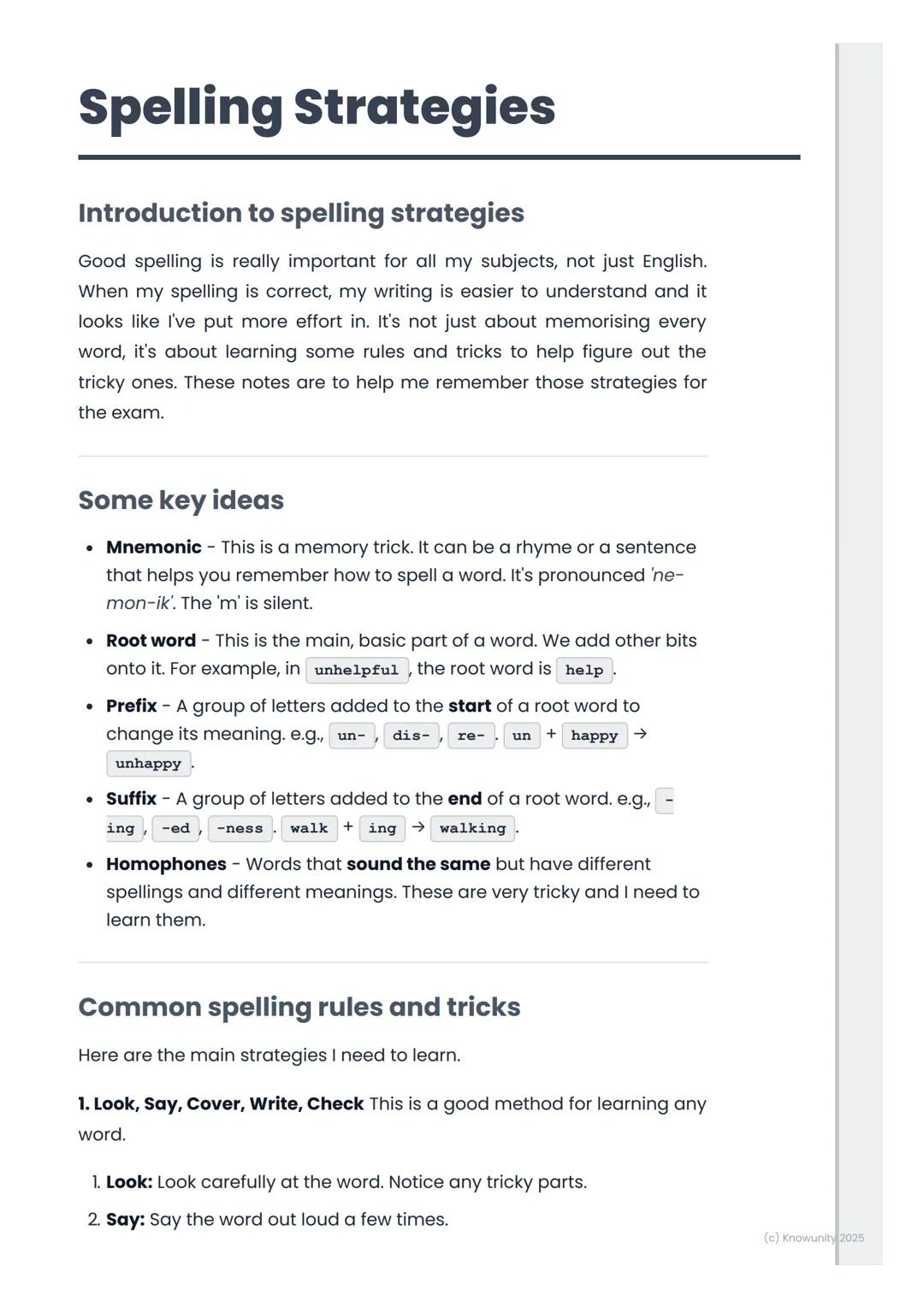
Introduction to Spelling Strategies
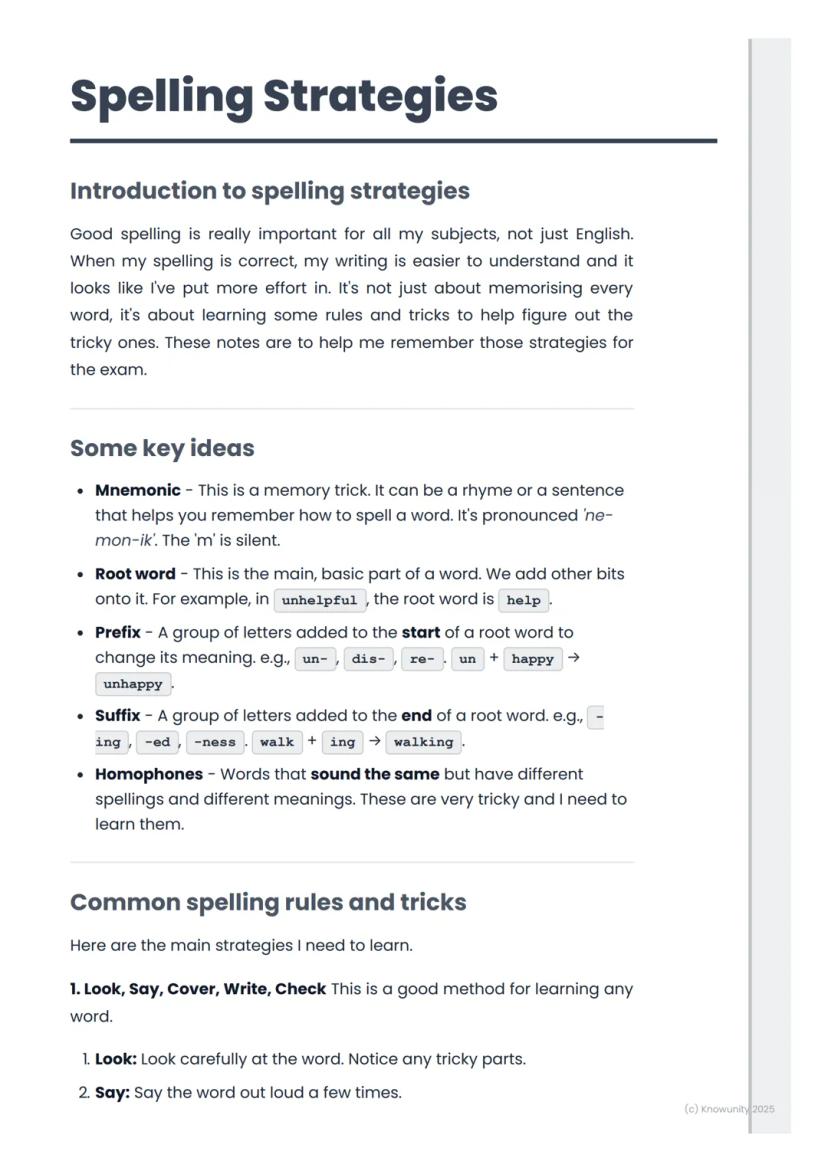
Spelling matters way more than you might think! When your spelling is spot-on, your writing looks polished and professional across all subjects, not just English. The brilliant thing is that you don't need to memorise every word in the dictionary.
Let's start with the essential spelling terminology you need to know. A mnemonic is basically a memory trick - think of it as a clever sentence or rhyme that helps you remember tricky spellings.
Understanding word parts makes spelling so much easier. The root word is the main part (like 'help' in 'unhelpful'), whilst a prefix goes at the beginning and a suffix goes at the end . Homophones are the sneaky words that sound identical but have completely different spellings and meanings.
Quick Tip: Think of word parts like building blocks - once you recognise the pattern, you can spell loads of related words!
2
of 5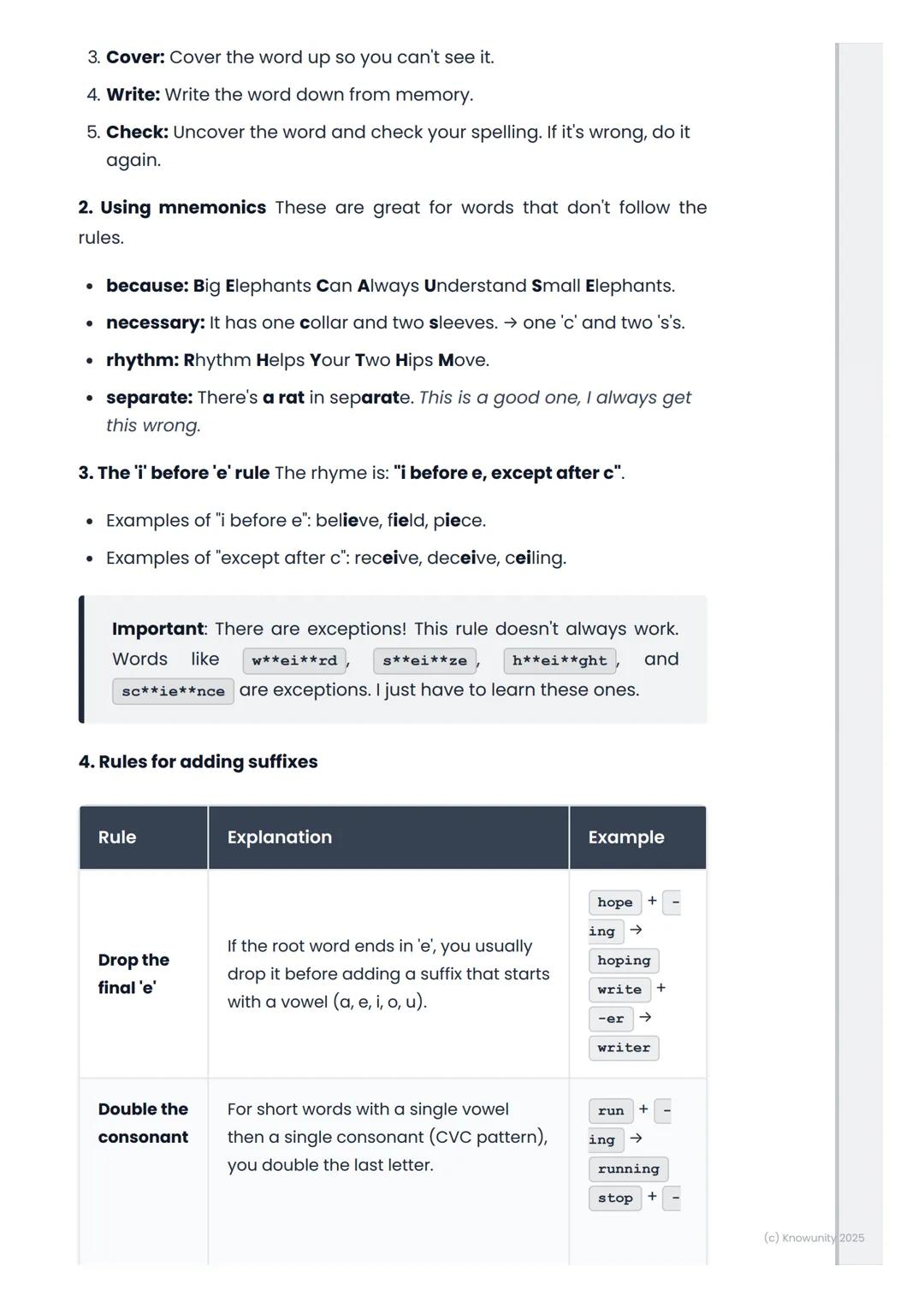
Essential Spelling Methods
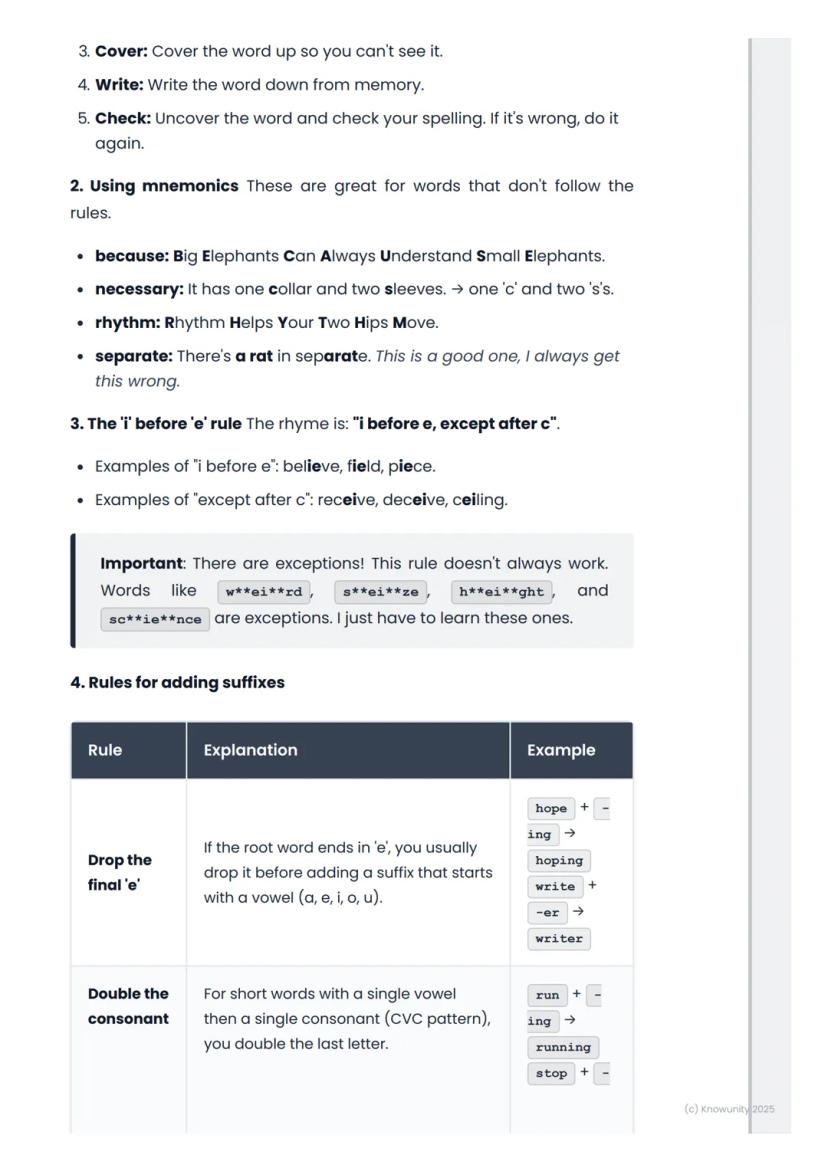
The Look, Say, Cover, Write, Check method is absolutely brilliant for learning any word. First, look carefully at the word and notice the tricky bits. Then say it out loud several times, cover it up, write it from memory, and finally check your spelling.
Mnemonics are lifesavers for stubborn words that refuse to follow rules. Try 'Big Elephants Can Always Understand Small Elephants' for 'because', or remember that 'necessary' has one collar and two sleeves (one 'c', two 's's). For 'separate', just remember there's 'a rat' hiding in the middle!
The famous 'i' before 'e' rule works brilliantly for words like 'believe', 'field', and 'piece'. After 'c', it flips to 'ei' in words like 'receive' and 'ceiling'. However, some words like 'weird', 'height', and 'science' are rebels that break this rule completely.
Remember: Even spelling rules have exceptions - that's what makes English both challenging and interesting!
3
of 5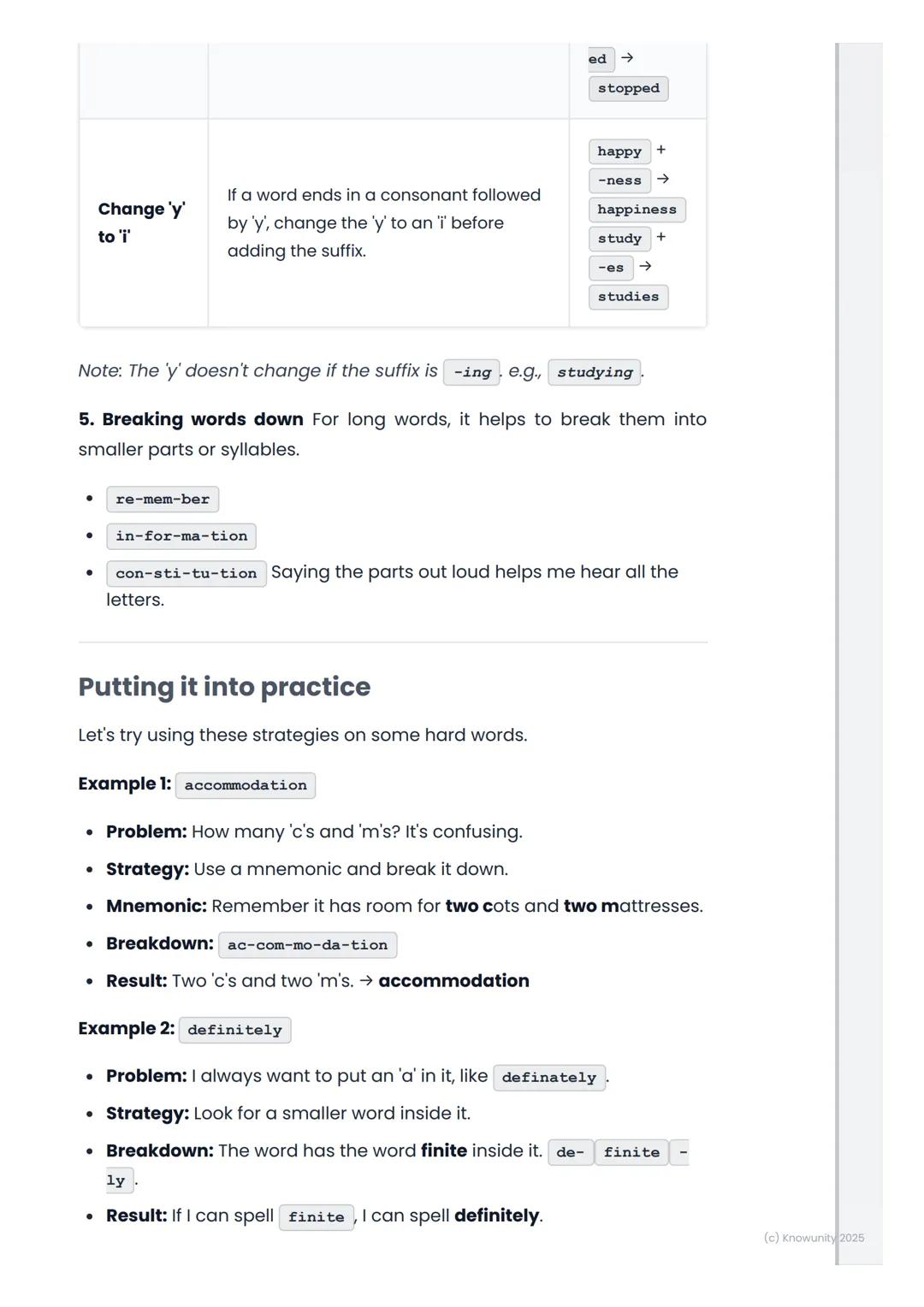
Suffix Rules and Word Building
Adding suffixes becomes dead easy once you know the patterns. When a word ends in 'e', drop it before adding suffixes starting with vowels . For short words following the consonant-vowel-consonant pattern, double that final consonant .
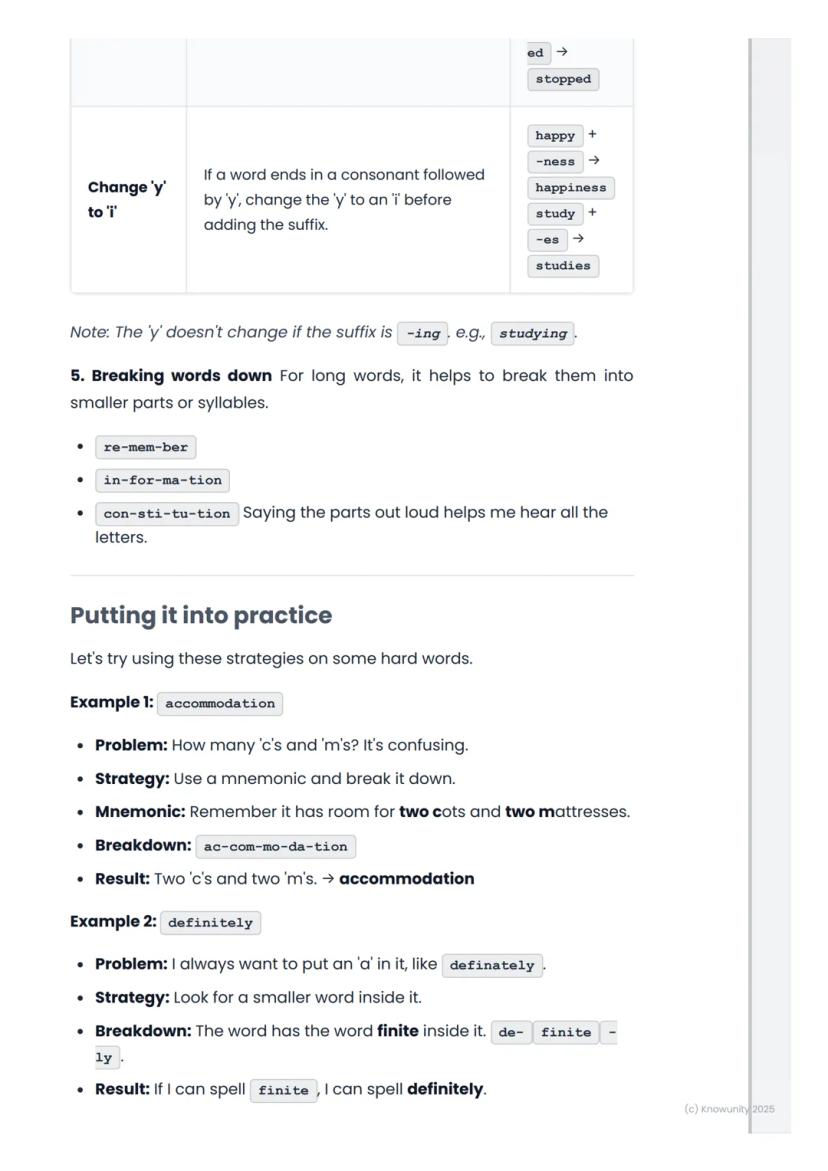
The 'y' rule is particularly useful - change 'y' to 'i' when adding most suffixes if there's a consonant before the 'y' . The exception? Keep the 'y' when adding '-ing' (studying, not studiing).
Breaking words into syllables transforms intimidating long words into manageable chunks. Try 're-mem-ber', 'in-for-ma-tion', or 'con-sti-tu-tion'. When you say each part out loud, you'll hear every single letter clearly.
Let's put this into practice with 'accommodation' - remember it needs room for two cots and two mattresses (explaining the double 'c' and double 'm'). Breaking it down as 'ac-com-mo-da-tion' makes it much less scary.
Pro Tip: If you can spell the smaller parts, you can definitely spell the whole word!
4
of 5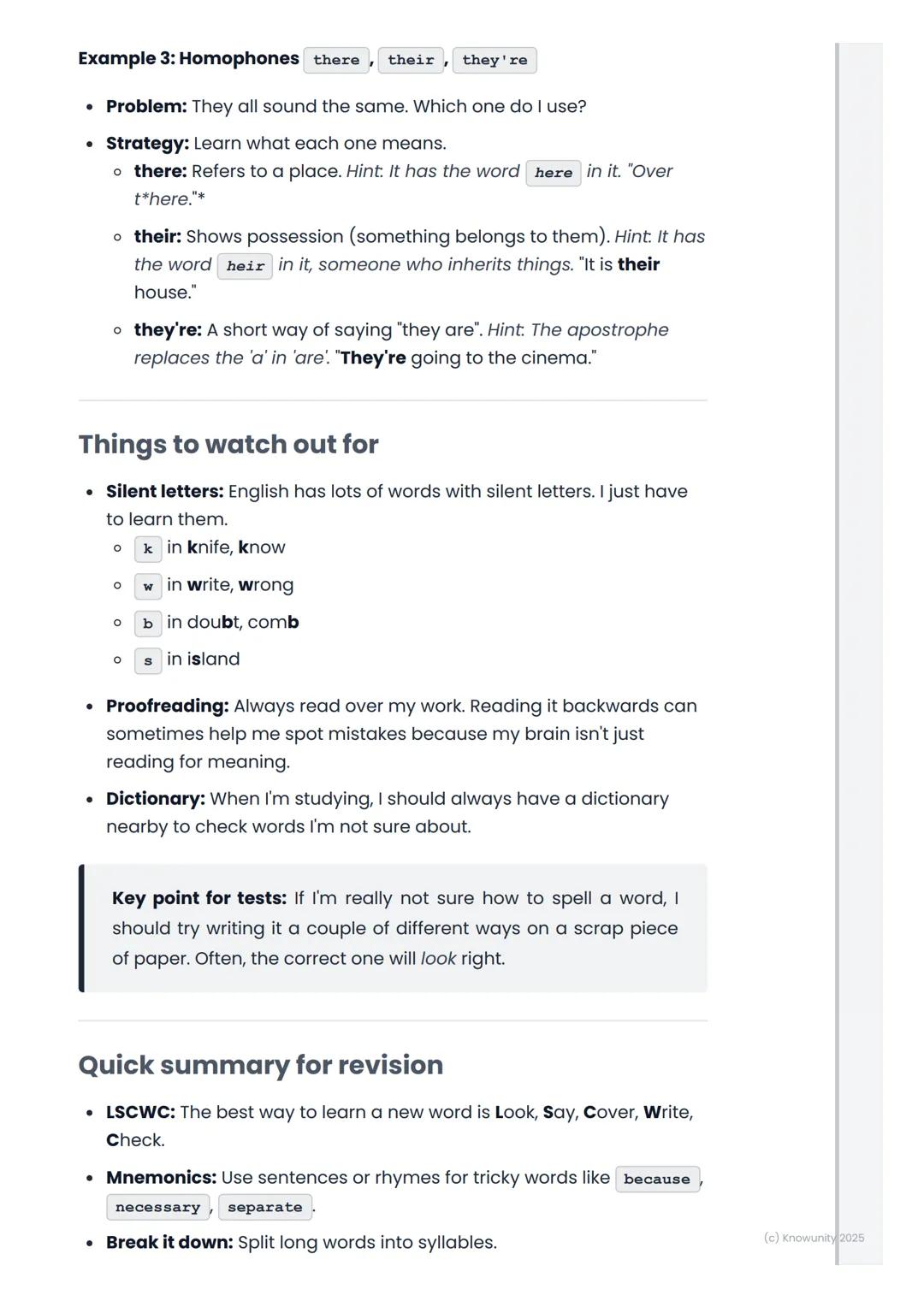
Tackling Tricky Words and Homophones
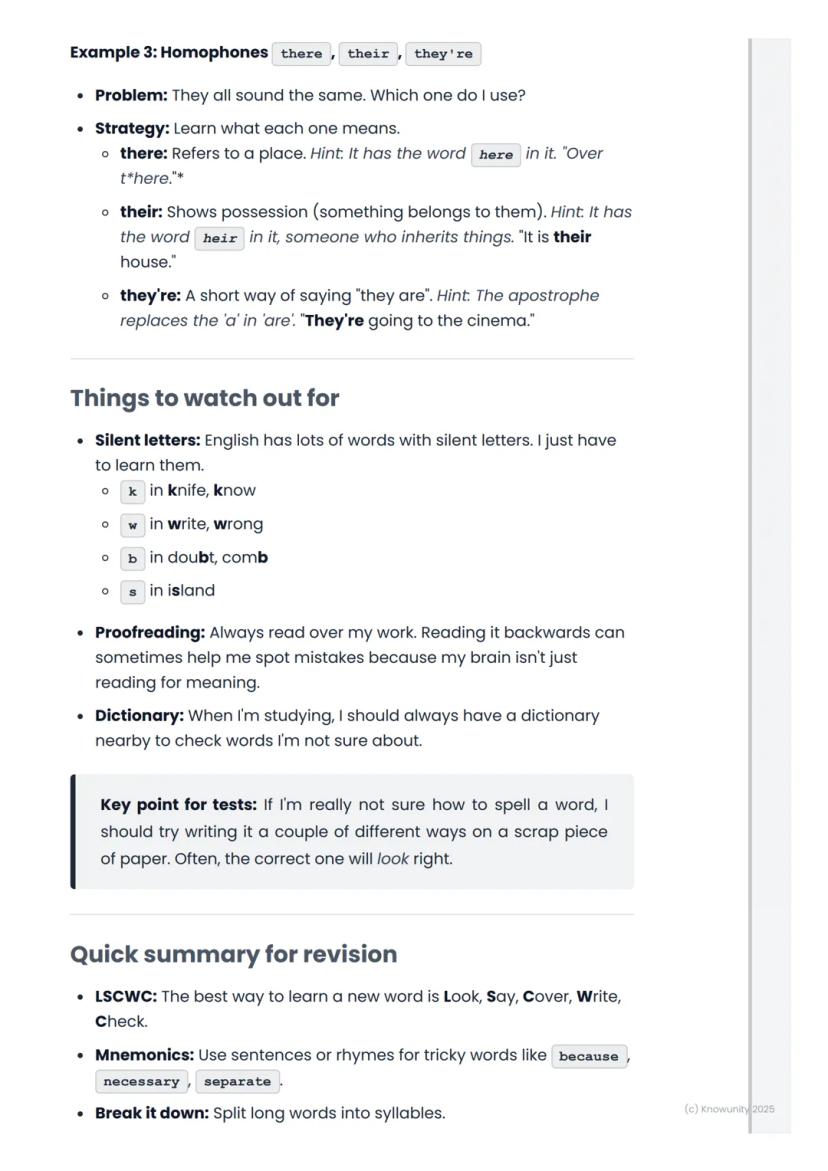
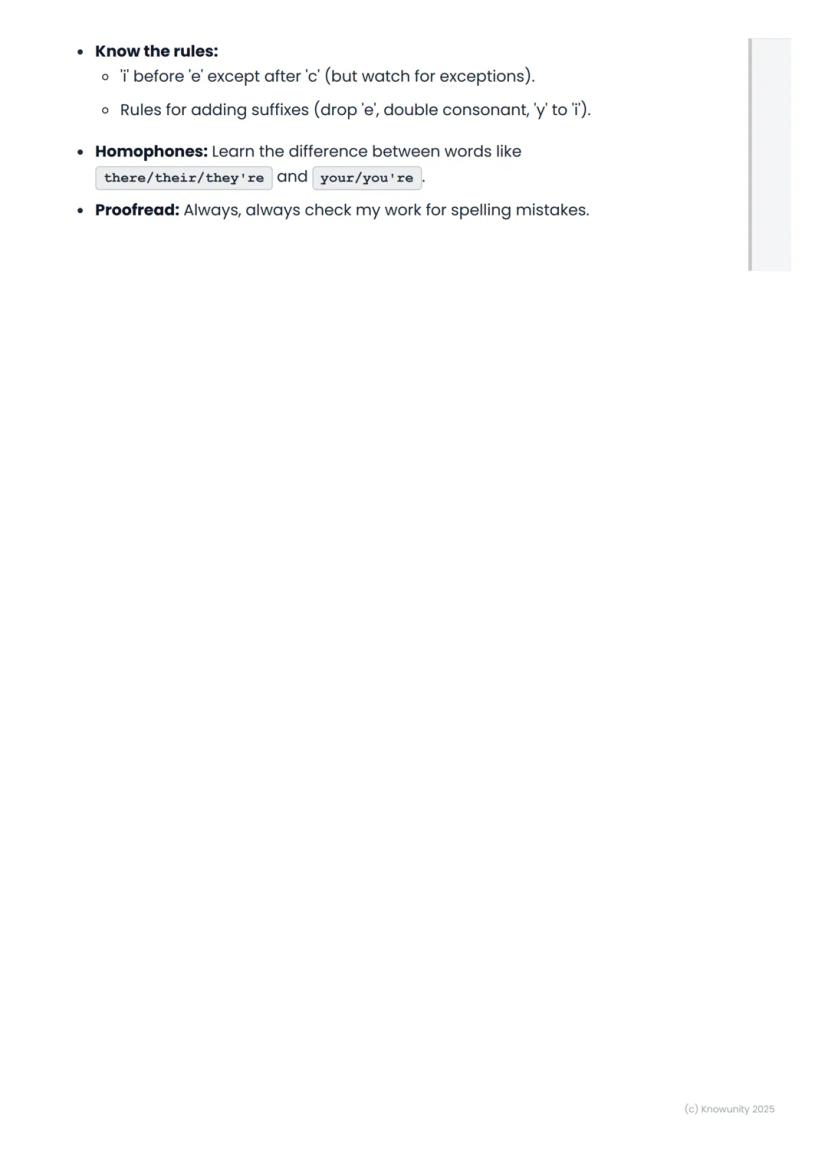
Homophones trip up even the best spellers, but they're manageable with the right approach. For the classic 'there/their/they're' confusion, remember that 'there' refers to places (it contains 'here'), 'their' shows ownership (think 'heir' who inherits things), and 'they're' simply means 'they are'.
Silent letters are everywhere in English - the 'k' in 'knife', 'w' in 'write', 'b' in 'doubt', and 's' in 'island'. Unfortunately, these just need memorising, but once you know them, you'll spot the patterns.
Proofreading is your secret weapon. Always read through your work, and try reading backwards sometimes - this stops your brain from auto-correcting mistakes. Keep a dictionary handy when studying, and don't be afraid to use it.
During tests, if you're genuinely stuck on a spelling, quickly write the word a couple of different ways on scrap paper. Often, the correct version will just look right to your brain.
Test Tip: Trust your instincts - if a word looks wrong when you write it, it probably is!
5
of 5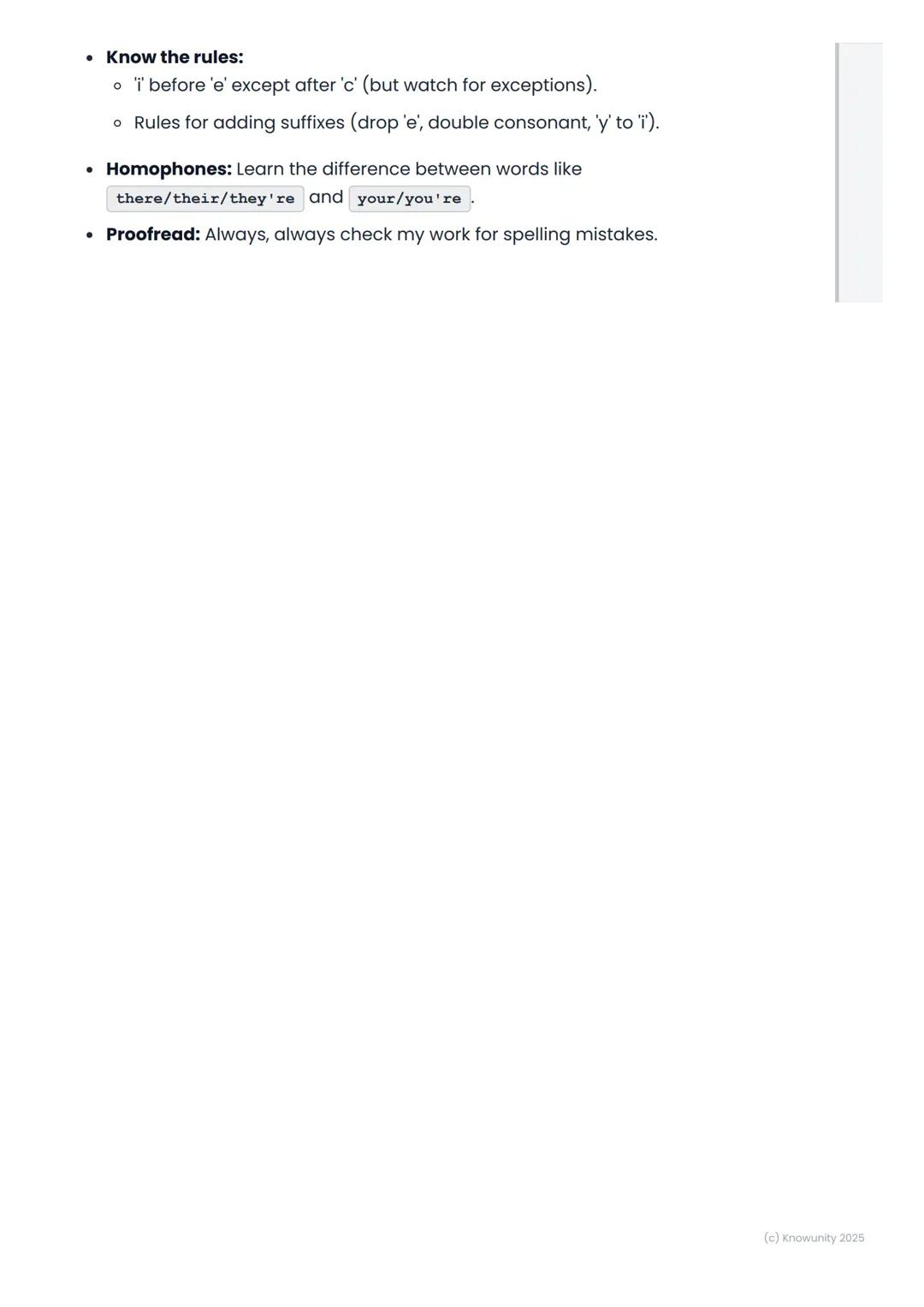
Quick Revision Summary
Master these key strategies and you'll tackle any spelling challenge with confidence. Use LSCWC (Look, Say, Cover, Write, Check) for learning new words, and create memorable mnemonics for particularly stubborn spellings.
Remember the essential suffix rules - drop 'e' before vowel suffixes, double consonants in short CVC words, and change 'y' to 'i' . The 'i before e except after c' rule works most of the time, but watch out for those sneaky exceptions.
Breaking words into syllables makes even the longest words manageable, whilst understanding homophones prevents embarrassing mix-ups in your writing. Most importantly, always proofread your work - it's the final step that catches those last few mistakes.
With these strategies in your toolkit, spelling becomes less about memorisation and more about understanding patterns and using clever tricks. You've absolutely got this!
Final Reminder: Good spelling comes from practice and using these strategies consistently - you'll be amazed how quickly you improve!
We dachten al dat je dit zou vragen...
Wat is de Knowunity AI companion?
Onze AI Companion is een studentgerichte AI-tool die meer biedt dan alleen antwoorden. Gebouwd op miljoenen Knowunity bronnen, biedt het relevante informatie, gepersonaliseerde studieplannen, quizzes en inhoud direct in de chat, aangepast aan jouw individuele leertraject.
Waar kan ik de Knowunity-app downloaden?
Je kunt de app downloaden via Google Play Store en Apple App Store.
Is Knowunity echt gratis?
Dat klopt! Geniet van gratis toegang tot leerinhoud, maak contact met medestudenten en krijg directe hulp – alles binnen handbereik.
Populairste studiemateriaal voor English
9EnglishKey Quotes : Sive
Key Quotes and explanations: Sive
6th Year2842
EnglishCultural Context : Shawshank Redemption : Sive : Small Things Like These
Comparative Study : Cultural Context : Shawshank Redemption, Sive and Small Things Like These
6th Year1430
EnglishElizabeth Bishop notes
Elizabeth Bishop notes
6th Year1271
EnglishPoetry
Paula Meehan - the statue of the virgin at granard speaks, the exact moment i became a poet, prayer for the children of longing, the pattern notes. Seamus Heaney, the forge notes.
6th Year300
EnglishKey Moments of Macbeth
This is a one page summary for key moments of Macbeth including quotes and act numbers
6th Year320
EnglishMud term break
Jc poem english
1st Year141
EnglishBanquo Study Notes
Macbeth
6th Year280
EnglishNotes on Macbeth, poetry and comparative
Notes on Macbeth, dive and comparative
5th Year291
EnglishThe fish-Elizabeth bishop
Overview of Elizabeth bishops poem the fish written in 1940 ,include a summary,tone and mood,key quotes,imagery examples and theme examples
6th Year370
Populairste studiemateriaal
9 Irish
IrishIrish oral questions and answers
Questions and answers for the leaving cert oral
5th Year4264
EnglishKey Quotes : Sive
Key Quotes and explanations: Sive
6th Year2842
IrishIrish oral questions
Outline of oral questions
5th Year2055
IrishIníon- le hÁine Durkin
Aine Durkin’s poem, Iníon: Themes & summary
5th Year850
IrishIrish poetry 2027
Iníon + Dínit an Bhróin
5th Year1133
IrishLC HL notes- Iníon (poem)
Includes poem in English and Irish, theme, key words & phrases
5th Year2284
EnglishCultural Context : Shawshank Redemption : Sive : Small Things Like These
Comparative Study : Cultural Context : Shawshank Redemption, Sive and Small Things Like These
6th Year1430
IrishMo Ghrá-sa (Idir Lúibíní)
Notes on mo ghrá-sa
5th Year380
IrishAn Gaeilge Aiste
Irish Language essay
6th Year1320
Kan je niet vinden wat je zoekt? Ontdek andere vakken.
Studenten zijn dol op ons — en jij ook.
4.6/5App Store
4.7/5Google Play
De app is heel makkelijk te gebruiken en goed ontworpen. Ik heb tot nu toe alles kunnen vinden waar ik naar zocht en heb veel kunnen leren van de presentaties! Ik ga de app zeker gebruiken voor een schoolopdracht! En natuurlijk helpt het ook veel als inspiratie.
Stefan SiOS gebruiker
Deze app is echt geweldig. Er zijn zoveel aantekeningen en hulpmiddelen [...]. Mijn probleemvak is bijvoorbeeld Frans, en de app heeft zoveel opties voor hulp. Dankzij deze app ben ik beter geworden in Frans. Ik zou het iedereen aanraden.
Samantha KlichAndroid gebruiker
Wow, ik ben echt onder de indruk. Ik probeerde de app gewoon omdat ik hem vaak geadverteerd had gezien en was absoluut verbaasd. Deze app is DE HULP die je wilt voor school en bovenal biedt hij zoveel dingen, zoals oefeningen en factsheets, die mij persoonlijk HEEL erg hebben geholpen.
AnnaiOS gebruiker
English6 weergaven·Bijgewerkt Jun 13, 2026·5 pagina'sEffective Spelling Techniques
Ever wondered why spelling seems so tricky? Good spelling isn't just about memorising every single word - it's about learning clever strategies and rules that help you tackle even the most difficult words. These proven techniques will boost your confidence...
1
of 5
Meld je aan om de inhoud te zien. Het is gratis!
- Toegang tot alle documenten
- Verbeter je cijfers
- Sluit je aan bij miljoenen studenten
Introduction to Spelling Strategies
Spelling matters way more than you might think! When your spelling is spot-on, your writing looks polished and professional across all subjects, not just English. The brilliant thing is that you don't need to memorise every word in the dictionary.
Let's start with the essential spelling terminology you need to know. A mnemonic is basically a memory trick - think of it as a clever sentence or rhyme that helps you remember tricky spellings.
Understanding word parts makes spelling so much easier. The root word is the main part (like 'help' in 'unhelpful'), whilst a prefix goes at the beginning and a suffix goes at the end . Homophones are the sneaky words that sound identical but have completely different spellings and meanings.
Quick Tip: Think of word parts like building blocks - once you recognise the pattern, you can spell loads of related words!
2
of 5Meld je aan om de inhoud te zien. Het is gratis!
- Toegang tot alle documenten
- Verbeter je cijfers
- Sluit je aan bij miljoenen studenten
Essential Spelling Methods
The Look, Say, Cover, Write, Check method is absolutely brilliant for learning any word. First, look carefully at the word and notice the tricky bits. Then say it out loud several times, cover it up, write it from memory, and finally check your spelling.
Mnemonics are lifesavers for stubborn words that refuse to follow rules. Try 'Big Elephants Can Always Understand Small Elephants' for 'because', or remember that 'necessary' has one collar and two sleeves (one 'c', two 's's). For 'separate', just remember there's 'a rat' hiding in the middle!
The famous 'i' before 'e' rule works brilliantly for words like 'believe', 'field', and 'piece'. After 'c', it flips to 'ei' in words like 'receive' and 'ceiling'. However, some words like 'weird', 'height', and 'science' are rebels that break this rule completely.
Remember: Even spelling rules have exceptions - that's what makes English both challenging and interesting!
3
of 5Meld je aan om de inhoud te zien. Het is gratis!
- Toegang tot alle documenten
- Verbeter je cijfers
- Sluit je aan bij miljoenen studenten
Suffix Rules and Word Building
Adding suffixes becomes dead easy once you know the patterns. When a word ends in 'e', drop it before adding suffixes starting with vowels . For short words following the consonant-vowel-consonant pattern, double that final consonant .
The 'y' rule is particularly useful - change 'y' to 'i' when adding most suffixes if there's a consonant before the 'y' . The exception? Keep the 'y' when adding '-ing' (studying, not studiing).
Breaking words into syllables transforms intimidating long words into manageable chunks. Try 're-mem-ber', 'in-for-ma-tion', or 'con-sti-tu-tion'. When you say each part out loud, you'll hear every single letter clearly.
Let's put this into practice with 'accommodation' - remember it needs room for two cots and two mattresses (explaining the double 'c' and double 'm'). Breaking it down as 'ac-com-mo-da-tion' makes it much less scary.
Pro Tip: If you can spell the smaller parts, you can definitely spell the whole word!
4
of 5Meld je aan om de inhoud te zien. Het is gratis!
- Toegang tot alle documenten
- Verbeter je cijfers
- Sluit je aan bij miljoenen studenten
Tackling Tricky Words and Homophones
Homophones trip up even the best spellers, but they're manageable with the right approach. For the classic 'there/their/they're' confusion, remember that 'there' refers to places (it contains 'here'), 'their' shows ownership (think 'heir' who inherits things), and 'they're' simply means 'they are'.
Silent letters are everywhere in English - the 'k' in 'knife', 'w' in 'write', 'b' in 'doubt', and 's' in 'island'. Unfortunately, these just need memorising, but once you know them, you'll spot the patterns.
Proofreading is your secret weapon. Always read through your work, and try reading backwards sometimes - this stops your brain from auto-correcting mistakes. Keep a dictionary handy when studying, and don't be afraid to use it.
During tests, if you're genuinely stuck on a spelling, quickly write the word a couple of different ways on scrap paper. Often, the correct version will just look right to your brain.
Test Tip: Trust your instincts - if a word looks wrong when you write it, it probably is!
5
of 5Meld je aan om de inhoud te zien. Het is gratis!
- Toegang tot alle documenten
- Verbeter je cijfers
- Sluit je aan bij miljoenen studenten
Quick Revision Summary
Master these key strategies and you'll tackle any spelling challenge with confidence. Use LSCWC (Look, Say, Cover, Write, Check) for learning new words, and create memorable mnemonics for particularly stubborn spellings.
Remember the essential suffix rules - drop 'e' before vowel suffixes, double consonants in short CVC words, and change 'y' to 'i' . The 'i before e except after c' rule works most of the time, but watch out for those sneaky exceptions.
Breaking words into syllables makes even the longest words manageable, whilst understanding homophones prevents embarrassing mix-ups in your writing. Most importantly, always proofread your work - it's the final step that catches those last few mistakes.
With these strategies in your toolkit, spelling becomes less about memorisation and more about understanding patterns and using clever tricks. You've absolutely got this!
Final Reminder: Good spelling comes from practice and using these strategies consistently - you'll be amazed how quickly you improve!
We dachten al dat je dit zou vragen...
Wat is de Knowunity AI companion?
Onze AI Companion is een studentgerichte AI-tool die meer biedt dan alleen antwoorden. Gebouwd op miljoenen Knowunity bronnen, biedt het relevante informatie, gepersonaliseerde studieplannen, quizzes en inhoud direct in de chat, aangepast aan jouw individuele leertraject.
Waar kan ik de Knowunity-app downloaden?
Je kunt de app downloaden via Google Play Store en Apple App Store.
Is Knowunity echt gratis?
Dat klopt! Geniet van gratis toegang tot leerinhoud, maak contact met medestudenten en krijg directe hulp – alles binnen handbereik.
Populairste studiemateriaal voor English
9EnglishKey Quotes : Sive
Key Quotes and explanations: Sive
6th Year2842
EnglishCultural Context : Shawshank Redemption : Sive : Small Things Like These
Comparative Study : Cultural Context : Shawshank Redemption, Sive and Small Things Like These
6th Year1430
EnglishElizabeth Bishop notes
Elizabeth Bishop notes
6th Year1271
EnglishPoetry
Paula Meehan - the statue of the virgin at granard speaks, the exact moment i became a poet, prayer for the children of longing, the pattern notes. Seamus Heaney, the forge notes.
6th Year300
EnglishKey Moments of Macbeth
This is a one page summary for key moments of Macbeth including quotes and act numbers
6th Year320
EnglishMud term break
Jc poem english
1st Year141
EnglishBanquo Study Notes
Macbeth
6th Year280
EnglishNotes on Macbeth, poetry and comparative
Notes on Macbeth, dive and comparative
5th Year291
EnglishThe fish-Elizabeth bishop
Overview of Elizabeth bishops poem the fish written in 1940 ,include a summary,tone and mood,key quotes,imagery examples and theme examples
6th Year370
Populairste studiemateriaal
9IrishIrish oral questions and answers
Questions and answers for the leaving cert oral
5th Year4264
EnglishKey Quotes : Sive
Key Quotes and explanations: Sive
6th Year2842
IrishIrish oral questions
Outline of oral questions
5th Year2055
IrishIníon- le hÁine Durkin
Aine Durkin’s poem, Iníon: Themes & summary
5th Year850
IrishIrish poetry 2027
Iníon + Dínit an Bhróin
5th Year1133
IrishLC HL notes- Iníon (poem)
Includes poem in English and Irish, theme, key words & phrases
5th Year2284
EnglishCultural Context : Shawshank Redemption : Sive : Small Things Like These
Comparative Study : Cultural Context : Shawshank Redemption, Sive and Small Things Like These
6th Year1430
IrishMo Ghrá-sa (Idir Lúibíní)
Notes on mo ghrá-sa
5th Year380
IrishAn Gaeilge Aiste
Irish Language essay
6th Year1320
Kan je niet vinden wat je zoekt? Ontdek andere vakken.
Studenten zijn dol op ons — en jij ook.
4.6/5App Store
4.7/5Google Play
De app is heel makkelijk te gebruiken en goed ontworpen. Ik heb tot nu toe alles kunnen vinden waar ik naar zocht en heb veel kunnen leren van de presentaties! Ik ga de app zeker gebruiken voor een schoolopdracht! En natuurlijk helpt het ook veel als inspiratie.
Stefan SiOS gebruiker
Deze app is echt geweldig. Er zijn zoveel aantekeningen en hulpmiddelen [...]. Mijn probleemvak is bijvoorbeeld Frans, en de app heeft zoveel opties voor hulp. Dankzij deze app ben ik beter geworden in Frans. Ik zou het iedereen aanraden.
Samantha KlichAndroid gebruiker
Wow, ik ben echt onder de indruk. Ik probeerde de app gewoon omdat ik hem vaak geadverteerd had gezien en was absoluut verbaasd. Deze app is DE HULP die je wilt voor school en bovenal biedt hij zoveel dingen, zoals oefeningen en factsheets, die mij persoonlijk HEEL erg hebben geholpen.
AnnaiOS gebruiker