
Ever wondered how meteorologists predict whether you'll need an umbrella... Meer weergeven
 Geography6 weergaven·Bijgewerkt Jun 12, 2026·8 pagina's
Weather Measuring Instruments: A Simple Guide

1 / 8
1
of 8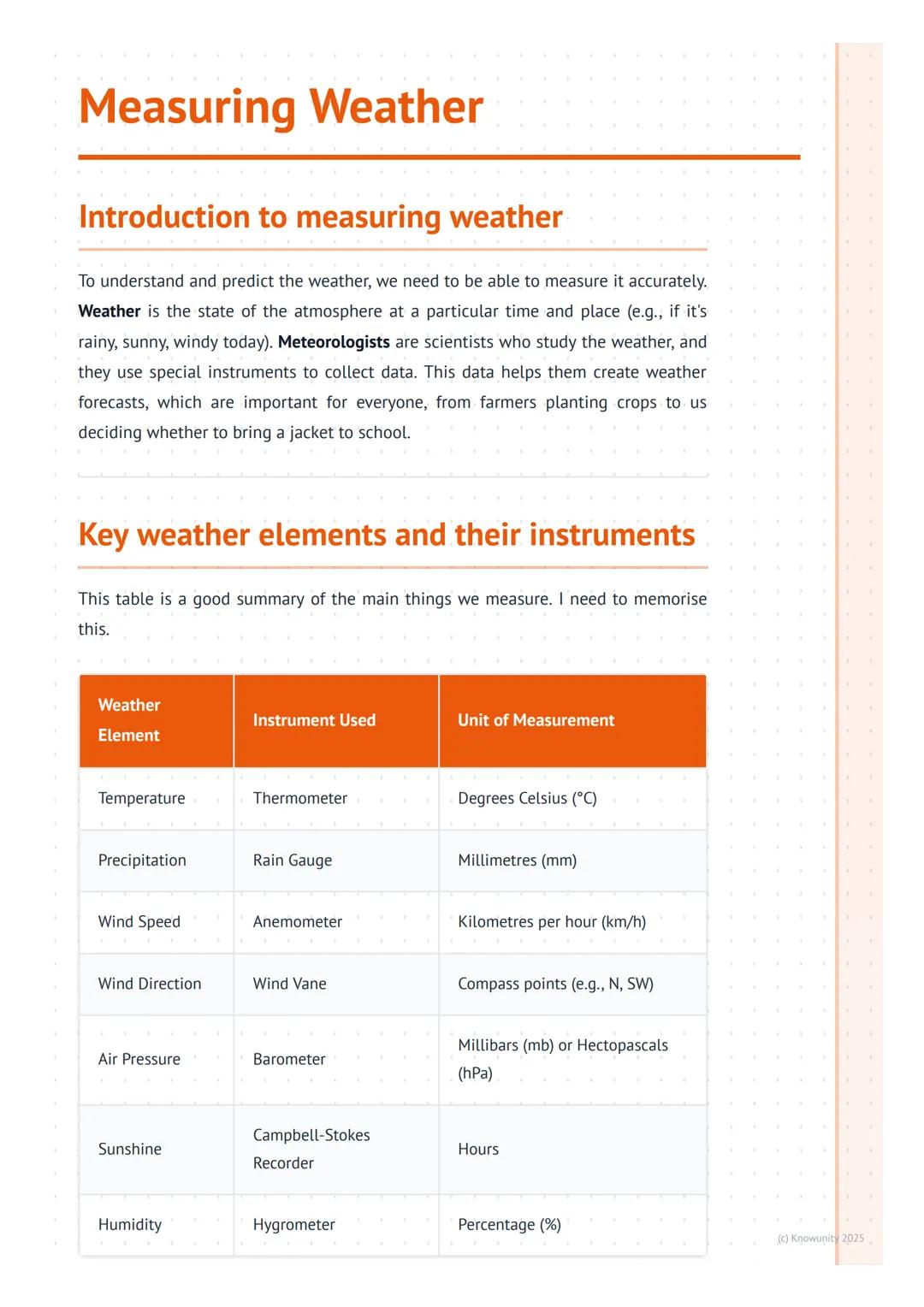
Measuring Weather Basics
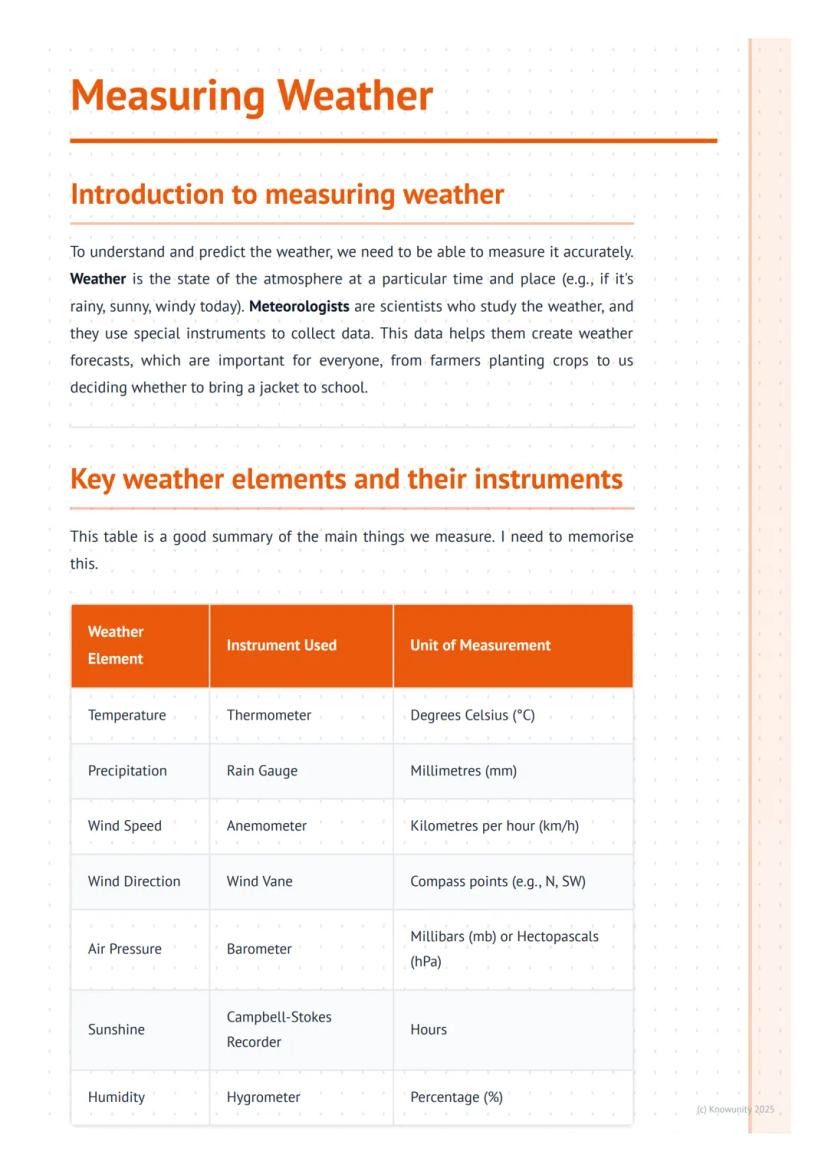
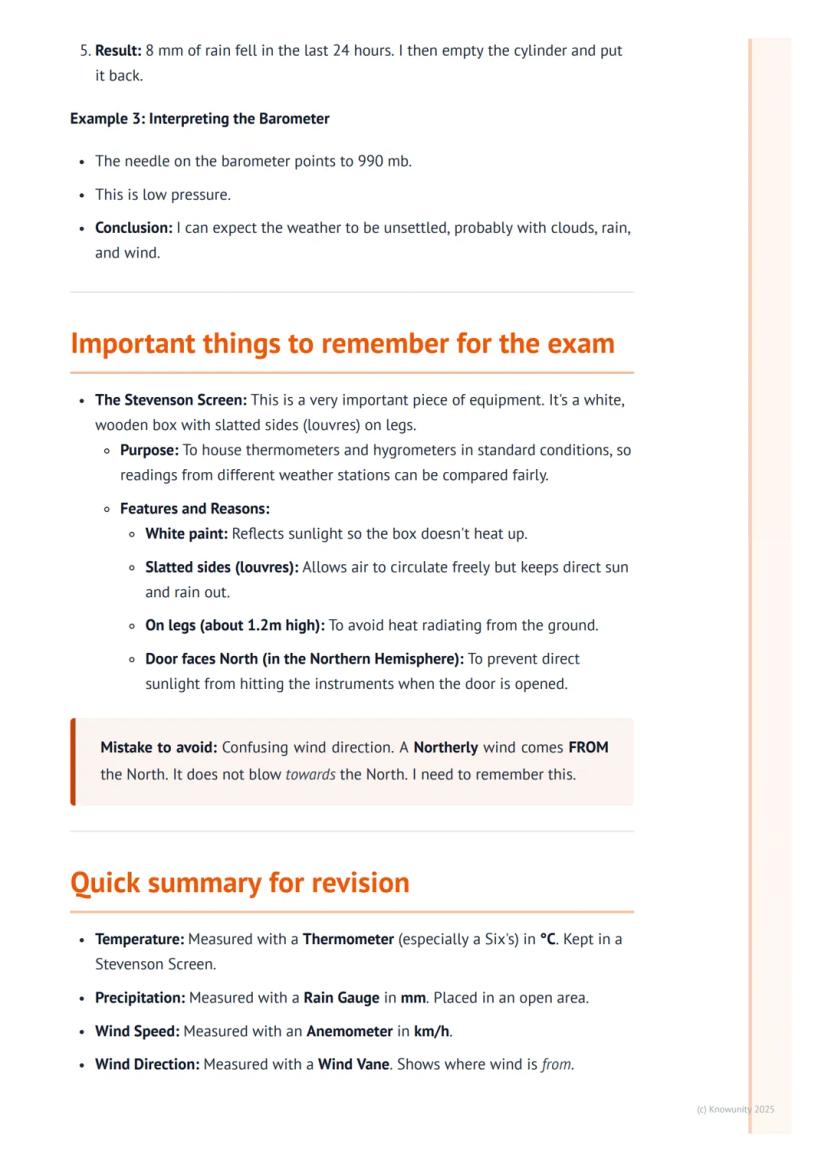
Weather measurement is all about collecting accurate data so meteorologists can create reliable forecasts. Whether it's farmers planning their harvests or you deciding what to wear to school, weather forecasts affect everyone's daily decisions.
There are seven main weather elements that scientists measure regularly. Each one requires a specific instrument and has its own unit of measurement. The most important ones you need to know are temperature (measured in °C with a thermometer), precipitation (measured in mm with a rain gauge), and air pressure (measured in millibars with a barometer).
Wind is measured in two ways: wind speed using an anemometer and wind direction using a wind vane (compass points). Scientists also track sunshine hours with a Campbell-Stokes recorder and humidity levels with a hygrometer.
Quick Tip: Create flashcards linking each weather element to its instrument and unit - this is exactly what examiners love to test!
2
of 8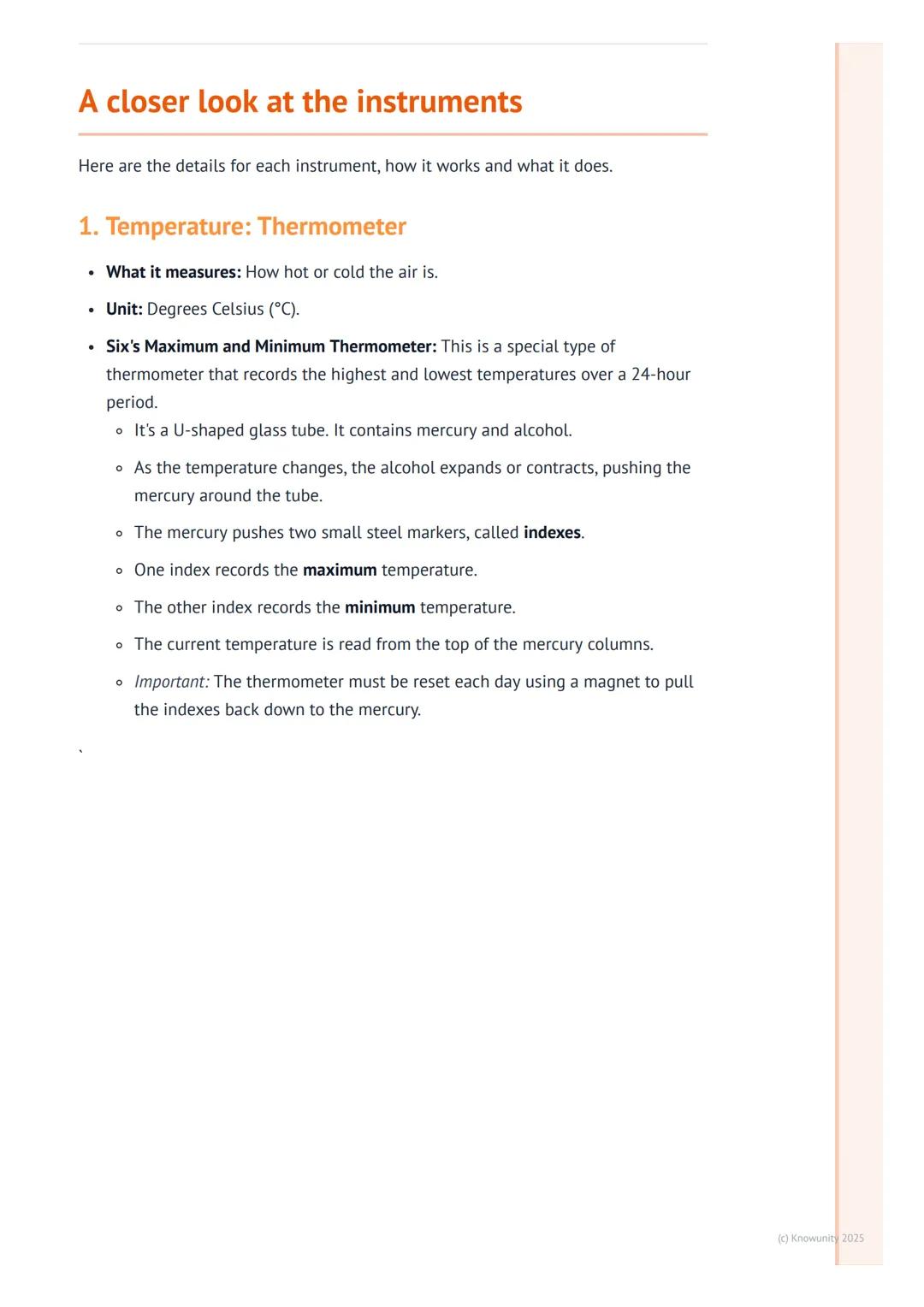
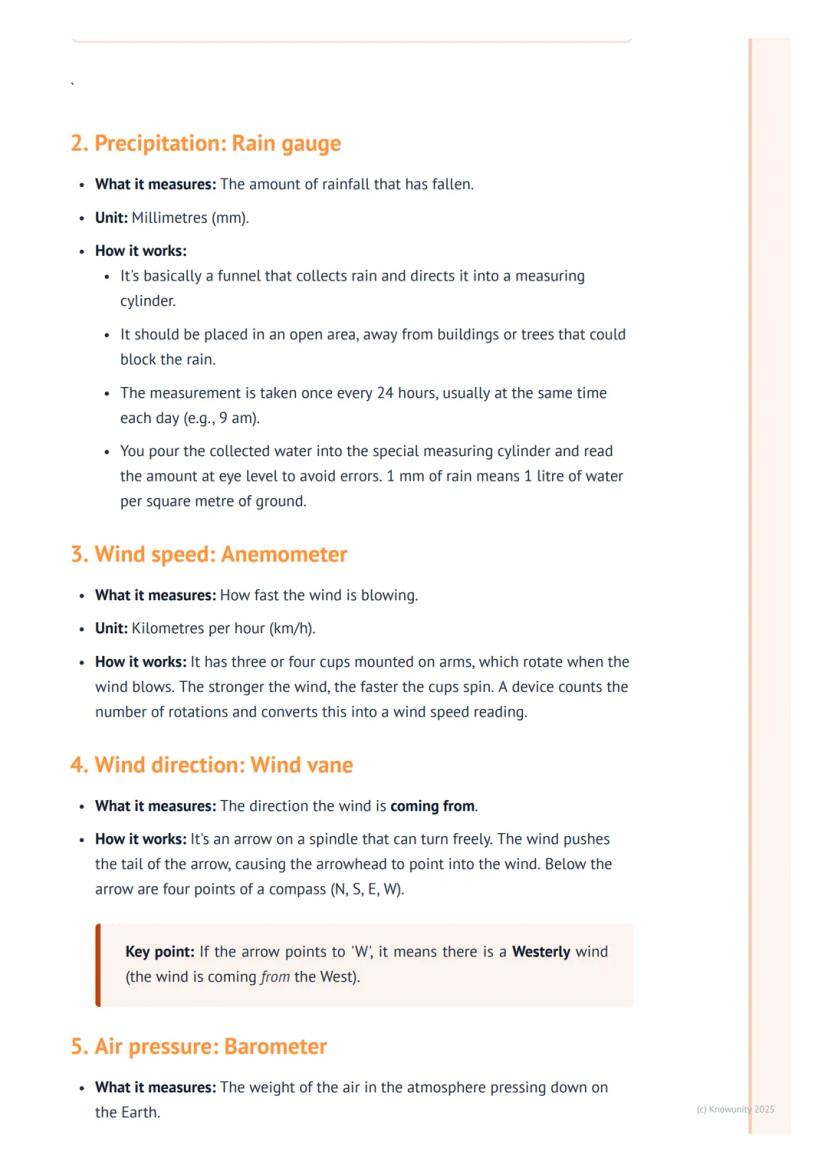
Temperature and Precipitation Instruments
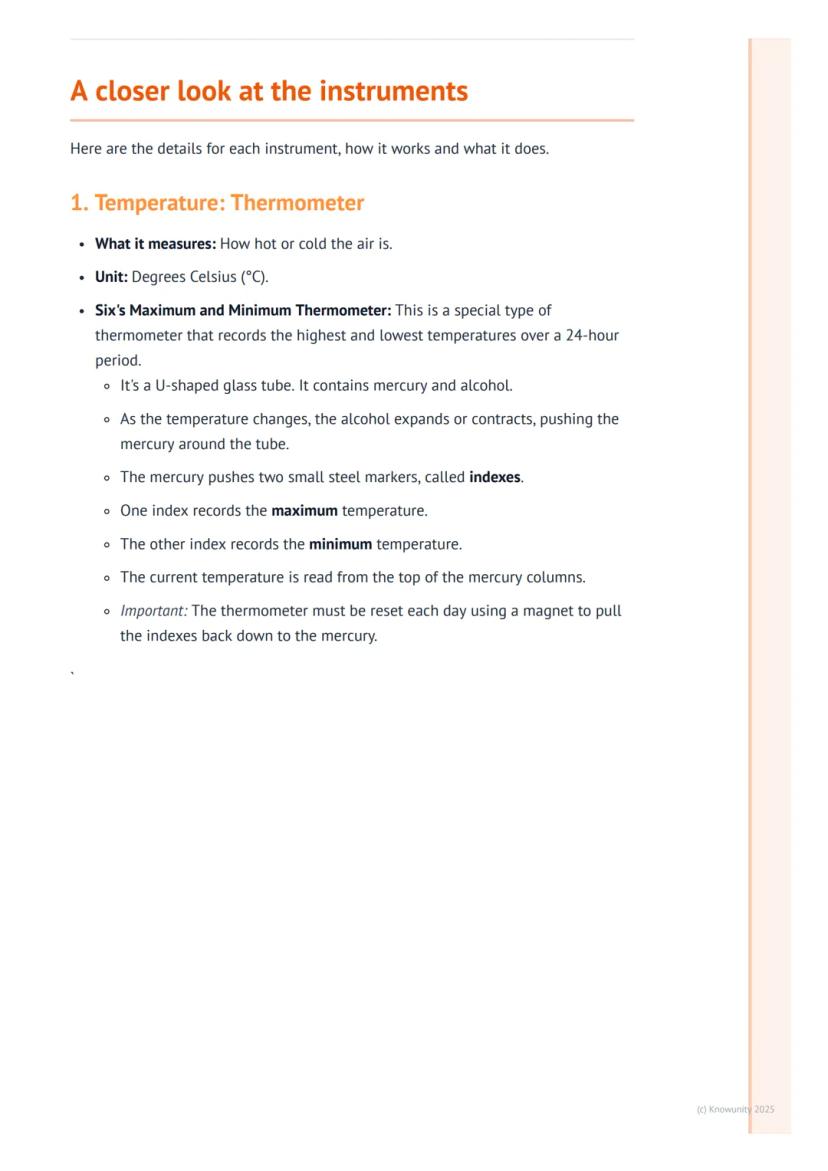
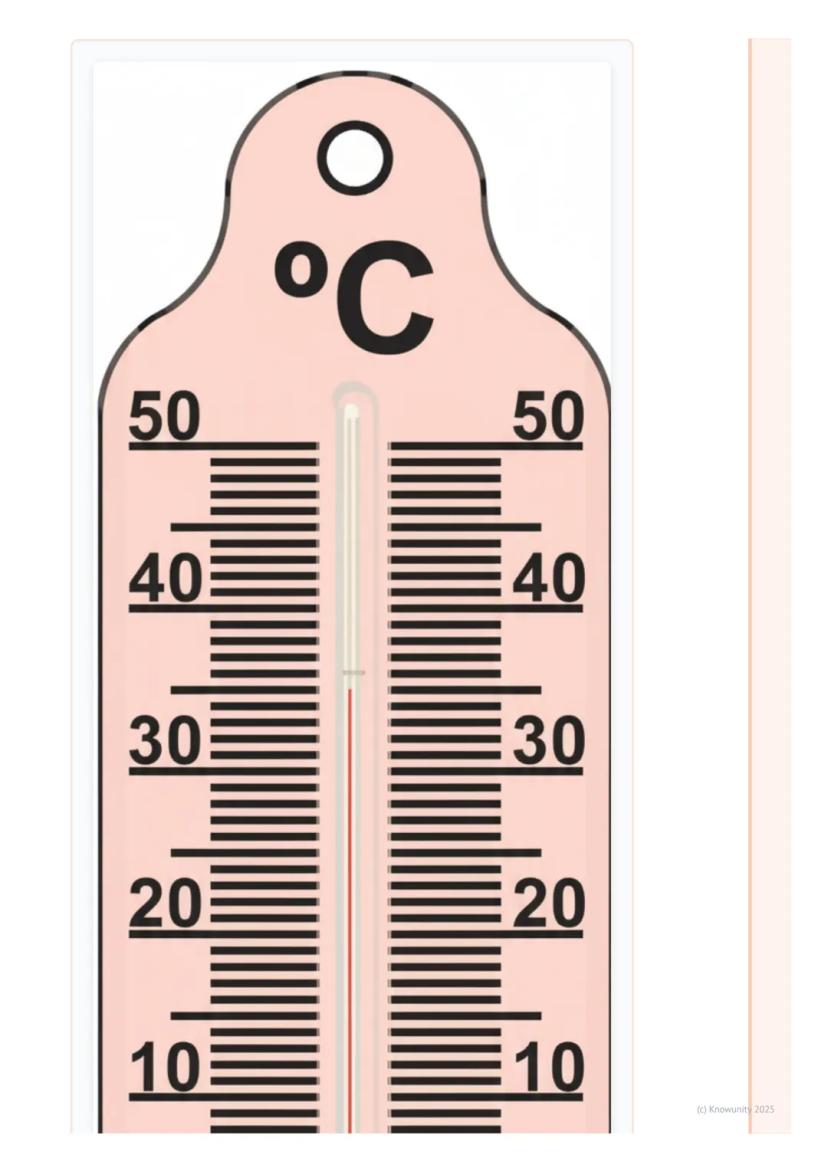
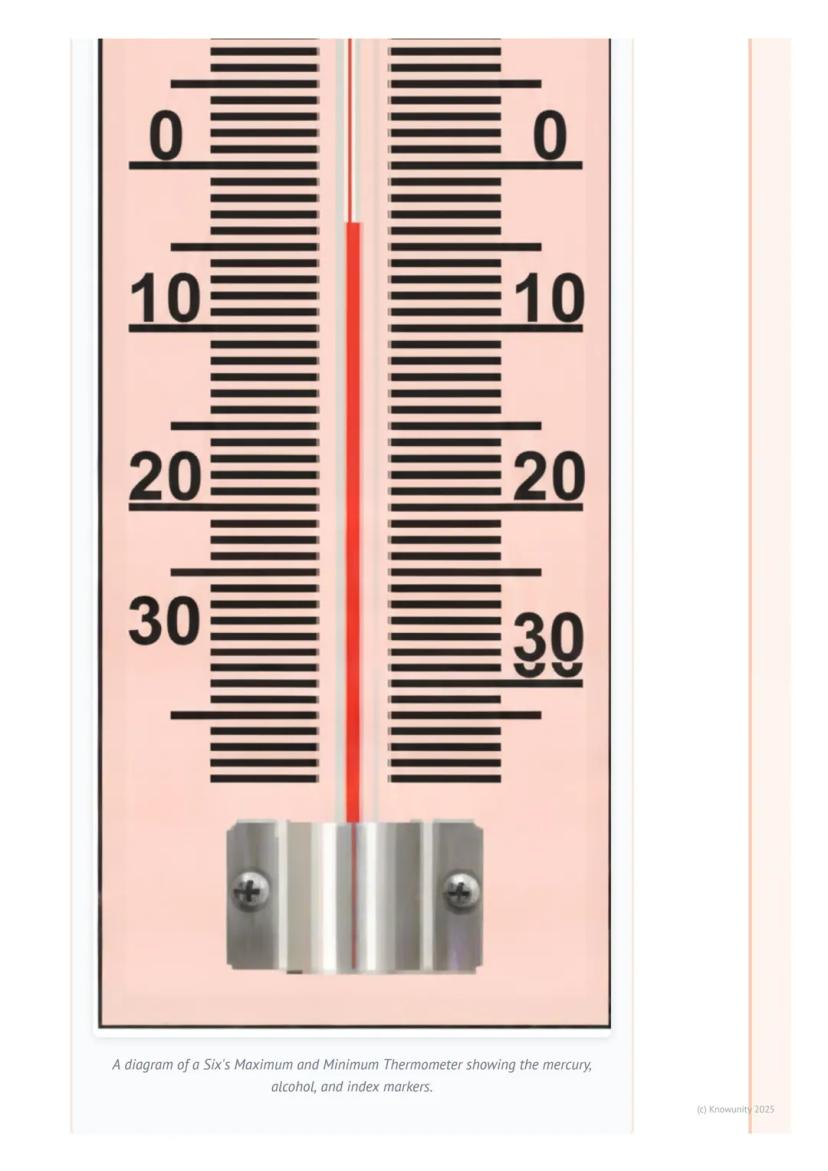
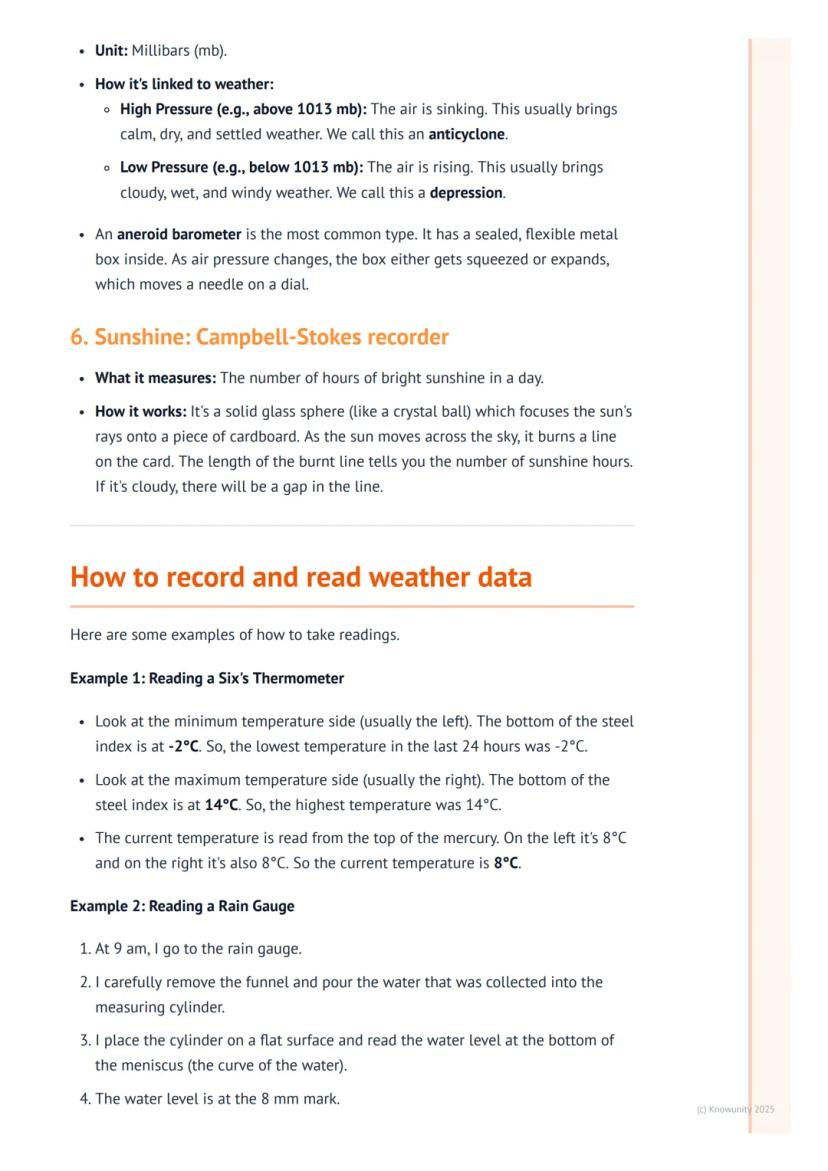
The Six's Maximum and Minimum Thermometer is your best friend for understanding temperature measurement. This clever U-shaped device contains mercury and alcohol, with two small steel markers called indexes that track the highest and lowest temperatures over 24 hours.
Here's how it works: as temperature changes, the alcohol expands or contracts, pushing mercury around the tube. The mercury moves the indexes, which stay in place to record the maximum and minimum temperatures. You read the current temperature from the top of the mercury columns, and the thermometer must be reset daily using a magnet.
Rain gauges are brilliantly simple - they're basically funnels that collect rainwater into a measuring cylinder. The key is placing them in open areas away from buildings or trees that might block rainfall. Measurements are taken at the same time each day (usually 9 am), and you read the water level at eye level to avoid errors.
Remember: 1 mm of rainfall means 1 litre of water fell on every square metre of ground - that's quite a lot when you think about it!
3
of 8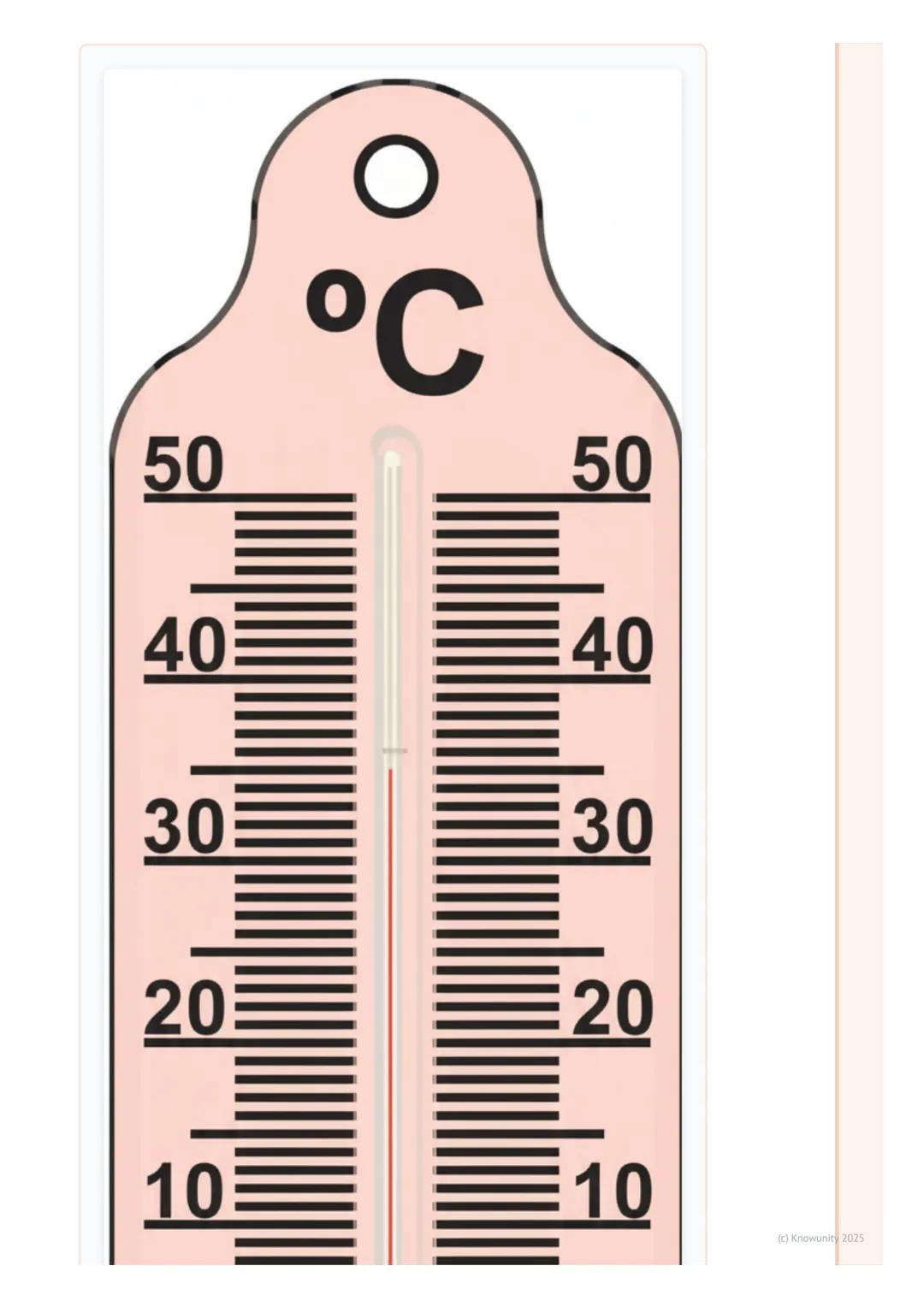
Wind and Air Pressure Measurement
Anemometers measure wind speed using three or four cups mounted on rotating arms. The faster the wind blows, the quicker the cups spin, and a counter converts these rotations into kilometres per hour. Wind vanes are even simpler - they're arrows that point into the wind to show direction.
Here's a crucial point that trips up many students: if a wind vane points west, you have a westerly wind coming FROM the west, not blowing towards it. This distinction is vital for exam success.
Barometers measure air pressure and are fantastic weather predictors. High pressure (above 1013 mb) usually means calm, dry weather because air is sinking - we call this an anticyclone. Low pressure (below 1013 mb) typically brings cloudy, wet, windy conditions because air is rising - this is called a depression.
Exam Gold: High pressure = happy weather, Low pressure = lousy weather. This simple rule will help you interpret barometer readings instantly!
4
of 8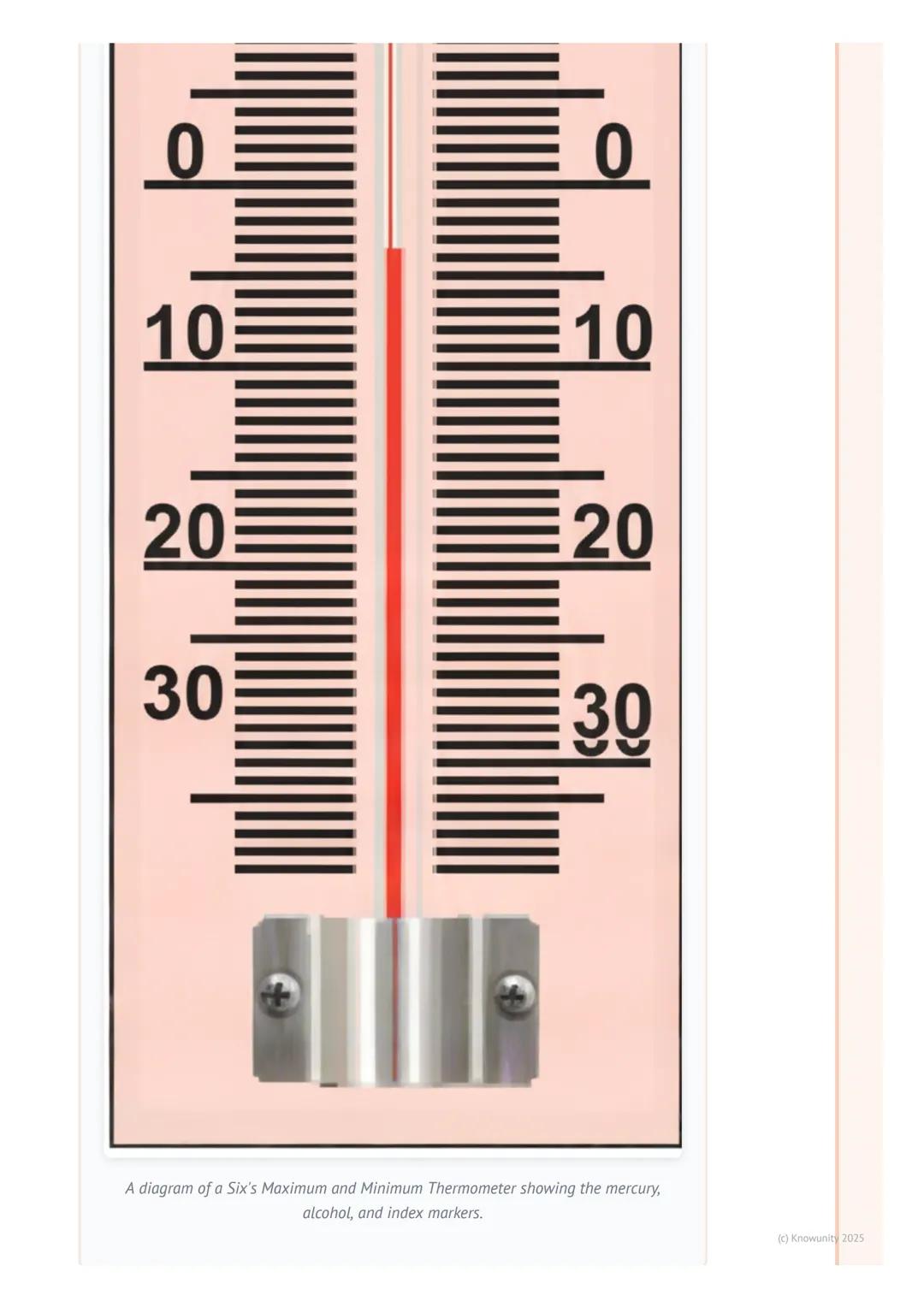
The Stevenson Screen and Data Recording
The Stevenson Screen is absolutely crucial for accurate weather measurement. This white wooden box with slatted sides (called louvres) houses thermometers and hygrometers in standardised conditions, ensuring readings from different weather stations can be fairly compared.
Every feature has a purpose: the white paint reflects sunlight to prevent overheating, the louvres allow air circulation whilst blocking direct sun and rain, and the legs (about 1.2m high) avoid ground heat interference. The door faces north to prevent direct sunlight hitting instruments when opened for readings.
When taking readings, accuracy is everything. For rain gauges, pour collected water into the measuring cylinder and read at the bottom of the meniscus (water's curved surface). For Six's thermometers, read minimum and maximum temperatures from the bottom of the steel indexes, and current temperature from the mercury tops.
The Campbell-Stokes recorder uses a glass sphere to focus sunlight onto cardboard, burning a line that shows sunshine hours. Gaps in the burnt line indicate cloudy periods - it's like having a solar-powered weather diary!
Pro Tip: Practice reading instrument diagrams regularly - examiners often include them in questions, and understanding how to interpret readings is worth serious marks!
5
of 8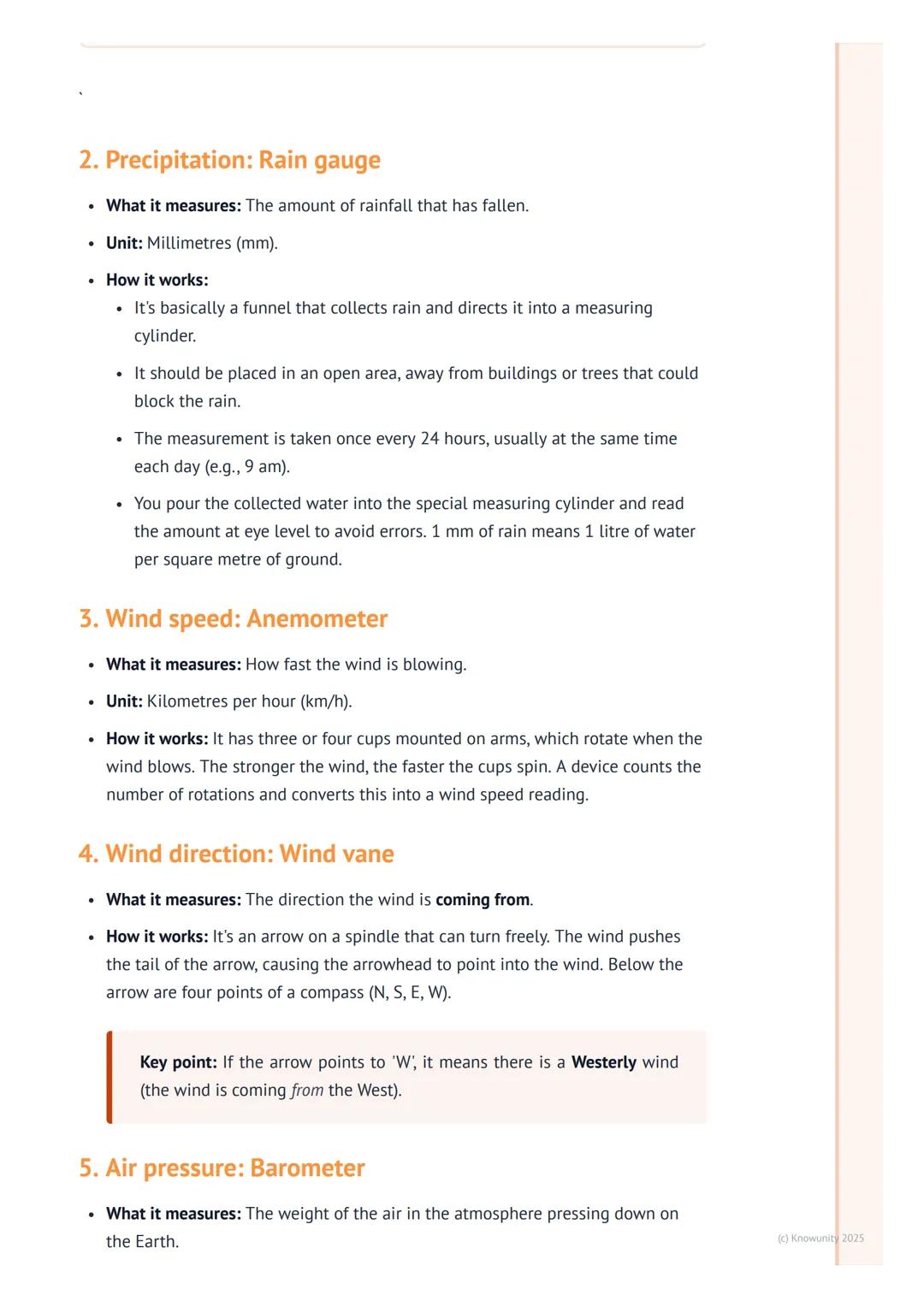
6
of 8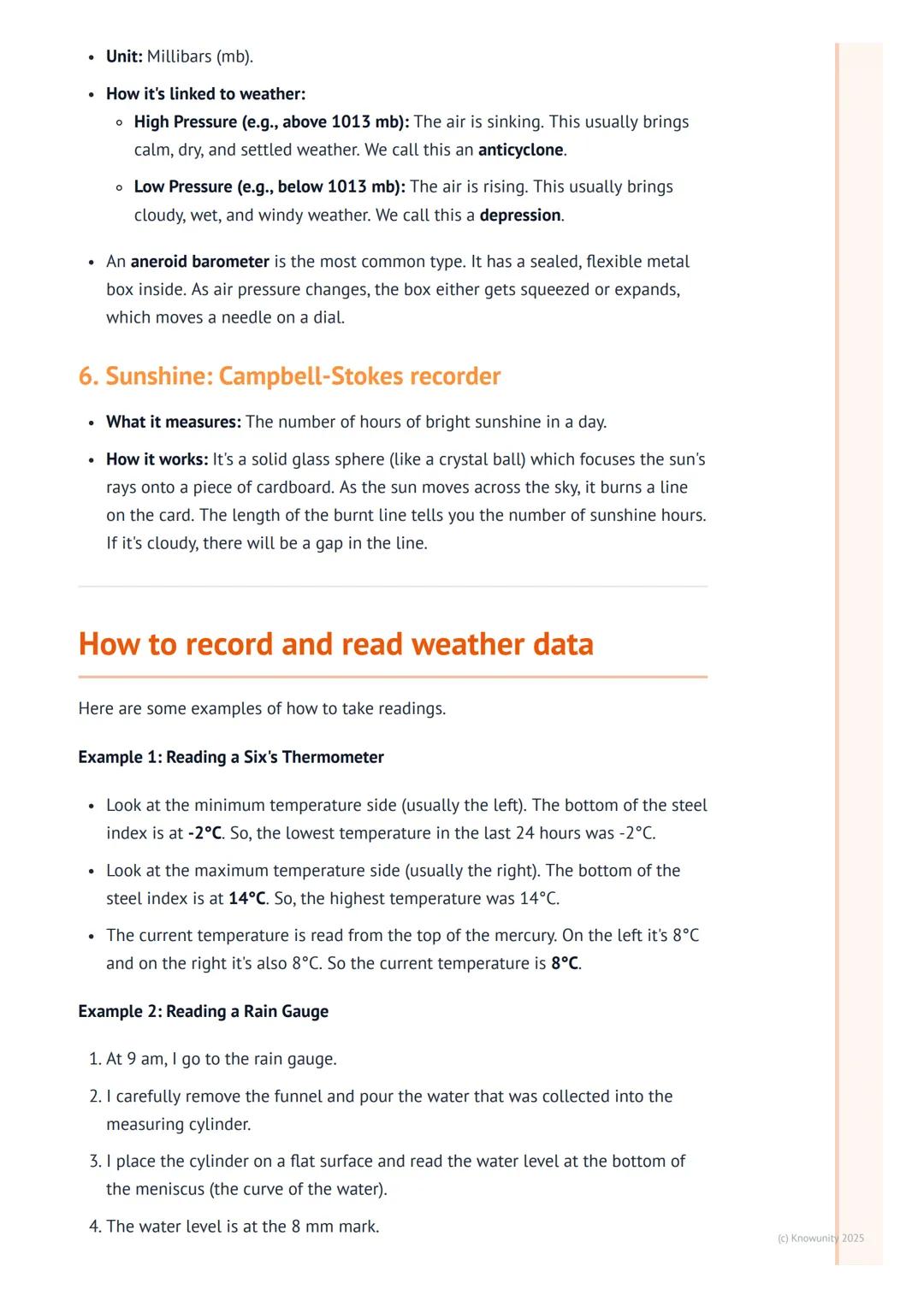
7
of 8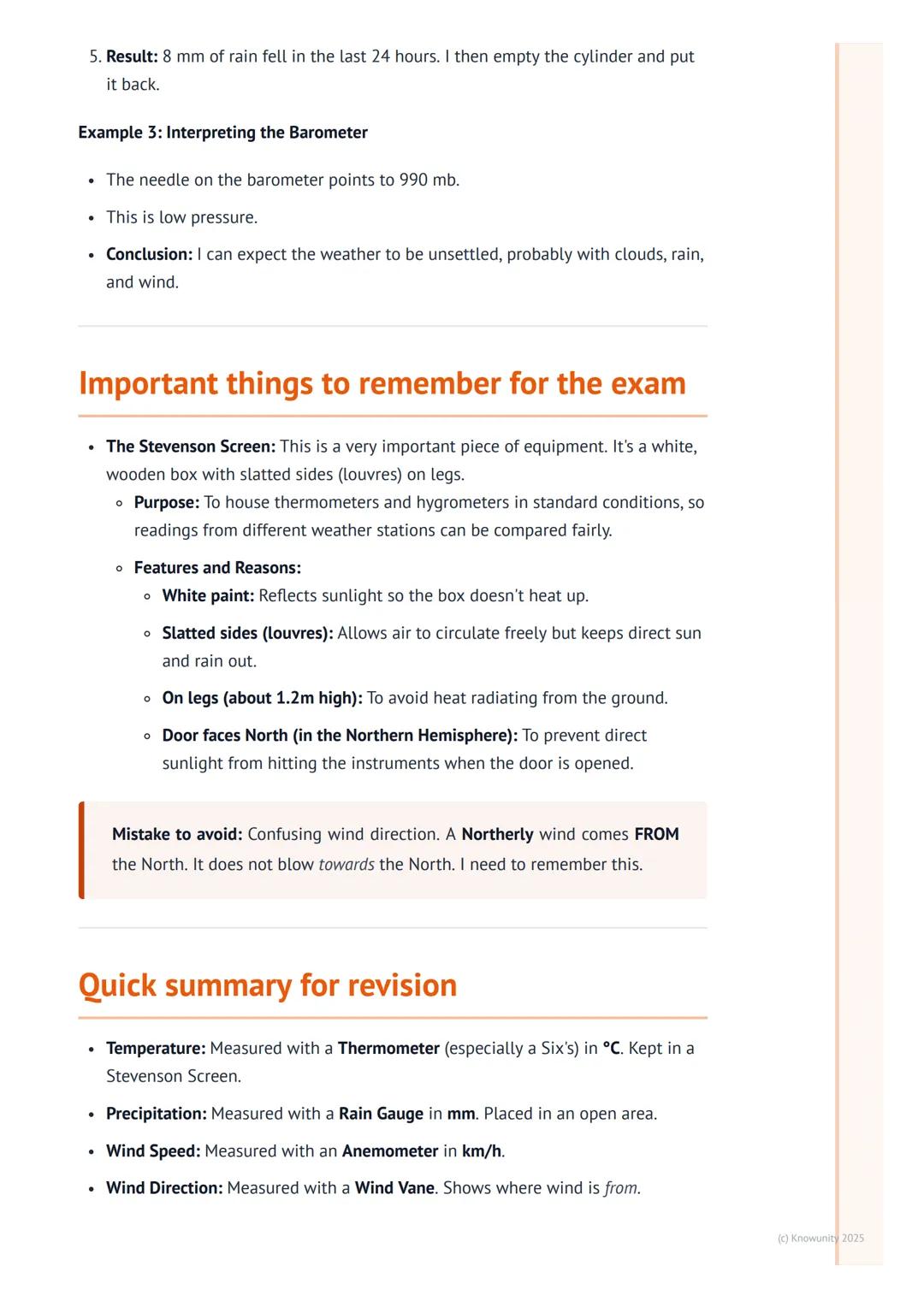
8
of 8
We dachten al dat je dit zou vragen...
Wat is de Knowunity AI companion?
Onze AI Companion is een studentgerichte AI-tool die meer biedt dan alleen antwoorden. Gebouwd op miljoenen Knowunity bronnen, biedt het relevante informatie, gepersonaliseerde studieplannen, quizzes en inhoud direct in de chat, aangepast aan jouw individuele leertraject.
Waar kan ik de Knowunity-app downloaden?
Je kunt de app downloaden via Google Play Store en Apple App Store.
Is Knowunity echt gratis?
Dat klopt! Geniet van gratis toegang tot leerinhoud, maak contact met medestudenten en krijg directe hulp – alles binnen handbereik.
Populairste studiemateriaal voor Geography
9GeographyGeography notes on rocks
Includes types of rocks,uses of rocks, case studies
1st Year341
GeographyEarthquakes revision notes
Notes on earthquakes with diagrams
1st Year110
GeographyPopulation Change and Migration
This covers factors that cause populations to grow or shrink, including birth rates, death rates, and the reasons people migrate.
2nd Year90
GeographyRock notes geography
Geography
5th Year250
GeographyThe sea
Jc Geography
1st Year230
GeographyGeography notes On the sea
Includes costal erosion, sea cliffs, longshore drift etc.
1st Year160
GeographyInside the Earth
Students will learn about the basic layers of the Earth: the crust, mantle, and core, understanding that our planet is made up of different parts.
1st Year51
GeographyGeography notes on glaciation
Includes diagrams, erosion, deposition, transportation
1st Year210
GeographyGeography notes on weather
Includes instruments, diagrams, how to read weather
1st Year120
Populairste studiemateriaal
9 Irish
IrishIrish oral questions and answers
Questions and answers for the leaving cert oral
5th Year4264
 English
Key Quotes : Sive
Key Quotes and explanations: Sive
6th Year2842
IrishIrish oral questions
Outline of oral questions
5th Year2055
IrishIníon- le hÁine Durkin
Aine Durkin’s poem, Iníon: Themes & summary
5th Year850
IrishIrish poetry 2027
Iníon + Dínit an Bhróin
5th Year1133
IrishLC HL notes- Iníon (poem)
Includes poem in English and Irish, theme, key words & phrases
5th Year2284
EnglishCultural Context : Shawshank Redemption : Sive : Small Things Like These
Comparative Study : Cultural Context : Shawshank Redemption, Sive and Small Things Like These
6th Year1430
IrishMo Ghrá-sa (Idir Lúibíní)
Notes on mo ghrá-sa
5th Year380
IrishAn Gaeilge Aiste
Irish Language essay
6th Year1320
Kan je niet vinden wat je zoekt? Ontdek andere vakken.
Studenten zijn dol op ons — en jij ook.
4.6/5App Store
4.7/5Google Play
De app is heel makkelijk te gebruiken en goed ontworpen. Ik heb tot nu toe alles kunnen vinden waar ik naar zocht en heb veel kunnen leren van de presentaties! Ik ga de app zeker gebruiken voor een schoolopdracht! En natuurlijk helpt het ook veel als inspiratie.
Stefan SiOS gebruiker
Deze app is echt geweldig. Er zijn zoveel aantekeningen en hulpmiddelen [...]. Mijn probleemvak is bijvoorbeeld Frans, en de app heeft zoveel opties voor hulp. Dankzij deze app ben ik beter geworden in Frans. Ik zou het iedereen aanraden.
Samantha KlichAndroid gebruiker
Wow, ik ben echt onder de indruk. Ik probeerde de app gewoon omdat ik hem vaak geadverteerd had gezien en was absoluut verbaasd. Deze app is DE HULP die je wilt voor school en bovenal biedt hij zoveel dingen, zoals oefeningen en factsheets, die mij persoonlijk HEEL erg hebben geholpen.
AnnaiOS gebruiker
Geography6 weergaven·Bijgewerkt Jun 12, 2026·8 pagina'sWeather Measuring Instruments: A Simple Guide
Ever wondered how meteorologists predict whether you'll need an umbrella or sunglasses tomorrow? Understanding weather measurement is the key to accurate forecasting, and it's simpler than you might think. By learning about the instruments scientists use and how to read... Meer weergeven
1
of 8Meld je aan om de inhoud te zien. Het is gratis!
- Toegang tot alle documenten
- Verbeter je cijfers
- Sluit je aan bij miljoenen studenten
Measuring Weather Basics
Weather measurement is all about collecting accurate data so meteorologists can create reliable forecasts. Whether it's farmers planning their harvests or you deciding what to wear to school, weather forecasts affect everyone's daily decisions.
There are seven main weather elements that scientists measure regularly. Each one requires a specific instrument and has its own unit of measurement. The most important ones you need to know are temperature (measured in °C with a thermometer), precipitation (measured in mm with a rain gauge), and air pressure (measured in millibars with a barometer).
Wind is measured in two ways: wind speed using an anemometer and wind direction using a wind vane (compass points). Scientists also track sunshine hours with a Campbell-Stokes recorder and humidity levels with a hygrometer.
Quick Tip: Create flashcards linking each weather element to its instrument and unit - this is exactly what examiners love to test!
2
of 8Meld je aan om de inhoud te zien. Het is gratis!
- Toegang tot alle documenten
- Verbeter je cijfers
- Sluit je aan bij miljoenen studenten
Temperature and Precipitation Instruments
The Six's Maximum and Minimum Thermometer is your best friend for understanding temperature measurement. This clever U-shaped device contains mercury and alcohol, with two small steel markers called indexes that track the highest and lowest temperatures over 24 hours.
Here's how it works: as temperature changes, the alcohol expands or contracts, pushing mercury around the tube. The mercury moves the indexes, which stay in place to record the maximum and minimum temperatures. You read the current temperature from the top of the mercury columns, and the thermometer must be reset daily using a magnet.
Rain gauges are brilliantly simple - they're basically funnels that collect rainwater into a measuring cylinder. The key is placing them in open areas away from buildings or trees that might block rainfall. Measurements are taken at the same time each day (usually 9 am), and you read the water level at eye level to avoid errors.
Remember: 1 mm of rainfall means 1 litre of water fell on every square metre of ground - that's quite a lot when you think about it!
3
of 8Meld je aan om de inhoud te zien. Het is gratis!
- Toegang tot alle documenten
- Verbeter je cijfers
- Sluit je aan bij miljoenen studenten
Wind and Air Pressure Measurement
Anemometers measure wind speed using three or four cups mounted on rotating arms. The faster the wind blows, the quicker the cups spin, and a counter converts these rotations into kilometres per hour. Wind vanes are even simpler - they're arrows that point into the wind to show direction.
Here's a crucial point that trips up many students: if a wind vane points west, you have a westerly wind coming FROM the west, not blowing towards it. This distinction is vital for exam success.
Barometers measure air pressure and are fantastic weather predictors. High pressure (above 1013 mb) usually means calm, dry weather because air is sinking - we call this an anticyclone. Low pressure (below 1013 mb) typically brings cloudy, wet, windy conditions because air is rising - this is called a depression.
Exam Gold: High pressure = happy weather, Low pressure = lousy weather. This simple rule will help you interpret barometer readings instantly!
4
of 8Meld je aan om de inhoud te zien. Het is gratis!
- Toegang tot alle documenten
- Verbeter je cijfers
- Sluit je aan bij miljoenen studenten
The Stevenson Screen and Data Recording
The Stevenson Screen is absolutely crucial for accurate weather measurement. This white wooden box with slatted sides (called louvres) houses thermometers and hygrometers in standardised conditions, ensuring readings from different weather stations can be fairly compared.
Every feature has a purpose: the white paint reflects sunlight to prevent overheating, the louvres allow air circulation whilst blocking direct sun and rain, and the legs (about 1.2m high) avoid ground heat interference. The door faces north to prevent direct sunlight hitting instruments when opened for readings.
When taking readings, accuracy is everything. For rain gauges, pour collected water into the measuring cylinder and read at the bottom of the meniscus (water's curved surface). For Six's thermometers, read minimum and maximum temperatures from the bottom of the steel indexes, and current temperature from the mercury tops.
The Campbell-Stokes recorder uses a glass sphere to focus sunlight onto cardboard, burning a line that shows sunshine hours. Gaps in the burnt line indicate cloudy periods - it's like having a solar-powered weather diary!
Pro Tip: Practice reading instrument diagrams regularly - examiners often include them in questions, and understanding how to interpret readings is worth serious marks!
5
of 8Meld je aan om de inhoud te zien. Het is gratis!
- Toegang tot alle documenten
- Verbeter je cijfers
- Sluit je aan bij miljoenen studenten
6
of 8Meld je aan om de inhoud te zien. Het is gratis!
- Toegang tot alle documenten
- Verbeter je cijfers
- Sluit je aan bij miljoenen studenten
7
of 8Meld je aan om de inhoud te zien. Het is gratis!
- Toegang tot alle documenten
- Verbeter je cijfers
- Sluit je aan bij miljoenen studenten
8
of 8Meld je aan om de inhoud te zien. Het is gratis!
- Toegang tot alle documenten
- Verbeter je cijfers
- Sluit je aan bij miljoenen studenten
We dachten al dat je dit zou vragen...
Wat is de Knowunity AI companion?
Onze AI Companion is een studentgerichte AI-tool die meer biedt dan alleen antwoorden. Gebouwd op miljoenen Knowunity bronnen, biedt het relevante informatie, gepersonaliseerde studieplannen, quizzes en inhoud direct in de chat, aangepast aan jouw individuele leertraject.
Waar kan ik de Knowunity-app downloaden?
Je kunt de app downloaden via Google Play Store en Apple App Store.
Is Knowunity echt gratis?
Dat klopt! Geniet van gratis toegang tot leerinhoud, maak contact met medestudenten en krijg directe hulp – alles binnen handbereik.
Populairste studiemateriaal voor Geography
9GeographyGeography notes on rocks
Includes types of rocks,uses of rocks, case studies
1st Year341
GeographyEarthquakes revision notes
Notes on earthquakes with diagrams
1st Year110
GeographyPopulation Change and Migration
This covers factors that cause populations to grow or shrink, including birth rates, death rates, and the reasons people migrate.
2nd Year90
GeographyRock notes geography
Geography
5th Year250
GeographyThe sea
Jc Geography
1st Year230
GeographyGeography notes On the sea
Includes costal erosion, sea cliffs, longshore drift etc.
1st Year160
GeographyInside the Earth
Students will learn about the basic layers of the Earth: the crust, mantle, and core, understanding that our planet is made up of different parts.
1st Year51
GeographyGeography notes on glaciation
Includes diagrams, erosion, deposition, transportation
1st Year210
GeographyGeography notes on weather
Includes instruments, diagrams, how to read weather
1st Year120
Populairste studiemateriaal
9IrishIrish oral questions and answers
Questions and answers for the leaving cert oral
5th Year4264
EnglishKey Quotes : Sive
Key Quotes and explanations: Sive
6th Year2842
IrishIrish oral questions
Outline of oral questions
5th Year2055
IrishIníon- le hÁine Durkin
Aine Durkin’s poem, Iníon: Themes & summary
5th Year850
IrishIrish poetry 2027
Iníon + Dínit an Bhróin
5th Year1133
IrishLC HL notes- Iníon (poem)
Includes poem in English and Irish, theme, key words & phrases
5th Year2284
EnglishCultural Context : Shawshank Redemption : Sive : Small Things Like These
Comparative Study : Cultural Context : Shawshank Redemption, Sive and Small Things Like These
6th Year1430
IrishMo Ghrá-sa (Idir Lúibíní)
Notes on mo ghrá-sa
5th Year380
IrishAn Gaeilge Aiste
Irish Language essay
6th Year1320
Kan je niet vinden wat je zoekt? Ontdek andere vakken.
Studenten zijn dol op ons — en jij ook.
4.6/5App Store
4.7/5Google Play
De app is heel makkelijk te gebruiken en goed ontworpen. Ik heb tot nu toe alles kunnen vinden waar ik naar zocht en heb veel kunnen leren van de presentaties! Ik ga de app zeker gebruiken voor een schoolopdracht! En natuurlijk helpt het ook veel als inspiratie.
Stefan SiOS gebruiker
Deze app is echt geweldig. Er zijn zoveel aantekeningen en hulpmiddelen [...]. Mijn probleemvak is bijvoorbeeld Frans, en de app heeft zoveel opties voor hulp. Dankzij deze app ben ik beter geworden in Frans. Ik zou het iedereen aanraden.
Samantha KlichAndroid gebruiker
Wow, ik ben echt onder de indruk. Ik probeerde de app gewoon omdat ik hem vaak geadverteerd had gezien en was absoluut verbaasd. Deze app is DE HULP die je wilt voor school en bovenal biedt hij zoveel dingen, zoals oefeningen en factsheets, die mij persoonlijk HEEL erg hebben geholpen.
AnnaiOS gebruiker