
Ready to nail your German speaking exam? This guide breaks... Meer weergeven
 German2 weergaven·Bijgewerkt May 20, 2026·6 pagina's
German Speaking Practice: Fun Role-Plays and Picture Descriptions
1 / 6
1
of 6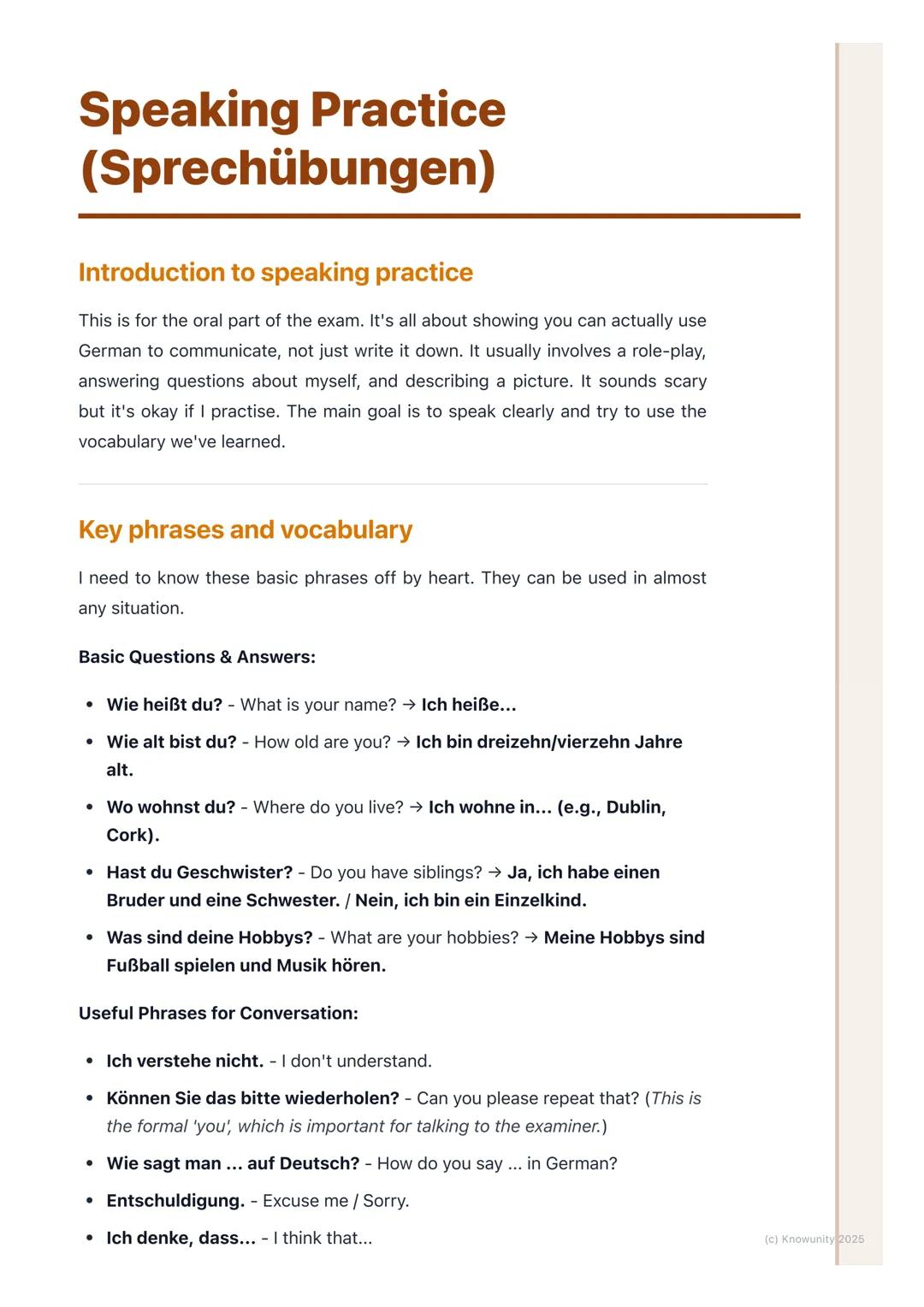
Getting Started with German Speaking
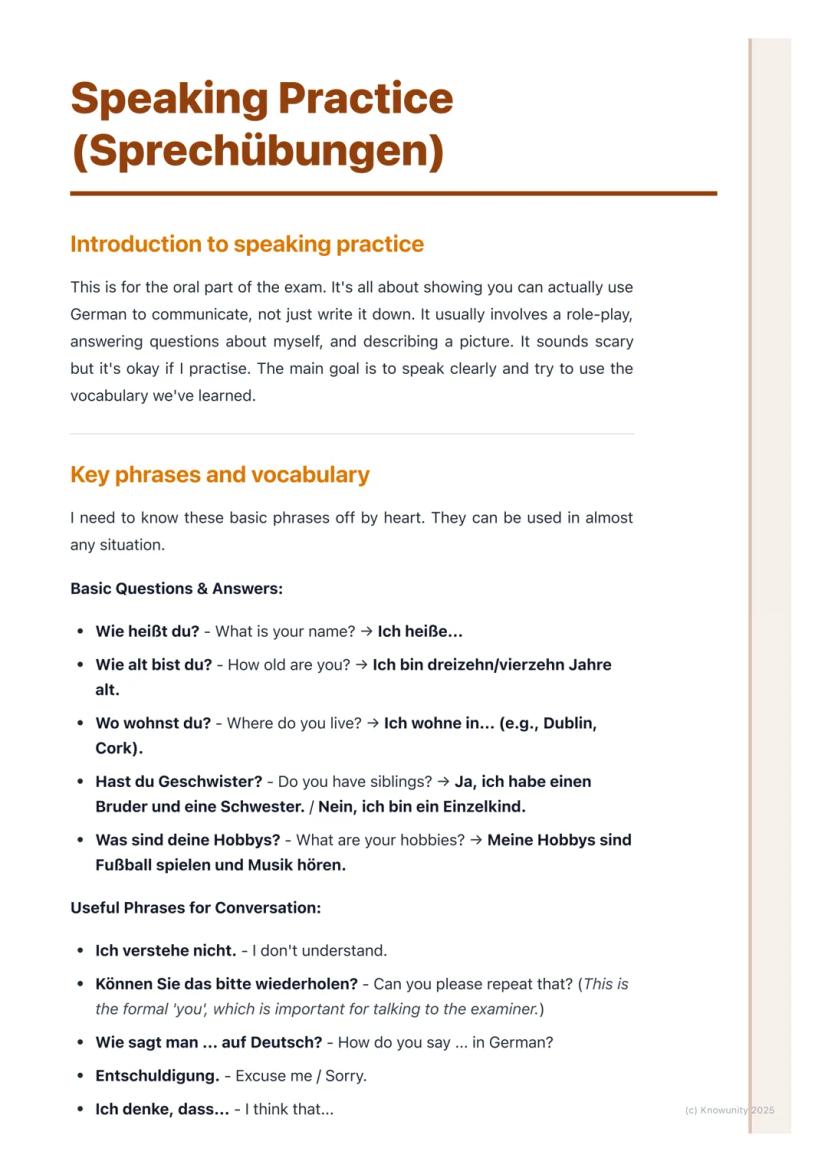
Your German oral exam has three main parts: role-plays, personal questions, and picture descriptions. Don't stress - the goal isn't to be perfect, just to show you can communicate using the vocabulary you've learned.
You absolutely need to memorise these basic phrases. They'll work in almost any speaking situation and give you confidence when you're nervous.
Essential questions and answers include introducing yourself (Ich heiße...), your age (Ich bin vierzehn Jahre alt), where you live (Ich wohne in Dublin), and your hobbies (Meine Hobbys sind...).
Lifesaver phrases like "Ich verstehe nicht" (I don't understand) and "Können Sie das bitte wiederholen?" (Can you repeat that?) will help when you get stuck. It's much better to ask than to guess!
Top Tip: Learn "Meiner Meinung nach..." (In my opinion) - it makes you sound more advanced and buys you thinking time.
2
of 6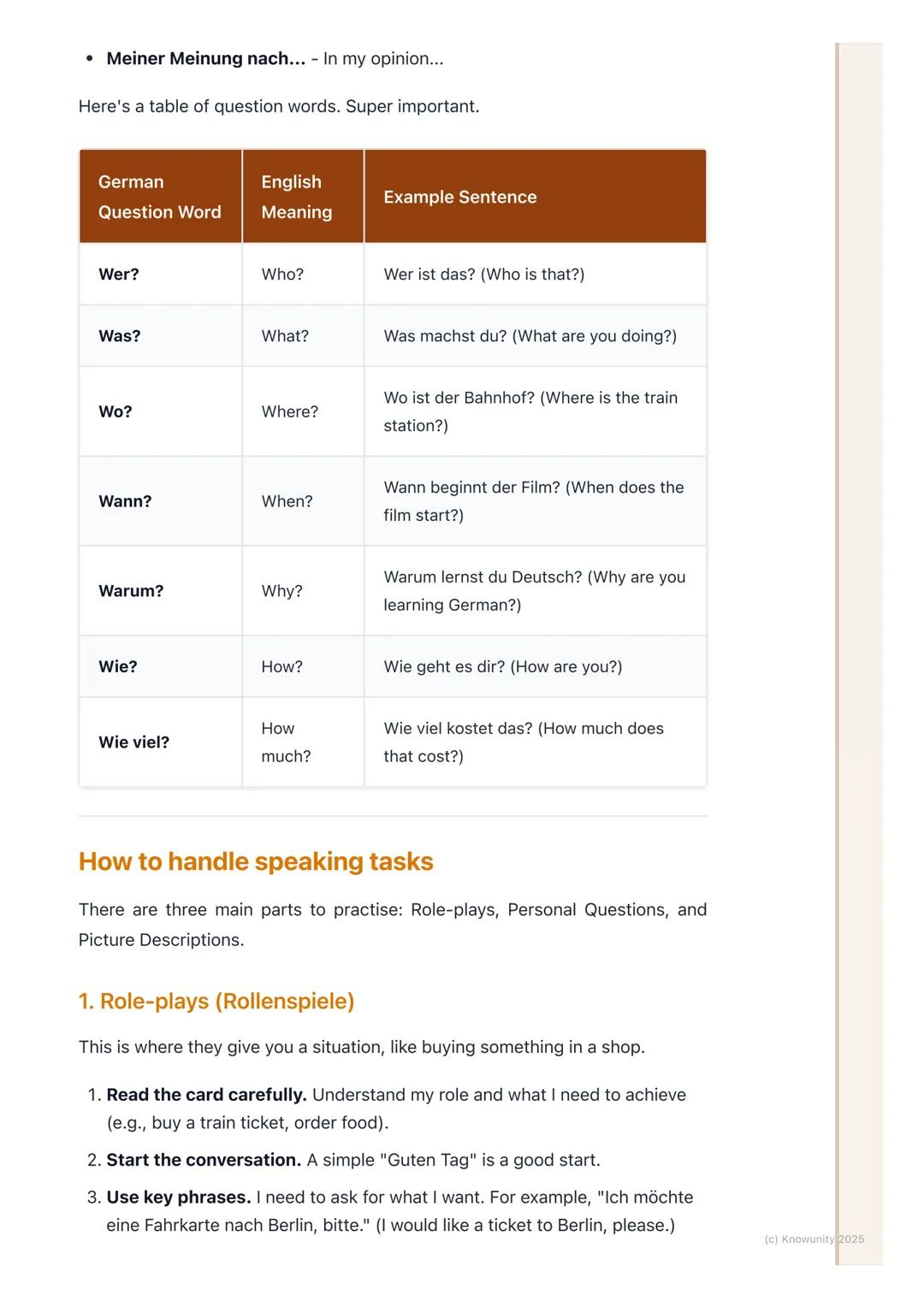
Mastering Question Words
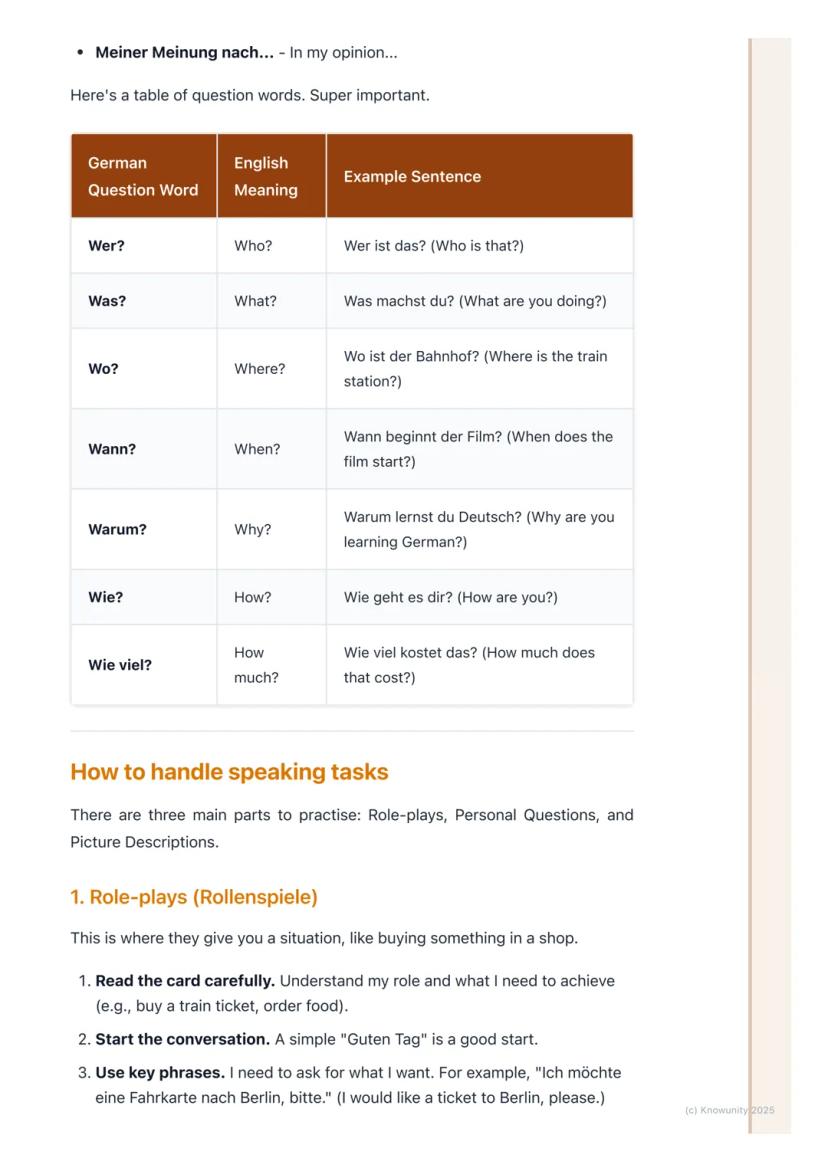
These German question words are absolutely crucial for understanding what the examiner wants from you. Wer (who), Was (what), Wo (where), Wann (when), Warum (why), and Wie (how) pop up constantly in speaking exams.
Practice recognising them quickly so you can respond properly. For example, "Wer ist das?" means "Who is that?" and "Wie viel kostet das?" means "How much does that cost?"
The beauty of question words is that once you know them, you can work out what someone's asking even if you don't catch every word. They're your compass in German conversation.
Remember: If you hear "Wie geht es dir?", they're asking how you are - a perfect chance to use "Gut, danke!" and maybe add something about your day.
3
of 6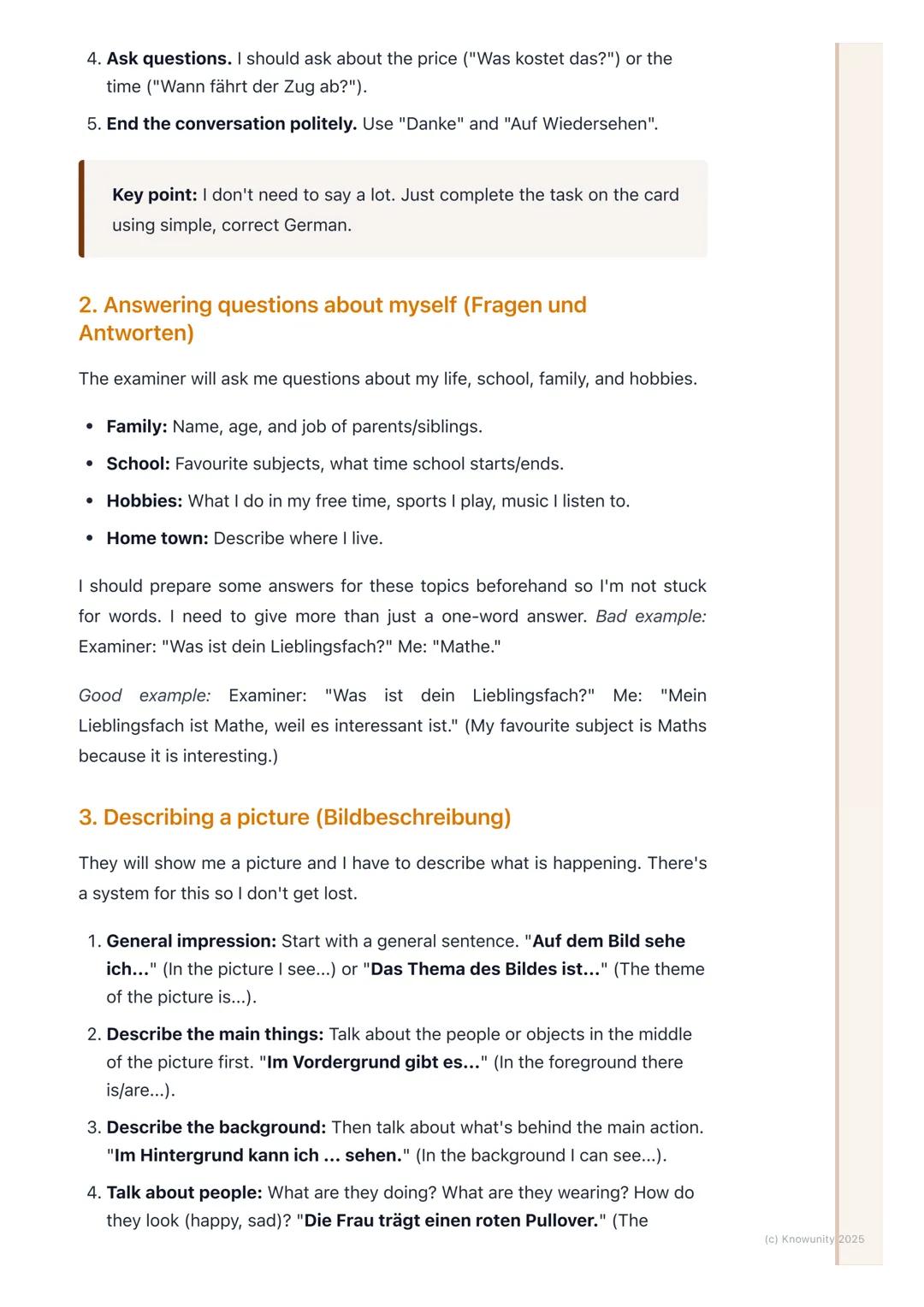
Role-Plays Made Simple
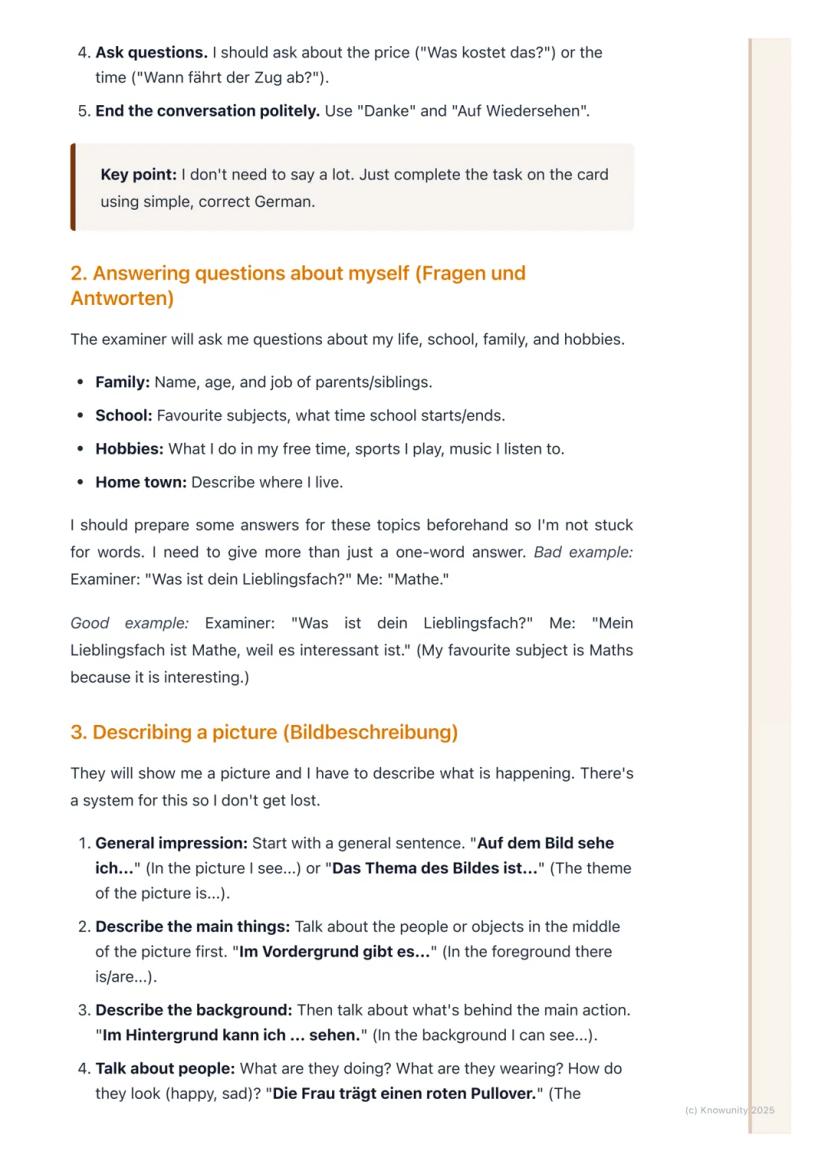
Role-play scenarios might involve buying something, ordering food, or asking for directions. The secret is following a simple pattern: greet, state what you want, ask a question, and say goodbye politely.
Start with "Guten Tag" and end with "Auf Wiedersehen". In between, use phrases like "Ich möchte..." (I would like) and "Was kostet das?" (How much does that cost?). Don't overthink it - simple and correct beats complicated and wrong.
When answering personal questions, give more than one-word answers. Instead of just "Mathe" for your favourite subject, try "Mein Lieblingsfach ist Mathe, weil es interessant ist." It shows you can form proper sentences.
Prepare answers about your family, school, hobbies, and hometown beforehand. You'll feel much more confident knowing what you want to say.
Smart Move: Practice common scenarios with a friend or family member - the more you rehearse, the more natural it becomes.
4
of 6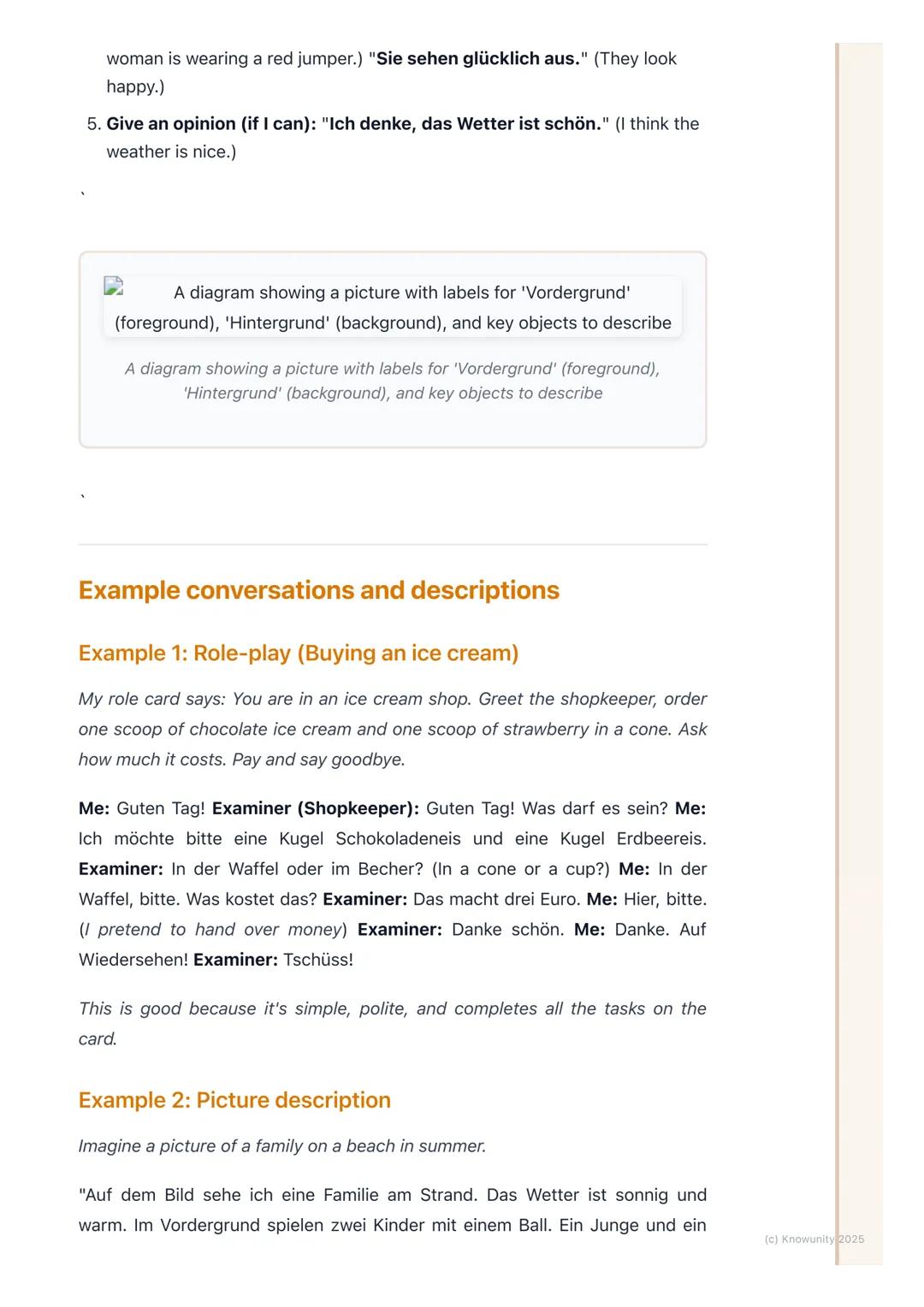
Picture Description Strategy
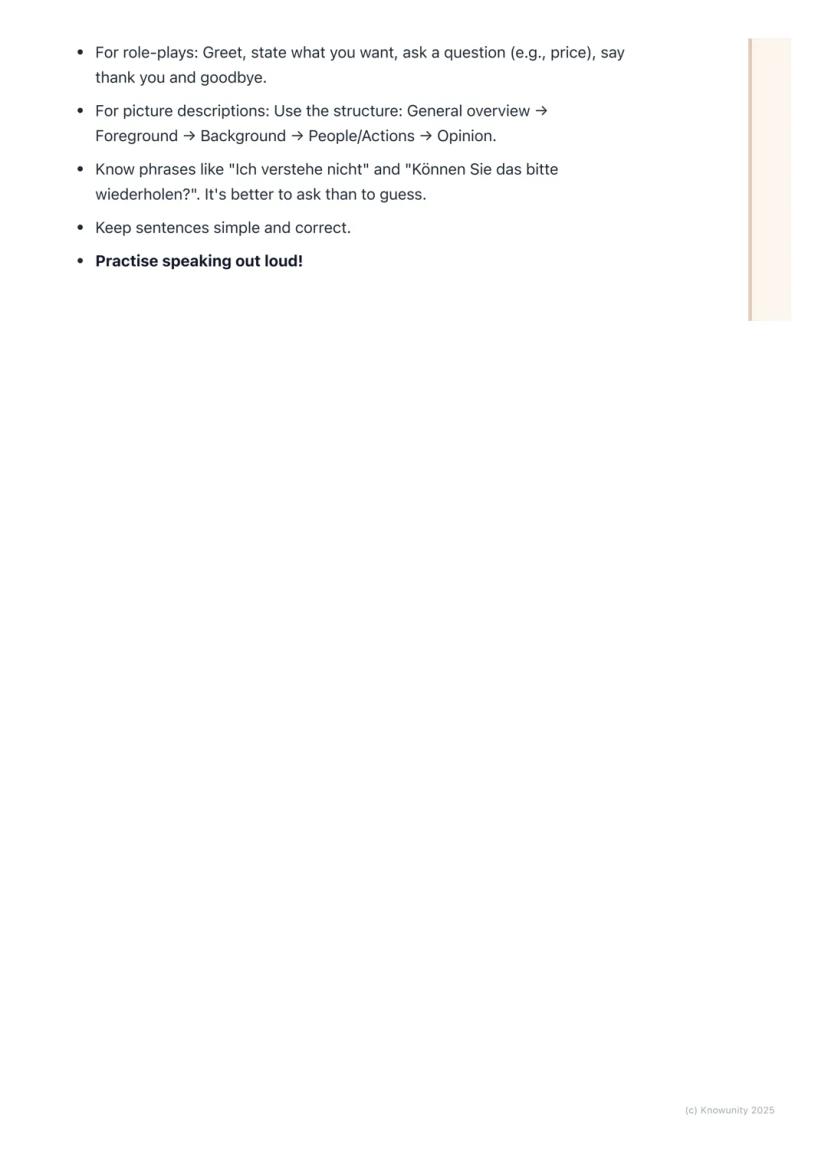
Picture descriptions follow a clear structure that makes them much easier. Start with a general statement like "Auf dem Bild sehe ich..." (In the picture I see...), then work from foreground to background.
Describe the main action first using "Im Vordergrund gibt es..." (In the foreground there is...). Then move to the background with "Im Hintergrund kann ich ... sehen" (In the background I can see...).
Talk about what people are wearing and doing. Simple phrases like "Die Frau trägt einen roten Pullover" (The woman is wearing a red jumper) work perfectly. Finish with an opinion if you can: "Ich denke, das Wetter ist schön."
Pro Tip: Even if you're not sure about something in the picture, describe what you can see clearly rather than guessing at details.
5
of 6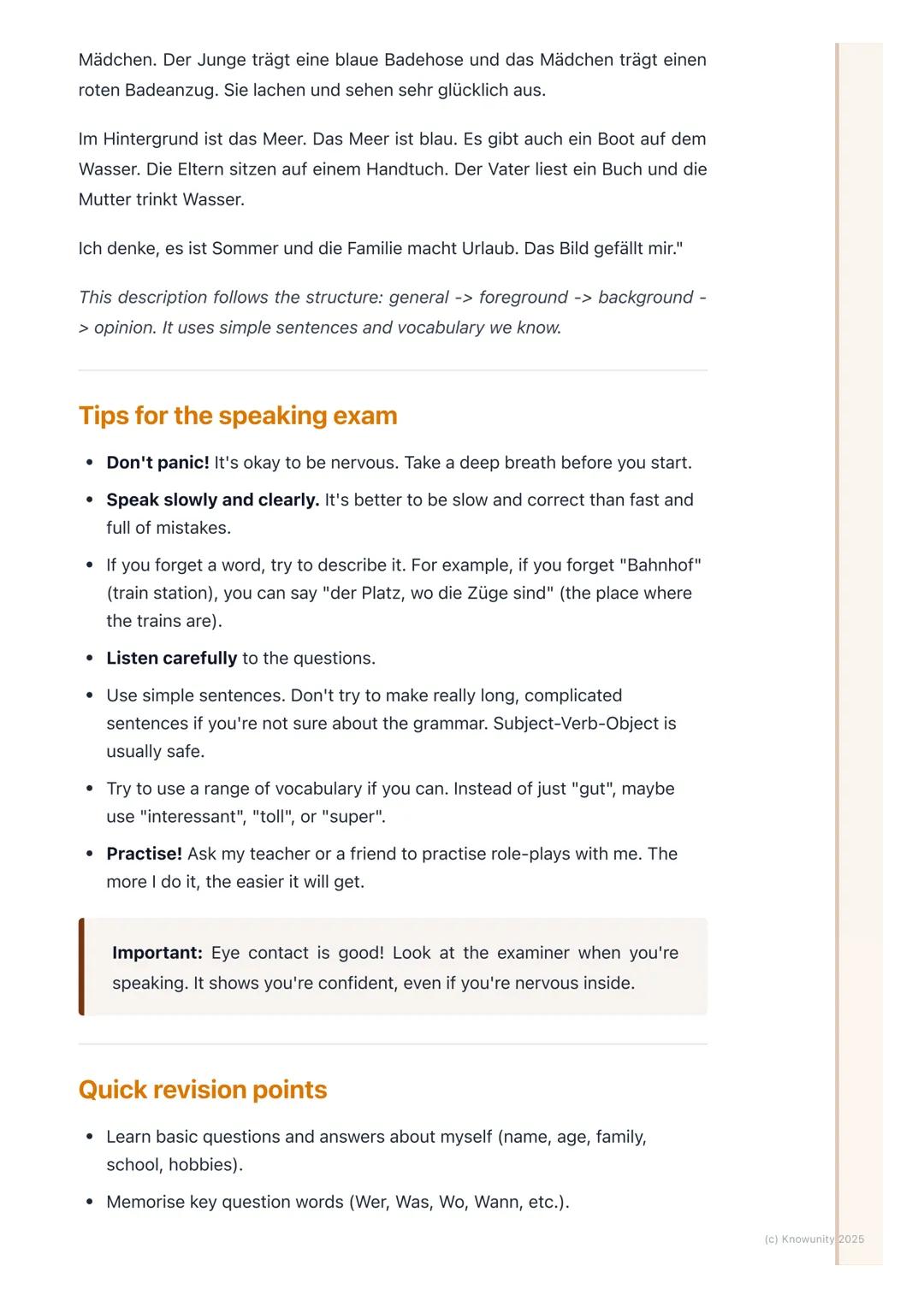
Example Conversations
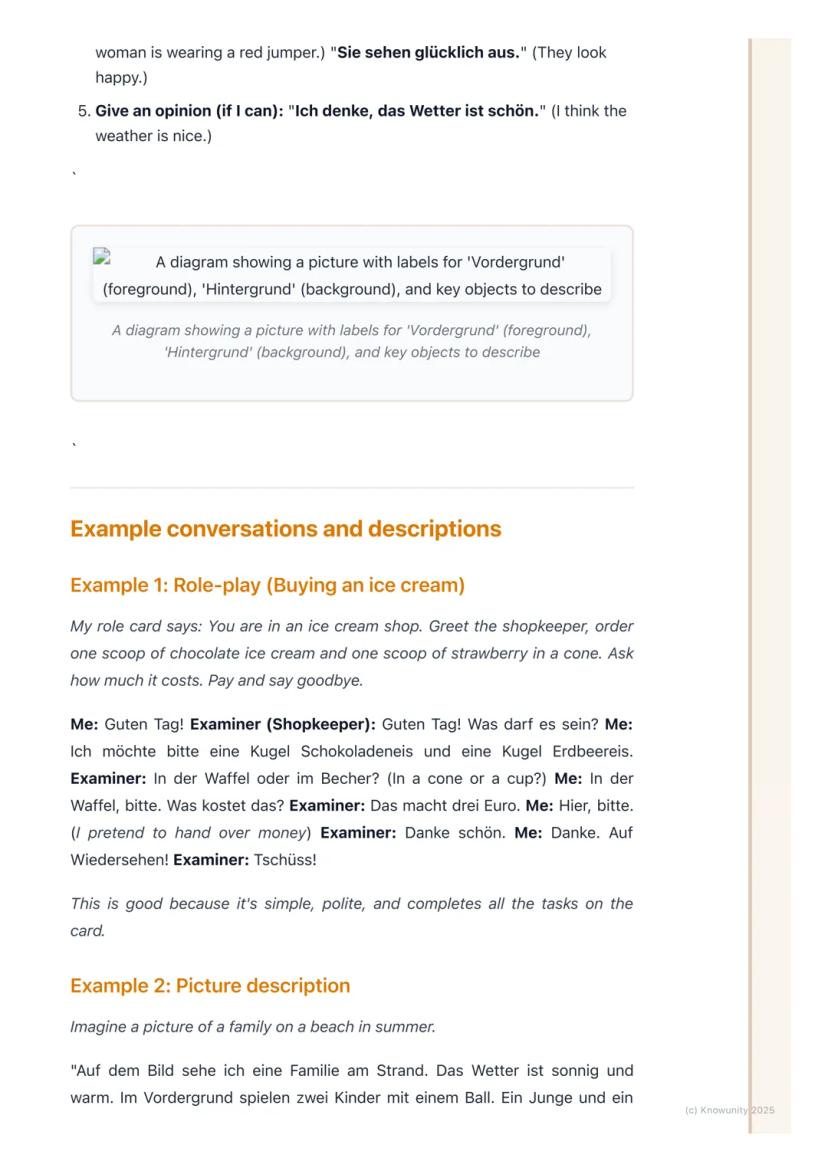
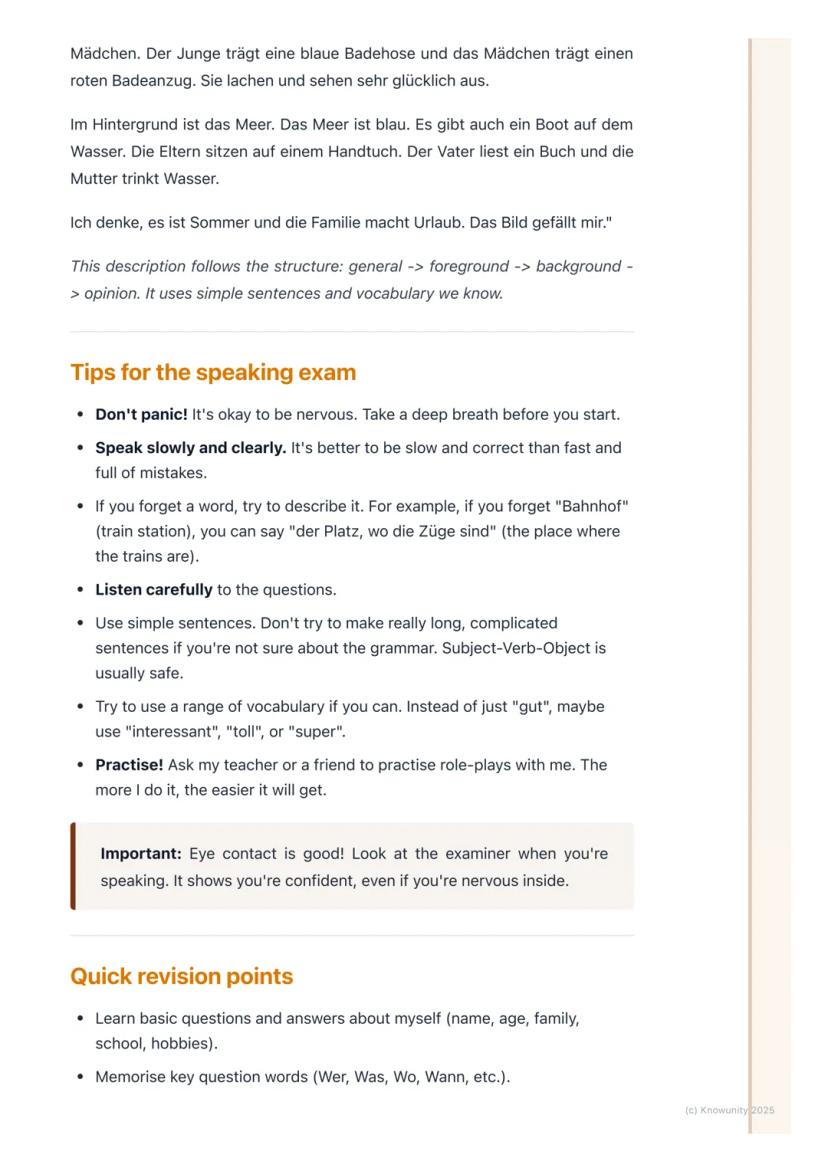
Here's how a role-play conversation might go when buying ice cream. You greet the shopkeeper, order what you want (Ich möchte bitte eine Kugel Schokoladeneis), ask the price (Was kostet das?), and say goodbye politely.
For picture descriptions, follow your structure religiously. Describe a beach scene by starting with the general setting, then the children playing in the foreground, the sea and boat in the background, and finish with your opinion about the lovely summer day.
The key is using simple, correct sentences rather than trying to be fancy. Subject-verb-object order keeps you safe, and don't be afraid to repeat successful phrases.
Practice speaking out loud regularly - it's the only way to get comfortable with the sounds and rhythm of German.
Confidence Booster: If you forget a word, describe it instead. Can't remember "Bahnhof"? Say "der Platz, wo die Züge sind" (the place where the trains are).
6
of 6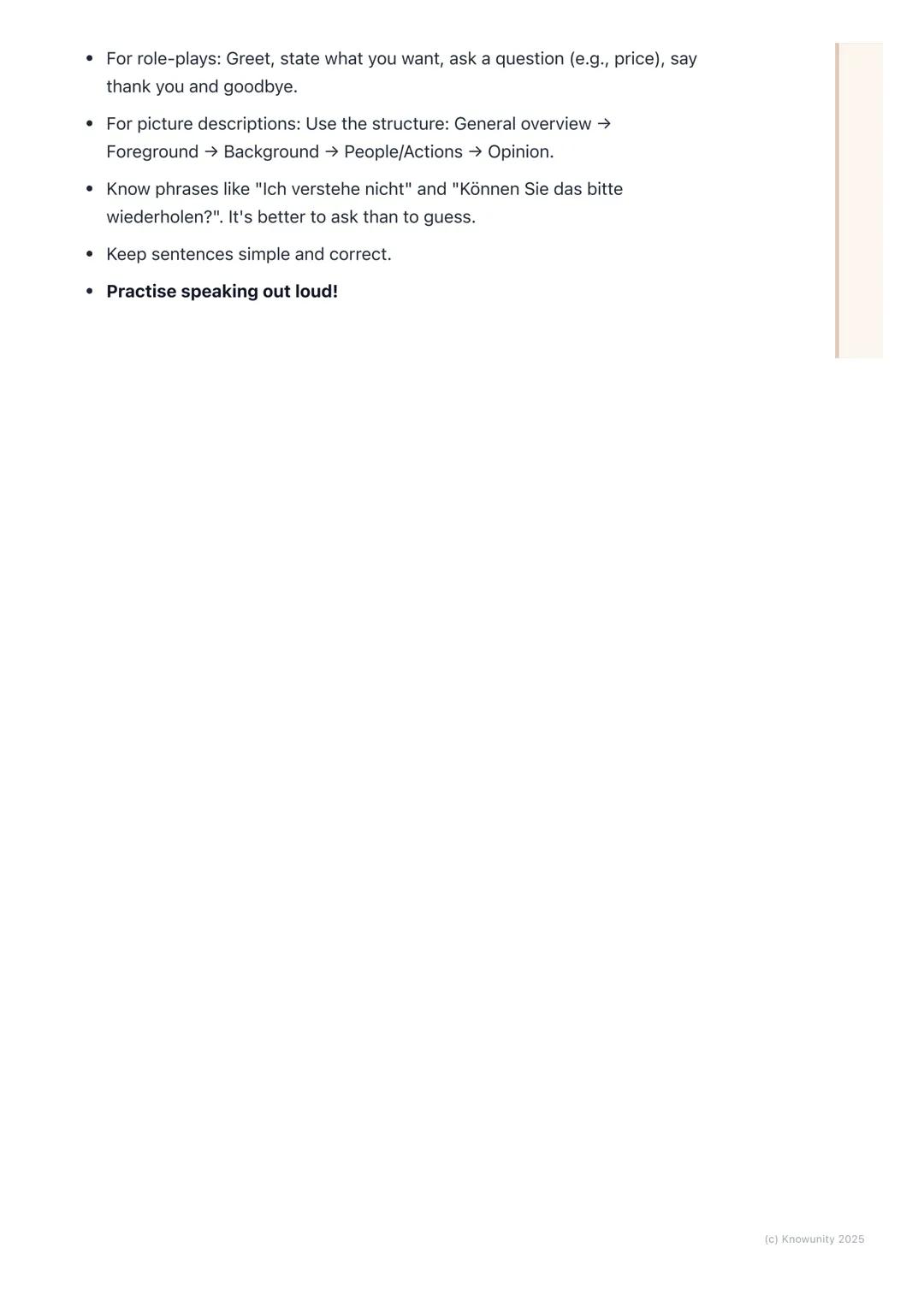
Exam Day Success Tips
Speak slowly and clearly rather than rushing through your answers. Eye contact with the examiner shows confidence, even when you're feeling nervous inside.
Use a variety of vocabulary when possible - instead of always saying "gut", try "interessant", "toll", or "super" to show your range. Simple sentences that are correct will always beat complicated ones that are wrong.
If you don't understand something, ask! Phrases like "Können Sie das bitte wiederholen?" show you're engaged and trying to communicate properly.
Remember your revision essentials: basic personal information, question words, role-play structure (greet, request, ask, thank, goodbye), and picture description method (general to specific to opinion).
Final Reminder: The examiner wants you to succeed - they're looking for communication, not perfection. Take a deep breath and show what you know!
We dachten al dat je dit zou vragen...
Wat is de Knowunity AI companion?
Onze AI Companion is een studentgerichte AI-tool die meer biedt dan alleen antwoorden. Gebouwd op miljoenen Knowunity bronnen, biedt het relevante informatie, gepersonaliseerde studieplannen, quizzes en inhoud direct in de chat, aangepast aan jouw individuele leertraject.
Waar kan ik de Knowunity-app downloaden?
Je kunt de app downloaden via Google Play Store en Apple App Store.
Is Knowunity echt gratis?
Dat klopt! Geniet van gratis toegang tot leerinhoud, maak contact met medestudenten en krijg directe hulp – alles binnen handbereik.
Populairste studiemateriaal voor German
1Populairste studiemateriaal
9 Irish
IrishIrish oral questions and answers
Questions and answers for the leaving cert oral
5th Year4254
IrishIrish oral questions
Outline of oral questions
5th Year2055
 English
Key Quotes : Sive
Key Quotes and explanations: Sive
6th Year2822
IrishIníon- le hÁine Durkin
Aine Durkin’s poem, Iníon: Themes & summary
5th Year850
IrishIrish poetry 2027
Iníon + Dínit an Bhróin
5th Year1133
IrishLC HL notes- Iníon (poem)
Includes poem in English and Irish, theme, key words & phrases
5th Year2284
IrishGaeilge Grammar Office
All the basics you need to know on Irish grammar.
6th Year1013
EnglishCultural Context : Shawshank Redemption : Sive : Small Things Like These
Comparative Study : Cultural Context : Shawshank Redemption, Sive and Small Things Like These
6th Year1420
IrishAn Gaeilge Aiste
Irish Language essay
6th Year1310
Kan je niet vinden wat je zoekt? Ontdek andere vakken.
Studenten zijn dol op ons — en jij ook.
4.6/5App Store
4.7/5Google Play
De app is heel makkelijk te gebruiken en goed ontworpen. Ik heb tot nu toe alles kunnen vinden waar ik naar zocht en heb veel kunnen leren van de presentaties! Ik ga de app zeker gebruiken voor een schoolopdracht! En natuurlijk helpt het ook veel als inspiratie.
Stefan SiOS gebruiker
Deze app is echt geweldig. Er zijn zoveel aantekeningen en hulpmiddelen [...]. Mijn probleemvak is bijvoorbeeld Frans, en de app heeft zoveel opties voor hulp. Dankzij deze app ben ik beter geworden in Frans. Ik zou het iedereen aanraden.
Samantha KlichAndroid gebruiker
Wow, ik ben echt onder de indruk. Ik probeerde de app gewoon omdat ik hem vaak geadverteerd had gezien en was absoluut verbaasd. Deze app is DE HULP die je wilt voor school en bovenal biedt hij zoveel dingen, zoals oefeningen en factsheets, die mij persoonlijk HEEL erg hebben geholpen.
AnnaiOS gebruiker
German2 weergaven·Bijgewerkt May 20, 2026·6 pagina'sGerman Speaking Practice: Fun Role-Plays and Picture Descriptions
Ready to nail your German speaking exam? This guide breaks down everything you need to know for the oral part of your German exam, from basic phrases to role-plays and picture descriptions. It's actually much easier than it seems once... Meer weergeven
1
of 6Meld je aan om de inhoud te zien. Het is gratis!
- Toegang tot alle documenten
- Verbeter je cijfers
- Sluit je aan bij miljoenen studenten
Getting Started with German Speaking
Your German oral exam has three main parts: role-plays, personal questions, and picture descriptions. Don't stress - the goal isn't to be perfect, just to show you can communicate using the vocabulary you've learned.
You absolutely need to memorise these basic phrases. They'll work in almost any speaking situation and give you confidence when you're nervous.
Essential questions and answers include introducing yourself (Ich heiße...), your age (Ich bin vierzehn Jahre alt), where you live (Ich wohne in Dublin), and your hobbies (Meine Hobbys sind...).
Lifesaver phrases like "Ich verstehe nicht" (I don't understand) and "Können Sie das bitte wiederholen?" (Can you repeat that?) will help when you get stuck. It's much better to ask than to guess!
Top Tip: Learn "Meiner Meinung nach..." (In my opinion) - it makes you sound more advanced and buys you thinking time.
2
of 6Meld je aan om de inhoud te zien. Het is gratis!
- Toegang tot alle documenten
- Verbeter je cijfers
- Sluit je aan bij miljoenen studenten
Mastering Question Words
These German question words are absolutely crucial for understanding what the examiner wants from you. Wer (who), Was (what), Wo (where), Wann (when), Warum (why), and Wie (how) pop up constantly in speaking exams.
Practice recognising them quickly so you can respond properly. For example, "Wer ist das?" means "Who is that?" and "Wie viel kostet das?" means "How much does that cost?"
The beauty of question words is that once you know them, you can work out what someone's asking even if you don't catch every word. They're your compass in German conversation.
Remember: If you hear "Wie geht es dir?", they're asking how you are - a perfect chance to use "Gut, danke!" and maybe add something about your day.
3
of 6Meld je aan om de inhoud te zien. Het is gratis!
- Toegang tot alle documenten
- Verbeter je cijfers
- Sluit je aan bij miljoenen studenten
Role-Plays Made Simple
Role-play scenarios might involve buying something, ordering food, or asking for directions. The secret is following a simple pattern: greet, state what you want, ask a question, and say goodbye politely.
Start with "Guten Tag" and end with "Auf Wiedersehen". In between, use phrases like "Ich möchte..." (I would like) and "Was kostet das?" (How much does that cost?). Don't overthink it - simple and correct beats complicated and wrong.
When answering personal questions, give more than one-word answers. Instead of just "Mathe" for your favourite subject, try "Mein Lieblingsfach ist Mathe, weil es interessant ist." It shows you can form proper sentences.
Prepare answers about your family, school, hobbies, and hometown beforehand. You'll feel much more confident knowing what you want to say.
Smart Move: Practice common scenarios with a friend or family member - the more you rehearse, the more natural it becomes.
4
of 6Meld je aan om de inhoud te zien. Het is gratis!
- Toegang tot alle documenten
- Verbeter je cijfers
- Sluit je aan bij miljoenen studenten
Picture Description Strategy
Picture descriptions follow a clear structure that makes them much easier. Start with a general statement like "Auf dem Bild sehe ich..." (In the picture I see...), then work from foreground to background.
Describe the main action first using "Im Vordergrund gibt es..." (In the foreground there is...). Then move to the background with "Im Hintergrund kann ich ... sehen" (In the background I can see...).
Talk about what people are wearing and doing. Simple phrases like "Die Frau trägt einen roten Pullover" (The woman is wearing a red jumper) work perfectly. Finish with an opinion if you can: "Ich denke, das Wetter ist schön."
Pro Tip: Even if you're not sure about something in the picture, describe what you can see clearly rather than guessing at details.
5
of 6Meld je aan om de inhoud te zien. Het is gratis!
- Toegang tot alle documenten
- Verbeter je cijfers
- Sluit je aan bij miljoenen studenten
Example Conversations
Here's how a role-play conversation might go when buying ice cream. You greet the shopkeeper, order what you want (Ich möchte bitte eine Kugel Schokoladeneis), ask the price (Was kostet das?), and say goodbye politely.
For picture descriptions, follow your structure religiously. Describe a beach scene by starting with the general setting, then the children playing in the foreground, the sea and boat in the background, and finish with your opinion about the lovely summer day.
The key is using simple, correct sentences rather than trying to be fancy. Subject-verb-object order keeps you safe, and don't be afraid to repeat successful phrases.
Practice speaking out loud regularly - it's the only way to get comfortable with the sounds and rhythm of German.
Confidence Booster: If you forget a word, describe it instead. Can't remember "Bahnhof"? Say "der Platz, wo die Züge sind" (the place where the trains are).
6
of 6Meld je aan om de inhoud te zien. Het is gratis!
- Toegang tot alle documenten
- Verbeter je cijfers
- Sluit je aan bij miljoenen studenten
Exam Day Success Tips
Speak slowly and clearly rather than rushing through your answers. Eye contact with the examiner shows confidence, even when you're feeling nervous inside.
Use a variety of vocabulary when possible - instead of always saying "gut", try "interessant", "toll", or "super" to show your range. Simple sentences that are correct will always beat complicated ones that are wrong.
If you don't understand something, ask! Phrases like "Können Sie das bitte wiederholen?" show you're engaged and trying to communicate properly.
Remember your revision essentials: basic personal information, question words, role-play structure (greet, request, ask, thank, goodbye), and picture description method (general to specific to opinion).
Final Reminder: The examiner wants you to succeed - they're looking for communication, not perfection. Take a deep breath and show what you know!
We dachten al dat je dit zou vragen...
Wat is de Knowunity AI companion?
Onze AI Companion is een studentgerichte AI-tool die meer biedt dan alleen antwoorden. Gebouwd op miljoenen Knowunity bronnen, biedt het relevante informatie, gepersonaliseerde studieplannen, quizzes en inhoud direct in de chat, aangepast aan jouw individuele leertraject.
Waar kan ik de Knowunity-app downloaden?
Je kunt de app downloaden via Google Play Store en Apple App Store.
Is Knowunity echt gratis?
Dat klopt! Geniet van gratis toegang tot leerinhoud, maak contact met medestudenten en krijg directe hulp – alles binnen handbereik.
Populairste studiemateriaal voor German
1Populairste studiemateriaal
9IrishIrish oral questions and answers
Questions and answers for the leaving cert oral
5th Year4254
IrishIrish oral questions
Outline of oral questions
5th Year2055
EnglishKey Quotes : Sive
Key Quotes and explanations: Sive
6th Year2822
IrishIníon- le hÁine Durkin
Aine Durkin’s poem, Iníon: Themes & summary
5th Year850
IrishIrish poetry 2027
Iníon + Dínit an Bhróin
5th Year1133
IrishLC HL notes- Iníon (poem)
Includes poem in English and Irish, theme, key words & phrases
5th Year2284
IrishGaeilge Grammar Office
All the basics you need to know on Irish grammar.
6th Year1013
EnglishCultural Context : Shawshank Redemption : Sive : Small Things Like These
Comparative Study : Cultural Context : Shawshank Redemption, Sive and Small Things Like These
6th Year1420
IrishAn Gaeilge Aiste
Irish Language essay
6th Year1310
Kan je niet vinden wat je zoekt? Ontdek andere vakken.
Studenten zijn dol op ons — en jij ook.
4.6/5App Store
4.7/5Google Play
De app is heel makkelijk te gebruiken en goed ontworpen. Ik heb tot nu toe alles kunnen vinden waar ik naar zocht en heb veel kunnen leren van de presentaties! Ik ga de app zeker gebruiken voor een schoolopdracht! En natuurlijk helpt het ook veel als inspiratie.
Stefan SiOS gebruiker
Deze app is echt geweldig. Er zijn zoveel aantekeningen en hulpmiddelen [...]. Mijn probleemvak is bijvoorbeeld Frans, en de app heeft zoveel opties voor hulp. Dankzij deze app ben ik beter geworden in Frans. Ik zou het iedereen aanraden.
Samantha KlichAndroid gebruiker
Wow, ik ben echt onder de indruk. Ik probeerde de app gewoon omdat ik hem vaak geadverteerd had gezien en was absoluut verbaasd. Deze app is DE HULP die je wilt voor school en bovenal biedt hij zoveel dingen, zoals oefeningen en factsheets, die mij persoonlijk HEEL erg hebben geholpen.
AnnaiOS gebruiker