
Ever wondered how to say "I am" or "you are"...
 German6 weergaven·Bijgewerkt May 30, 2026·4 pagina's
Mastering the German Verb 'sein' - Conjugation Made Simple
1 / 4
1
of 4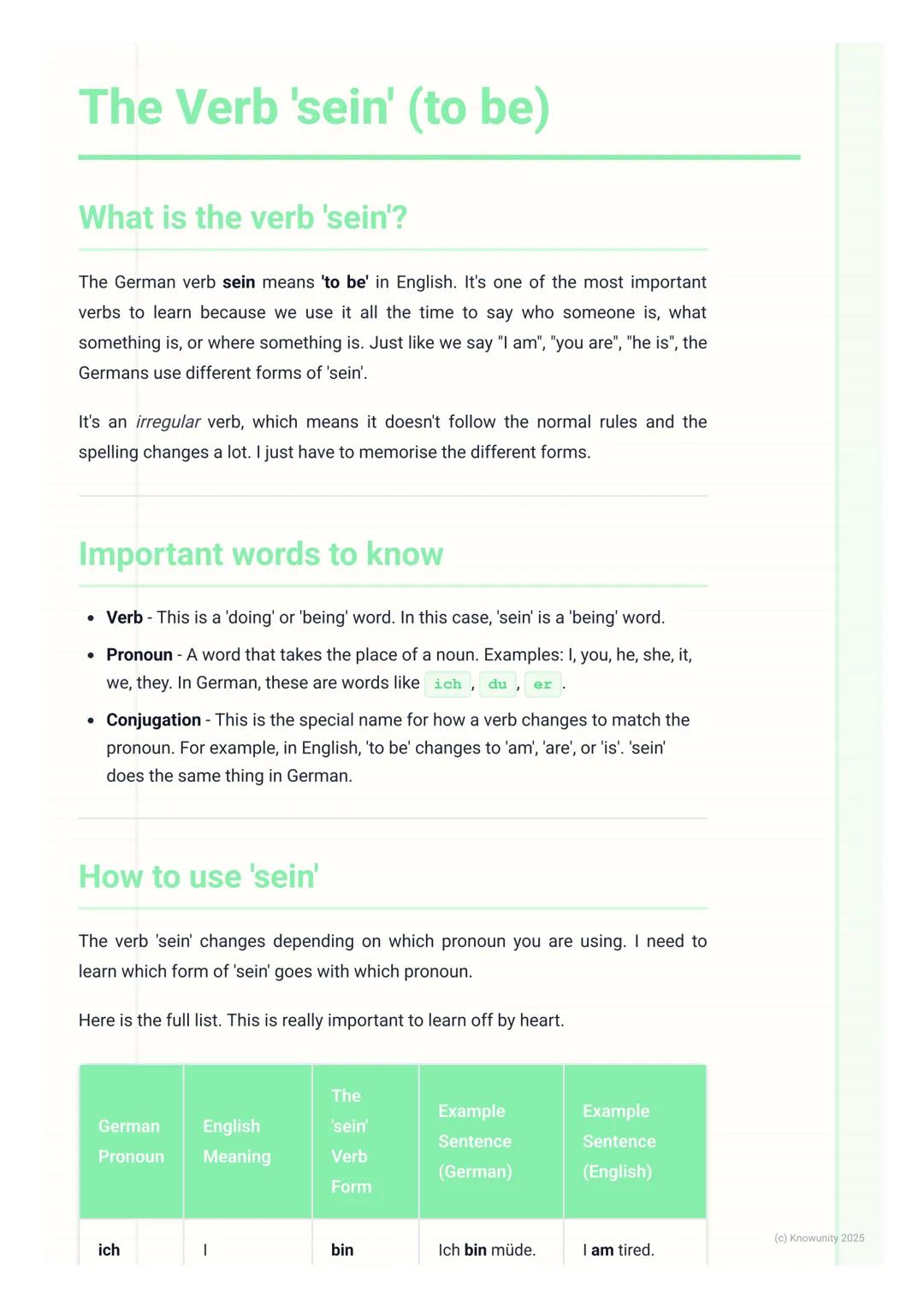
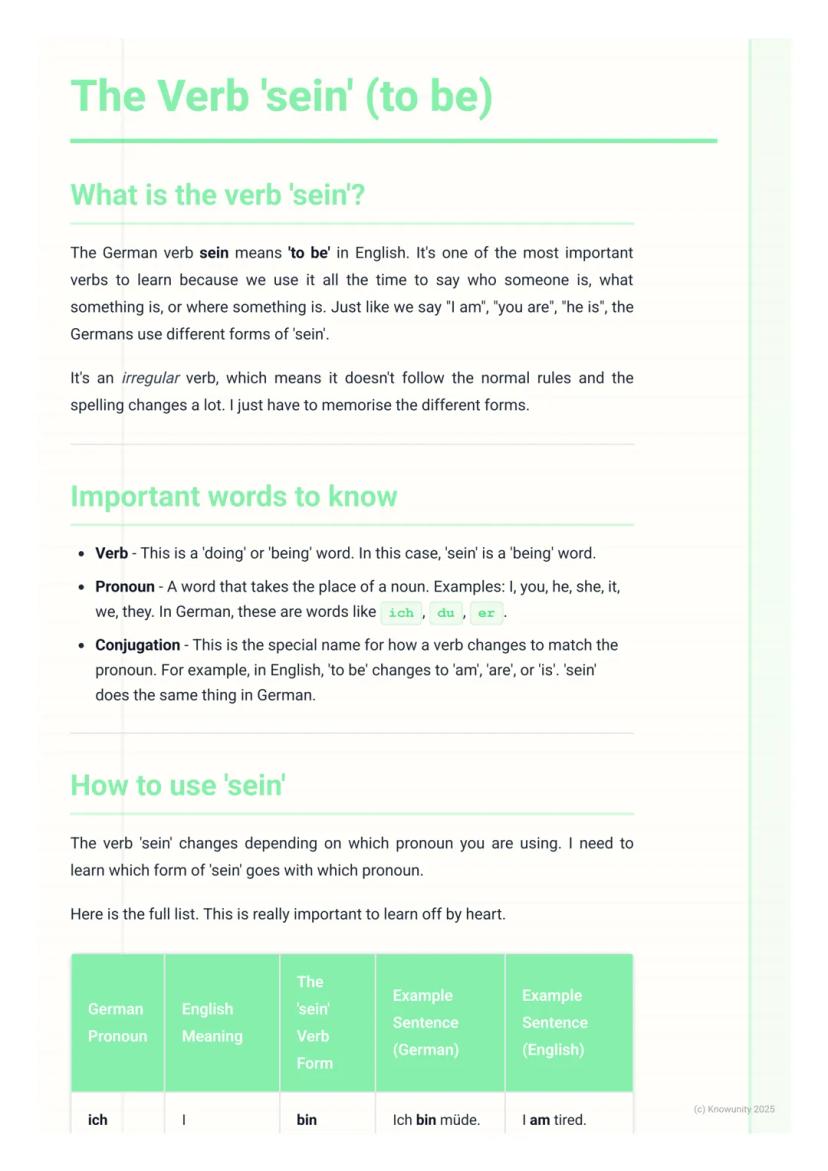
Understanding the Verb 'sein'
Think of sein as the building block of German - you'll use it constantly to describe yourself, others, and everything around you. Just like English changes "to be" into "am", "are", and "is", German does the same thing with sein, but with its own special patterns.
Here's the tricky bit: sein is an irregular verb, which means it doesn't follow normal rules and changes quite dramatically. There's no clever shortcut here - you've got to memorise each form, but once you do, you'll be chatting away in German!
💡 Quick tip: Don't worry about understanding why the forms change so much - even native German speakers just memorise them as children. Focus on learning the patterns rather than the grammar rules.
The key terms you need to know are conjugation (how verbs change to match different people) and pronouns (words like "I", "you", "he" that replace names).
2
of 4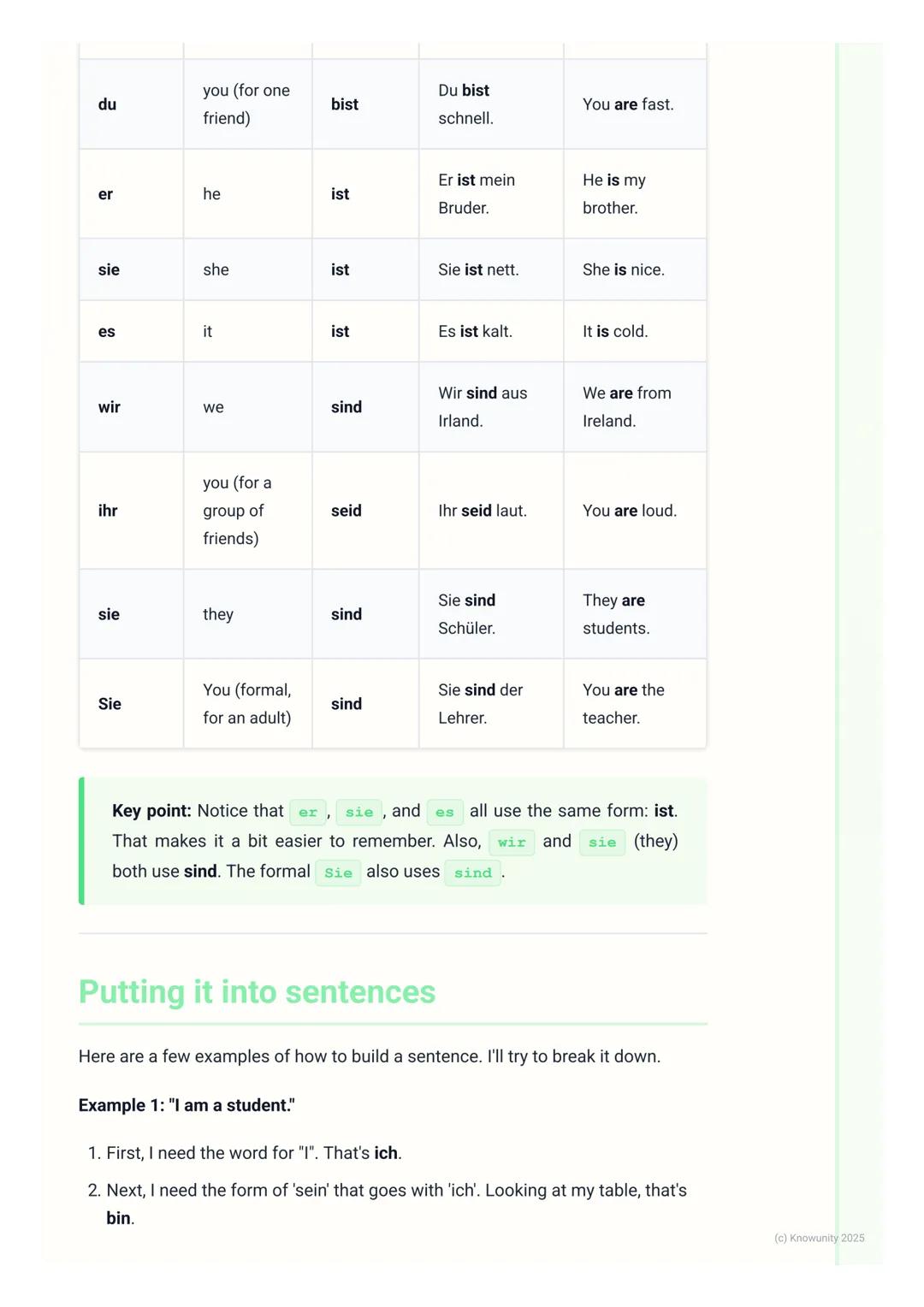
The Complete sein Table
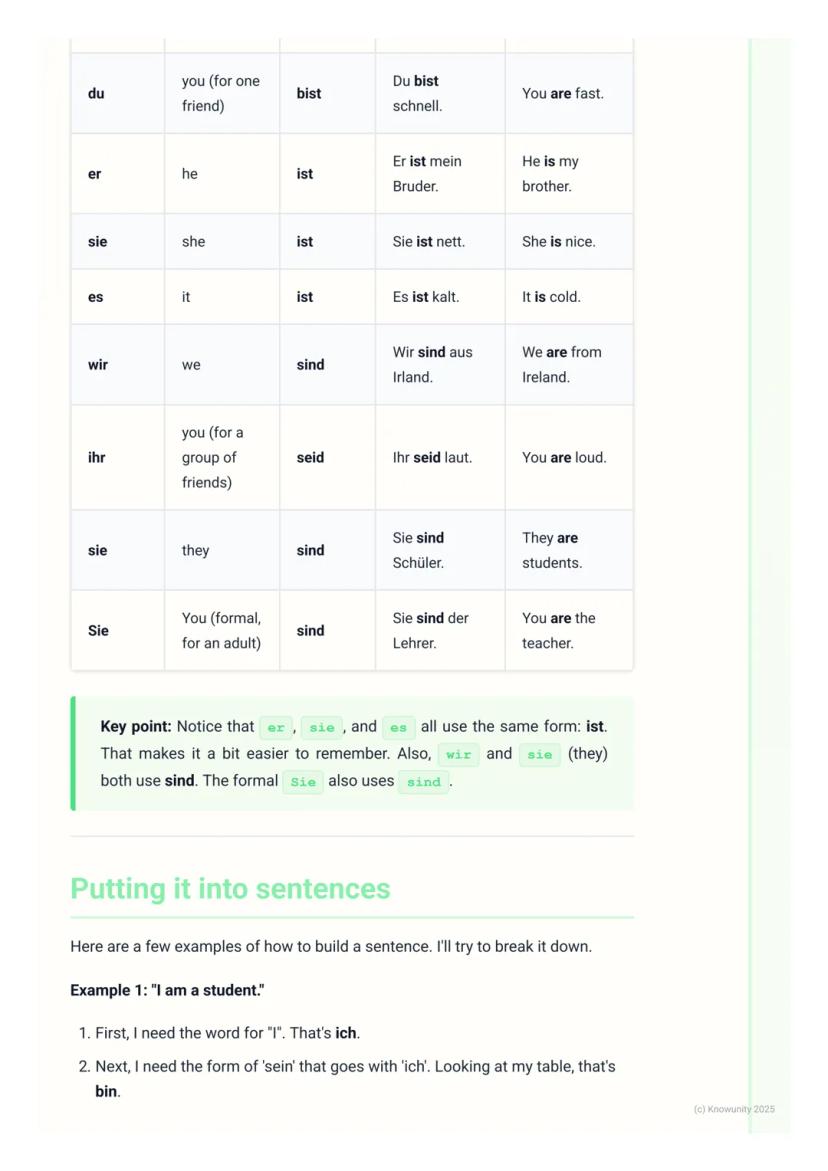
Here's the essential table you need to memorise - think of it as your German survival kit! Each German pronoun pairs with its specific form of sein, and there's no wiggling around this.
The good news? There are some helpful patterns hidden in the chaos. Notice that er, sie, and es all use ist - that's three pronouns sorted with one word. Similarly, wir and sie (they) both use sind, making your memorisation job a bit easier.
💡 Remember this: The formal Sie (for adults) also uses sind and always has a capital S, so you can spot it easily in writing.
Watch out for the trickiest pair: sind vs seid. Most students mix these up, but here's the secret - sind goes with "we" and "they", whilst seid is only for groups of friends (ihr).
3
of 4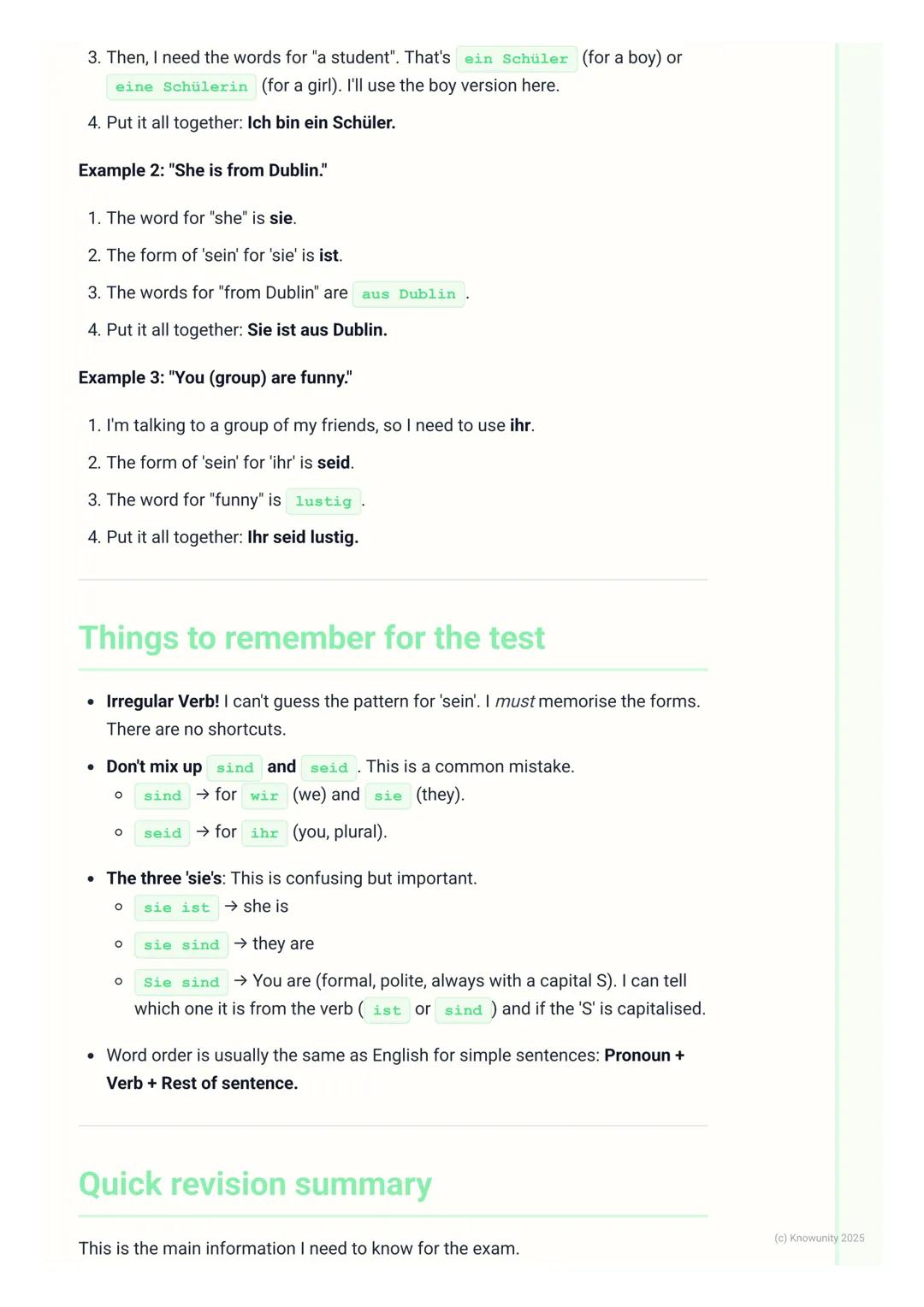
Building Your First German Sentences
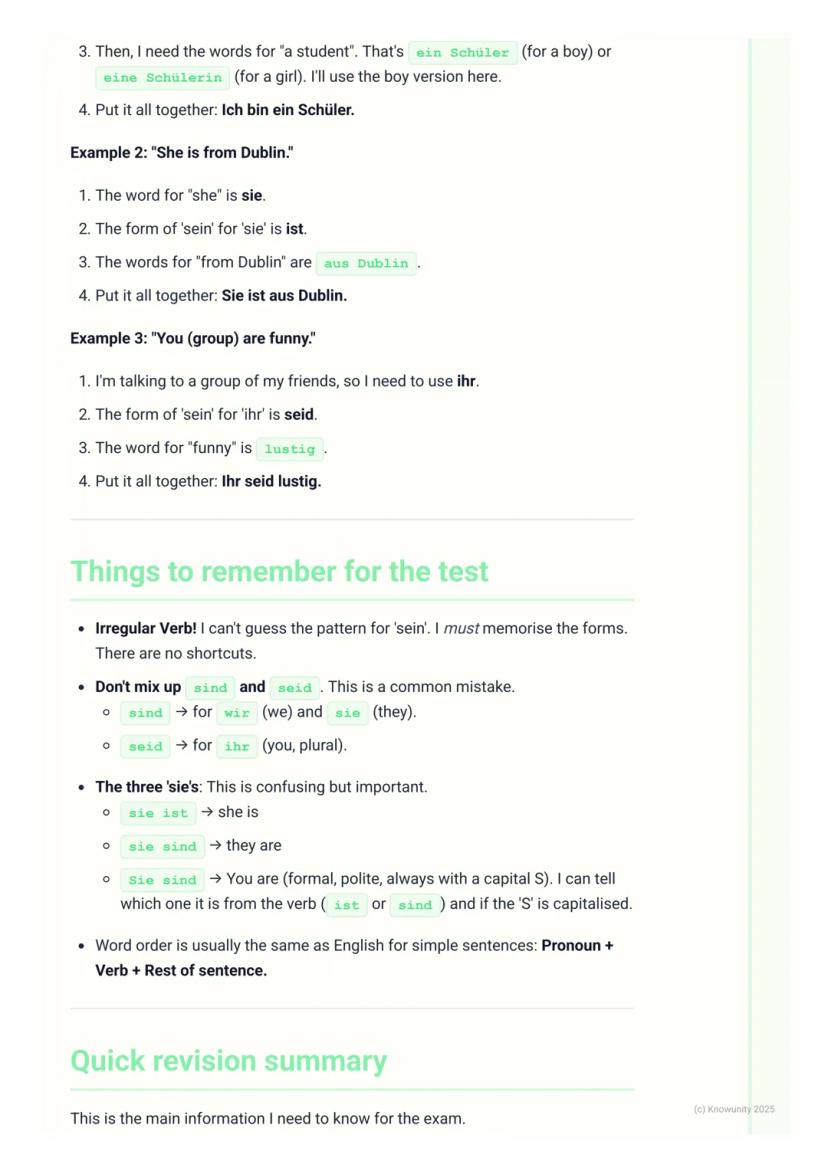
Now comes the fun part - putting your knowledge into action! German sentence structure follows the same pattern as English for basic sentences: pronoun + verb + rest of sentence.
Let's break down "Ich bin müde" (I am tired). Start with ich (I), add the matching form bin, then finish with müde (tired). See how straightforward that is?
For "Sie ist aus Dublin" (She is from Dublin), you follow the same pattern: sie (she) + ist (the form for she) + aus Dublin (from Dublin). Once you know the sein forms, sentence building becomes quite logical.
💡 Pro tip: Practice with simple sentences first. Don't worry about complex grammar yet - master the basic pattern and you'll gain confidence quickly.
4
of 4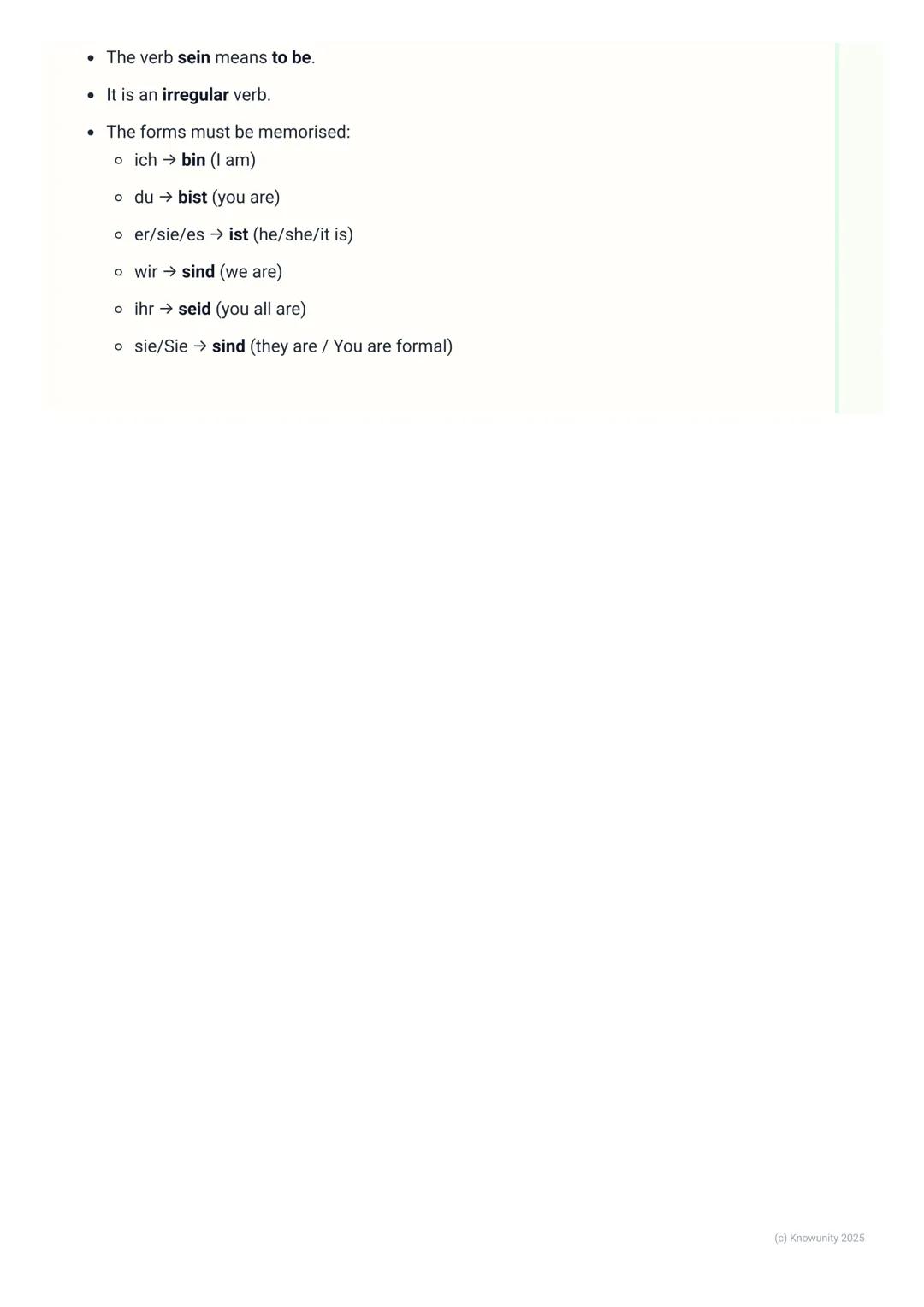
Test Success Strategies
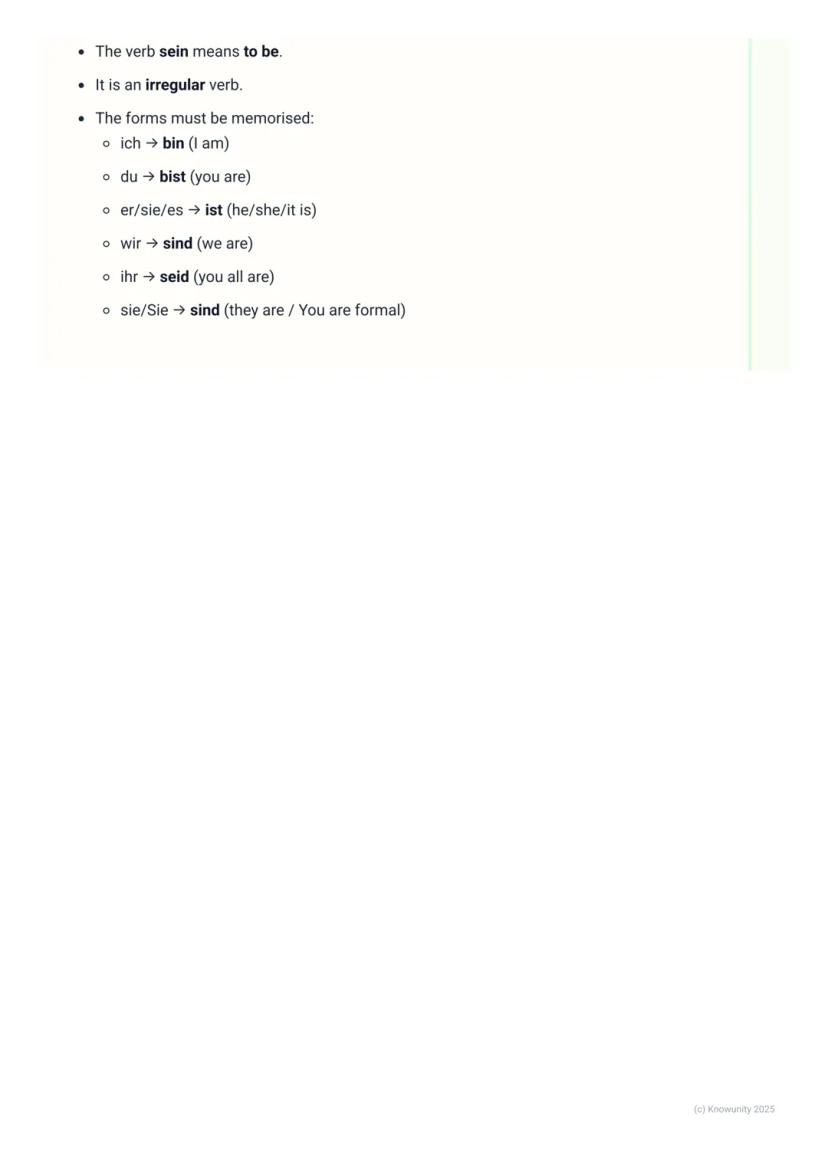
Your exam success depends on memorising those sein forms perfectly - there's simply no way around it. Create flashcards, practice daily, or make up silly songs, but make sure you know ich bin, du bist, er/sie/es ist, wir sind, ihr seid, sie/Sie sind by heart.
The biggest test trap is confusing the different meanings of sie. Remember: sie ist means "she is", sie sind means "they are", and Sie sind (capital S) means "You are" in formal situations.
💡 Final reminder: Don't panic if this feels overwhelming at first. Every German speaker has mastered these forms, and with consistent practice, you absolutely can too. Focus on one pronoun at a time and build up gradually.
Word order in basic sentences mirrors English, so you're already halfway there!
We dachten al dat je dit zou vragen...
Wat is de Knowunity AI companion?
Onze AI Companion is een studentgerichte AI-tool die meer biedt dan alleen antwoorden. Gebouwd op miljoenen Knowunity bronnen, biedt het relevante informatie, gepersonaliseerde studieplannen, quizzes en inhoud direct in de chat, aangepast aan jouw individuele leertraject.
Waar kan ik de Knowunity-app downloaden?
Je kunt de app downloaden via Google Play Store en Apple App Store.
Is Knowunity echt gratis?
Dat klopt! Geniet van gratis toegang tot leerinhoud, maak contact met medestudenten en krijg directe hulp – alles binnen handbereik.
Populairste studiemateriaal voor German
2Populairste studiemateriaal
9Kan je niet vinden wat je zoekt? Ontdek andere vakken.
Studenten zijn dol op ons — en jij ook.
4.6/5App Store
4.7/5Google Play
De app is heel makkelijk te gebruiken en goed ontworpen. Ik heb tot nu toe alles kunnen vinden waar ik naar zocht en heb veel kunnen leren van de presentaties! Ik ga de app zeker gebruiken voor een schoolopdracht! En natuurlijk helpt het ook veel als inspiratie.
Stefan SiOS gebruiker
Deze app is echt geweldig. Er zijn zoveel aantekeningen en hulpmiddelen [...]. Mijn probleemvak is bijvoorbeeld Frans, en de app heeft zoveel opties voor hulp. Dankzij deze app ben ik beter geworden in Frans. Ik zou het iedereen aanraden.
Samantha KlichAndroid gebruiker
Wow, ik ben echt onder de indruk. Ik probeerde de app gewoon omdat ik hem vaak geadverteerd had gezien en was absoluut verbaasd. Deze app is DE HULP die je wilt voor school en bovenal biedt hij zoveel dingen, zoals oefeningen en factsheets, die mij persoonlijk HEEL erg hebben geholpen.
AnnaiOS gebruiker
German6 weergaven·Bijgewerkt May 30, 2026·4 pagina'sMastering the German Verb 'sein' - Conjugation Made Simple
Ever wondered how to say "I am" or "you are" in German? The verb sein (to be) is your gateway to building basic German sentences and it's absolutely essential for any conversation.
1
of 4
Meld je aan om de inhoud te zien. Het is gratis!
- Toegang tot alle documenten
- Verbeter je cijfers
- Sluit je aan bij miljoenen studenten
Understanding the Verb 'sein'
Think of sein as the building block of German - you'll use it constantly to describe yourself, others, and everything around you. Just like English changes "to be" into "am", "are", and "is", German does the same thing with sein, but with its own special patterns.
Here's the tricky bit: sein is an irregular verb, which means it doesn't follow normal rules and changes quite dramatically. There's no clever shortcut here - you've got to memorise each form, but once you do, you'll be chatting away in German!
💡 Quick tip: Don't worry about understanding why the forms change so much - even native German speakers just memorise them as children. Focus on learning the patterns rather than the grammar rules.
The key terms you need to know are conjugation (how verbs change to match different people) and pronouns (words like "I", "you", "he" that replace names).
2
of 4Meld je aan om de inhoud te zien. Het is gratis!
- Toegang tot alle documenten
- Verbeter je cijfers
- Sluit je aan bij miljoenen studenten
The Complete sein Table
Here's the essential table you need to memorise - think of it as your German survival kit! Each German pronoun pairs with its specific form of sein, and there's no wiggling around this.
The good news? There are some helpful patterns hidden in the chaos. Notice that er, sie, and es all use ist - that's three pronouns sorted with one word. Similarly, wir and sie (they) both use sind, making your memorisation job a bit easier.
💡 Remember this: The formal Sie (for adults) also uses sind and always has a capital S, so you can spot it easily in writing.
Watch out for the trickiest pair: sind vs seid. Most students mix these up, but here's the secret - sind goes with "we" and "they", whilst seid is only for groups of friends (ihr).
3
of 4Meld je aan om de inhoud te zien. Het is gratis!
- Toegang tot alle documenten
- Verbeter je cijfers
- Sluit je aan bij miljoenen studenten
Building Your First German Sentences
Now comes the fun part - putting your knowledge into action! German sentence structure follows the same pattern as English for basic sentences: pronoun + verb + rest of sentence.
Let's break down "Ich bin müde" (I am tired). Start with ich (I), add the matching form bin, then finish with müde (tired). See how straightforward that is?
For "Sie ist aus Dublin" (She is from Dublin), you follow the same pattern: sie (she) + ist (the form for she) + aus Dublin (from Dublin). Once you know the sein forms, sentence building becomes quite logical.
💡 Pro tip: Practice with simple sentences first. Don't worry about complex grammar yet - master the basic pattern and you'll gain confidence quickly.
4
of 4Meld je aan om de inhoud te zien. Het is gratis!
- Toegang tot alle documenten
- Verbeter je cijfers
- Sluit je aan bij miljoenen studenten
Test Success Strategies
Your exam success depends on memorising those sein forms perfectly - there's simply no way around it. Create flashcards, practice daily, or make up silly songs, but make sure you know ich bin, du bist, er/sie/es ist, wir sind, ihr seid, sie/Sie sind by heart.
The biggest test trap is confusing the different meanings of sie. Remember: sie ist means "she is", sie sind means "they are", and Sie sind (capital S) means "You are" in formal situations.
💡 Final reminder: Don't panic if this feels overwhelming at first. Every German speaker has mastered these forms, and with consistent practice, you absolutely can too. Focus on one pronoun at a time and build up gradually.
Word order in basic sentences mirrors English, so you're already halfway there!
We dachten al dat je dit zou vragen...
Wat is de Knowunity AI companion?
Onze AI Companion is een studentgerichte AI-tool die meer biedt dan alleen antwoorden. Gebouwd op miljoenen Knowunity bronnen, biedt het relevante informatie, gepersonaliseerde studieplannen, quizzes en inhoud direct in de chat, aangepast aan jouw individuele leertraject.
Waar kan ik de Knowunity-app downloaden?
Je kunt de app downloaden via Google Play Store en Apple App Store.
Is Knowunity echt gratis?
Dat klopt! Geniet van gratis toegang tot leerinhoud, maak contact met medestudenten en krijg directe hulp – alles binnen handbereik.
Populairste studiemateriaal voor German
2Populairste studiemateriaal
9Kan je niet vinden wat je zoekt? Ontdek andere vakken.
Studenten zijn dol op ons — en jij ook.
4.6/5App Store
4.7/5Google Play
De app is heel makkelijk te gebruiken en goed ontworpen. Ik heb tot nu toe alles kunnen vinden waar ik naar zocht en heb veel kunnen leren van de presentaties! Ik ga de app zeker gebruiken voor een schoolopdracht! En natuurlijk helpt het ook veel als inspiratie.
Stefan SiOS gebruiker
Deze app is echt geweldig. Er zijn zoveel aantekeningen en hulpmiddelen [...]. Mijn probleemvak is bijvoorbeeld Frans, en de app heeft zoveel opties voor hulp. Dankzij deze app ben ik beter geworden in Frans. Ik zou het iedereen aanraden.
Samantha KlichAndroid gebruiker
Wow, ik ben echt onder de indruk. Ik probeerde de app gewoon omdat ik hem vaak geadverteerd had gezien en was absoluut verbaasd. Deze app is DE HULP die je wilt voor school en bovenal biedt hij zoveel dingen, zoals oefeningen en factsheets, die mij persoonlijk HEEL erg hebben geholpen.
AnnaiOS gebruiker