
World War II was the deadliest conflict in human history,... Meer weergeven
 History15 weergaven·Bijgewerkt May 26, 2026·6 pagina's
The Causes and Effects of World War II
1 / 6
1
of 6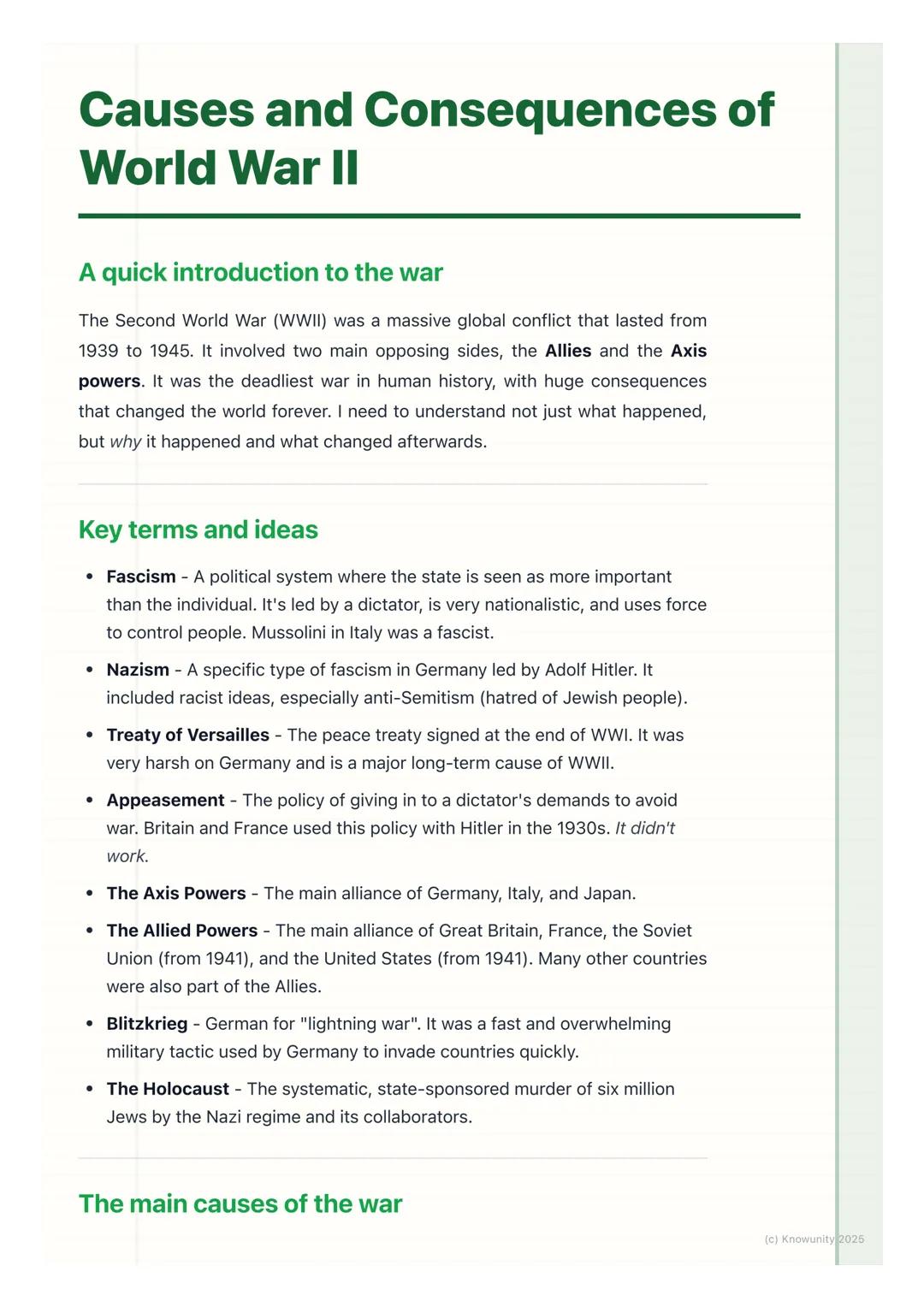
Introduction and Key Concepts
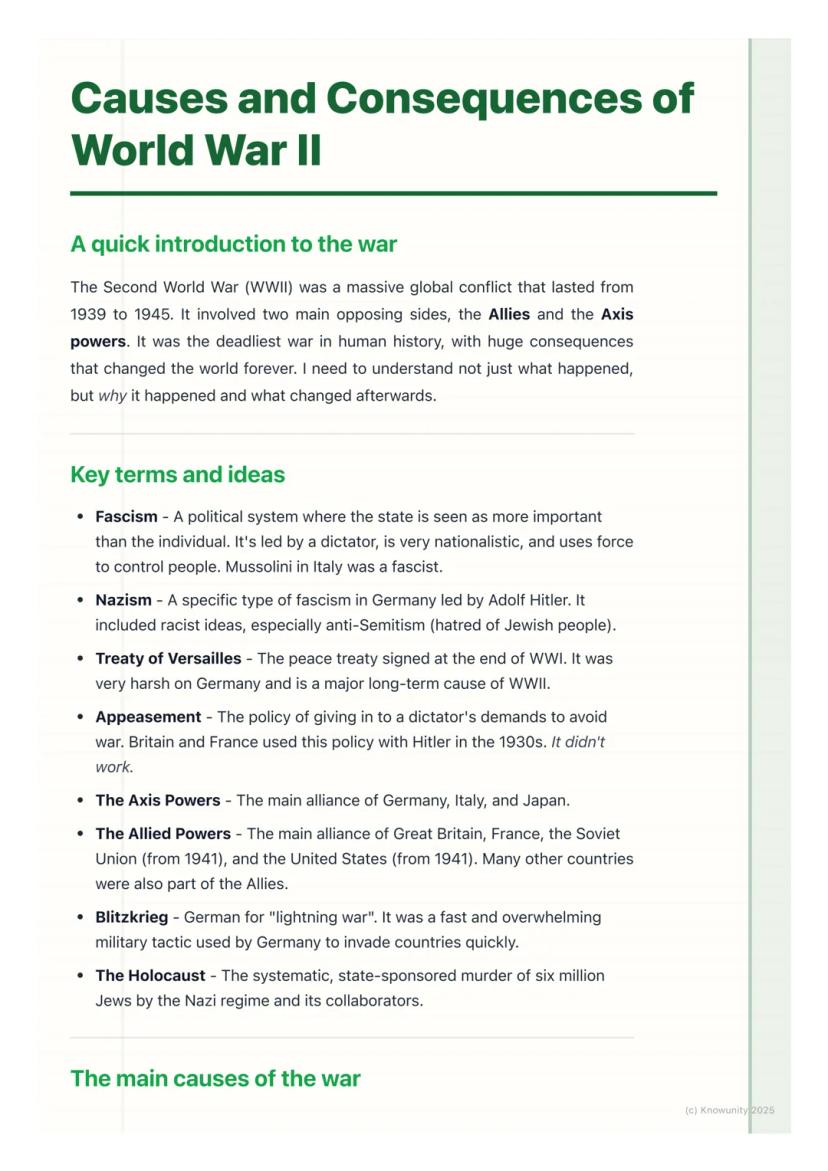
You've probably heard of WWII, but understanding why it happened makes all the difference in your exams. This massive global conflict split the world into two sides: the Allies (mainly Britain, France, USSR, and USA) versus the Axis powers (Germany, Italy, and Japan).
The most important concept to grasp is fascism – a political system where dictators control everything and the state matters more than individual people. Hitler's version, called Nazism, added horrific racist ideas that led to the Holocaust.
Two other key terms will come up constantly: appeasement (when Britain and France tried to avoid war by giving Hitler what he wanted) and blitzkrieg . The Treaty of Versailles from 1919 is also crucial – it was meant to keep peace after WWI but actually helped cause WWII.
Remember: Don't just memorise dates – focus on understanding the connections between causes and consequences.
2
of 6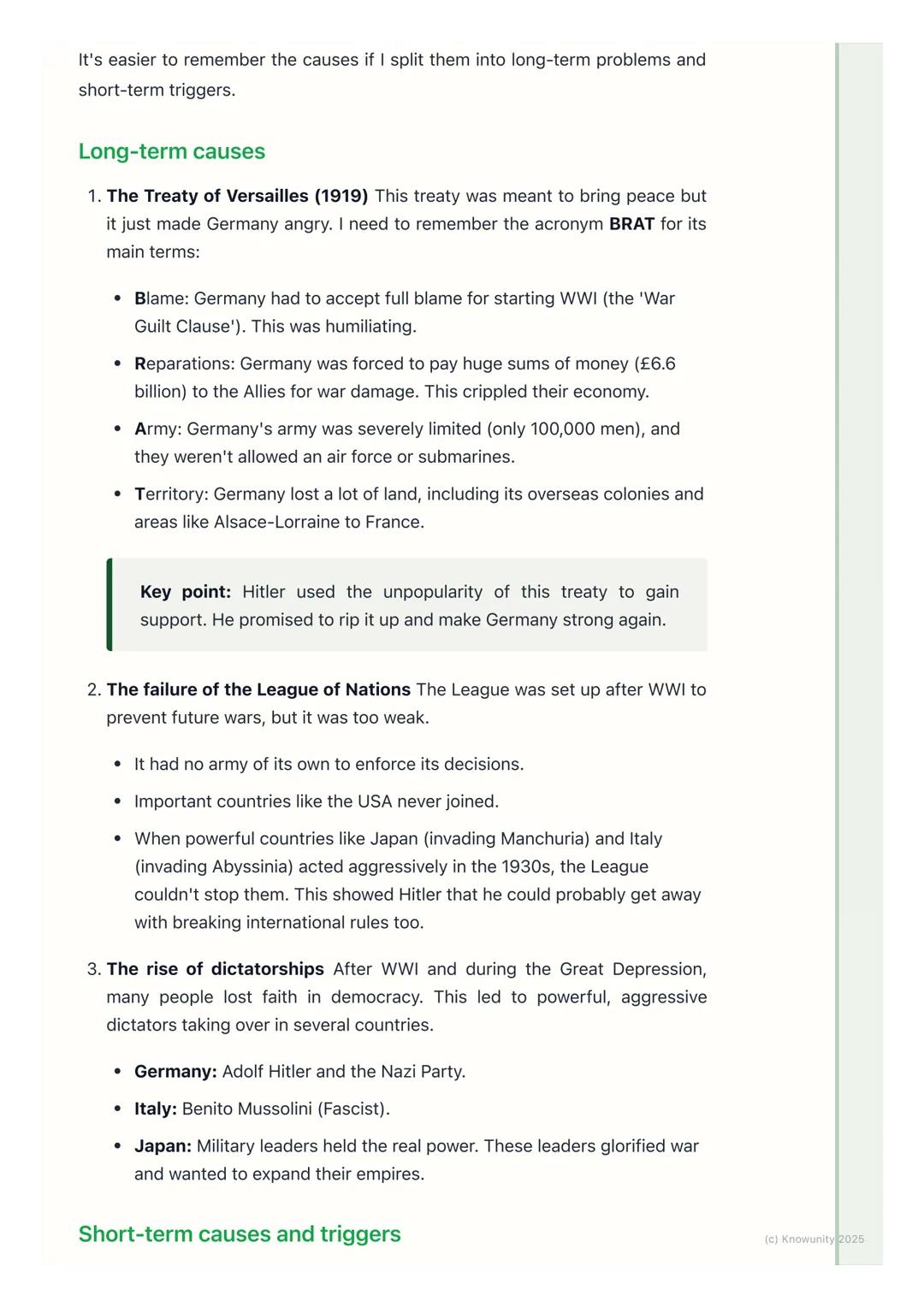
Long-term Causes
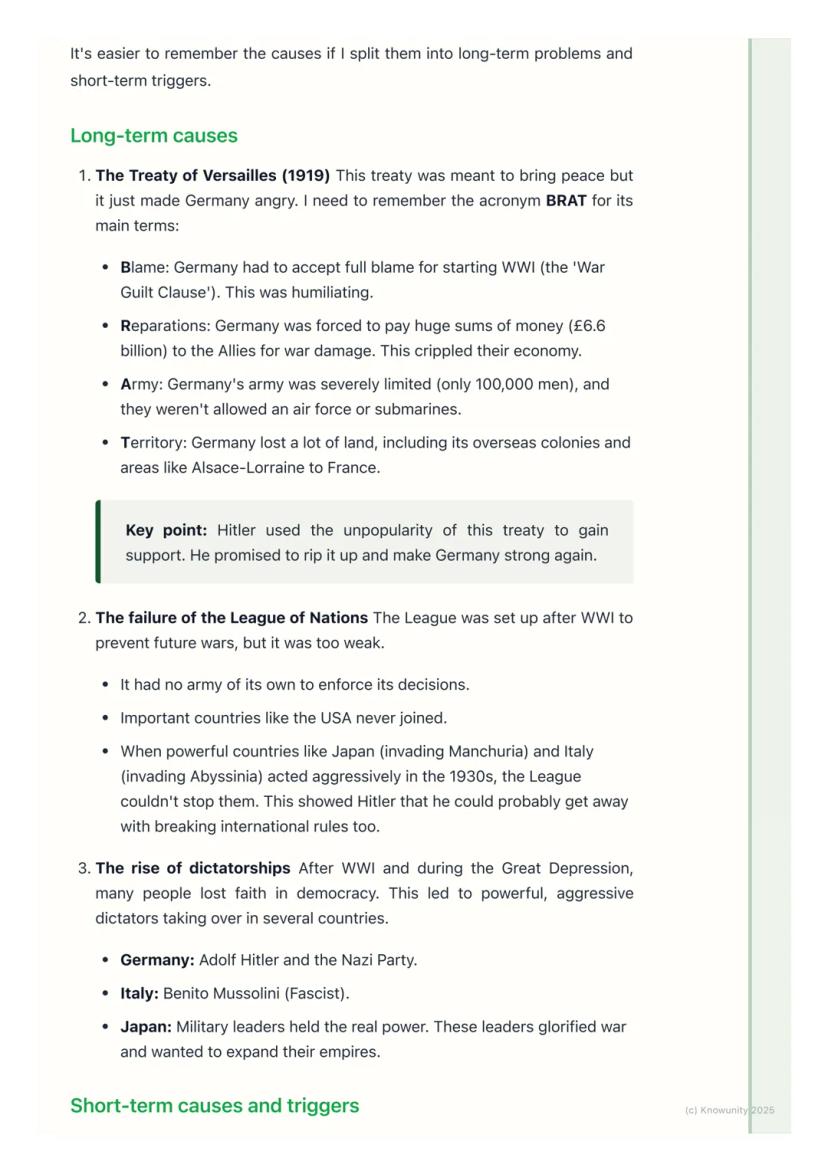
The Treaty of Versailles was basically a recipe for disaster. Use the acronym BRAT to remember its harsh terms: Blame (Germany had to accept full responsibility for WWI), Reparations (£6.6 billion in payments that crippled Germany's economy), Army (limited to just 100,000 men), and Territory (Germany lost loads of land).
Hitler used Germans' anger about this treaty to gain support. People were desperate after economic crisis and national humiliation, so his promises to tear up the treaty and make Germany great again sounded brilliant.
The League of Nations was supposed to prevent future wars but was completely useless. It had no army and couldn't stop aggressive countries like Japan or Italy from invading other nations. This showed Hitler he could probably get away with breaking international rules too.
Meanwhile, dictatorships were popping up everywhere as people lost faith in democracy during the Great Depression. These leaders – Hitler in Germany, Mussolini in Italy, and military leaders in Japan – all glorified war and wanted to expand their empires.
Exam tip: Long-term causes are just as important as the immediate trigger – make sure you can explain both!
3
of 6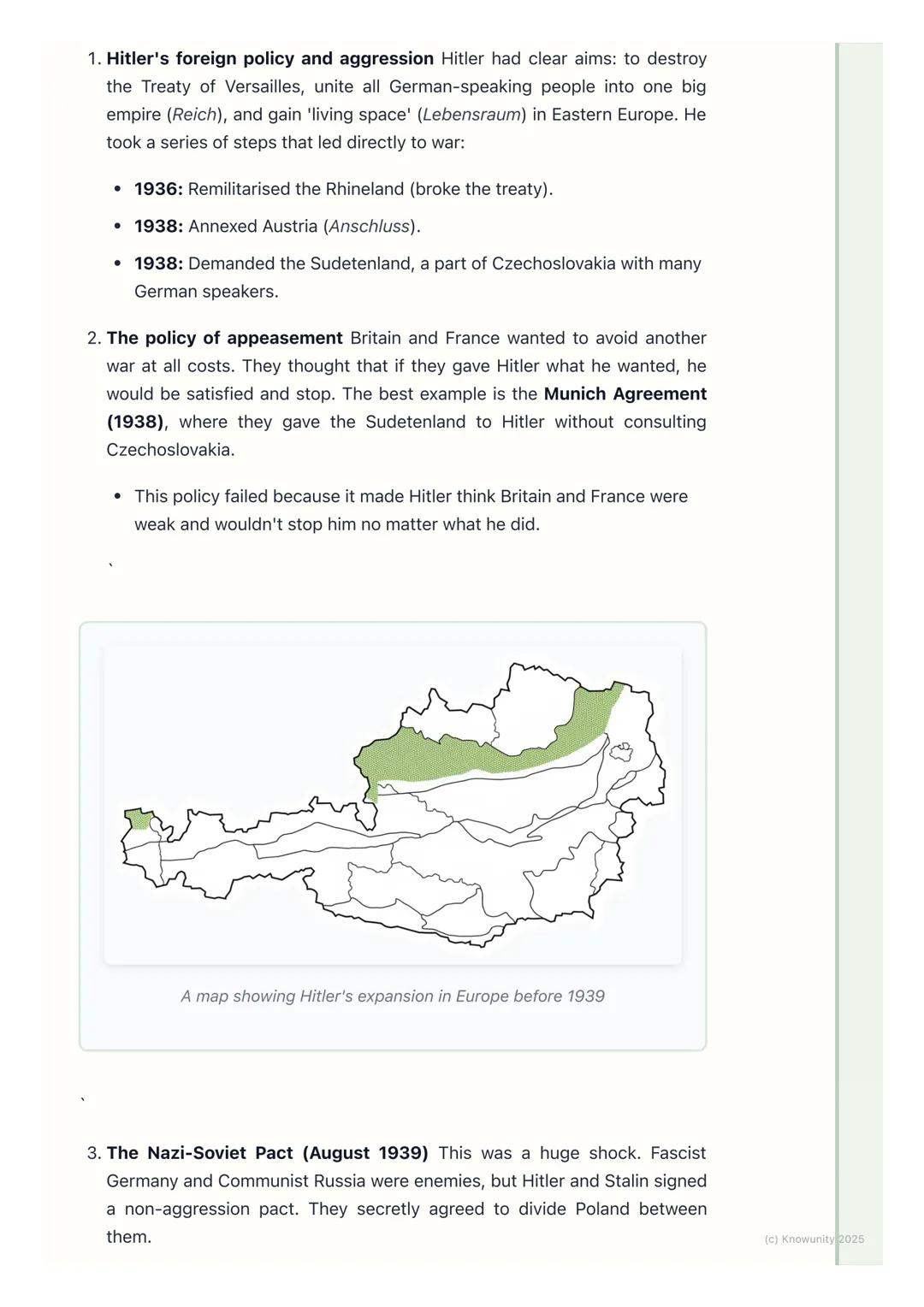
Short-term Causes and Triggers
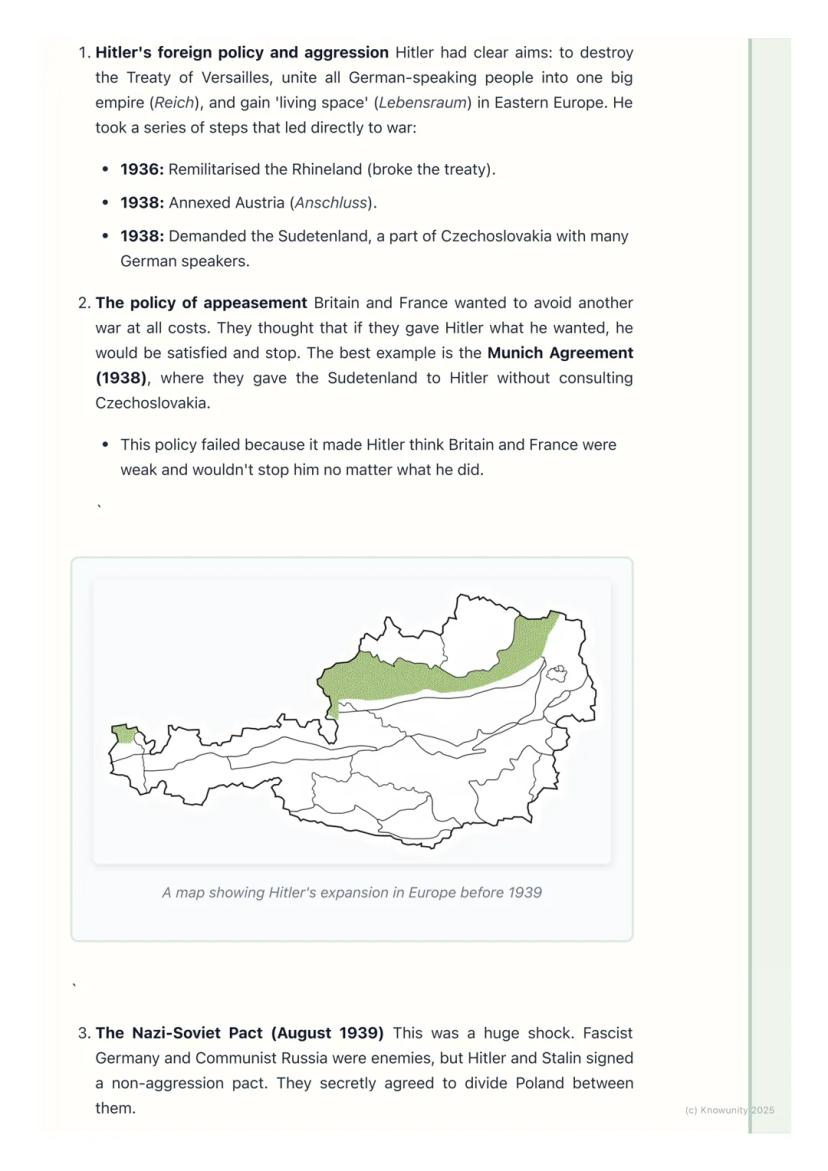
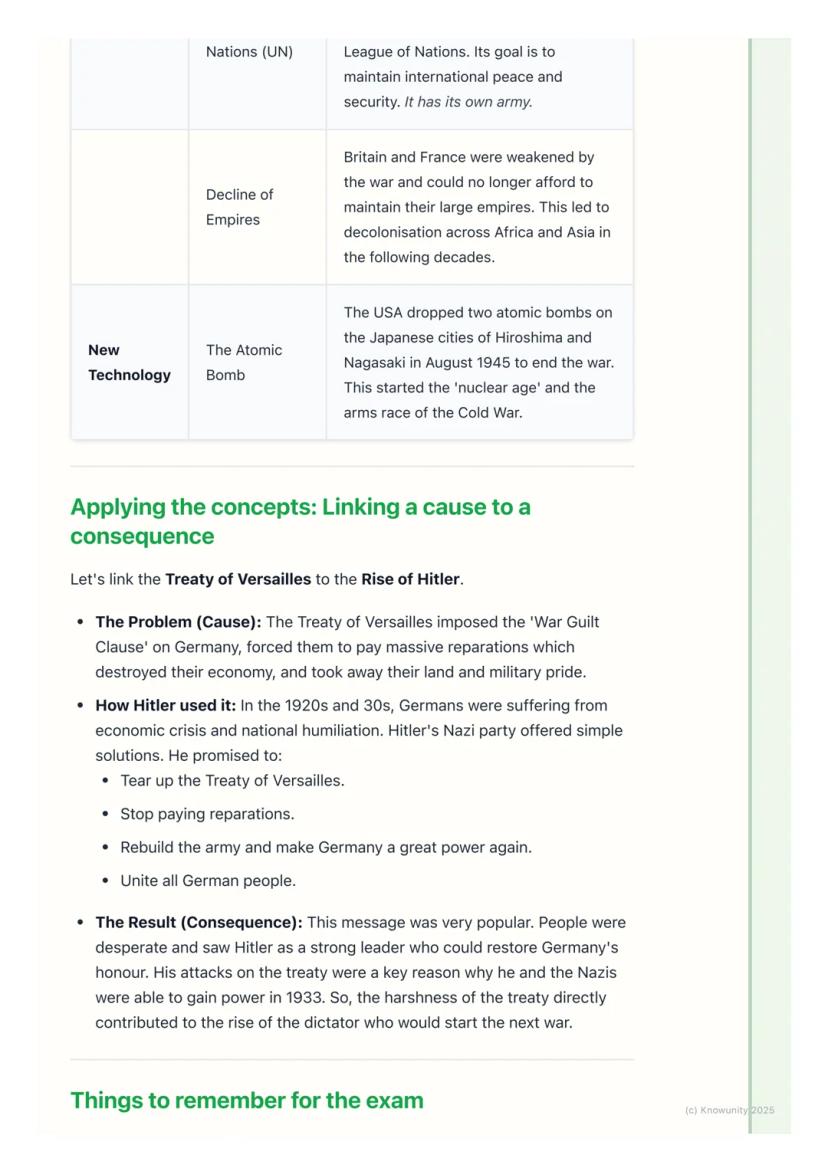
Hitler had clear goals: destroy the Treaty of Versailles, unite all German speakers, and grab 'living space' (Lebensraum) in Eastern Europe. He tested the waters by remilitarising the Rhineland in 1936, then annexed Austria in 1938, then demanded the Sudetenland from Czechoslovakia.
This is where appeasement comes in. Britain and France were so desperate to avoid another war that they kept giving Hitler what he wanted. The Munich Agreement in 1938 handed over the Sudetenland without even asking Czechoslovakia – basically throwing them under the bus.
Appeasement completely backfired because it made Hitler think Britain and France were weak and wouldn't stop him no matter what he did. He was getting bolder with each success.
The Nazi-Soviet Pact in August 1939 was a massive shock – fascist Germany and communist Russia agreeing not to fight each other and secretly planning to carve up Poland between them. This meant Hitler didn't have to worry about fighting on two fronts, giving him the green light for invasion.
Key point: Appeasement wasn't cowardice – leaders genuinely thought they were preventing war, but it actually encouraged Hitler's aggression.
4
of 6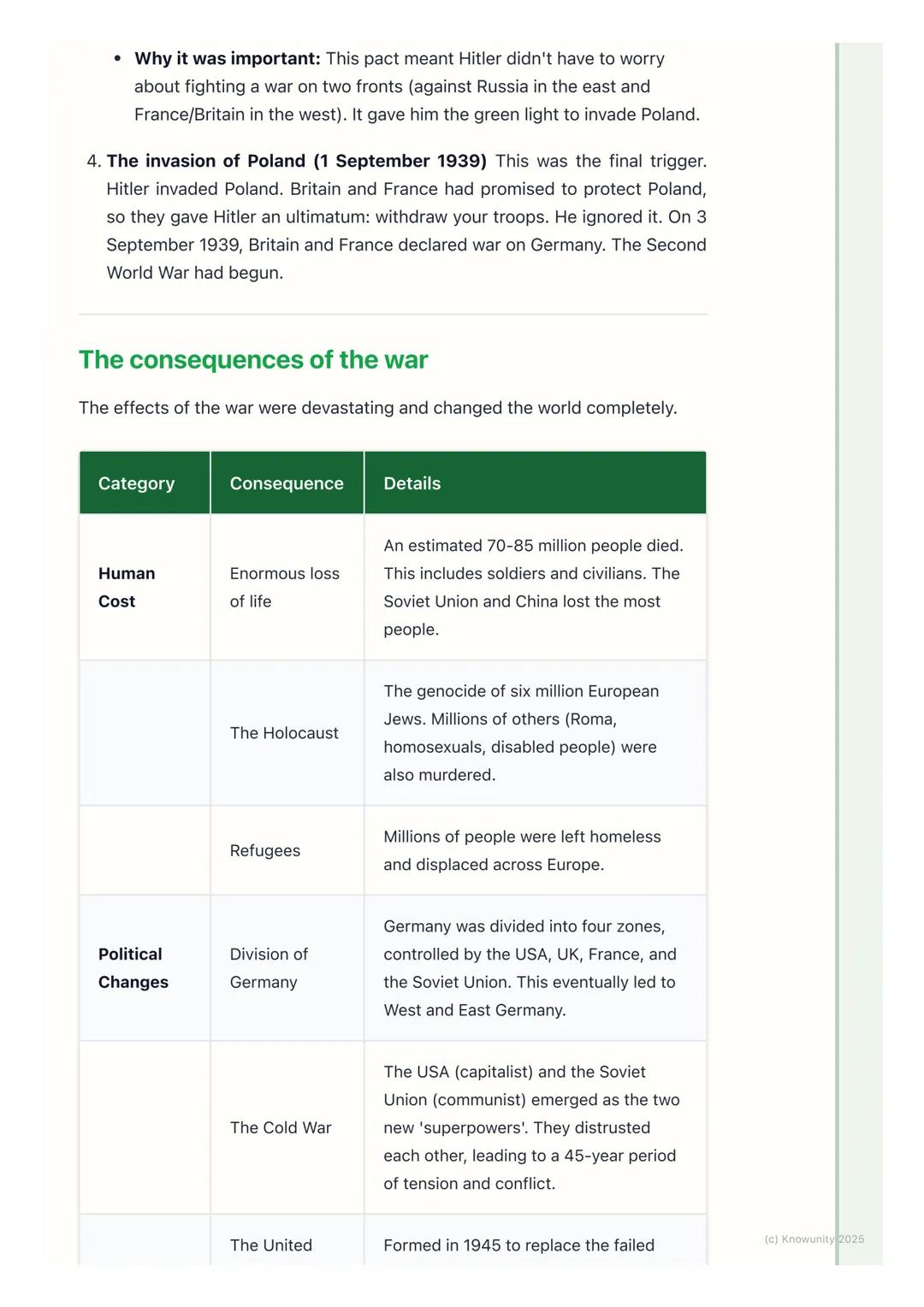
The Final Trigger and Human Consequences
On 1 September 1939, Hitler invaded Poland. Britain and France had promised to protect Poland, so they gave Hitler an ultimatum to withdraw. When he ignored it, they declared war on 3 September 1939. World War II had officially begun.
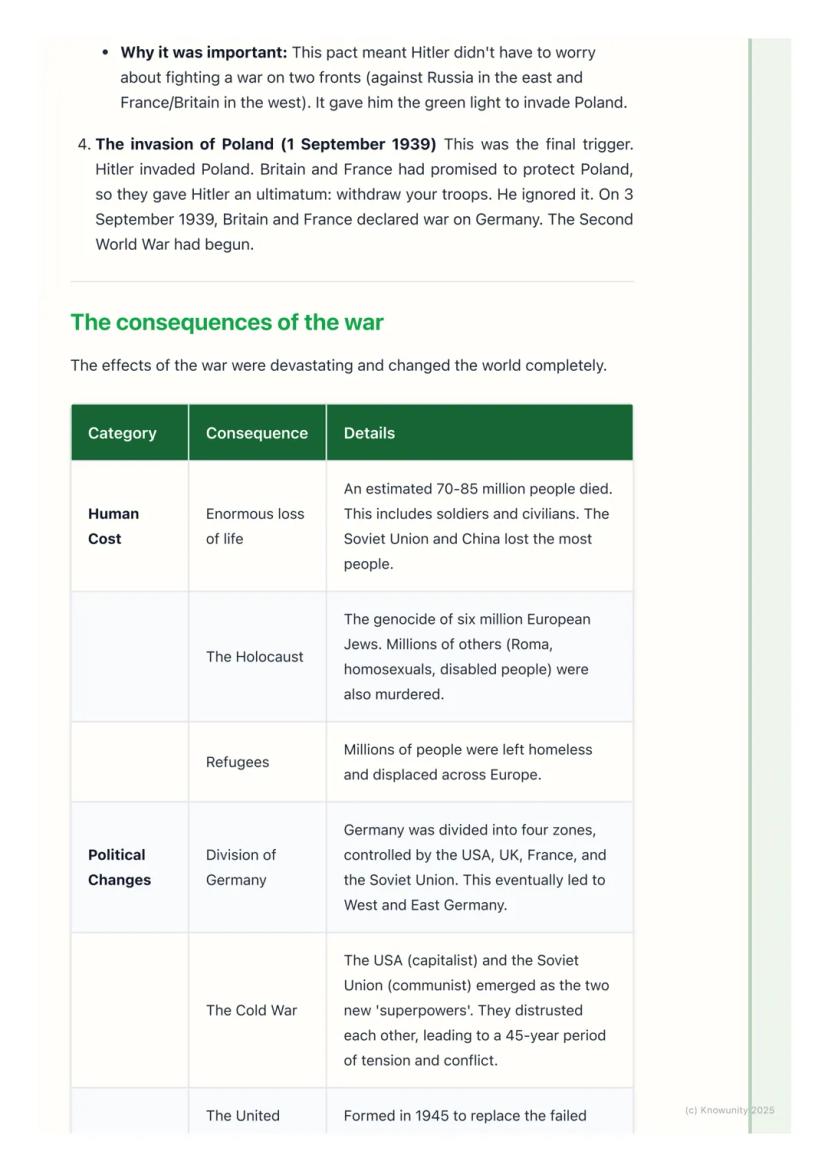
The human cost was absolutely staggering. An estimated 70-85 million people died – that's more than the entire population of Britain today. The Holocaust saw six million Jews systematically murdered, along with millions of others including Roma people, homosexuals, and disabled individuals.
Millions more became refugees, left homeless and displaced across Europe. The Soviet Union and China lost the most people, with some estimates putting Soviet deaths alone at 27 million. These weren't just numbers – they were real people with families, dreams, and lives cut short.
The war also saw the first use of atomic weapons when the USA dropped bombs on Hiroshima and Nagasaki in August 1945. This wasn't just about ending the war – it ushered in the nuclear age and changed warfare forever.
Remember: The scale of suffering was unprecedented – understanding this helps explain why the world was so determined to create international organisations like the UN afterwards.
5
of 6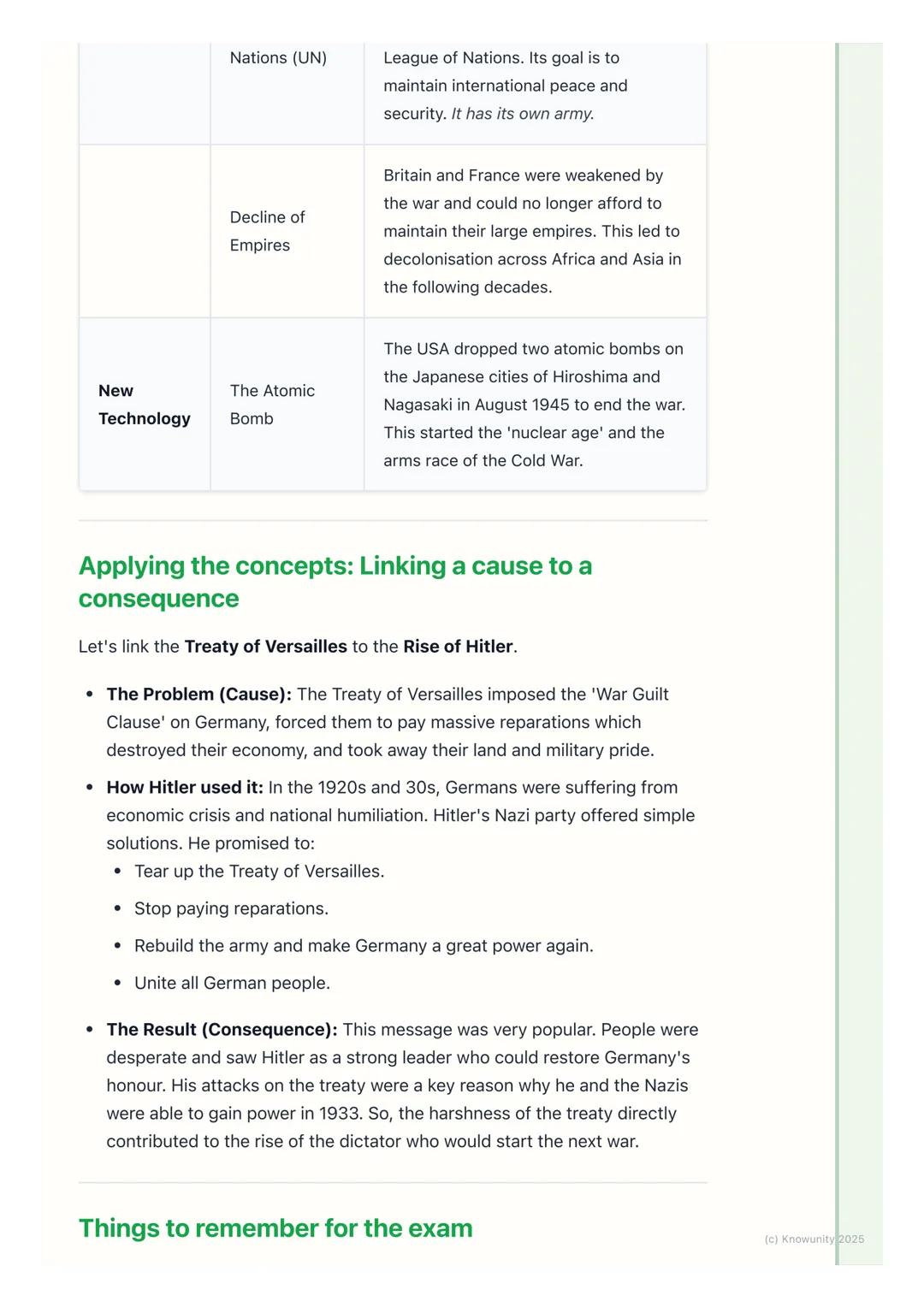
Political and Global Consequences
The war's aftermath completely reshaped the world map and power structure. Germany was divided into four zones controlled by the USA, UK, France, and Soviet Union, eventually becoming West and East Germany. This division symbolised the broader split that was coming.
The Cold War emerged as the USA and Soviet Union became the world's new superpowers. Despite being wartime allies, their opposing ideologies (capitalism vs communism) created 45 years of tension, proxy wars, and the constant threat of nuclear conflict.
The United Nations was founded in 1945 to replace the failed League of Nations. Unlike its predecessor, the UN had more power and backing from major world powers, though it still struggles with enforcement today.
European empires crumbled as Britain and France, weakened by the war, could no longer afford to maintain their colonies. This triggered decolonisation across Africa and Asia in the following decades, creating many of the countries we know today.
Think about it: Many of today's global conflicts and political tensions can be traced back to these post-WWII changes – the war's consequences are still with us.
6
of 6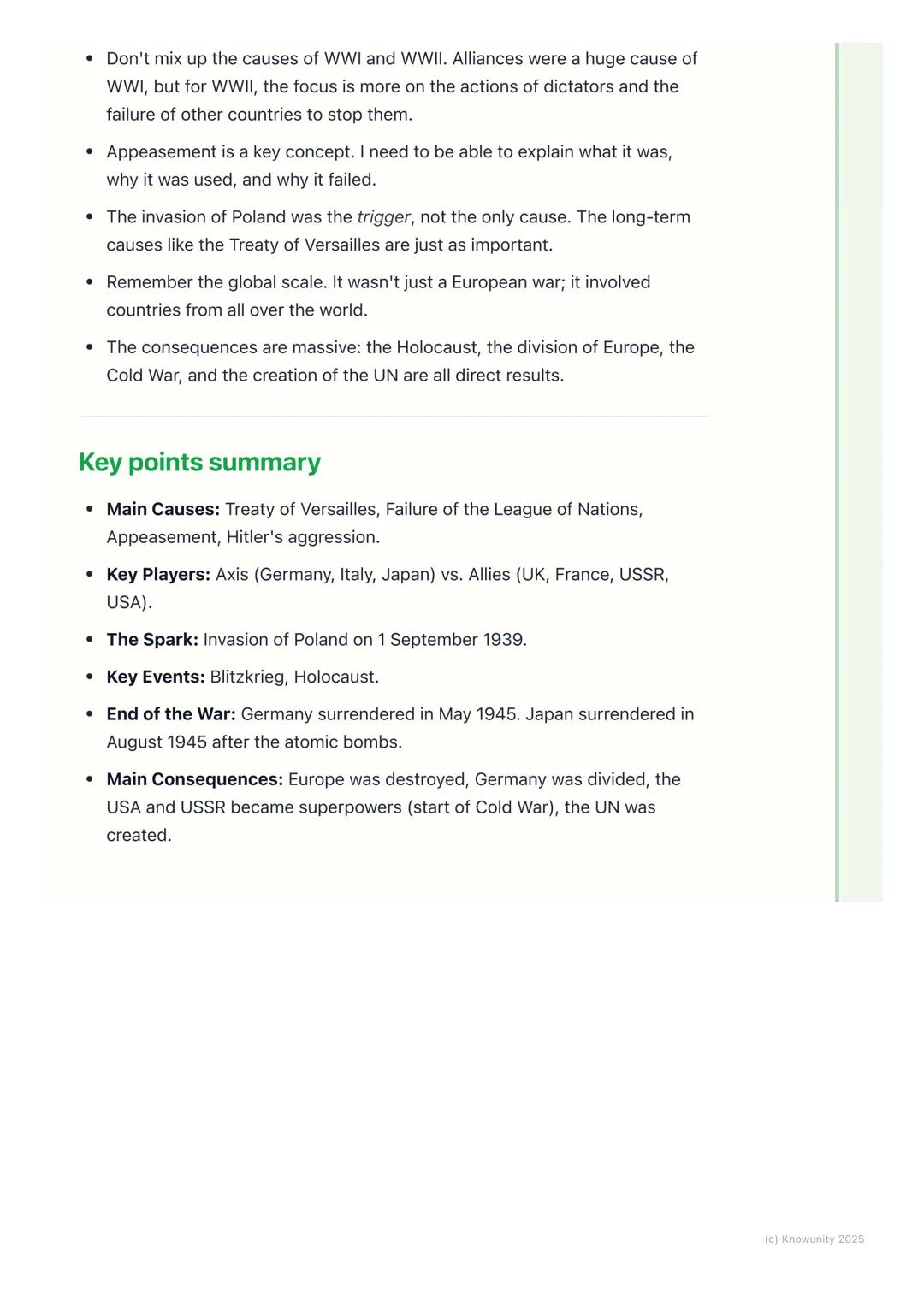
Exam Success Tips
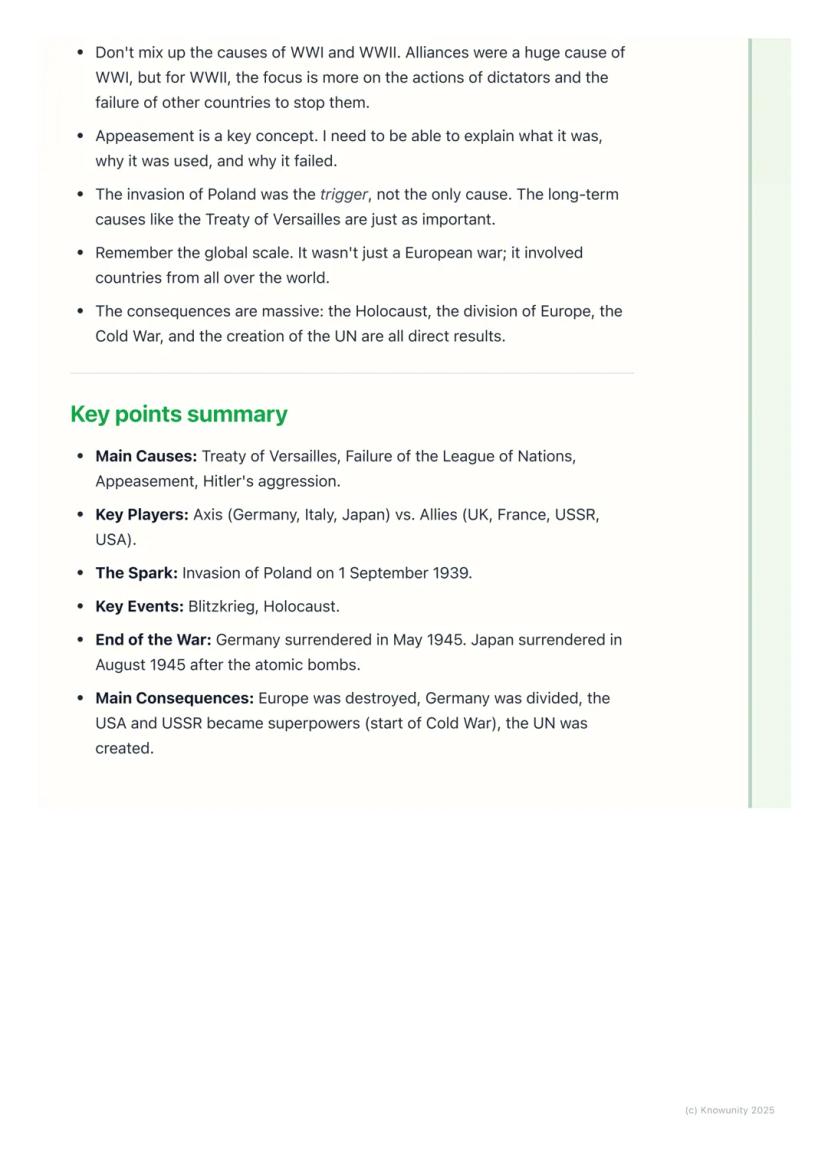
Don't confuse WWI and WWII causes – alliances were crucial for the first war, but WWII was more about dictators' actions and other countries' failure to stop them early. Make sure you can explain the difference clearly.
Appeasement is absolutely vital to understand. Know what it was (giving dictators what they want to avoid war), why leaders used it (desperate to prevent another devastating conflict), and why it failed (encouraged Hitler's aggression).
The invasion of Poland was just the trigger, not the whole story. Your essays need to show you understand the long-term causes like the Treaty of Versailles were equally important in creating the conditions for war.
Remember the global scale – this wasn't just Europeans fighting each other. Countries from every continent were involved, and the consequences affected the entire world. The Holocaust, the Cold War division of Europe, and the creation of the UN all stemmed directly from this conflict.
Exam strategy: Always link causes to consequences in your answers – show how the harsh Treaty of Versailles helped Hitler rise to power, or how appeasement encouraged his aggression.
We dachten al dat je dit zou vragen...
Wat is de Knowunity AI companion?
Onze AI Companion is een studentgerichte AI-tool die meer biedt dan alleen antwoorden. Gebouwd op miljoenen Knowunity bronnen, biedt het relevante informatie, gepersonaliseerde studieplannen, quizzes en inhoud direct in de chat, aangepast aan jouw individuele leertraject.
Waar kan ik de Knowunity-app downloaden?
Je kunt de app downloaden via Google Play Store en Apple App Store.
Is Knowunity echt gratis?
Dat klopt! Geniet van gratis toegang tot leerinhoud, maak contact met medestudenten en krijg directe hulp – alles binnen handbereik.
Populairste studiemateriaal voor History
9Populairste studiemateriaal
9Kan je niet vinden wat je zoekt? Ontdek andere vakken.
Studenten zijn dol op ons — en jij ook.
4.6/5App Store
4.7/5Google Play
De app is heel makkelijk te gebruiken en goed ontworpen. Ik heb tot nu toe alles kunnen vinden waar ik naar zocht en heb veel kunnen leren van de presentaties! Ik ga de app zeker gebruiken voor een schoolopdracht! En natuurlijk helpt het ook veel als inspiratie.
Stefan SiOS gebruiker
Deze app is echt geweldig. Er zijn zoveel aantekeningen en hulpmiddelen [...]. Mijn probleemvak is bijvoorbeeld Frans, en de app heeft zoveel opties voor hulp. Dankzij deze app ben ik beter geworden in Frans. Ik zou het iedereen aanraden.
Samantha KlichAndroid gebruiker
Wow, ik ben echt onder de indruk. Ik probeerde de app gewoon omdat ik hem vaak geadverteerd had gezien en was absoluut verbaasd. Deze app is DE HULP die je wilt voor school en bovenal biedt hij zoveel dingen, zoals oefeningen en factsheets, die mij persoonlijk HEEL erg hebben geholpen.
AnnaiOS gebruiker
History15 weergaven·Bijgewerkt May 26, 2026·6 pagina'sThe Causes and Effects of World War II
World War II was the deadliest conflict in human history, lasting from 1939 to 1945 and changing the world forever. Understanding why it started and what happened afterwards is crucial for grasping how our modern world was shaped. This wasn't... Meer weergeven
1
of 6Meld je aan om de inhoud te zien. Het is gratis!
- Toegang tot alle documenten
- Verbeter je cijfers
- Sluit je aan bij miljoenen studenten
Introduction and Key Concepts
You've probably heard of WWII, but understanding why it happened makes all the difference in your exams. This massive global conflict split the world into two sides: the Allies (mainly Britain, France, USSR, and USA) versus the Axis powers (Germany, Italy, and Japan).
The most important concept to grasp is fascism – a political system where dictators control everything and the state matters more than individual people. Hitler's version, called Nazism, added horrific racist ideas that led to the Holocaust.
Two other key terms will come up constantly: appeasement (when Britain and France tried to avoid war by giving Hitler what he wanted) and blitzkrieg . The Treaty of Versailles from 1919 is also crucial – it was meant to keep peace after WWI but actually helped cause WWII.
Remember: Don't just memorise dates – focus on understanding the connections between causes and consequences.
2
of 6Meld je aan om de inhoud te zien. Het is gratis!
- Toegang tot alle documenten
- Verbeter je cijfers
- Sluit je aan bij miljoenen studenten
Long-term Causes
The Treaty of Versailles was basically a recipe for disaster. Use the acronym BRAT to remember its harsh terms: Blame (Germany had to accept full responsibility for WWI), Reparations (£6.6 billion in payments that crippled Germany's economy), Army (limited to just 100,000 men), and Territory (Germany lost loads of land).
Hitler used Germans' anger about this treaty to gain support. People were desperate after economic crisis and national humiliation, so his promises to tear up the treaty and make Germany great again sounded brilliant.
The League of Nations was supposed to prevent future wars but was completely useless. It had no army and couldn't stop aggressive countries like Japan or Italy from invading other nations. This showed Hitler he could probably get away with breaking international rules too.
Meanwhile, dictatorships were popping up everywhere as people lost faith in democracy during the Great Depression. These leaders – Hitler in Germany, Mussolini in Italy, and military leaders in Japan – all glorified war and wanted to expand their empires.
Exam tip: Long-term causes are just as important as the immediate trigger – make sure you can explain both!
3
of 6Meld je aan om de inhoud te zien. Het is gratis!
- Toegang tot alle documenten
- Verbeter je cijfers
- Sluit je aan bij miljoenen studenten
Short-term Causes and Triggers
Hitler had clear goals: destroy the Treaty of Versailles, unite all German speakers, and grab 'living space' (Lebensraum) in Eastern Europe. He tested the waters by remilitarising the Rhineland in 1936, then annexed Austria in 1938, then demanded the Sudetenland from Czechoslovakia.
This is where appeasement comes in. Britain and France were so desperate to avoid another war that they kept giving Hitler what he wanted. The Munich Agreement in 1938 handed over the Sudetenland without even asking Czechoslovakia – basically throwing them under the bus.
Appeasement completely backfired because it made Hitler think Britain and France were weak and wouldn't stop him no matter what he did. He was getting bolder with each success.
The Nazi-Soviet Pact in August 1939 was a massive shock – fascist Germany and communist Russia agreeing not to fight each other and secretly planning to carve up Poland between them. This meant Hitler didn't have to worry about fighting on two fronts, giving him the green light for invasion.
Key point: Appeasement wasn't cowardice – leaders genuinely thought they were preventing war, but it actually encouraged Hitler's aggression.
4
of 6Meld je aan om de inhoud te zien. Het is gratis!
- Toegang tot alle documenten
- Verbeter je cijfers
- Sluit je aan bij miljoenen studenten
The Final Trigger and Human Consequences
On 1 September 1939, Hitler invaded Poland. Britain and France had promised to protect Poland, so they gave Hitler an ultimatum to withdraw. When he ignored it, they declared war on 3 September 1939. World War II had officially begun.
The human cost was absolutely staggering. An estimated 70-85 million people died – that's more than the entire population of Britain today. The Holocaust saw six million Jews systematically murdered, along with millions of others including Roma people, homosexuals, and disabled individuals.
Millions more became refugees, left homeless and displaced across Europe. The Soviet Union and China lost the most people, with some estimates putting Soviet deaths alone at 27 million. These weren't just numbers – they were real people with families, dreams, and lives cut short.
The war also saw the first use of atomic weapons when the USA dropped bombs on Hiroshima and Nagasaki in August 1945. This wasn't just about ending the war – it ushered in the nuclear age and changed warfare forever.
Remember: The scale of suffering was unprecedented – understanding this helps explain why the world was so determined to create international organisations like the UN afterwards.
5
of 6Meld je aan om de inhoud te zien. Het is gratis!
- Toegang tot alle documenten
- Verbeter je cijfers
- Sluit je aan bij miljoenen studenten
Political and Global Consequences
The war's aftermath completely reshaped the world map and power structure. Germany was divided into four zones controlled by the USA, UK, France, and Soviet Union, eventually becoming West and East Germany. This division symbolised the broader split that was coming.
The Cold War emerged as the USA and Soviet Union became the world's new superpowers. Despite being wartime allies, their opposing ideologies (capitalism vs communism) created 45 years of tension, proxy wars, and the constant threat of nuclear conflict.
The United Nations was founded in 1945 to replace the failed League of Nations. Unlike its predecessor, the UN had more power and backing from major world powers, though it still struggles with enforcement today.
European empires crumbled as Britain and France, weakened by the war, could no longer afford to maintain their colonies. This triggered decolonisation across Africa and Asia in the following decades, creating many of the countries we know today.
Think about it: Many of today's global conflicts and political tensions can be traced back to these post-WWII changes – the war's consequences are still with us.
6
of 6Meld je aan om de inhoud te zien. Het is gratis!
- Toegang tot alle documenten
- Verbeter je cijfers
- Sluit je aan bij miljoenen studenten
Exam Success Tips
Don't confuse WWI and WWII causes – alliances were crucial for the first war, but WWII was more about dictators' actions and other countries' failure to stop them early. Make sure you can explain the difference clearly.
Appeasement is absolutely vital to understand. Know what it was (giving dictators what they want to avoid war), why leaders used it (desperate to prevent another devastating conflict), and why it failed (encouraged Hitler's aggression).
The invasion of Poland was just the trigger, not the whole story. Your essays need to show you understand the long-term causes like the Treaty of Versailles were equally important in creating the conditions for war.
Remember the global scale – this wasn't just Europeans fighting each other. Countries from every continent were involved, and the consequences affected the entire world. The Holocaust, the Cold War division of Europe, and the creation of the UN all stemmed directly from this conflict.
Exam strategy: Always link causes to consequences in your answers – show how the harsh Treaty of Versailles helped Hitler rise to power, or how appeasement encouraged his aggression.
We dachten al dat je dit zou vragen...
Wat is de Knowunity AI companion?
Onze AI Companion is een studentgerichte AI-tool die meer biedt dan alleen antwoorden. Gebouwd op miljoenen Knowunity bronnen, biedt het relevante informatie, gepersonaliseerde studieplannen, quizzes en inhoud direct in de chat, aangepast aan jouw individuele leertraject.
Waar kan ik de Knowunity-app downloaden?
Je kunt de app downloaden via Google Play Store en Apple App Store.
Is Knowunity echt gratis?
Dat klopt! Geniet van gratis toegang tot leerinhoud, maak contact met medestudenten en krijg directe hulp – alles binnen handbereik.
Populairste studiemateriaal voor History
9Populairste studiemateriaal
9Kan je niet vinden wat je zoekt? Ontdek andere vakken.
Studenten zijn dol op ons — en jij ook.
4.6/5App Store
4.7/5Google Play
De app is heel makkelijk te gebruiken en goed ontworpen. Ik heb tot nu toe alles kunnen vinden waar ik naar zocht en heb veel kunnen leren van de presentaties! Ik ga de app zeker gebruiken voor een schoolopdracht! En natuurlijk helpt het ook veel als inspiratie.
Stefan SiOS gebruiker
Deze app is echt geweldig. Er zijn zoveel aantekeningen en hulpmiddelen [...]. Mijn probleemvak is bijvoorbeeld Frans, en de app heeft zoveel opties voor hulp. Dankzij deze app ben ik beter geworden in Frans. Ik zou het iedereen aanraden.
Samantha KlichAndroid gebruiker
Wow, ik ben echt onder de indruk. Ik probeerde de app gewoon omdat ik hem vaak geadverteerd had gezien en was absoluut verbaasd. Deze app is DE HULP die je wilt voor school en bovenal biedt hij zoveel dingen, zoals oefeningen en factsheets, die mij persoonlijk HEEL erg hebben geholpen.
AnnaiOS gebruiker