
Learning Irish verb conjugations might seem daunting, but it's actually...
 Irish3 weergaven·Bijgewerkt Jun 4, 2026·6 pagina's
Irish Verb Conjugations Explained: First and Second Types
1 / 6
1
of 6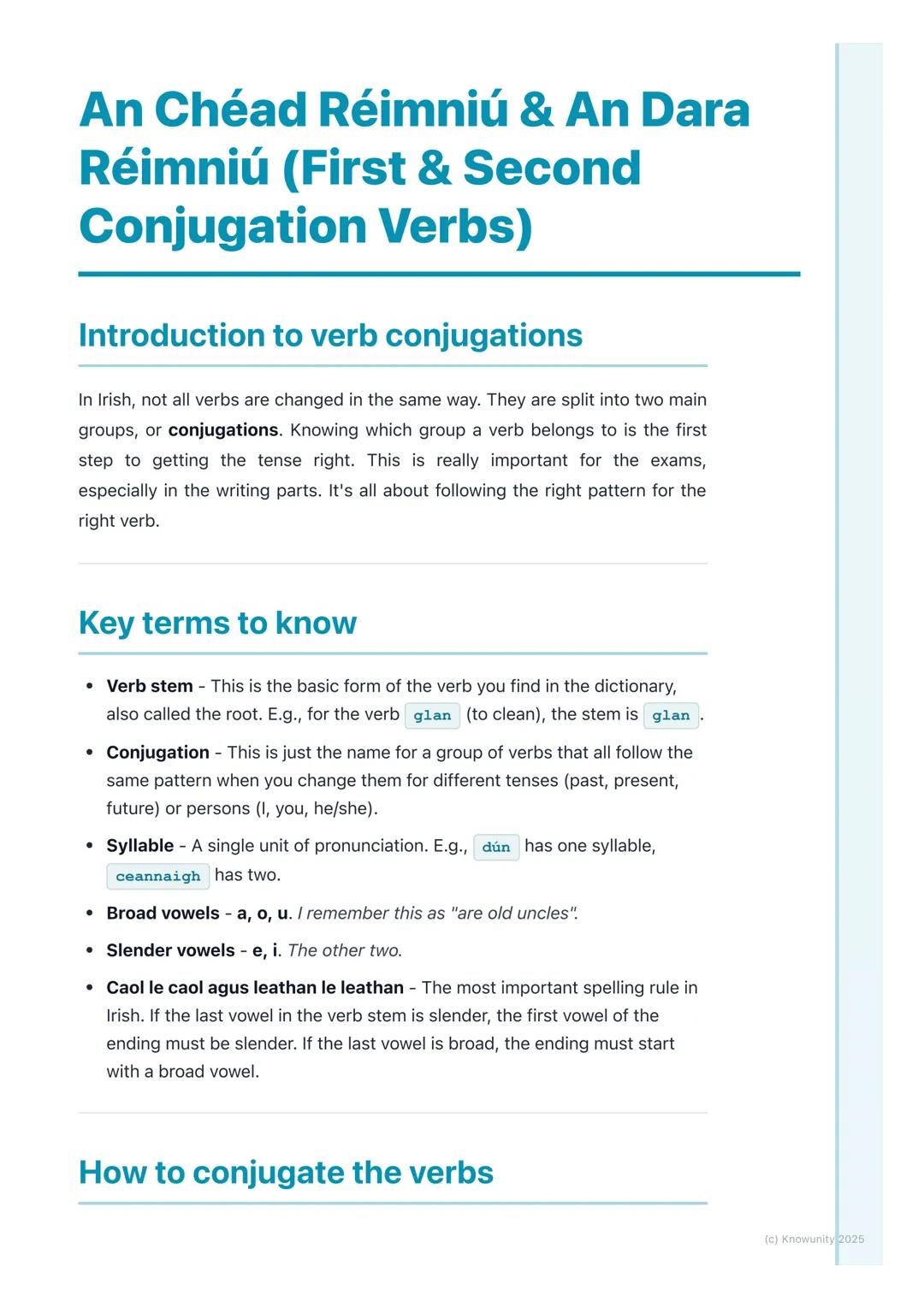
Understanding Irish Verb Conjugations
Getting your head around Irish verb conjugations is absolutely crucial for your exams, especially in the writing sections. The good news? Once you crack the system, it becomes much easier than you think.
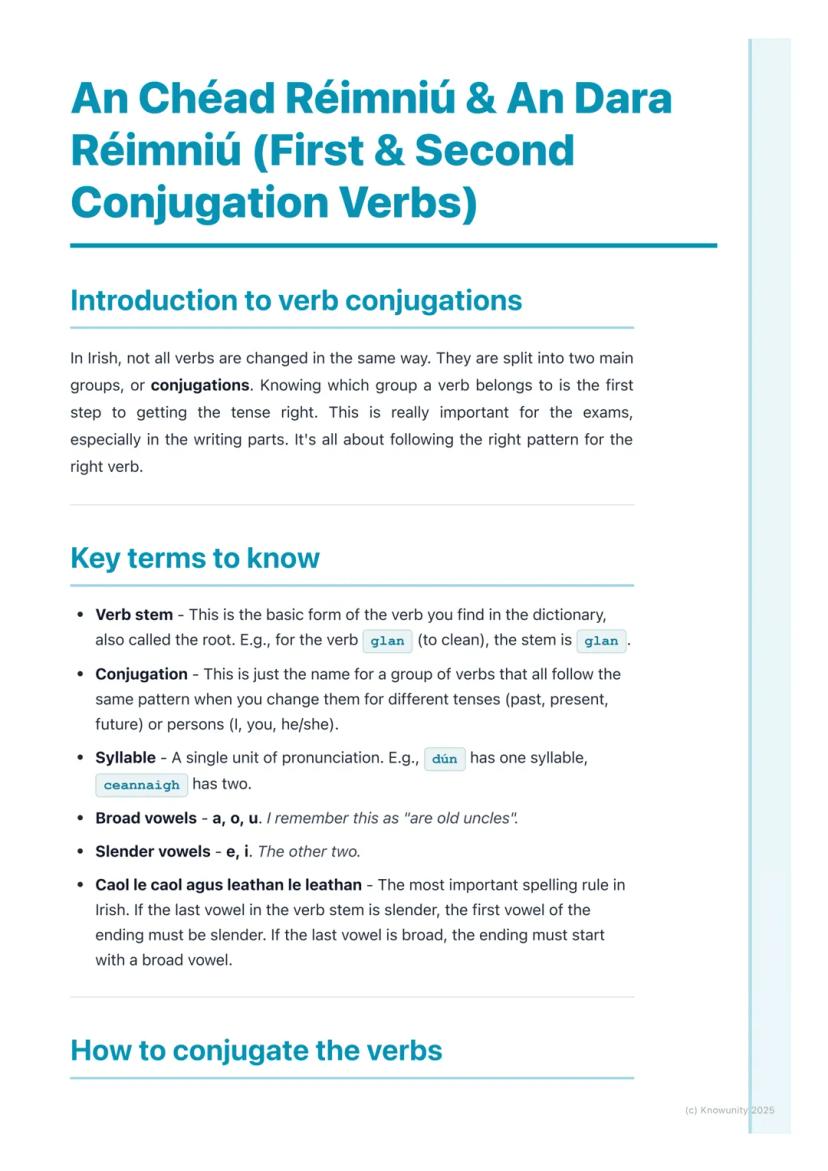
Irish verbs are split into two main groups called conjugations. Think of these as different teams that follow their own playbook. The verb stem is just the basic dictionary form of the verb - like glan (to clean) or dún (to close).
Here's a game-changer: caol le caol agus leathan le leathan is the most important spelling rule you'll ever learn in Irish. If the last vowel in your verb stem is slender (e, i), your ending must start with a slender vowel. If it's broad (a, o, u), your ending must start with a broad vowel.
Quick tip: Remember broad vowels as "are old uncles" - a, o, u. The slender vowels are just e and i!
2
of 6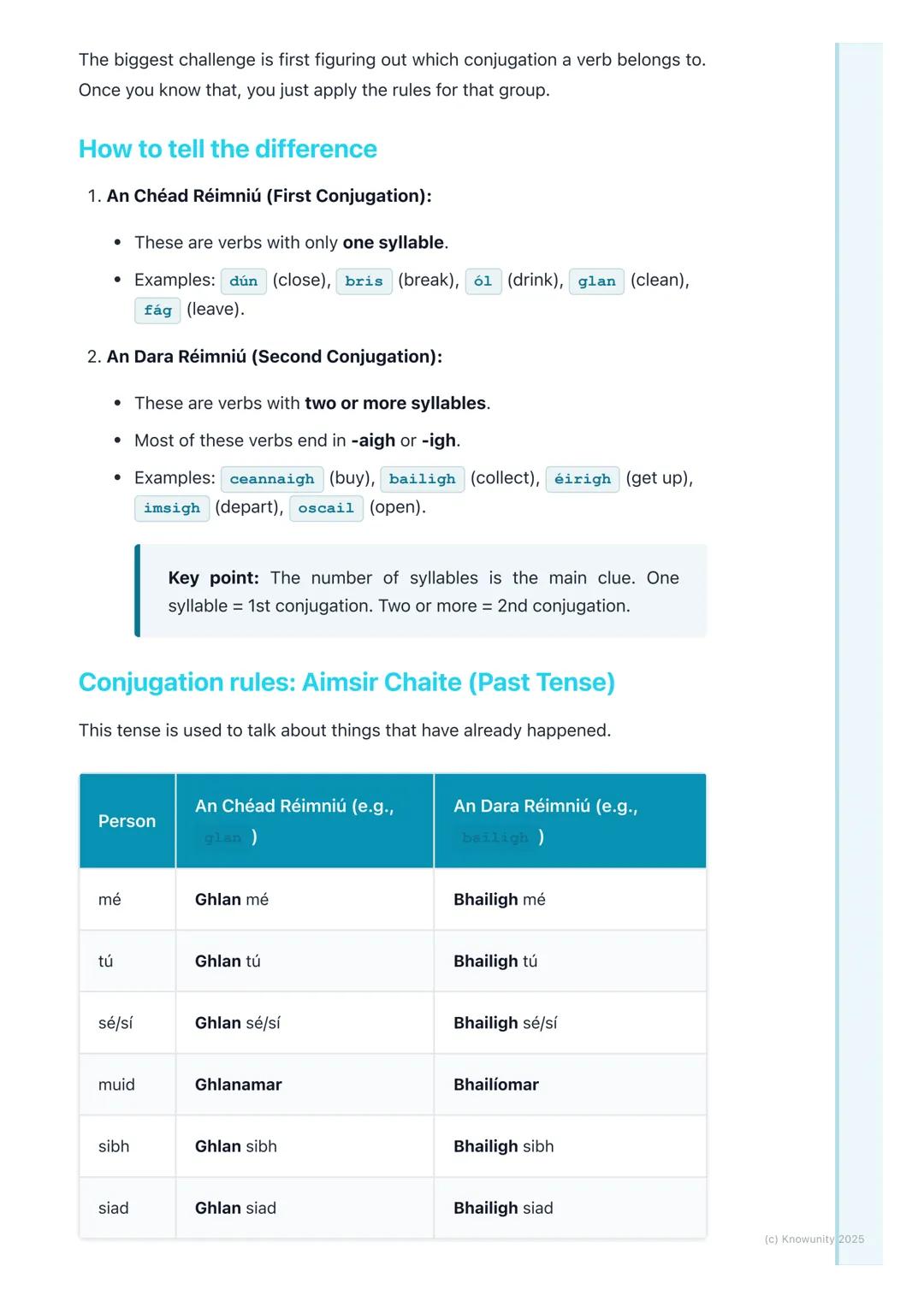
Telling the Conjugations Apart
The secret to mastering first conjugation and second conjugation verbs is surprisingly simple - just count the syllables! It's honestly that straightforward.
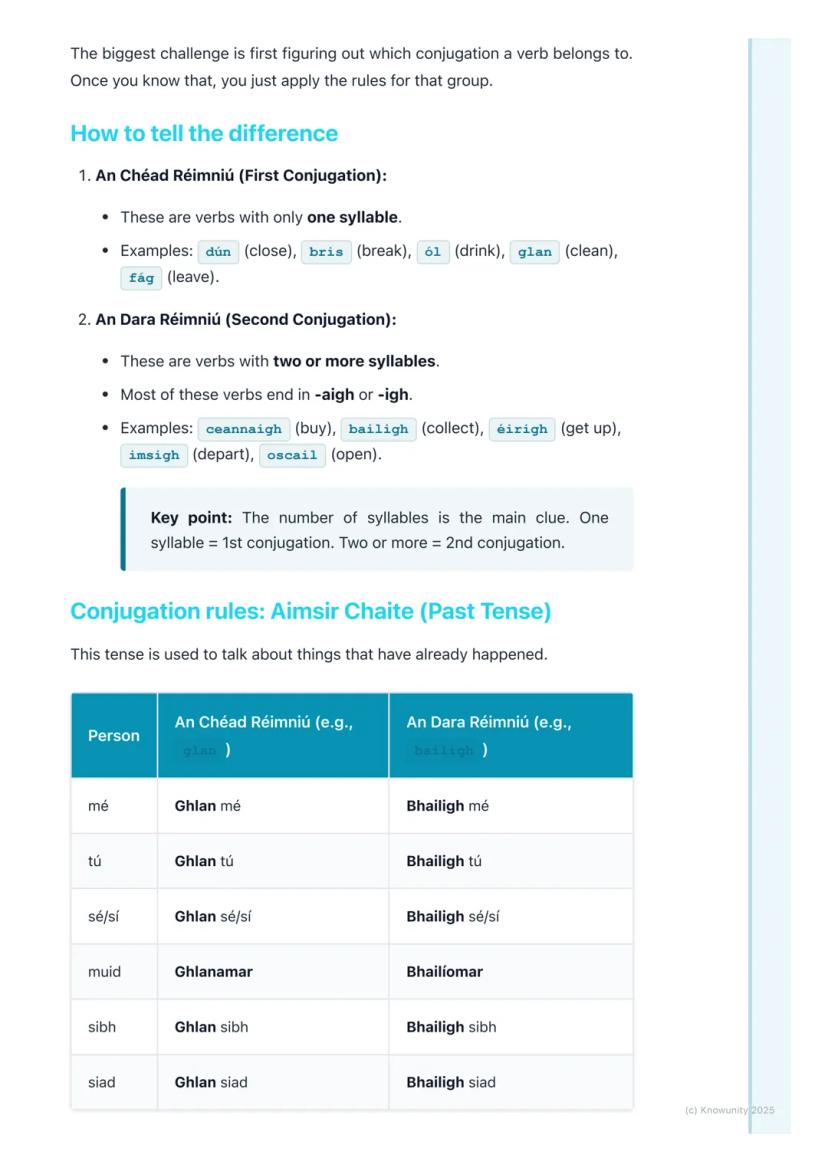
An Chéad Réimniú (First Conjugation) includes all verbs with just one syllable. Think of verbs like dún (close), bris (break), ól (drink), and glan (clean). These are your short, snappy verbs.
An Dara Réimniú (Second Conjugation) covers verbs with two or more syllables. Most of these end in -aigh or -igh, like ceannaigh (buy), bailigh (collect), éirigh (get up), and oscail (open).
Remember: One syllable = first conjugation, two or more = second conjugation. Count those syllables and you're halfway there!
3
of 6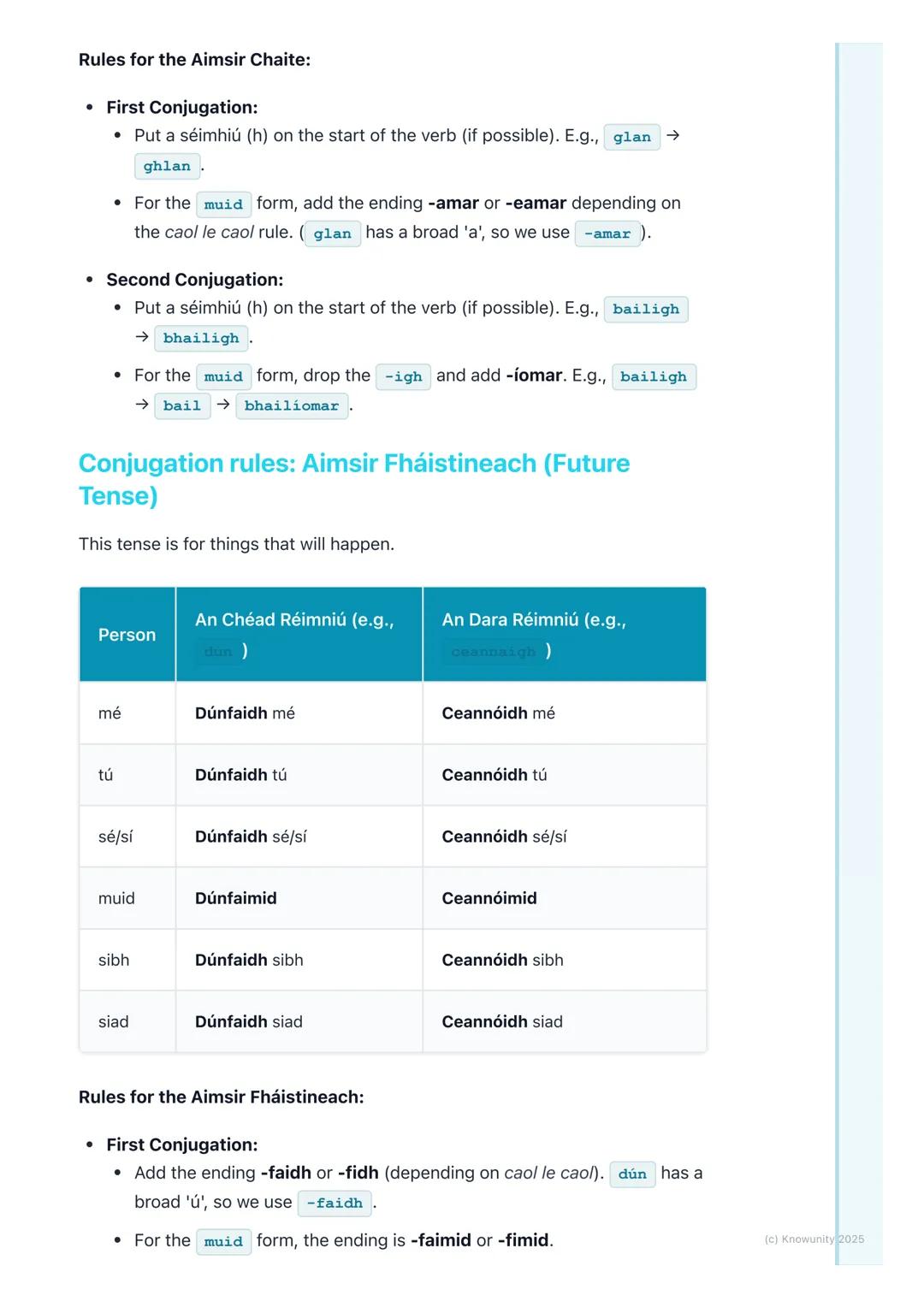
Past Tense (Aimsir Chaite)
The past tense is your go-to for describing things that have already happened, and the patterns are actually quite predictable once you get the hang of them.
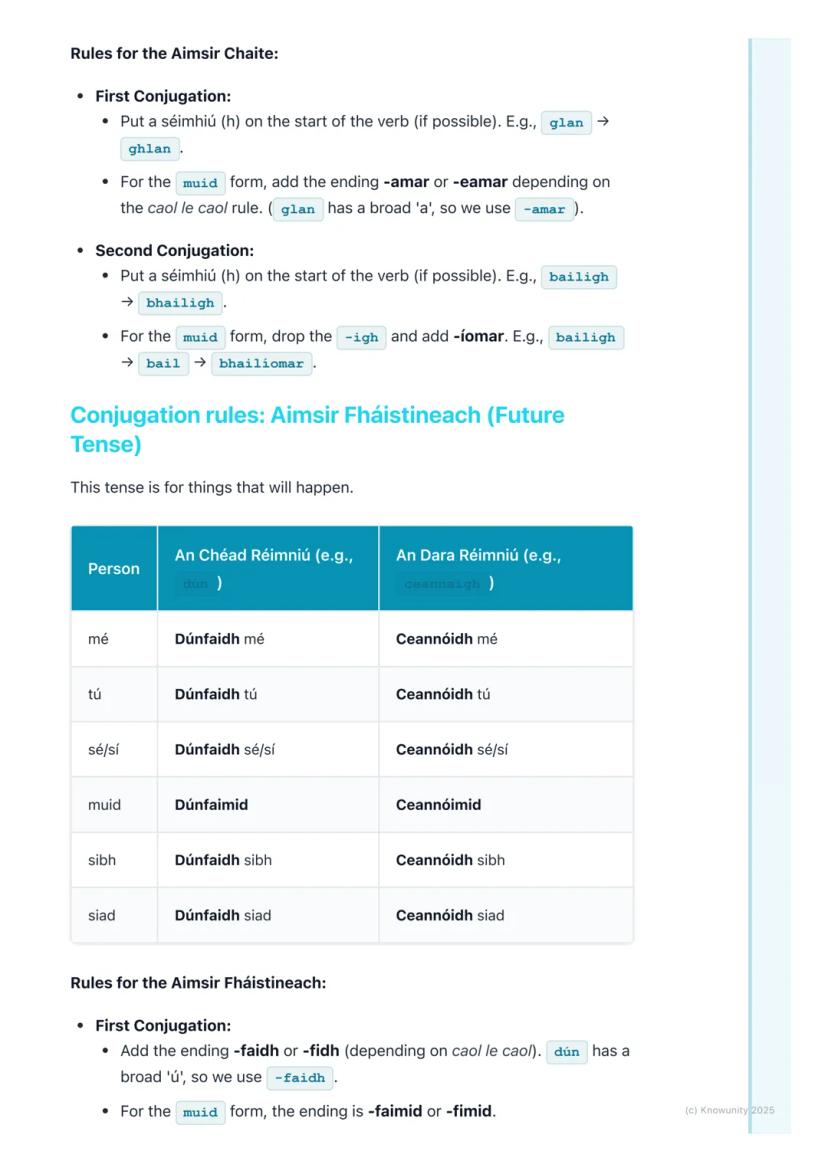
For first conjugation verbs, you add a séimhiú (that's the 'h' after the first letter) to the start. So glan becomes ghlan. For the muid form, you tack on -amar or -eamar depending on that golden rule - ghlanamar in this case.
Second conjugation verbs also get the séimhiú treatment - bailigh becomes bhailigh. But here's where it gets interesting: for the muid form, you drop the -igh and add -íomar. So bailigh becomes bhailíomar.
Watch out: Verbs starting with vowels, l, n, r, or f can't take a séimhiú. Instead, you might need to add d' before them, like d'ól mé.
4
of 6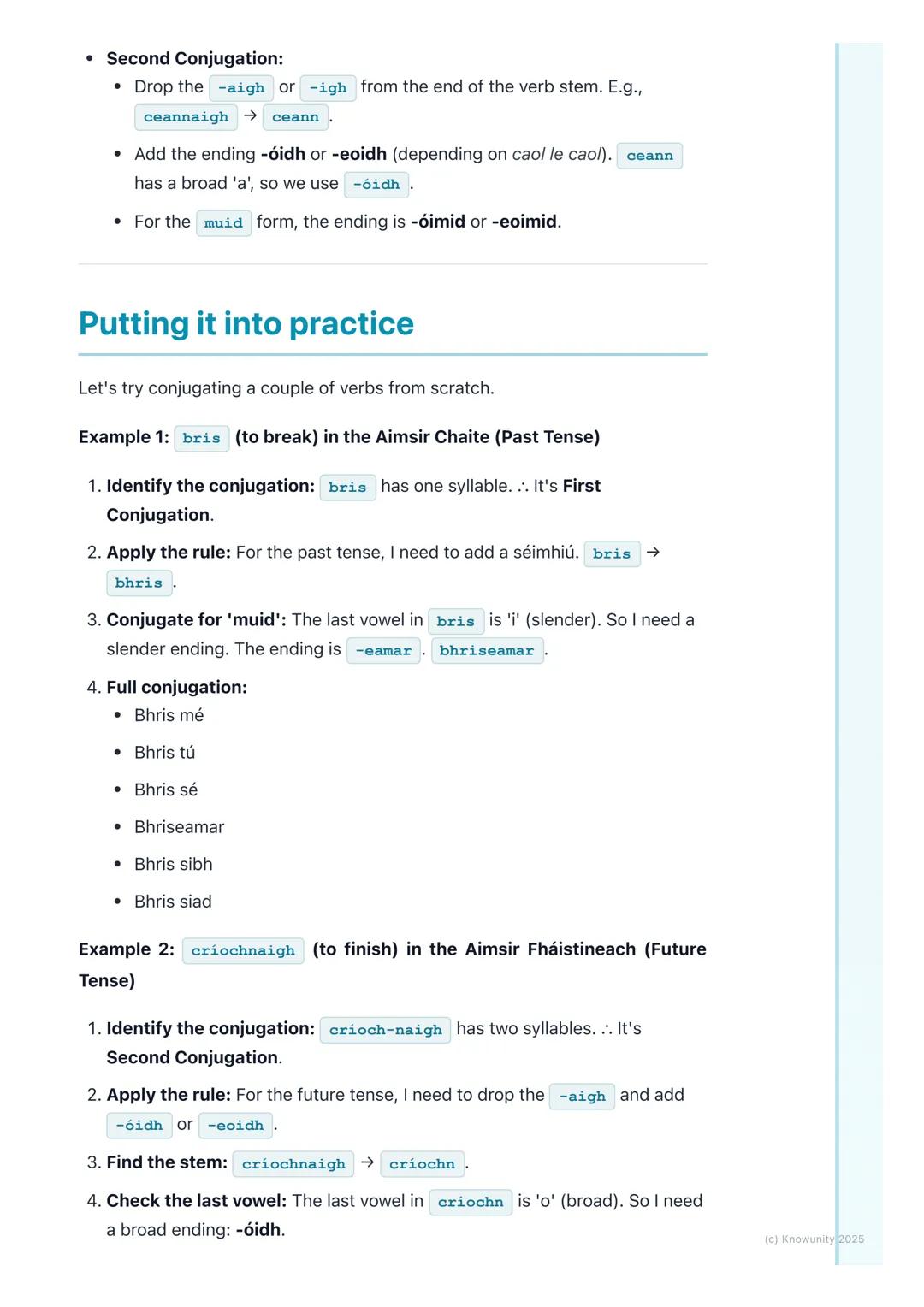
Future Tense (Aimsir Fháistineach)
The future tense is brilliant for talking about what's going to happen, and it follows some really clear patterns that'll make your life easier.
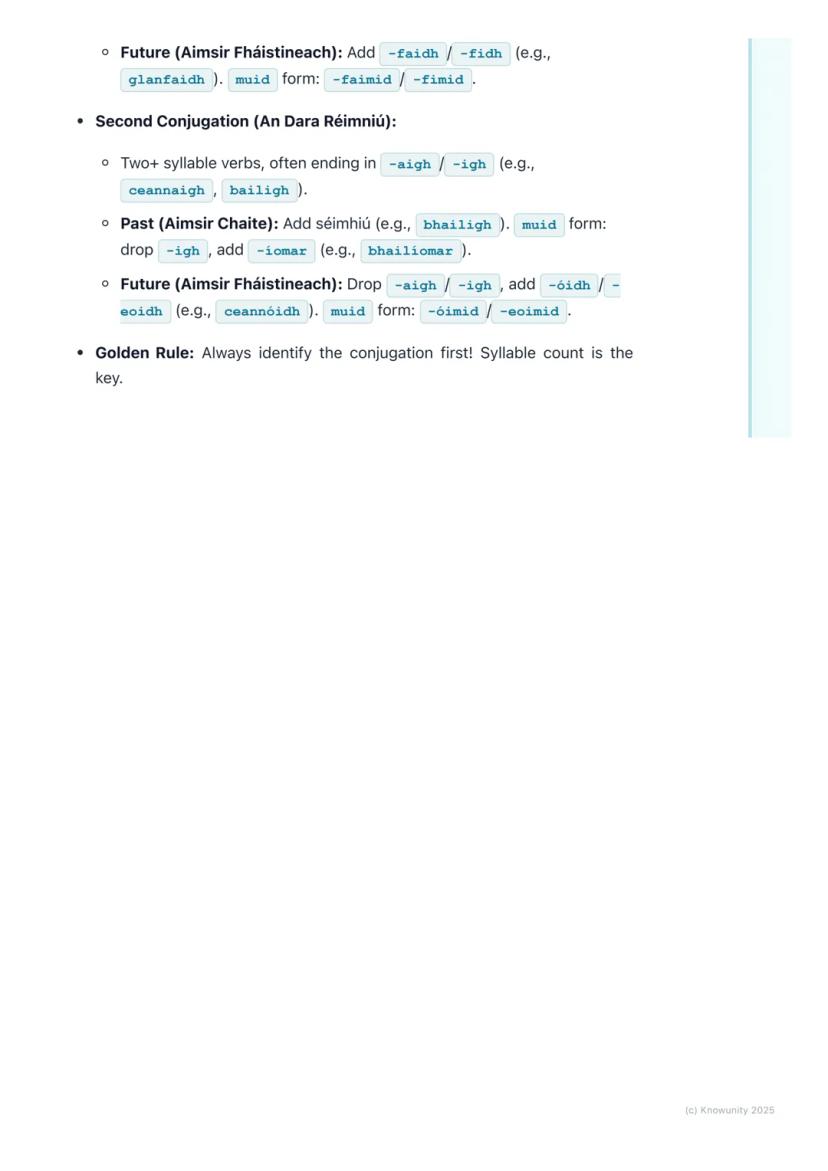
First conjugation verbs get -faidh or -fidh added to the end, following our caol le caol rule. So dún becomes dúnfaidh. For the muid form, use -faimid or -fimid - giving you dúnfaimid.
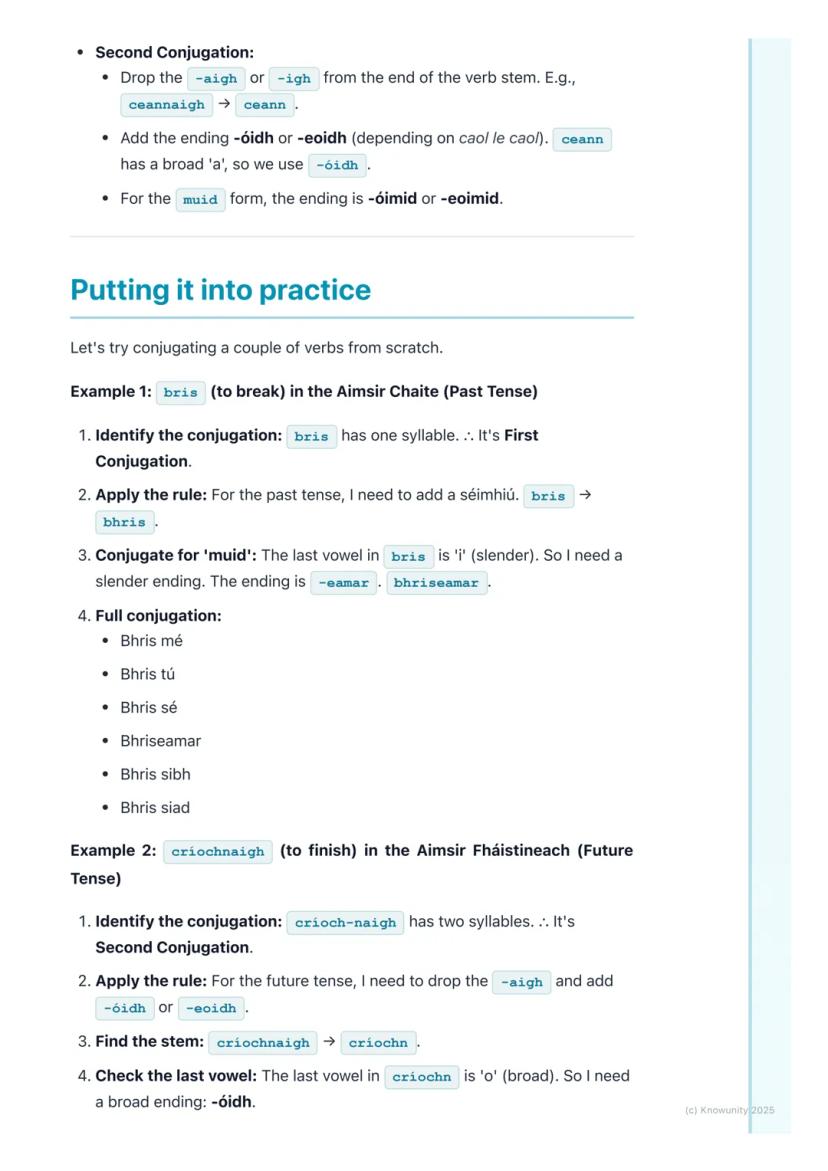
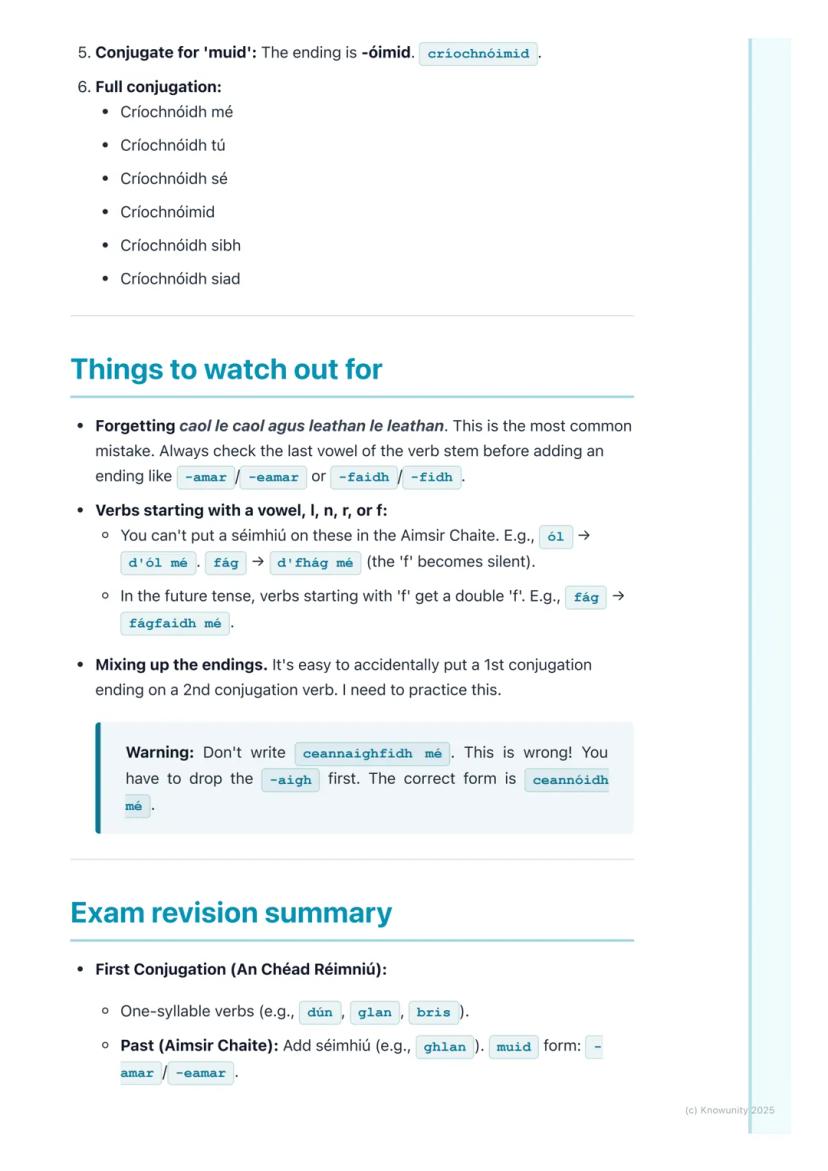
Second conjugation verbs need a bit more work. First, drop that -aigh or -igh from the end - ceannaigh becomes ceann. Then add -óidh or -eoidh depending on whether the last vowel is broad or slender. Since ceann ends with broad 'a', we get ceannóidh.
Critical mistake to avoid: Never write ceannaighfidh! You must drop the -aigh first, then add the future ending.
5
of 6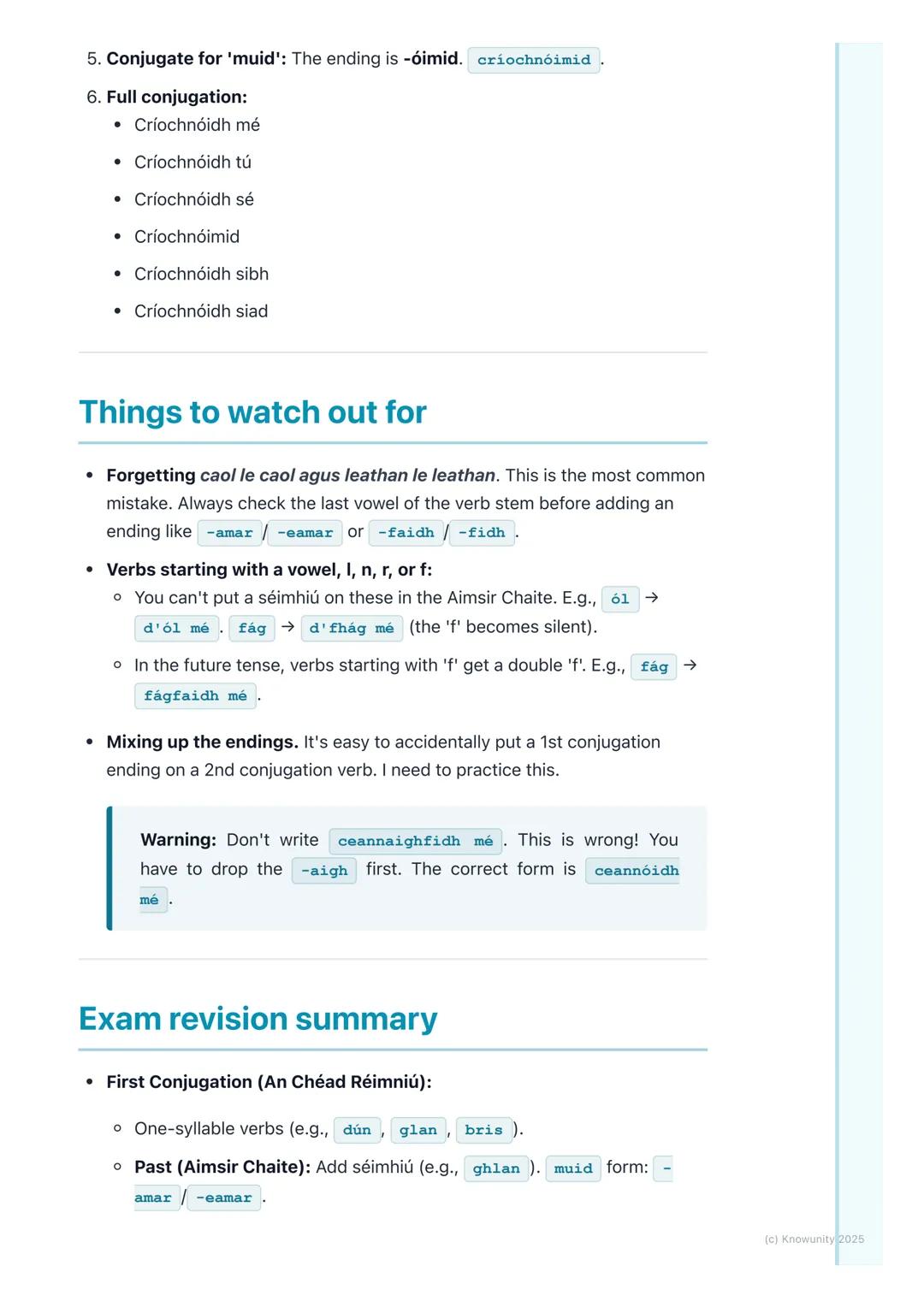
Working Through Examples
Let's put this into practice with some real examples that'll show you exactly how this works in action.
Take bris (to break) in the past tense. It's one syllable, so it's first conjugation. Add the séimhiú to get bhris, and for muid, the 'i' is slender so we need -eamar: bhriseamar. Simple as that!
Now try críochnaigh (to finish) in the future tense. Two syllables means second conjugation. Drop the -aigh to get críochn, then since the 'o' is broad, add -óidh: críochnóidh. The muid form becomes críochnóimid.
The key is following the steps methodically - identify the conjugation, apply the right rule, check your vowels, and you're sorted. Practice with different verbs and you'll spot the patterns quickly.
Pro tip: Always identify which conjugation you're dealing with before you start changing anything. This one step will save you from most mistakes!
6
of 6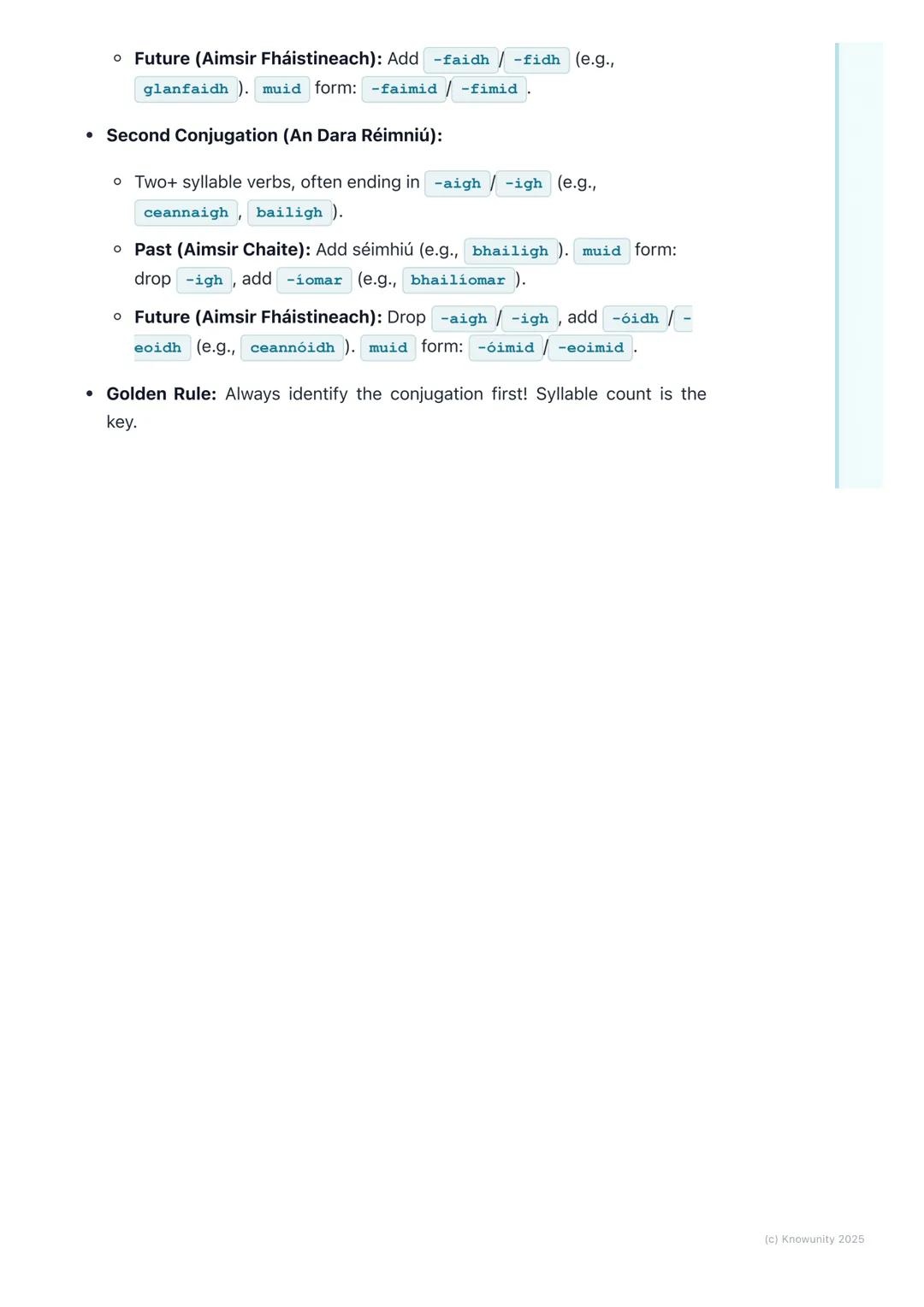
Exam Success Summary
Here's everything you need to remember for your exams, broken down into bite-sized chunks that'll stick in your memory.
First conjugation verbs have one syllable (like dún, glan, bris). In the past tense, add séimhiú and use -amar/-eamar for muid. In the future, add -faidh/-fidh and -faimid/-fimid for muid.
Second conjugation verbs have two or more syllables, often ending in -aigh/-igh (like ceannaigh, bailigh). Past tense gets séimhiú, with muid dropping -igh and adding -íomar. Future tense drops -aigh/-igh and adds -óidh/-eoidh, with muid getting -óimid/-eoimid.
Remember: count syllables first, follow the pattern for that conjugation, and always check your caol le caol rule. You've absolutely got this!
Final reminder: The syllable count is your compass - it'll always point you in the right direction for which conjugation to use.
We dachten al dat je dit zou vragen...
Wat is de Knowunity AI companion?
Onze AI Companion is een studentgerichte AI-tool die meer biedt dan alleen antwoorden. Gebouwd op miljoenen Knowunity bronnen, biedt het relevante informatie, gepersonaliseerde studieplannen, quizzes en inhoud direct in de chat, aangepast aan jouw individuele leertraject.
Waar kan ik de Knowunity-app downloaden?
Je kunt de app downloaden via Google Play Store en Apple App Store.
Is Knowunity echt gratis?
Dat klopt! Geniet van gratis toegang tot leerinhoud, maak contact met medestudenten en krijg directe hulp – alles binnen handbereik.
Populairste studiemateriaal voor Irish
9IrishIrish oral questions and answers
Questions and answers for the leaving cert oral
5th Year4264
IrishIrish oral questions
Outline of oral questions
5th Year2055
IrishIrish poetry 2027
Iníon + Dínit an Bhróin
5th Year1133
IrishIníon- le hÁine Durkin
Aine Durkin’s poem, Iníon: Themes & summary
5th Year850
IrishLC HL notes- Iníon (poem)
Includes poem in English and Irish, theme, key words & phrases
5th Year2284
IrishMo Ghrá-sa (Idir Lúibíní)
Notes on mo ghrá-sa
5th Year380
IrishGaeilge Grammar Office
All the basics you need to know on Irish grammar.
6th Year1063
IrishAn Gaeilge Aiste
Irish Language essay
6th Year1320
IrishMé Féin & Mo Chlann (Myself & My Family)
Students will learn vocabulary to describe themselves, their family members, and daily routines. This helps in personal introductions and discussions.
TY291
Populairste studiemateriaal
9IrishIrish oral questions and answers
Questions and answers for the leaving cert oral
5th Year4264
 English
Key Quotes : Sive
Key Quotes and explanations: Sive
6th Year2842
IrishIrish oral questions
Outline of oral questions
5th Year2055
IrishIníon- le hÁine Durkin
Aine Durkin’s poem, Iníon: Themes & summary
5th Year850
IrishIrish poetry 2027
Iníon + Dínit an Bhróin
5th Year1133
IrishLC HL notes- Iníon (poem)
Includes poem in English and Irish, theme, key words & phrases
5th Year2284
EnglishCultural Context : Shawshank Redemption : Sive : Small Things Like These
Comparative Study : Cultural Context : Shawshank Redemption, Sive and Small Things Like These
6th Year1430
IrishMo Ghrá-sa (Idir Lúibíní)
Notes on mo ghrá-sa
5th Year380
IrishAn Gaeilge Aiste
Irish Language essay
6th Year1320
Kan je niet vinden wat je zoekt? Ontdek andere vakken.
Studenten zijn dol op ons — en jij ook.
4.6/5App Store
4.7/5Google Play
De app is heel makkelijk te gebruiken en goed ontworpen. Ik heb tot nu toe alles kunnen vinden waar ik naar zocht en heb veel kunnen leren van de presentaties! Ik ga de app zeker gebruiken voor een schoolopdracht! En natuurlijk helpt het ook veel als inspiratie.
Stefan SiOS gebruiker
Deze app is echt geweldig. Er zijn zoveel aantekeningen en hulpmiddelen [...]. Mijn probleemvak is bijvoorbeeld Frans, en de app heeft zoveel opties voor hulp. Dankzij deze app ben ik beter geworden in Frans. Ik zou het iedereen aanraden.
Samantha KlichAndroid gebruiker
Wow, ik ben echt onder de indruk. Ik probeerde de app gewoon omdat ik hem vaak geadverteerd had gezien en was absoluut verbaasd. Deze app is DE HULP die je wilt voor school en bovenal biedt hij zoveel dingen, zoals oefeningen en factsheets, die mij persoonlijk HEEL erg hebben geholpen.
AnnaiOS gebruiker
Irish3 weergaven·Bijgewerkt Jun 4, 2026·6 pagina'sIrish Verb Conjugations Explained: First and Second Types
Learning Irish verb conjugations might seem daunting, but it's actually quite straightforward once you know the patterns. All Irish verbs fall into two main groups based on how many syllables they have, and each group follows its own set of...
1
of 6
Meld je aan om de inhoud te zien. Het is gratis!
- Toegang tot alle documenten
- Verbeter je cijfers
- Sluit je aan bij miljoenen studenten
Understanding Irish Verb Conjugations
Getting your head around Irish verb conjugations is absolutely crucial for your exams, especially in the writing sections. The good news? Once you crack the system, it becomes much easier than you think.
Irish verbs are split into two main groups called conjugations. Think of these as different teams that follow their own playbook. The verb stem is just the basic dictionary form of the verb - like glan (to clean) or dún (to close).
Here's a game-changer: caol le caol agus leathan le leathan is the most important spelling rule you'll ever learn in Irish. If the last vowel in your verb stem is slender (e, i), your ending must start with a slender vowel. If it's broad (a, o, u), your ending must start with a broad vowel.
Quick tip: Remember broad vowels as "are old uncles" - a, o, u. The slender vowels are just e and i!
2
of 6Meld je aan om de inhoud te zien. Het is gratis!
- Toegang tot alle documenten
- Verbeter je cijfers
- Sluit je aan bij miljoenen studenten
Telling the Conjugations Apart
The secret to mastering first conjugation and second conjugation verbs is surprisingly simple - just count the syllables! It's honestly that straightforward.
An Chéad Réimniú (First Conjugation) includes all verbs with just one syllable. Think of verbs like dún (close), bris (break), ól (drink), and glan (clean). These are your short, snappy verbs.
An Dara Réimniú (Second Conjugation) covers verbs with two or more syllables. Most of these end in -aigh or -igh, like ceannaigh (buy), bailigh (collect), éirigh (get up), and oscail (open).
Remember: One syllable = first conjugation, two or more = second conjugation. Count those syllables and you're halfway there!
3
of 6Meld je aan om de inhoud te zien. Het is gratis!
- Toegang tot alle documenten
- Verbeter je cijfers
- Sluit je aan bij miljoenen studenten
Past Tense (Aimsir Chaite)
The past tense is your go-to for describing things that have already happened, and the patterns are actually quite predictable once you get the hang of them.
For first conjugation verbs, you add a séimhiú (that's the 'h' after the first letter) to the start. So glan becomes ghlan. For the muid form, you tack on -amar or -eamar depending on that golden rule - ghlanamar in this case.
Second conjugation verbs also get the séimhiú treatment - bailigh becomes bhailigh. But here's where it gets interesting: for the muid form, you drop the -igh and add -íomar. So bailigh becomes bhailíomar.
Watch out: Verbs starting with vowels, l, n, r, or f can't take a séimhiú. Instead, you might need to add d' before them, like d'ól mé.
4
of 6Meld je aan om de inhoud te zien. Het is gratis!
- Toegang tot alle documenten
- Verbeter je cijfers
- Sluit je aan bij miljoenen studenten
Future Tense (Aimsir Fháistineach)
The future tense is brilliant for talking about what's going to happen, and it follows some really clear patterns that'll make your life easier.
First conjugation verbs get -faidh or -fidh added to the end, following our caol le caol rule. So dún becomes dúnfaidh. For the muid form, use -faimid or -fimid - giving you dúnfaimid.
Second conjugation verbs need a bit more work. First, drop that -aigh or -igh from the end - ceannaigh becomes ceann. Then add -óidh or -eoidh depending on whether the last vowel is broad or slender. Since ceann ends with broad 'a', we get ceannóidh.
Critical mistake to avoid: Never write ceannaighfidh! You must drop the -aigh first, then add the future ending.
5
of 6Meld je aan om de inhoud te zien. Het is gratis!
- Toegang tot alle documenten
- Verbeter je cijfers
- Sluit je aan bij miljoenen studenten
Working Through Examples
Let's put this into practice with some real examples that'll show you exactly how this works in action.
Take bris (to break) in the past tense. It's one syllable, so it's first conjugation. Add the séimhiú to get bhris, and for muid, the 'i' is slender so we need -eamar: bhriseamar. Simple as that!
Now try críochnaigh (to finish) in the future tense. Two syllables means second conjugation. Drop the -aigh to get críochn, then since the 'o' is broad, add -óidh: críochnóidh. The muid form becomes críochnóimid.
The key is following the steps methodically - identify the conjugation, apply the right rule, check your vowels, and you're sorted. Practice with different verbs and you'll spot the patterns quickly.
Pro tip: Always identify which conjugation you're dealing with before you start changing anything. This one step will save you from most mistakes!
6
of 6Meld je aan om de inhoud te zien. Het is gratis!
- Toegang tot alle documenten
- Verbeter je cijfers
- Sluit je aan bij miljoenen studenten
Exam Success Summary
Here's everything you need to remember for your exams, broken down into bite-sized chunks that'll stick in your memory.
First conjugation verbs have one syllable (like dún, glan, bris). In the past tense, add séimhiú and use -amar/-eamar for muid. In the future, add -faidh/-fidh and -faimid/-fimid for muid.
Second conjugation verbs have two or more syllables, often ending in -aigh/-igh (like ceannaigh, bailigh). Past tense gets séimhiú, with muid dropping -igh and adding -íomar. Future tense drops -aigh/-igh and adds -óidh/-eoidh, with muid getting -óimid/-eoimid.
Remember: count syllables first, follow the pattern for that conjugation, and always check your caol le caol rule. You've absolutely got this!
Final reminder: The syllable count is your compass - it'll always point you in the right direction for which conjugation to use.
We dachten al dat je dit zou vragen...
Wat is de Knowunity AI companion?
Onze AI Companion is een studentgerichte AI-tool die meer biedt dan alleen antwoorden. Gebouwd op miljoenen Knowunity bronnen, biedt het relevante informatie, gepersonaliseerde studieplannen, quizzes en inhoud direct in de chat, aangepast aan jouw individuele leertraject.
Waar kan ik de Knowunity-app downloaden?
Je kunt de app downloaden via Google Play Store en Apple App Store.
Is Knowunity echt gratis?
Dat klopt! Geniet van gratis toegang tot leerinhoud, maak contact met medestudenten en krijg directe hulp – alles binnen handbereik.
Populairste studiemateriaal voor Irish
9IrishIrish oral questions and answers
Questions and answers for the leaving cert oral
5th Year4264
IrishIrish oral questions
Outline of oral questions
5th Year2055
IrishIrish poetry 2027
Iníon + Dínit an Bhróin
5th Year1133
IrishIníon- le hÁine Durkin
Aine Durkin’s poem, Iníon: Themes & summary
5th Year850
IrishLC HL notes- Iníon (poem)
Includes poem in English and Irish, theme, key words & phrases
5th Year2284
IrishMo Ghrá-sa (Idir Lúibíní)
Notes on mo ghrá-sa
5th Year380
IrishGaeilge Grammar Office
All the basics you need to know on Irish grammar.
6th Year1063
IrishAn Gaeilge Aiste
Irish Language essay
6th Year1320
IrishMé Féin & Mo Chlann (Myself & My Family)
Students will learn vocabulary to describe themselves, their family members, and daily routines. This helps in personal introductions and discussions.
TY291
Populairste studiemateriaal
9IrishIrish oral questions and answers
Questions and answers for the leaving cert oral
5th Year4264
EnglishKey Quotes : Sive
Key Quotes and explanations: Sive
6th Year2842
IrishIrish oral questions
Outline of oral questions
5th Year2055
IrishIníon- le hÁine Durkin
Aine Durkin’s poem, Iníon: Themes & summary
5th Year850
IrishIrish poetry 2027
Iníon + Dínit an Bhróin
5th Year1133
IrishLC HL notes- Iníon (poem)
Includes poem in English and Irish, theme, key words & phrases
5th Year2284
EnglishCultural Context : Shawshank Redemption : Sive : Small Things Like These
Comparative Study : Cultural Context : Shawshank Redemption, Sive and Small Things Like These
6th Year1430
IrishMo Ghrá-sa (Idir Lúibíní)
Notes on mo ghrá-sa
5th Year380
IrishAn Gaeilge Aiste
Irish Language essay
6th Year1320
Kan je niet vinden wat je zoekt? Ontdek andere vakken.
Studenten zijn dol op ons — en jij ook.
4.6/5App Store
4.7/5Google Play
De app is heel makkelijk te gebruiken en goed ontworpen. Ik heb tot nu toe alles kunnen vinden waar ik naar zocht en heb veel kunnen leren van de presentaties! Ik ga de app zeker gebruiken voor een schoolopdracht! En natuurlijk helpt het ook veel als inspiratie.
Stefan SiOS gebruiker
Deze app is echt geweldig. Er zijn zoveel aantekeningen en hulpmiddelen [...]. Mijn probleemvak is bijvoorbeeld Frans, en de app heeft zoveel opties voor hulp. Dankzij deze app ben ik beter geworden in Frans. Ik zou het iedereen aanraden.
Samantha KlichAndroid gebruiker
Wow, ik ben echt onder de indruk. Ik probeerde de app gewoon omdat ik hem vaak geadverteerd had gezien en was absoluut verbaasd. Deze app is DE HULP die je wilt voor school en bovenal biedt hij zoveel dingen, zoals oefeningen en factsheets, die mij persoonlijk HEEL erg hebben geholpen.
AnnaiOS gebruiker