
The genitive case (An Tuiseal Ginideach) is basically the 'of'... Meer weergeven
 Irish25 weergaven·Bijgewerkt May 18, 2026·6 pagina's
Mastering the Genitive Case: An Tuiseal Ginideach Demystified
1 / 6
1
of 6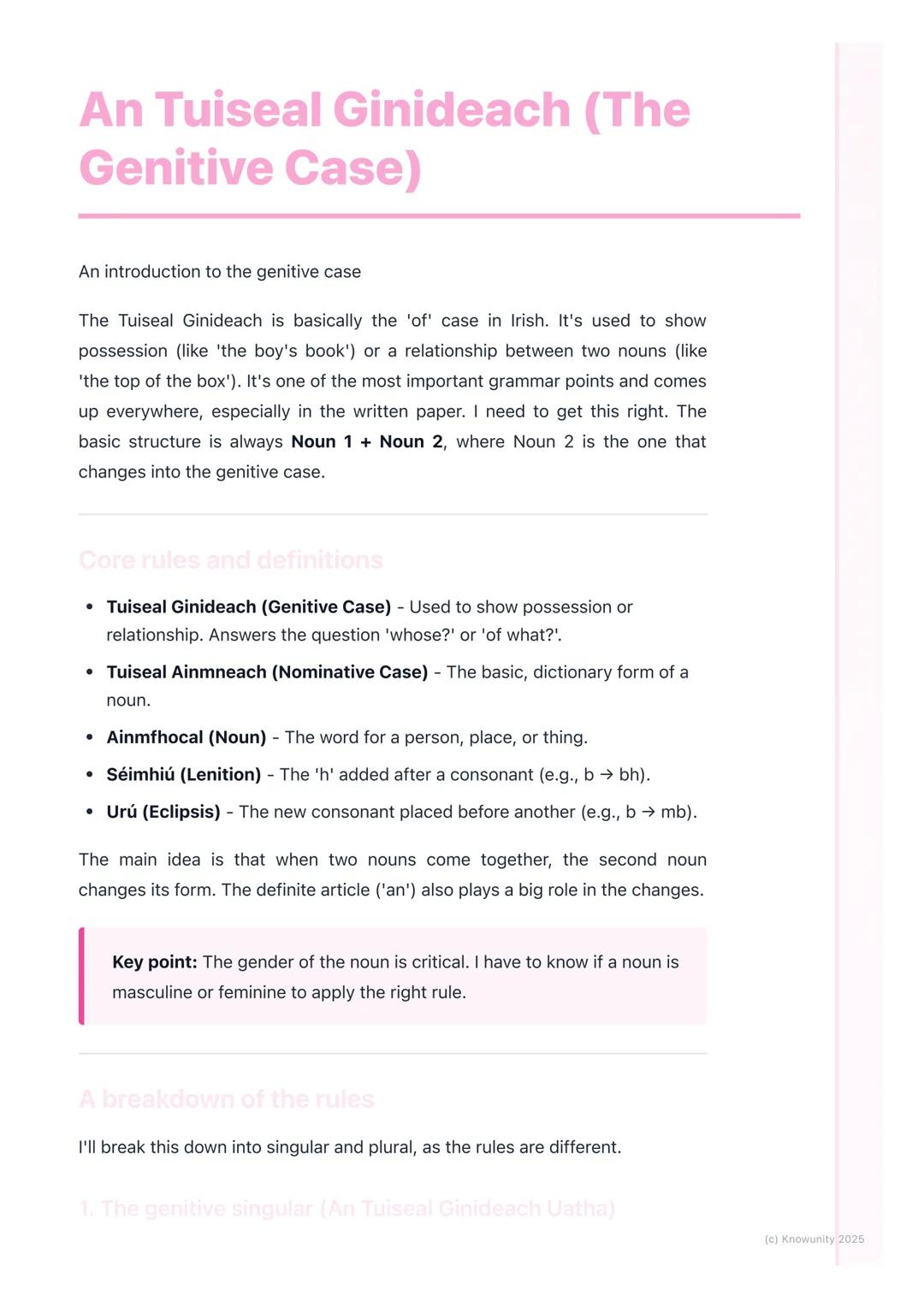
What Is the Genitive Case?
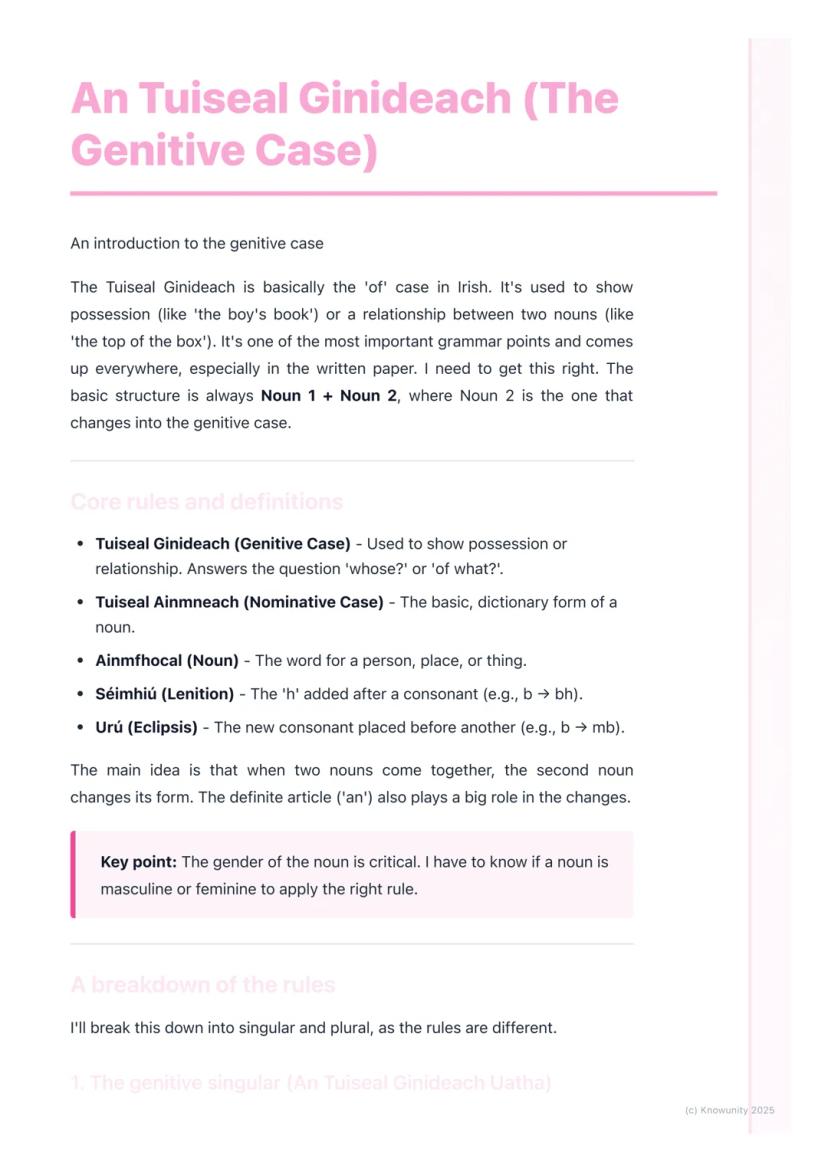
Think of the genitive as the Irish way of saying "John's car" or "the top of the mountain" - it connects two nouns together. The tuiseal ginideach always follows the same pattern: Noun 1 + Noun 2, where the second noun changes its form.
Here's what makes it tricky: the gender of your noun is absolutely everything. You can't apply the right rule without knowing if a noun is masculine or feminine first. The definite article also changes and affects how the noun mutates.
The basic building blocks you need to know are séimhiú (adding 'h' after consonants) and urú (placing new consonants before others). These mutations happen depending on which rules apply.
Quick Tip: Always identify the gender of the second noun first - this determines everything else that follows.
2
of 6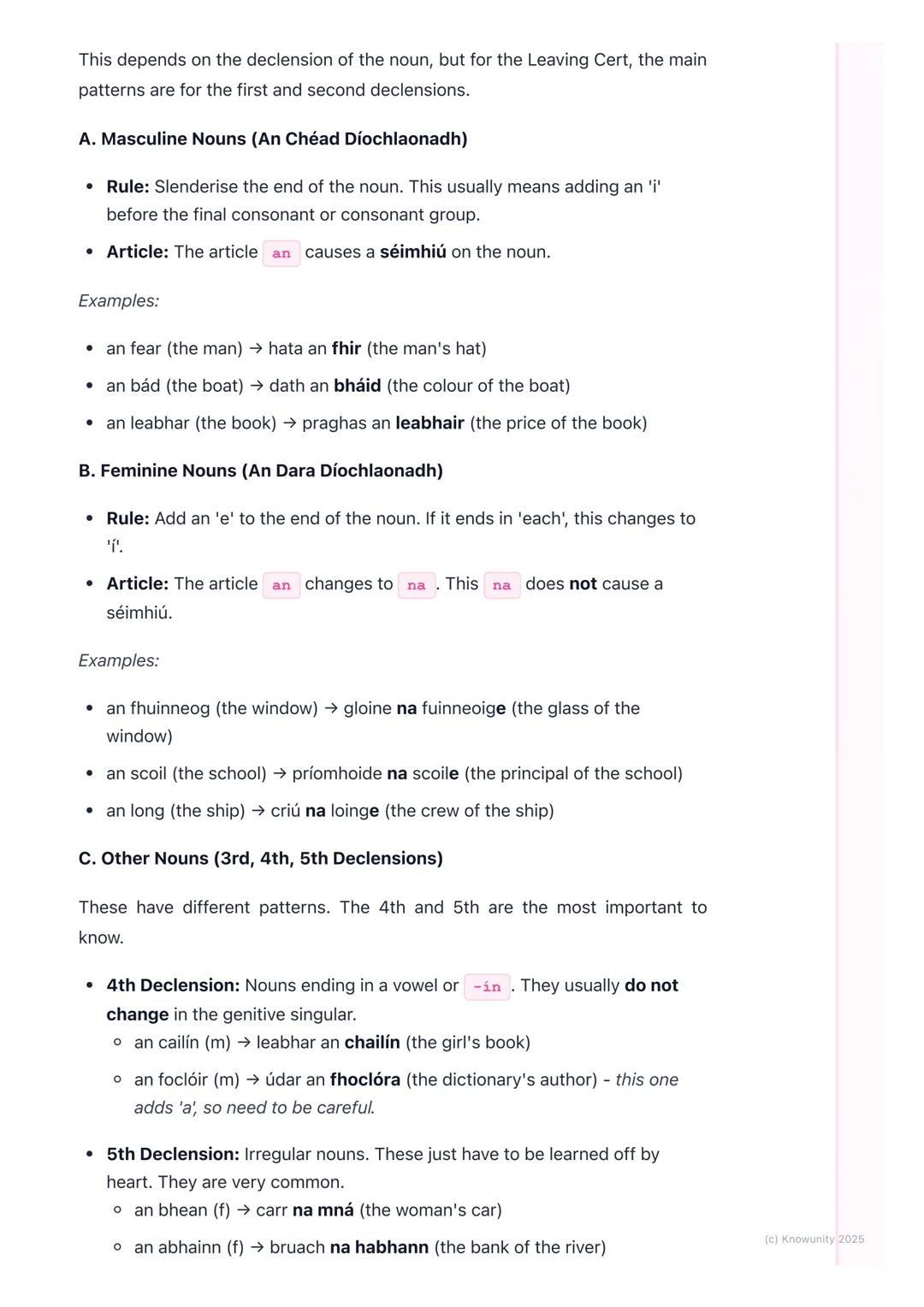
Singular Genitive Rules
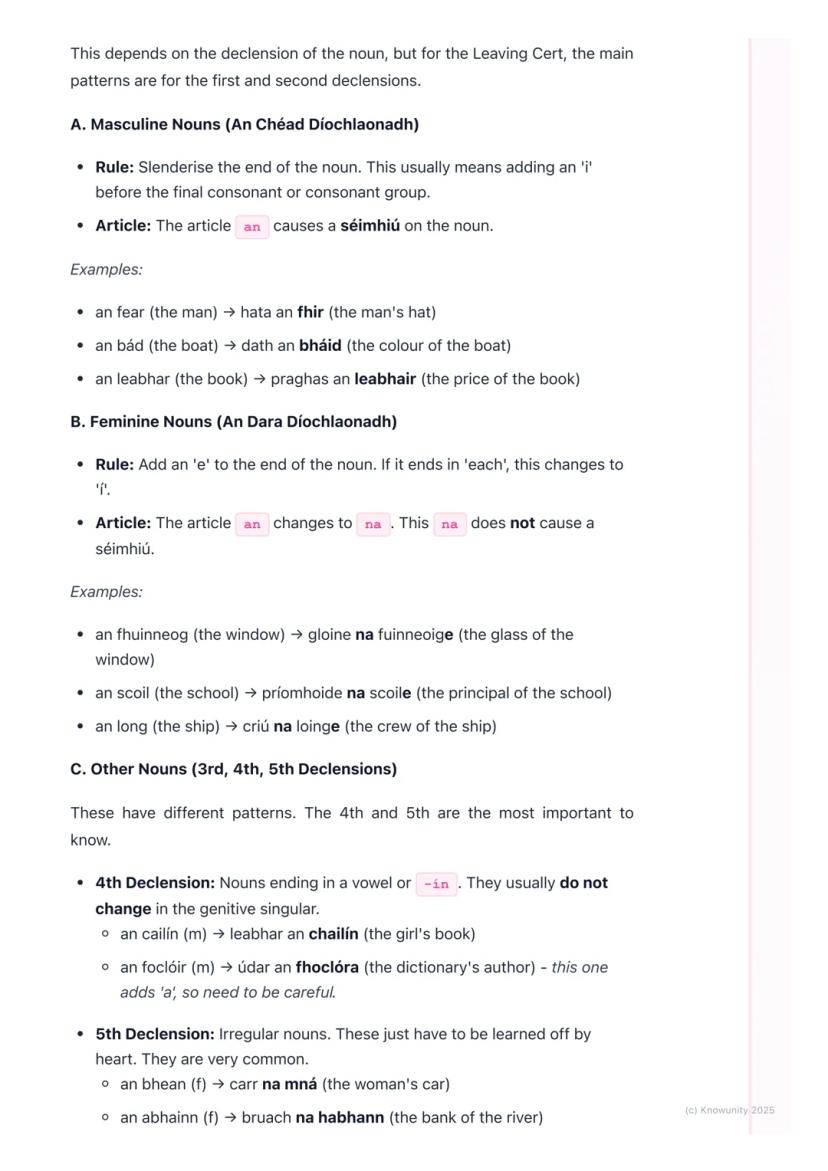
Masculine nouns follow a simple pattern: slenderise the ending (usually add 'i' before the final consonant) and use an + séimhiú. So "an fear" (the man) becomes "hata an fhir" (the man's hat), and "an bád" (the boat) becomes "dath an bháid" (the colour of the boat).
Feminine nouns work differently: add 'e' to the end and change an to na (no séimhiú). "An scoil" (the school) becomes "príomhoide na scoile" (the principal of the school).
Some nouns belong to other declensions with their own rules. Fourth declension nouns (like "an cailín") often don't change at all. Fifth declension nouns are completely irregular - "an bhean" becomes "carr na mná" (the woman's car).
Remember: The article change is crucial - "an" with séimhiú for masculine, "na" without séimhiú for feminine.
3
of 6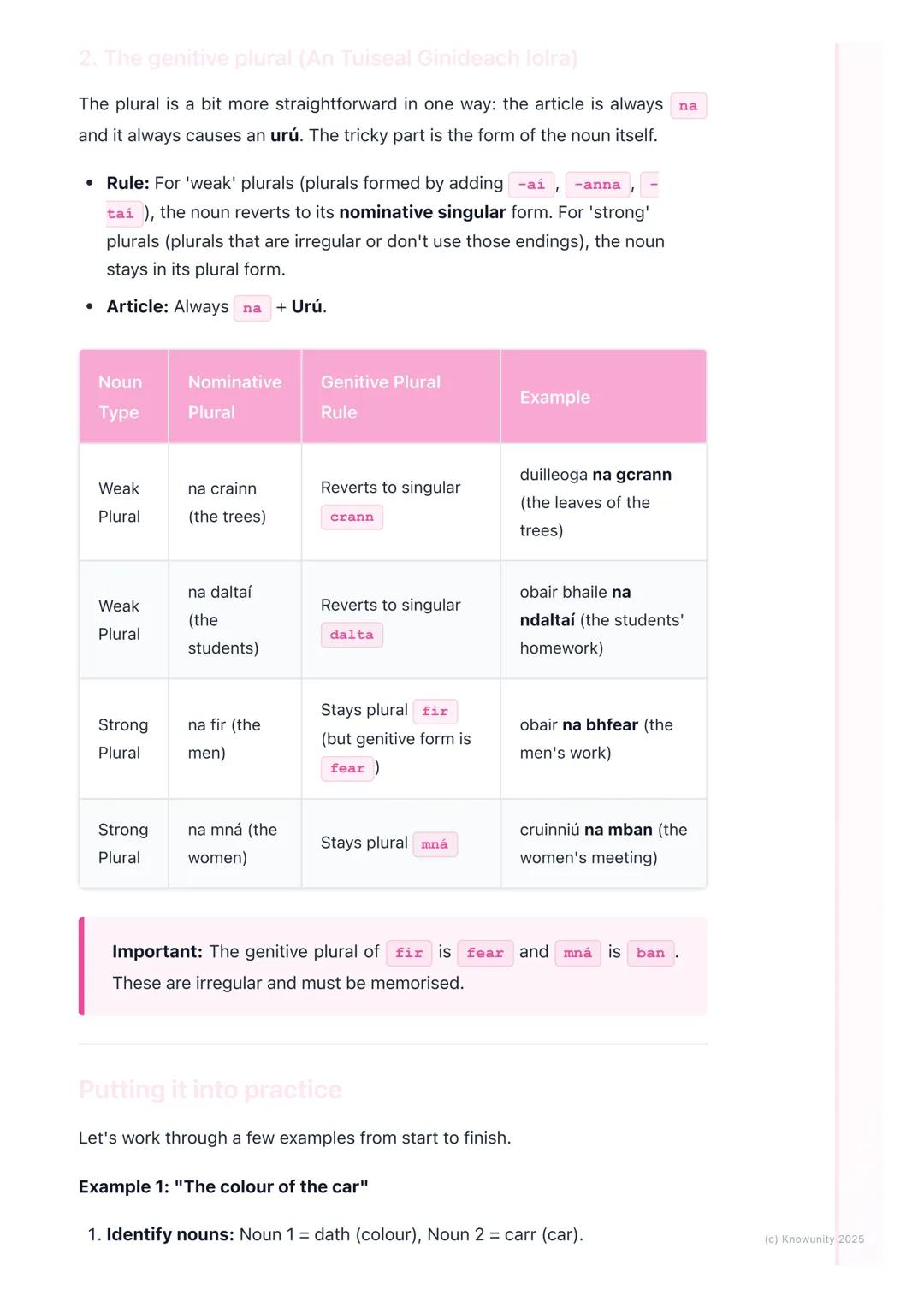
Plural Genitive Rules
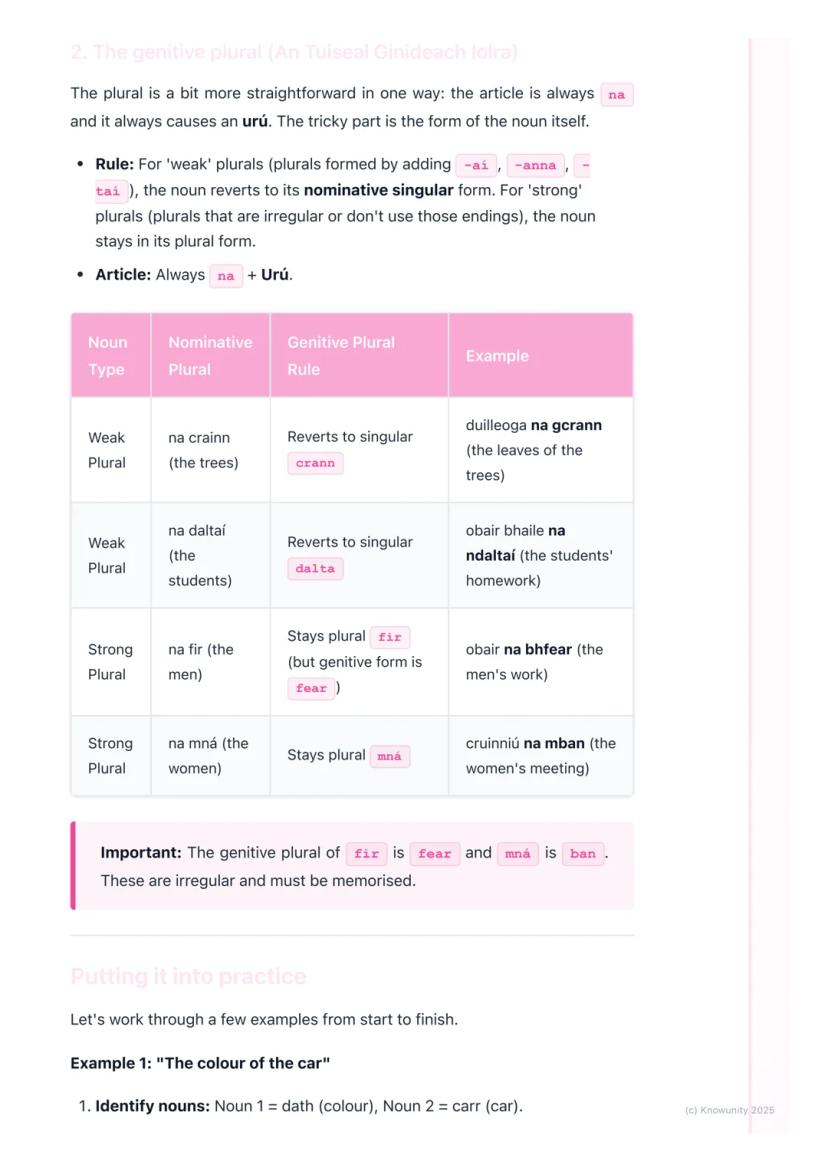
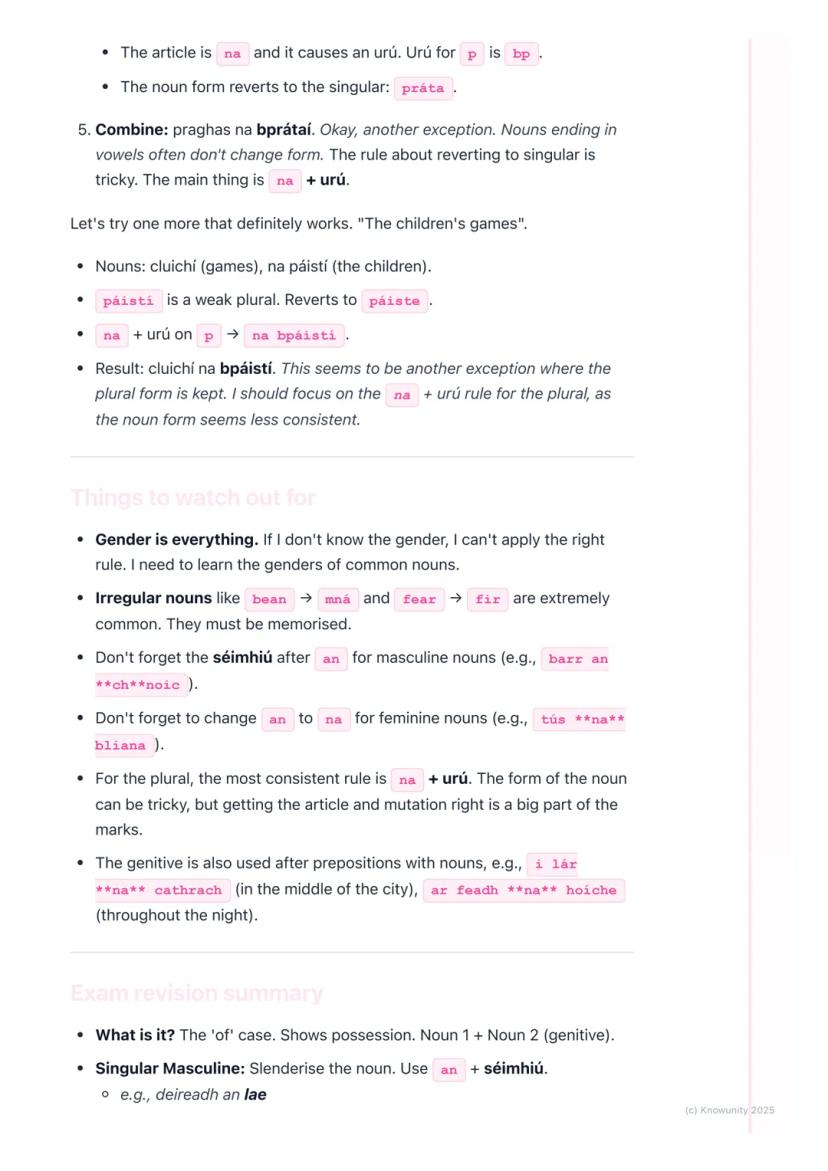
The plural genitive is actually more straightforward in one way: you always use na + urú, regardless of gender. The tricky bit is figuring out what form the noun takes.
Weak plurals typically revert to their singular form. So "na crainn" (the trees) becomes "duilleoga na gcrann" (the leaves of the trees). Strong plurals (irregular ones) usually keep their plural form but may have special genitive versions.
The most important irregulars to memorise are "na fir" → "obair na bhfear" (the men's work) and "na mná" → "cruinniú na mban" (the women's meeting). These come up constantly in exams.
Don't stress too much about whether the noun reverts to singular or stays plural - focus on getting na + urú right first, as that's where most of the marks are.
Exam Focus: Master "na + urú" for all plurals - this consistent rule will save you marks even when the noun form gets confusing.
4
of 6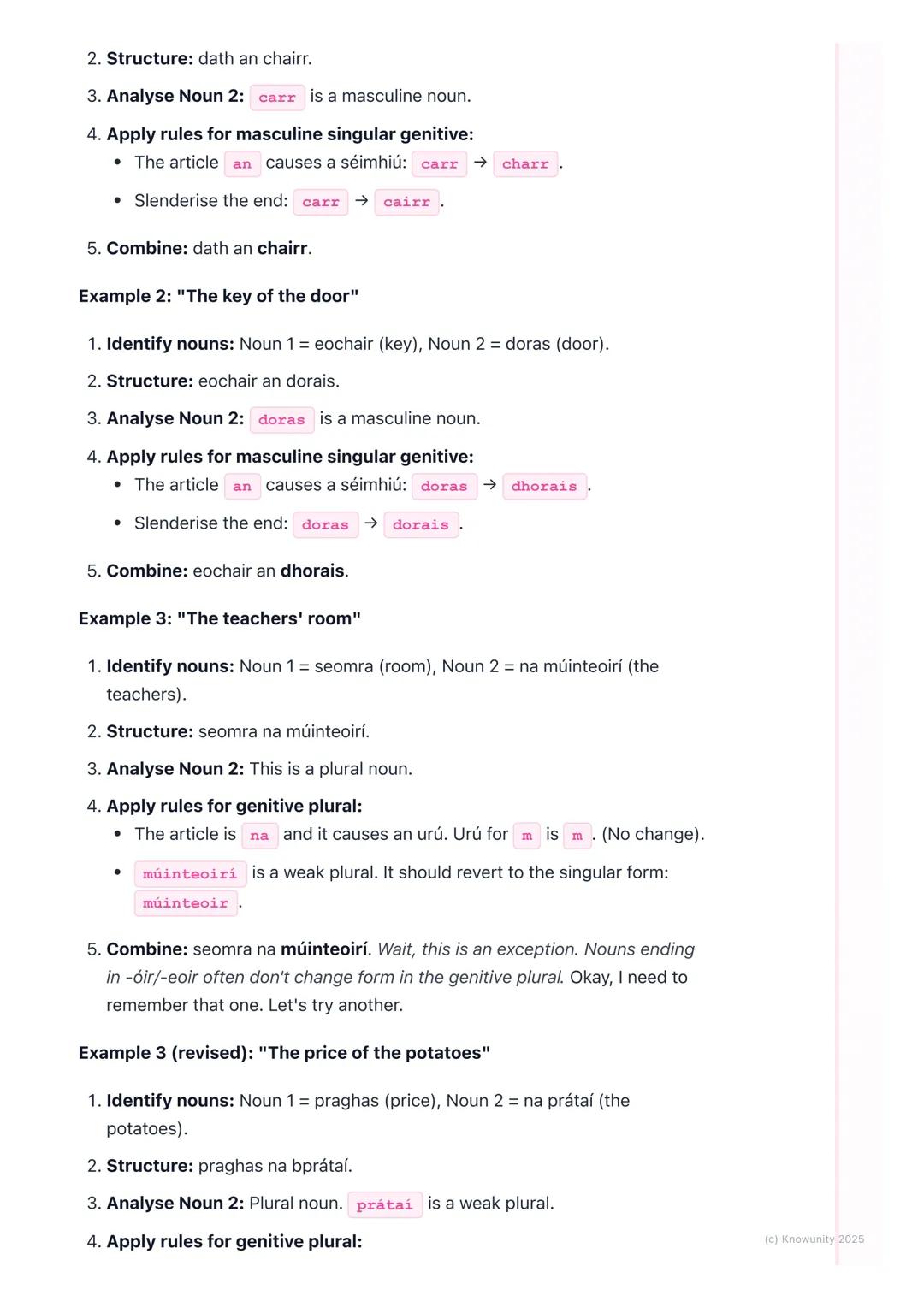
Working Through Examples
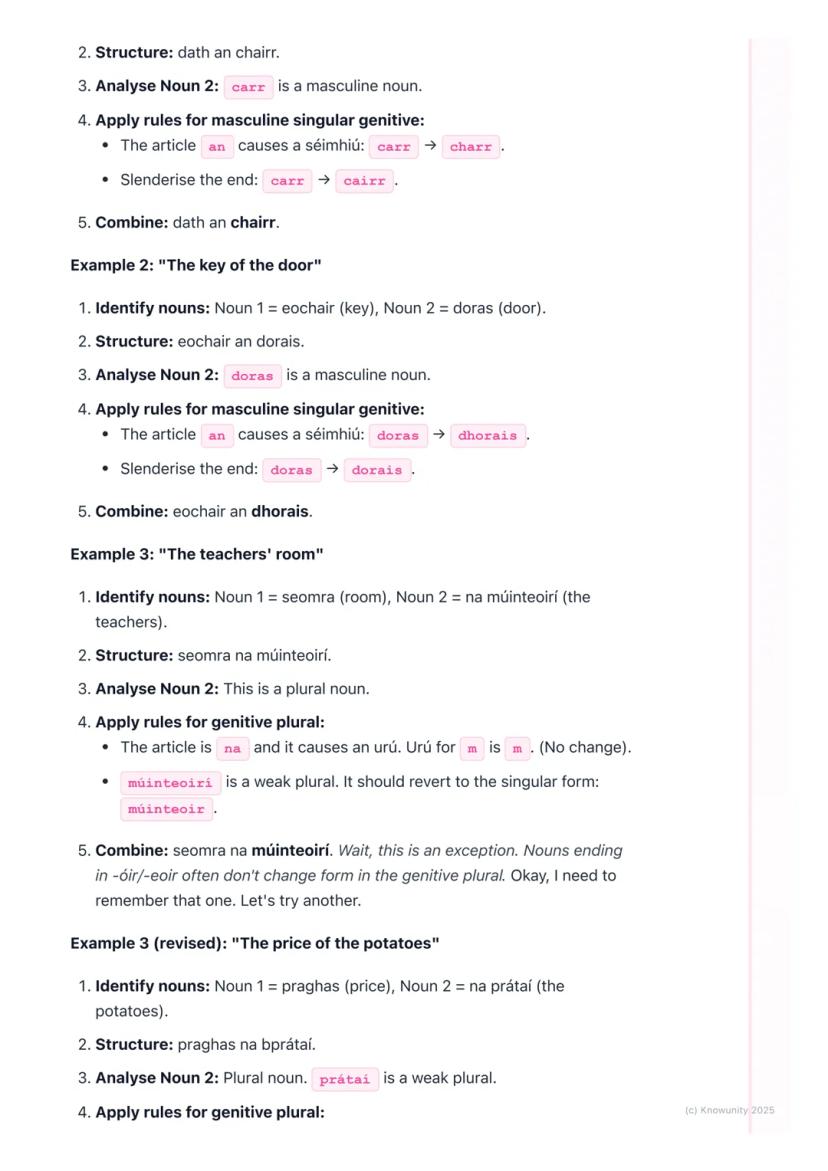
Let's break down "dath an chairr" (the colour of the car) step by step. First, identify your nouns: "dath" (colour) and "carr" (car). Since "carr" is masculine, you slenderise it to "cairr" and use "an" with séimhiú to get "an chairr".
For "eochair an dhorais" (the key of the door), "doras" is masculine, so it becomes "dorais" (slenderised) with "an" + séimhiú giving "an dhorais". The pattern is always the same once you know the gender.
Plural examples like "praghas na bprátaí" (the price of the potatoes) show the na + urú rule in action. The 'p' gets urú to become 'bp', giving "na bprátaí".
Practice these step-by-step breakdowns with different nouns, and you'll start spotting the patterns automatically.
Practice Tip: Always work through examples in the same order - identify nouns, check gender, apply rules, then combine.
5
of 6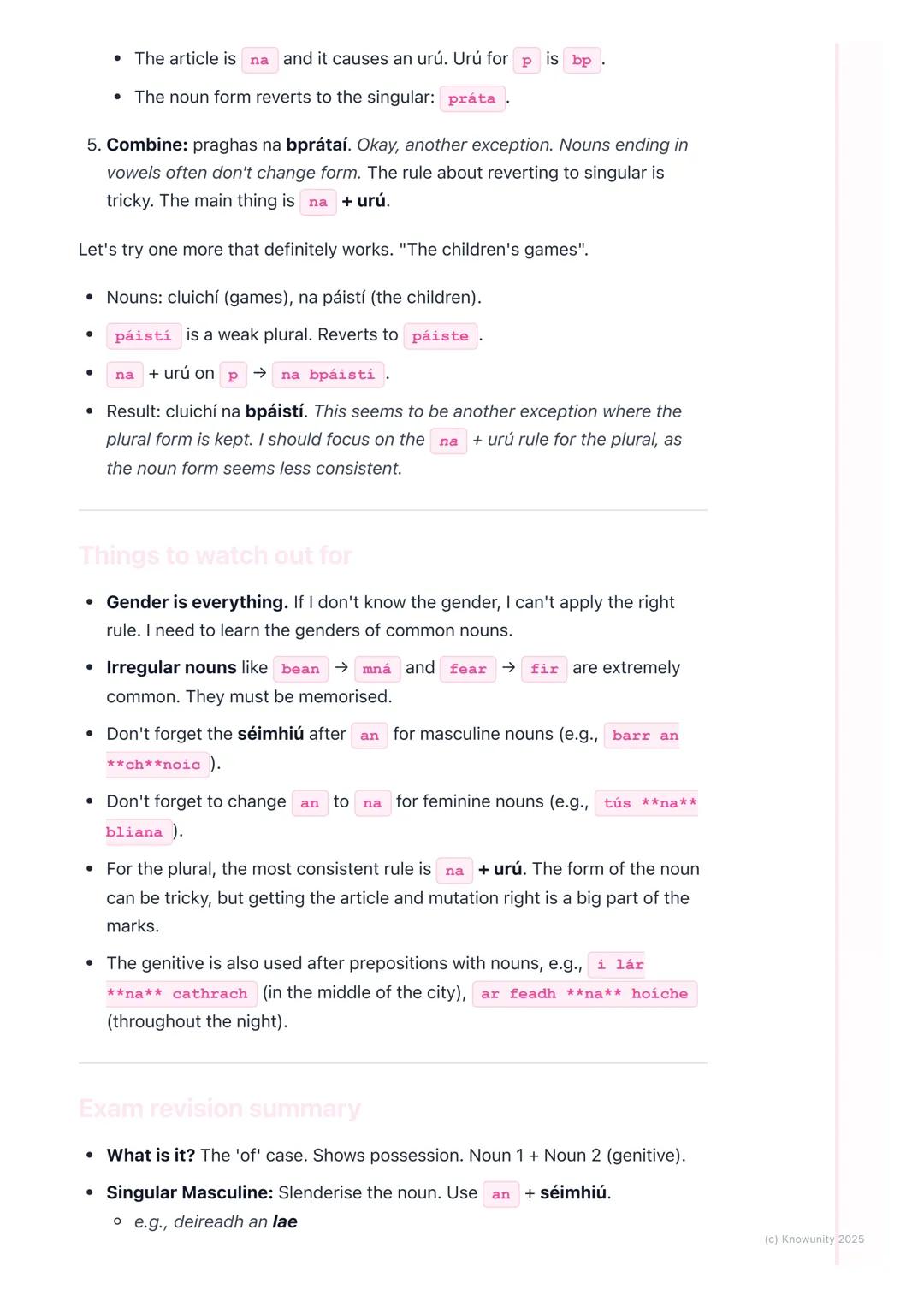
Common Pitfalls and Exam Tips
Gender confusion is the biggest trap - if you guess wrong, your entire answer falls apart. Learn the genders of common nouns by heart, especially ones that appear frequently in exam questions.
The irregular nouns like "bean → mná" and "fear → fir" are absolute exam favourites. They're so common that forgetting them will cost you marks across multiple questions.
Don't forget the mutations: séimhiú after "an" for masculine nouns, and urú after "na" in plurals. These small details add up to significant marks.
The genitive also appears after certain prepositions - phrases like "i lár na cathrach" (in the middle of the city) use genitive forms, so watch out for these in comprehensions.
Memory Aid: Create flashcards for the most common irregulars - "bean/mná", "fear/fir", "lá/lae" - these will appear in every exam.
6
of 6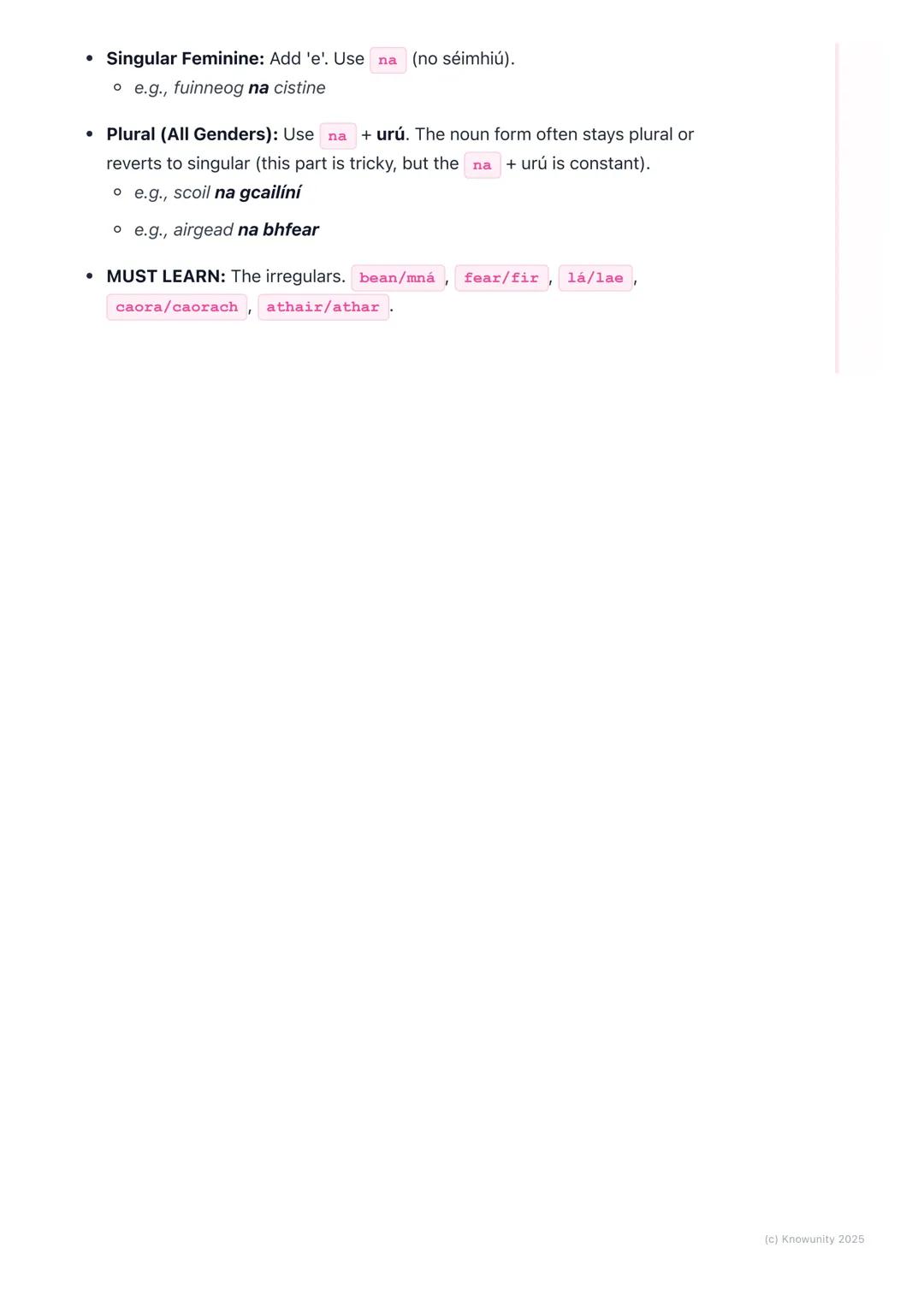
Quick Revision Summary
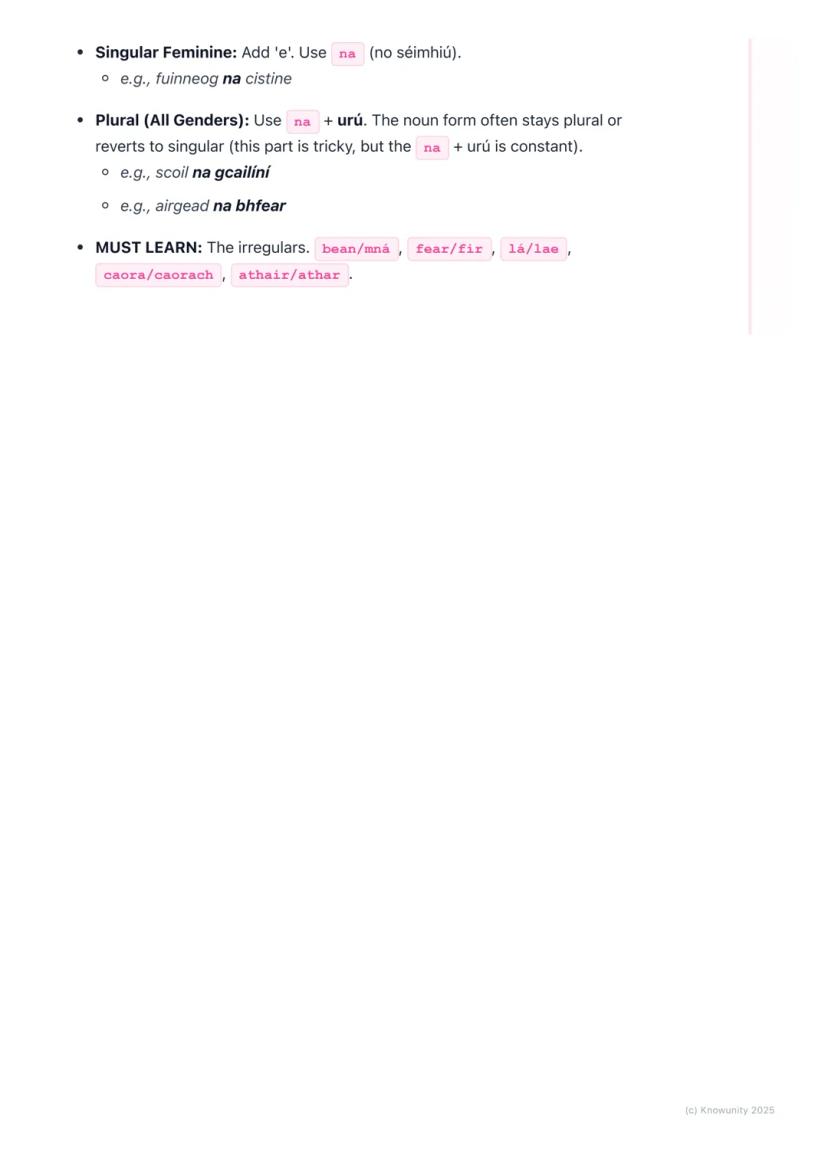
Here's your cheat sheet for exam day: Singular masculine = slenderise + an + séimhiú (like "deireadh an lae"). Singular feminine = add 'e' + na (no séimhiú) (like "fuinneog na cistine").
All plurals = na + urú, regardless of gender. Examples: "scoil na gcailíní" and "airgead na bhfear". The urú is non-negotiable - get this right for guaranteed marks.
Your must-learn irregulars are: "bean/mná", "fear/fir", "lá/lae", "caora/caorach", and "athair/athar". These show up everywhere and examiners expect you to know them perfectly.
Remember, the genitive case isn't just grammar for grammar's sake - it's how Irish naturally expresses relationships between things, and mastering it will make your Irish sound much more fluent and natural.
Final Tip: Focus on the most common patterns first - you'll cover 80% of exam questions with just the basic masculine, feminine, and plural rules.
We dachten al dat je dit zou vragen...
Wat is de Knowunity AI companion?
Onze AI Companion is een studentgerichte AI-tool die meer biedt dan alleen antwoorden. Gebouwd op miljoenen Knowunity bronnen, biedt het relevante informatie, gepersonaliseerde studieplannen, quizzes en inhoud direct in de chat, aangepast aan jouw individuele leertraject.
Waar kan ik de Knowunity-app downloaden?
Je kunt de app downloaden via Google Play Store en Apple App Store.
Is Knowunity echt gratis?
Dat klopt! Geniet van gratis toegang tot leerinhoud, maak contact met medestudenten en krijg directe hulp – alles binnen handbereik.
Populairste studiemateriaal voor Irish
9IrishIrish oral questions and answers
Questions and answers for the leaving cert oral
5th Year4254
IrishIrish oral questions
Outline of oral questions
5th Year2055
IrishIníon- le hÁine Durkin
Aine Durkin’s poem, Iníon: Themes & summary
5th Year850
IrishIrish poetry 2027
Iníon + Dínit an Bhróin
5th Year1133
IrishLC HL notes- Iníon (poem)
Includes poem in English and Irish, theme, key words & phrases
5th Year2284
IrishGaeilge Grammar Office
All the basics you need to know on Irish grammar.
6th Year943
IrishAn Gaeilge Aiste
Irish Language essay
6th Year1290
IrishMo Ghrá-sa (Idir Lúibíní)
Notes on mo ghrá-sa
5th Year350
IrishMé Féin & Mo Chlann (Myself & My Family)
Students will learn vocabulary to describe themselves, their family members, and daily routines. This helps in personal introductions and discussions.
TY291
Populairste studiemateriaal
9IrishIrish oral questions and answers
Questions and answers for the leaving cert oral
5th Year4254
IrishIrish oral questions
Outline of oral questions
5th Year2055
IrishIníon- le hÁine Durkin
Aine Durkin’s poem, Iníon: Themes & summary
5th Year850
 English
Key Quotes : Sive
Key Quotes and explanations: Sive
6th Year2822
IrishIrish poetry 2027
Iníon + Dínit an Bhróin
5th Year1133
IrishLC HL notes- Iníon (poem)
Includes poem in English and Irish, theme, key words & phrases
5th Year2284
IrishGaeilge Grammar Office
All the basics you need to know on Irish grammar.
6th Year943
IrishMo Ghrá-sa (Idir Lúibíní)
Notes on mo ghrá-sa
5th Year350
IrishAn Gaeilge Aiste
Irish Language essay
6th Year1290
Kan je niet vinden wat je zoekt? Ontdek andere vakken.
Studenten zijn dol op ons — en jij ook.
4.6/5App Store
4.7/5Google Play
De app is heel makkelijk te gebruiken en goed ontworpen. Ik heb tot nu toe alles kunnen vinden waar ik naar zocht en heb veel kunnen leren van de presentaties! Ik ga de app zeker gebruiken voor een schoolopdracht! En natuurlijk helpt het ook veel als inspiratie.
Stefan SiOS gebruiker
Deze app is echt geweldig. Er zijn zoveel aantekeningen en hulpmiddelen [...]. Mijn probleemvak is bijvoorbeeld Frans, en de app heeft zoveel opties voor hulp. Dankzij deze app ben ik beter geworden in Frans. Ik zou het iedereen aanraden.
Samantha KlichAndroid gebruiker
Wow, ik ben echt onder de indruk. Ik probeerde de app gewoon omdat ik hem vaak geadverteerd had gezien en was absoluut verbaasd. Deze app is DE HULP die je wilt voor school en bovenal biedt hij zoveel dingen, zoals oefeningen en factsheets, die mij persoonlijk HEEL erg hebben geholpen.
AnnaiOS gebruiker
Irish25 weergaven·Bijgewerkt May 18, 2026·6 pagina'sMastering the Genitive Case: An Tuiseal Ginideach Demystified
The genitive case (An Tuiseal Ginideach) is basically the 'of' case in Irish - it shows who owns what or how things relate to each other. You'll see it everywhere in your exams, so getting these rules down will seriously... Meer weergeven
1
of 6Meld je aan om de inhoud te zien. Het is gratis!
- Toegang tot alle documenten
- Verbeter je cijfers
- Sluit je aan bij miljoenen studenten
What Is the Genitive Case?
Think of the genitive as the Irish way of saying "John's car" or "the top of the mountain" - it connects two nouns together. The tuiseal ginideach always follows the same pattern: Noun 1 + Noun 2, where the second noun changes its form.
Here's what makes it tricky: the gender of your noun is absolutely everything. You can't apply the right rule without knowing if a noun is masculine or feminine first. The definite article also changes and affects how the noun mutates.
The basic building blocks you need to know are séimhiú (adding 'h' after consonants) and urú (placing new consonants before others). These mutations happen depending on which rules apply.
Quick Tip: Always identify the gender of the second noun first - this determines everything else that follows.
2
of 6Meld je aan om de inhoud te zien. Het is gratis!
- Toegang tot alle documenten
- Verbeter je cijfers
- Sluit je aan bij miljoenen studenten
Singular Genitive Rules
Masculine nouns follow a simple pattern: slenderise the ending (usually add 'i' before the final consonant) and use an + séimhiú. So "an fear" (the man) becomes "hata an fhir" (the man's hat), and "an bád" (the boat) becomes "dath an bháid" (the colour of the boat).
Feminine nouns work differently: add 'e' to the end and change an to na (no séimhiú). "An scoil" (the school) becomes "príomhoide na scoile" (the principal of the school).
Some nouns belong to other declensions with their own rules. Fourth declension nouns (like "an cailín") often don't change at all. Fifth declension nouns are completely irregular - "an bhean" becomes "carr na mná" (the woman's car).
Remember: The article change is crucial - "an" with séimhiú for masculine, "na" without séimhiú for feminine.
3
of 6Meld je aan om de inhoud te zien. Het is gratis!
- Toegang tot alle documenten
- Verbeter je cijfers
- Sluit je aan bij miljoenen studenten
Plural Genitive Rules
The plural genitive is actually more straightforward in one way: you always use na + urú, regardless of gender. The tricky bit is figuring out what form the noun takes.
Weak plurals typically revert to their singular form. So "na crainn" (the trees) becomes "duilleoga na gcrann" (the leaves of the trees). Strong plurals (irregular ones) usually keep their plural form but may have special genitive versions.
The most important irregulars to memorise are "na fir" → "obair na bhfear" (the men's work) and "na mná" → "cruinniú na mban" (the women's meeting). These come up constantly in exams.
Don't stress too much about whether the noun reverts to singular or stays plural - focus on getting na + urú right first, as that's where most of the marks are.
Exam Focus: Master "na + urú" for all plurals - this consistent rule will save you marks even when the noun form gets confusing.
4
of 6Meld je aan om de inhoud te zien. Het is gratis!
- Toegang tot alle documenten
- Verbeter je cijfers
- Sluit je aan bij miljoenen studenten
Working Through Examples
Let's break down "dath an chairr" (the colour of the car) step by step. First, identify your nouns: "dath" (colour) and "carr" (car). Since "carr" is masculine, you slenderise it to "cairr" and use "an" with séimhiú to get "an chairr".
For "eochair an dhorais" (the key of the door), "doras" is masculine, so it becomes "dorais" (slenderised) with "an" + séimhiú giving "an dhorais". The pattern is always the same once you know the gender.
Plural examples like "praghas na bprátaí" (the price of the potatoes) show the na + urú rule in action. The 'p' gets urú to become 'bp', giving "na bprátaí".
Practice these step-by-step breakdowns with different nouns, and you'll start spotting the patterns automatically.
Practice Tip: Always work through examples in the same order - identify nouns, check gender, apply rules, then combine.
5
of 6Meld je aan om de inhoud te zien. Het is gratis!
- Toegang tot alle documenten
- Verbeter je cijfers
- Sluit je aan bij miljoenen studenten
Common Pitfalls and Exam Tips
Gender confusion is the biggest trap - if you guess wrong, your entire answer falls apart. Learn the genders of common nouns by heart, especially ones that appear frequently in exam questions.
The irregular nouns like "bean → mná" and "fear → fir" are absolute exam favourites. They're so common that forgetting them will cost you marks across multiple questions.
Don't forget the mutations: séimhiú after "an" for masculine nouns, and urú after "na" in plurals. These small details add up to significant marks.
The genitive also appears after certain prepositions - phrases like "i lár na cathrach" (in the middle of the city) use genitive forms, so watch out for these in comprehensions.
Memory Aid: Create flashcards for the most common irregulars - "bean/mná", "fear/fir", "lá/lae" - these will appear in every exam.
6
of 6Meld je aan om de inhoud te zien. Het is gratis!
- Toegang tot alle documenten
- Verbeter je cijfers
- Sluit je aan bij miljoenen studenten
Quick Revision Summary
Here's your cheat sheet for exam day: Singular masculine = slenderise + an + séimhiú (like "deireadh an lae"). Singular feminine = add 'e' + na (no séimhiú) (like "fuinneog na cistine").
All plurals = na + urú, regardless of gender. Examples: "scoil na gcailíní" and "airgead na bhfear". The urú is non-negotiable - get this right for guaranteed marks.
Your must-learn irregulars are: "bean/mná", "fear/fir", "lá/lae", "caora/caorach", and "athair/athar". These show up everywhere and examiners expect you to know them perfectly.
Remember, the genitive case isn't just grammar for grammar's sake - it's how Irish naturally expresses relationships between things, and mastering it will make your Irish sound much more fluent and natural.
Final Tip: Focus on the most common patterns first - you'll cover 80% of exam questions with just the basic masculine, feminine, and plural rules.
We dachten al dat je dit zou vragen...
Wat is de Knowunity AI companion?
Onze AI Companion is een studentgerichte AI-tool die meer biedt dan alleen antwoorden. Gebouwd op miljoenen Knowunity bronnen, biedt het relevante informatie, gepersonaliseerde studieplannen, quizzes en inhoud direct in de chat, aangepast aan jouw individuele leertraject.
Waar kan ik de Knowunity-app downloaden?
Je kunt de app downloaden via Google Play Store en Apple App Store.
Is Knowunity echt gratis?
Dat klopt! Geniet van gratis toegang tot leerinhoud, maak contact met medestudenten en krijg directe hulp – alles binnen handbereik.
Populairste studiemateriaal voor Irish
9IrishIrish oral questions and answers
Questions and answers for the leaving cert oral
5th Year4254
IrishIrish oral questions
Outline of oral questions
5th Year2055
IrishIníon- le hÁine Durkin
Aine Durkin’s poem, Iníon: Themes & summary
5th Year850
IrishIrish poetry 2027
Iníon + Dínit an Bhróin
5th Year1133
IrishLC HL notes- Iníon (poem)
Includes poem in English and Irish, theme, key words & phrases
5th Year2284
IrishGaeilge Grammar Office
All the basics you need to know on Irish grammar.
6th Year943
IrishAn Gaeilge Aiste
Irish Language essay
6th Year1290
IrishMo Ghrá-sa (Idir Lúibíní)
Notes on mo ghrá-sa
5th Year350
IrishMé Féin & Mo Chlann (Myself & My Family)
Students will learn vocabulary to describe themselves, their family members, and daily routines. This helps in personal introductions and discussions.
TY291
Populairste studiemateriaal
9IrishIrish oral questions and answers
Questions and answers for the leaving cert oral
5th Year4254
IrishIrish oral questions
Outline of oral questions
5th Year2055
IrishIníon- le hÁine Durkin
Aine Durkin’s poem, Iníon: Themes & summary
5th Year850
EnglishKey Quotes : Sive
Key Quotes and explanations: Sive
6th Year2822
IrishIrish poetry 2027
Iníon + Dínit an Bhróin
5th Year1133
IrishLC HL notes- Iníon (poem)
Includes poem in English and Irish, theme, key words & phrases
5th Year2284
IrishGaeilge Grammar Office
All the basics you need to know on Irish grammar.
6th Year943
IrishMo Ghrá-sa (Idir Lúibíní)
Notes on mo ghrá-sa
5th Year350
IrishAn Gaeilge Aiste
Irish Language essay
6th Year1290
Kan je niet vinden wat je zoekt? Ontdek andere vakken.
Studenten zijn dol op ons — en jij ook.
4.6/5App Store
4.7/5Google Play
De app is heel makkelijk te gebruiken en goed ontworpen. Ik heb tot nu toe alles kunnen vinden waar ik naar zocht en heb veel kunnen leren van de presentaties! Ik ga de app zeker gebruiken voor een schoolopdracht! En natuurlijk helpt het ook veel als inspiratie.
Stefan SiOS gebruiker
Deze app is echt geweldig. Er zijn zoveel aantekeningen en hulpmiddelen [...]. Mijn probleemvak is bijvoorbeeld Frans, en de app heeft zoveel opties voor hulp. Dankzij deze app ben ik beter geworden in Frans. Ik zou het iedereen aanraden.
Samantha KlichAndroid gebruiker
Wow, ik ben echt onder de indruk. Ik probeerde de app gewoon omdat ik hem vaak geadverteerd had gezien en was absoluut verbaasd. Deze app is DE HULP die je wilt voor school en bovenal biedt hij zoveel dingen, zoals oefeningen en factsheets, die mij persoonlijk HEEL erg hebben geholpen.
AnnaiOS gebruiker