
Learning to talk about yourself and your family in Irish... Meer weergeven
 Irish24 weergaven·Bijgewerkt May 18, 2026·6 pagina's
Mé Féin agus Mo Theaghlach - Gach Rud Fúinn
1 / 6
1
of 6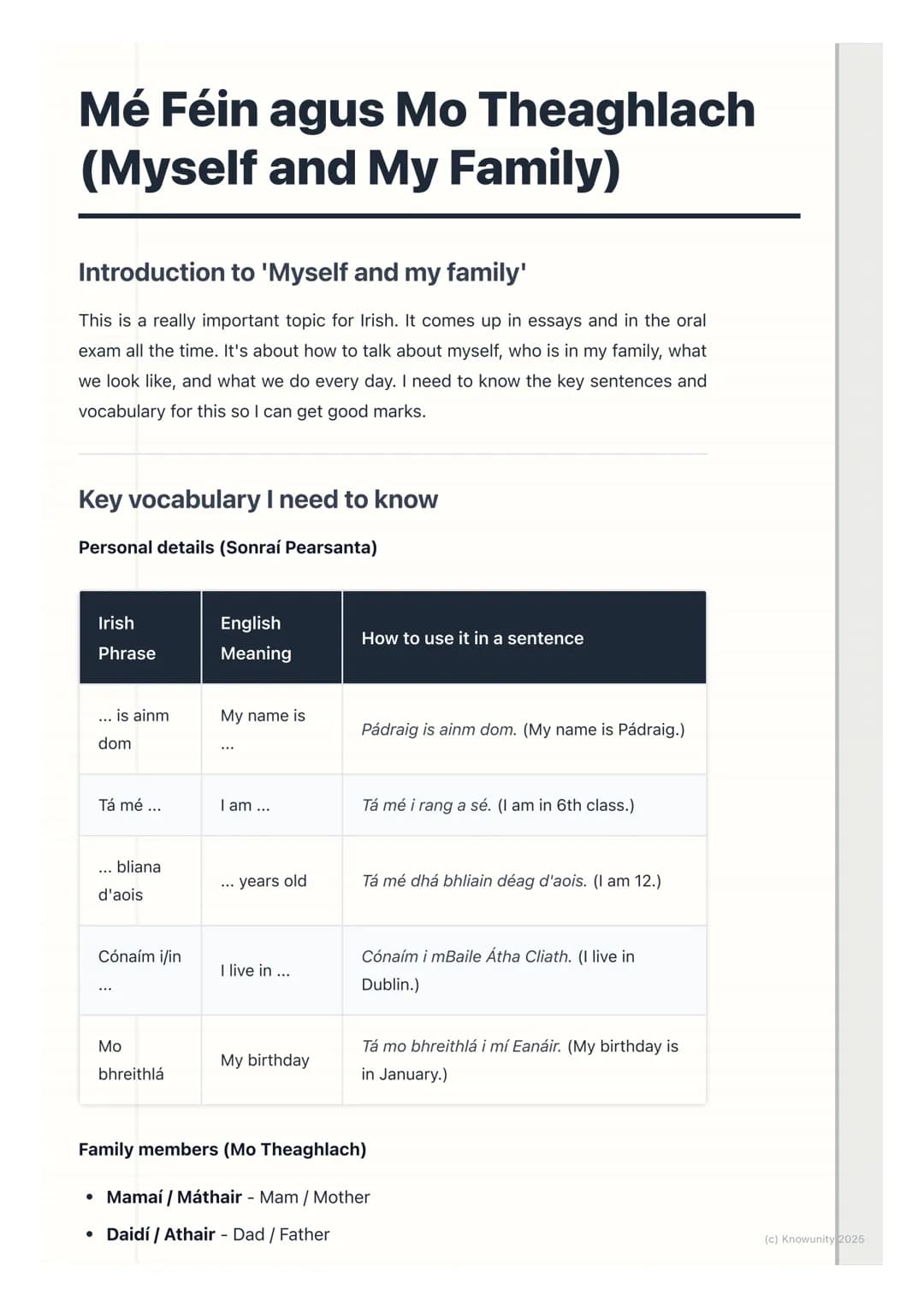
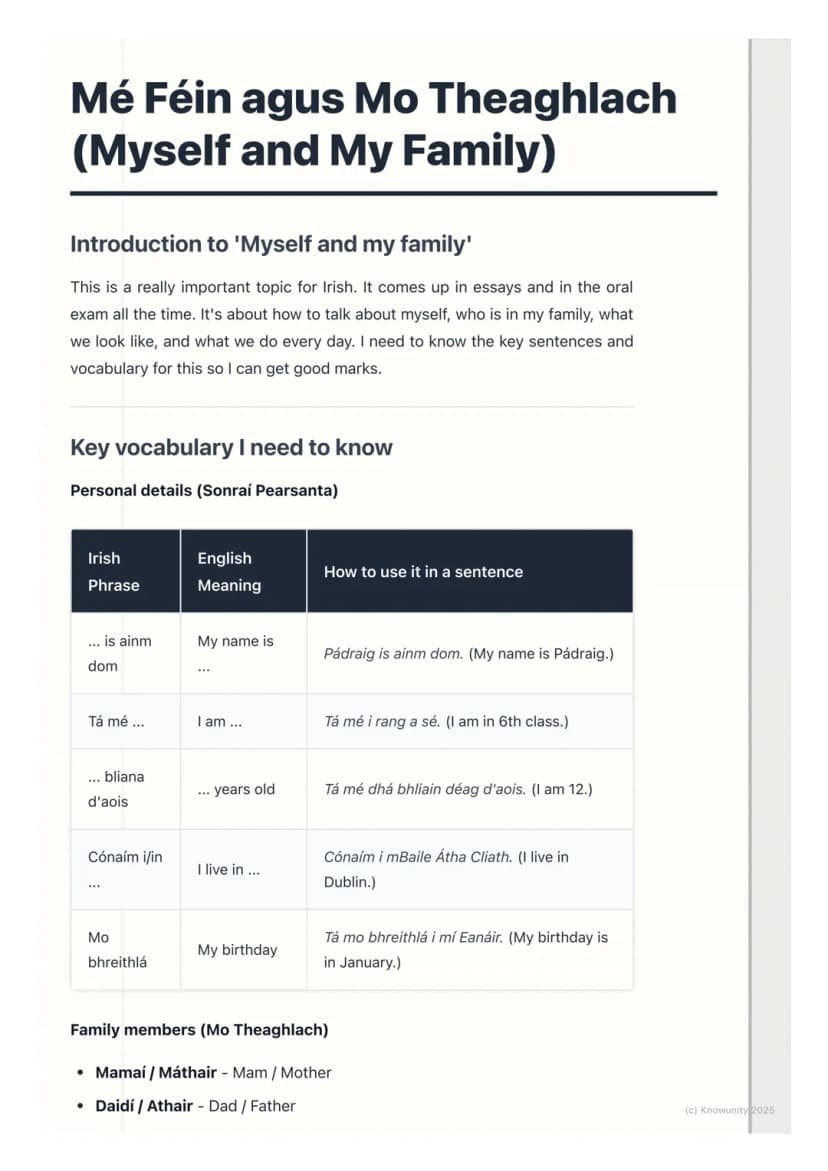
Getting Started with Personal Details
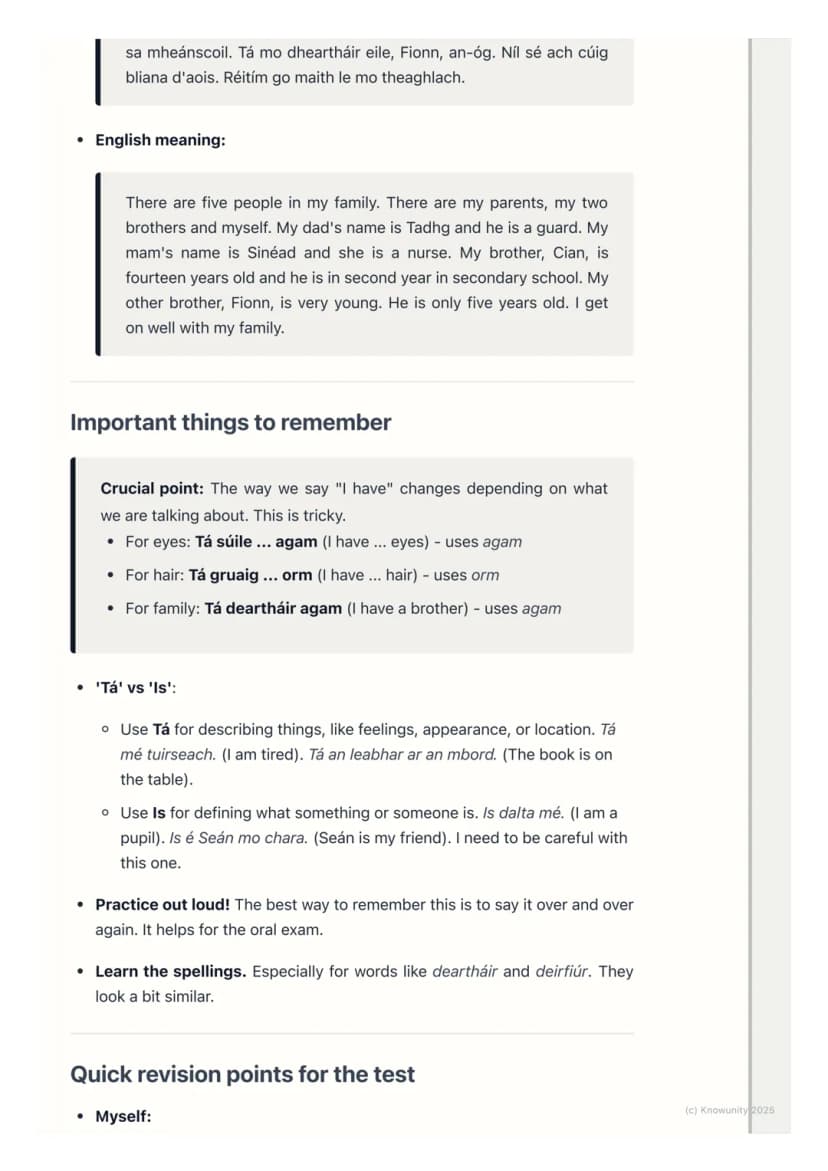
You'll use these personal details constantly in Irish class, so getting them right is brilliant for boosting your confidence! The most important phrase to master is "... is ainm dom" (My name is...), which you'll use in nearly every conversation.
When talking about your age, remember to use "Tá mé ... bliana d'aois" - this translates to "I am ... years old." For where you live, use "Cónaím i/in" followed by your town or city.
Top Tip: Practice saying your personal introduction out loud every day - it'll become automatic and help massively with your oral exam!
The key is to link these phrases together smoothly: "Pádraig is ainm dom. Tá mé dhá bhliain déag d'aois. Cónaím i mBaile Átha Cliath."
2
of 6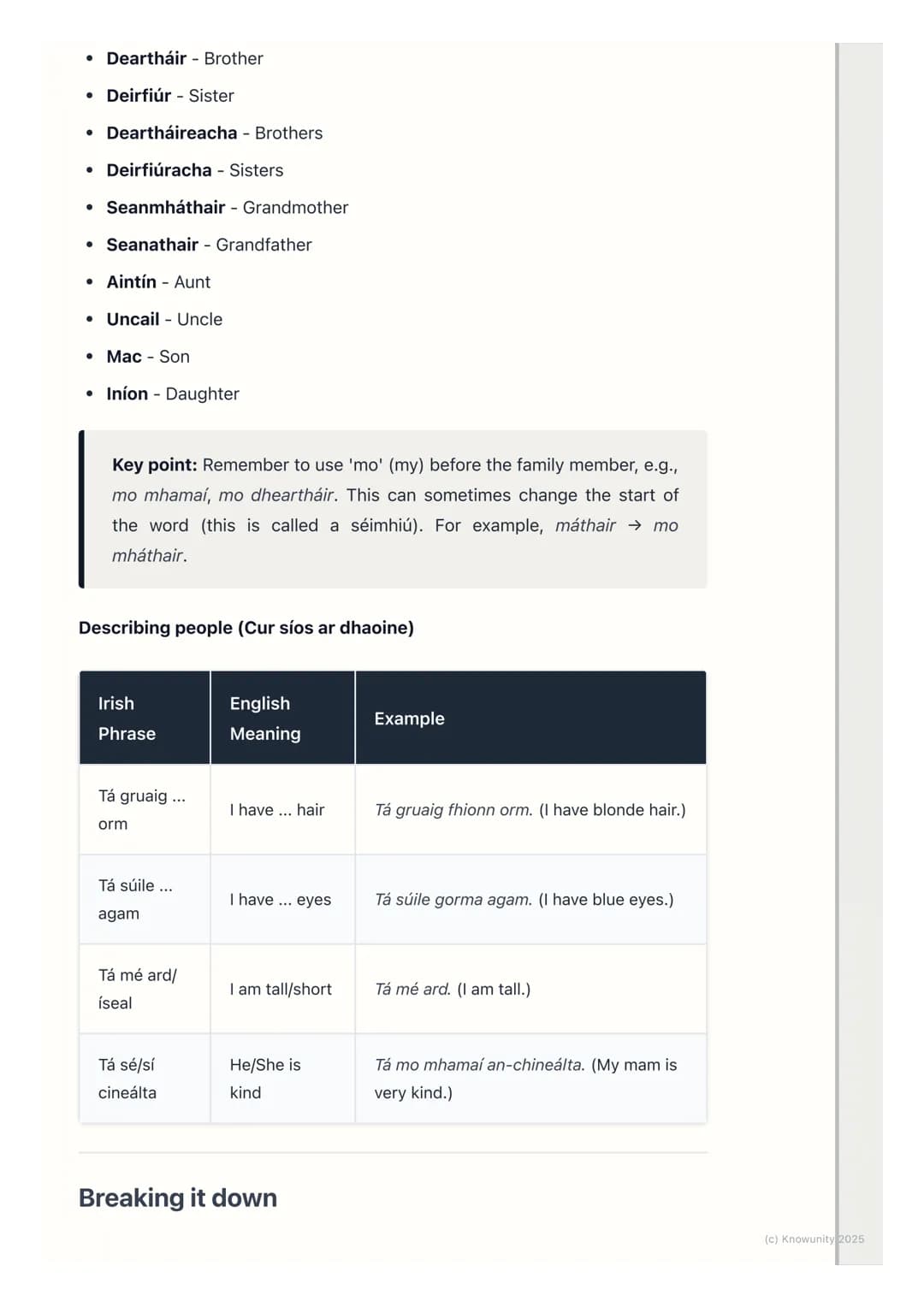
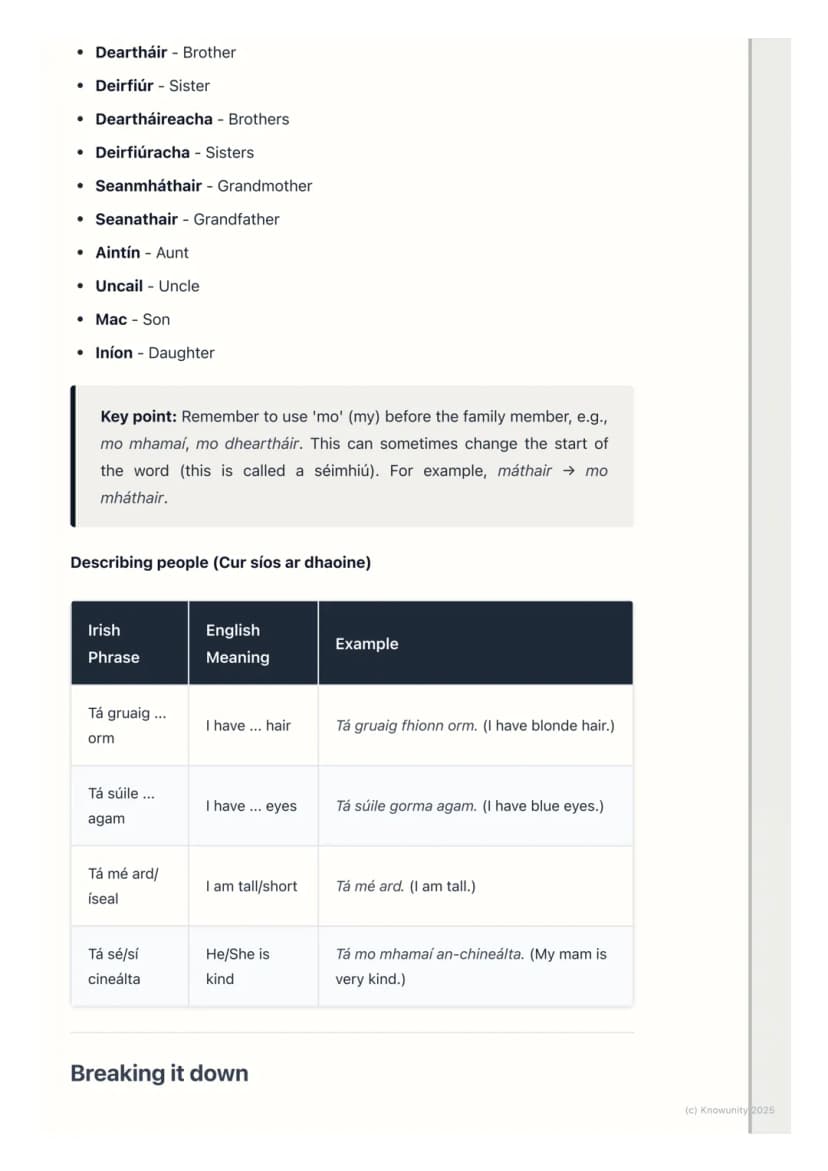
Family Members and Descriptions
Learning family vocabulary is straightforward once you know the pattern! Start with the basics: Mamaí/Máthair , Daidí/Athair , deartháir (brother), and deirfiúr (sister).
Here's the tricky bit that trips up loads of students: when you put "mo" (my) before family words, it sometimes changes the first letter. This is called séimhiú. So "máthair" becomes "mo mháthair" - notice the extra 'h'!
For describing people, you need two different patterns. For hair, use "Tá gruaig ... orm" (I have ... hair), but for eyes, use "Tá súile ... agam" (I have ... eyes). The endings change - "orm" for hair, "agam" for eyes.
Remember: Don't panic about séimhiú - even if you forget it occasionally, you'll still be understood perfectly!
3
of 6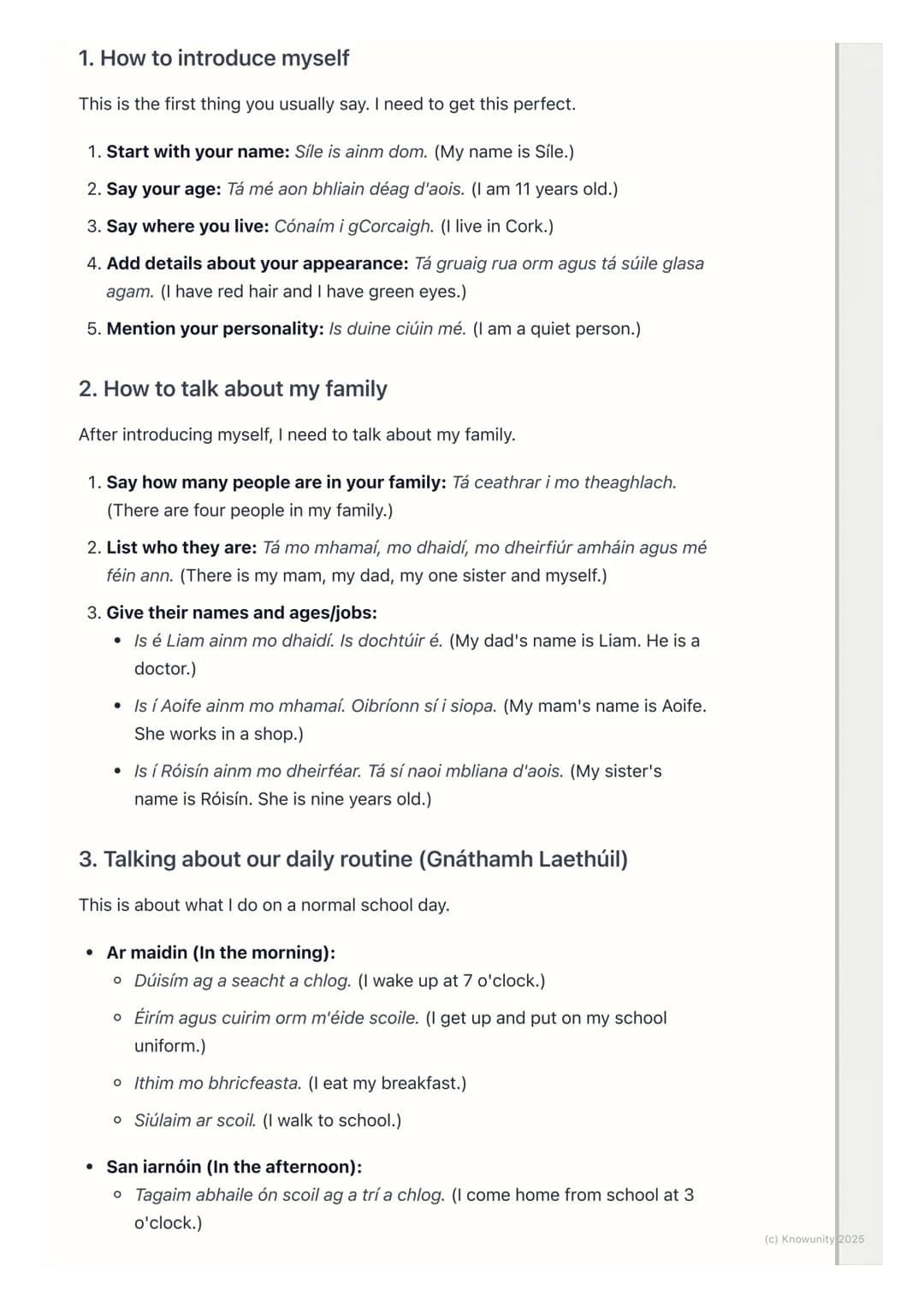
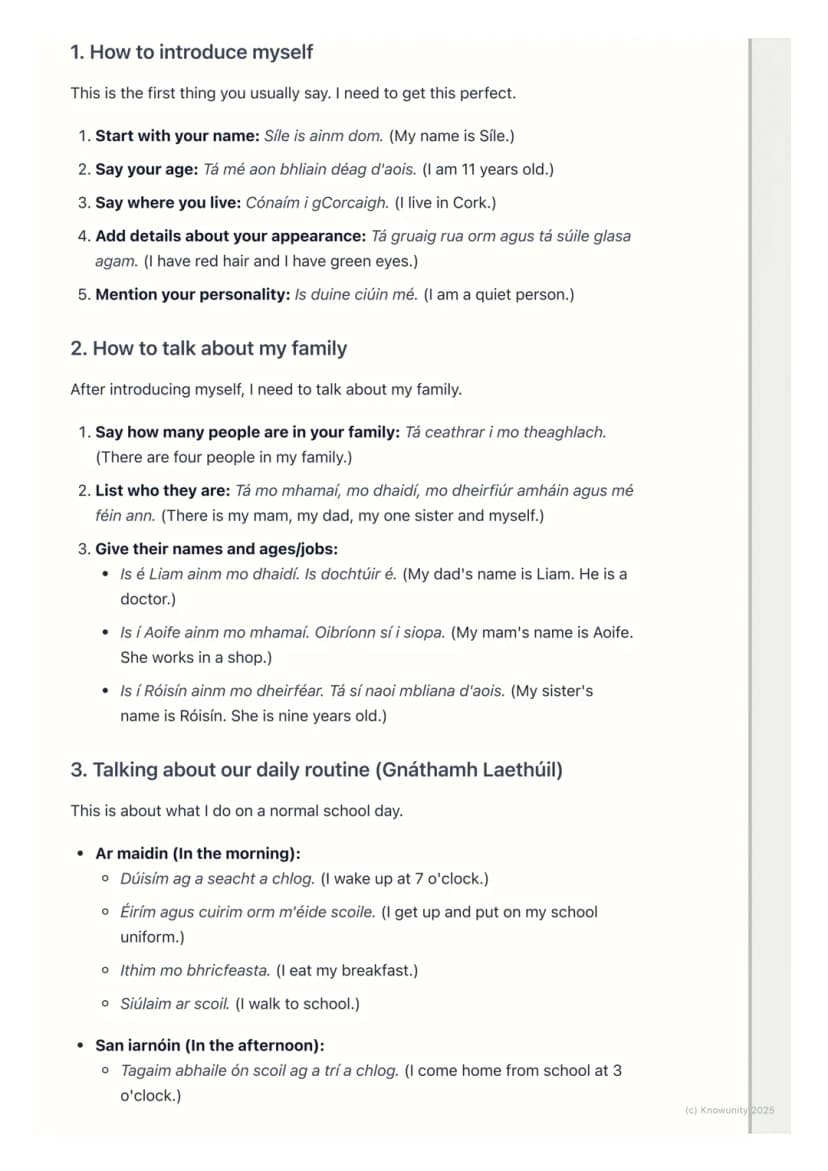
Introducing Yourself Like a Pro
Getting your personal introduction spot-on is like having a secret weapon for Irish exams! Follow this simple five-step formula and you'll nail it every time.
Start strong with your name and age: "Síle is ainm dom. Tá mé aon bhliain déag d'aois." Then add where you live: "Cónaím i gCorcaigh." Next, describe your appearance using the patterns you've learned: "Tá gruaig rua orm agus tá súile glasa agam."
When talking about your family size, use "Tá ... i mo theaghlach" (There are ... in my family). Then list everyone: "Tá mo mhamaí, mo dhaidí, mo dheirfiúr amháin agus mé féin ann."
Confidence Booster: Once you master this formula, you can adapt it for any family situation - it's that flexible!
Don't forget to add personality details or jobs to make your introduction more interesting and show off your vocabulary knowledge.
4
of 6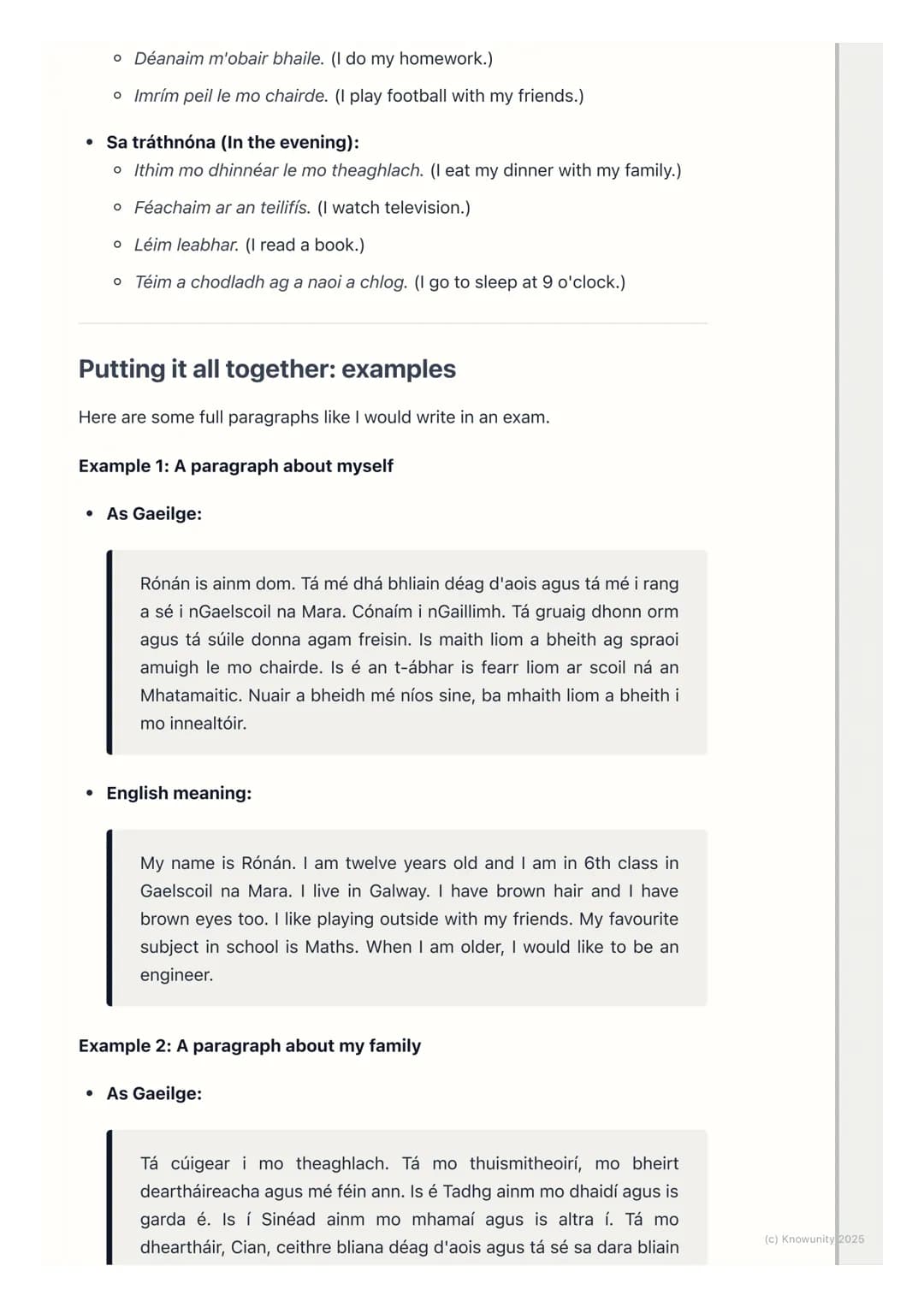
Daily Routines and Putting It All Together
Your daily routine vocabulary is perfect for showing off longer sentences in exams! Structure it by time periods: "ar maidin" (in the morning), "san iarnóin" (in the afternoon), and "sa tráthnóna" (in the evening).
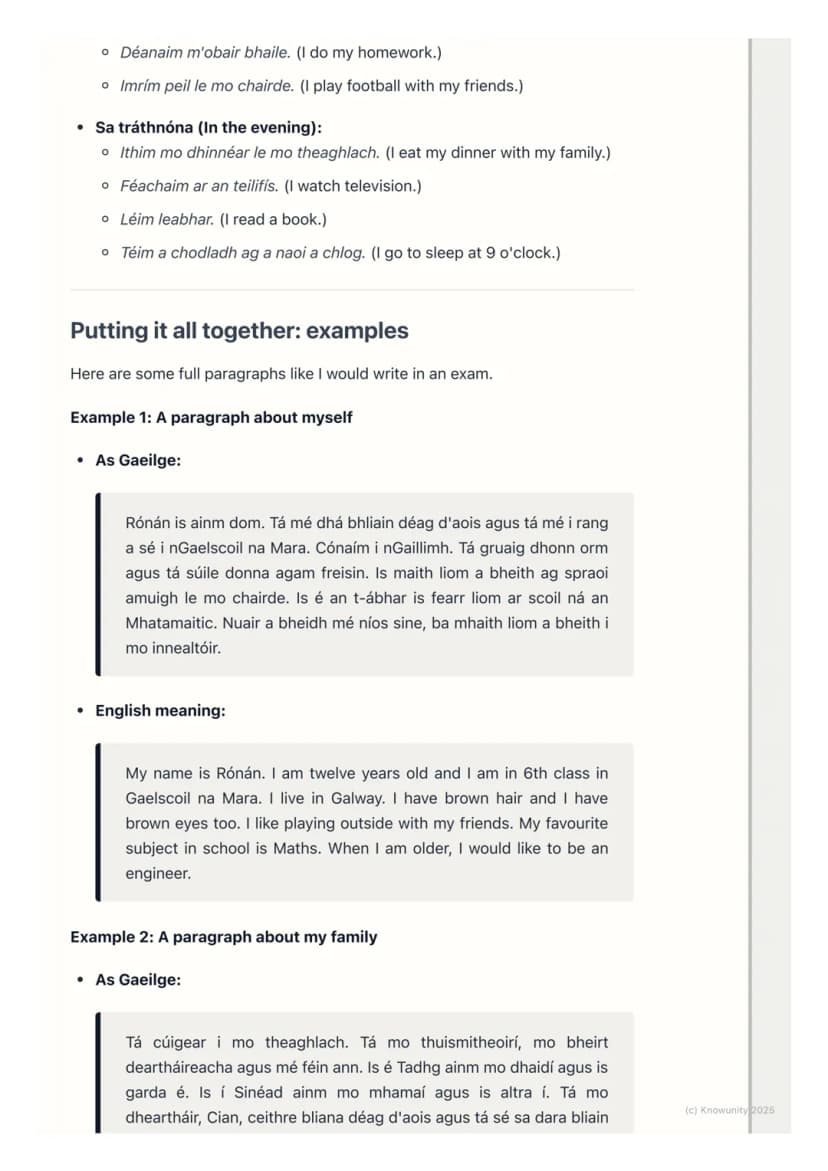
Morning activities include "Dúisím ag a seacht a chlog" (I wake up at 7 o'clock) and "Siúlaim ar scoil" (I walk to school). Afternoon and evening activities like "Déanaim m'obair bhaile" (I do my homework) and "Féachaim ar an teilifís" (I watch television) show you can handle different topics.
The example paragraphs show you exactly how to link sentences together naturally. Notice how they flow from personal details to family descriptions to daily activities - this structure works brilliantly in exams.
Exam Success: These complete paragraph examples are gold for revision - read them aloud until they feel natural!
5
of 6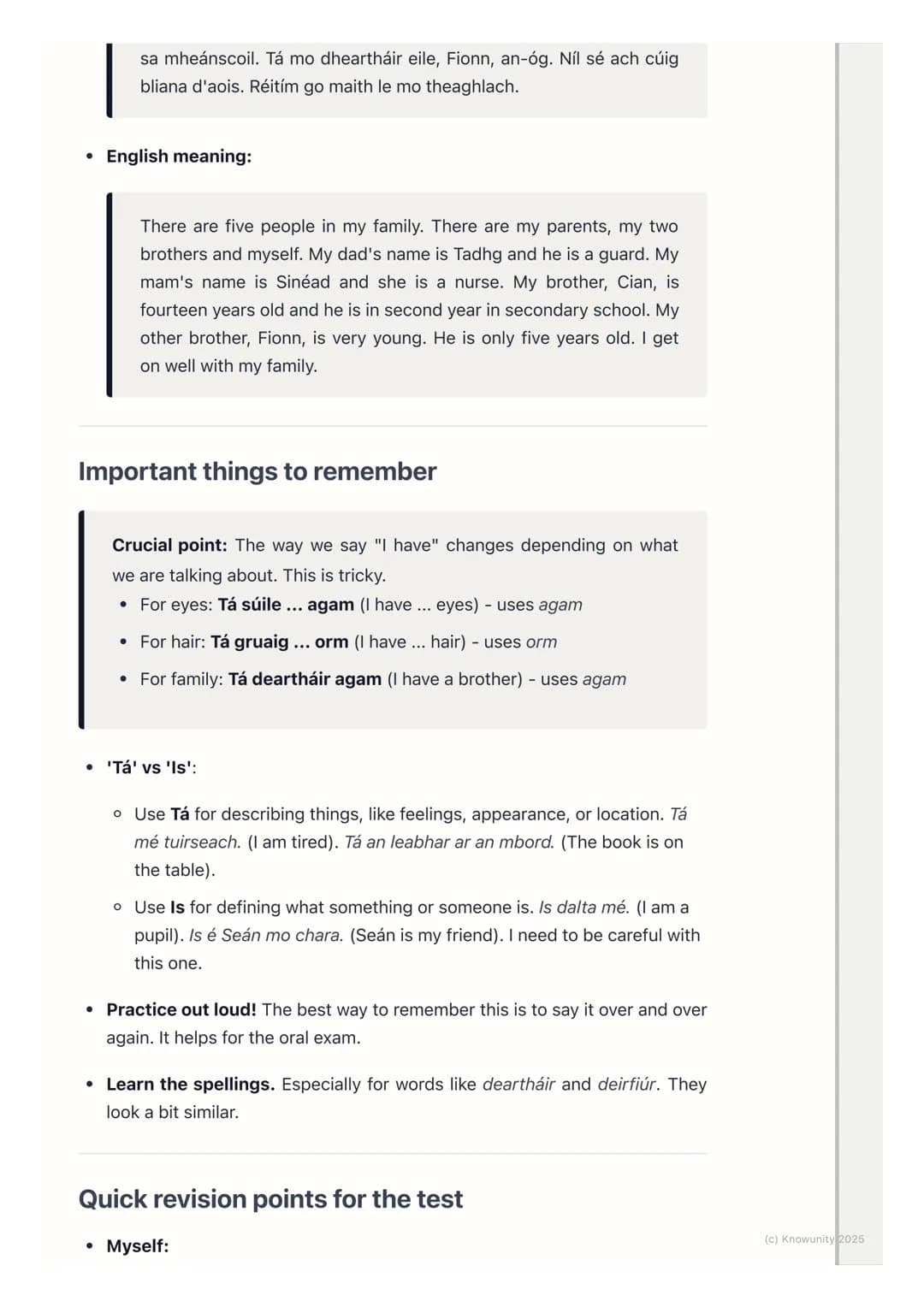
Grammar Rules That Actually Matter
The Tá vs Is rule seems complicated but it's actually quite logical once you get it! Use "Tá" for describing temporary things, feelings, or locations: "Tá mé tuirseach" (I am tired). Use "Is" for defining what someone or something actually is: "Is dalta mé" (I am a pupil).
Remember the different patterns for "I have": "Tá súile ... agam" for eyes but "Tá gruaig ... orm" for hair. This catches out loads of students, so getting it right will definitely impress your teacher!
Spelling matters too, especially for similar-looking words like "deartháir" and "deirfiúr." The key is regular practice rather than trying to memorise everything at once.
Study Smart: Focus on the patterns rather than individual words - once you know the system, everything else falls into place!
6
of 6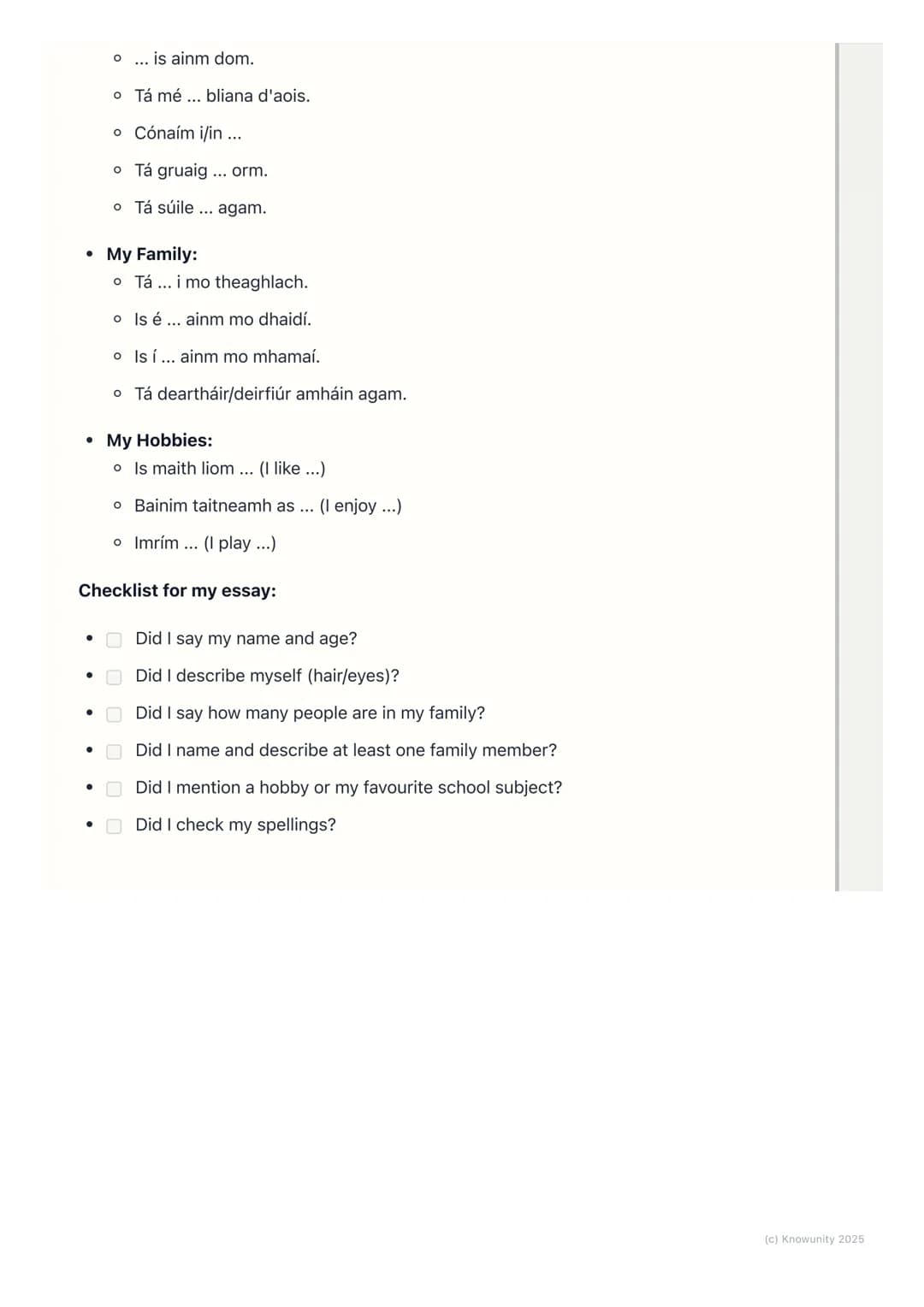
Quick Revision and Exam Success
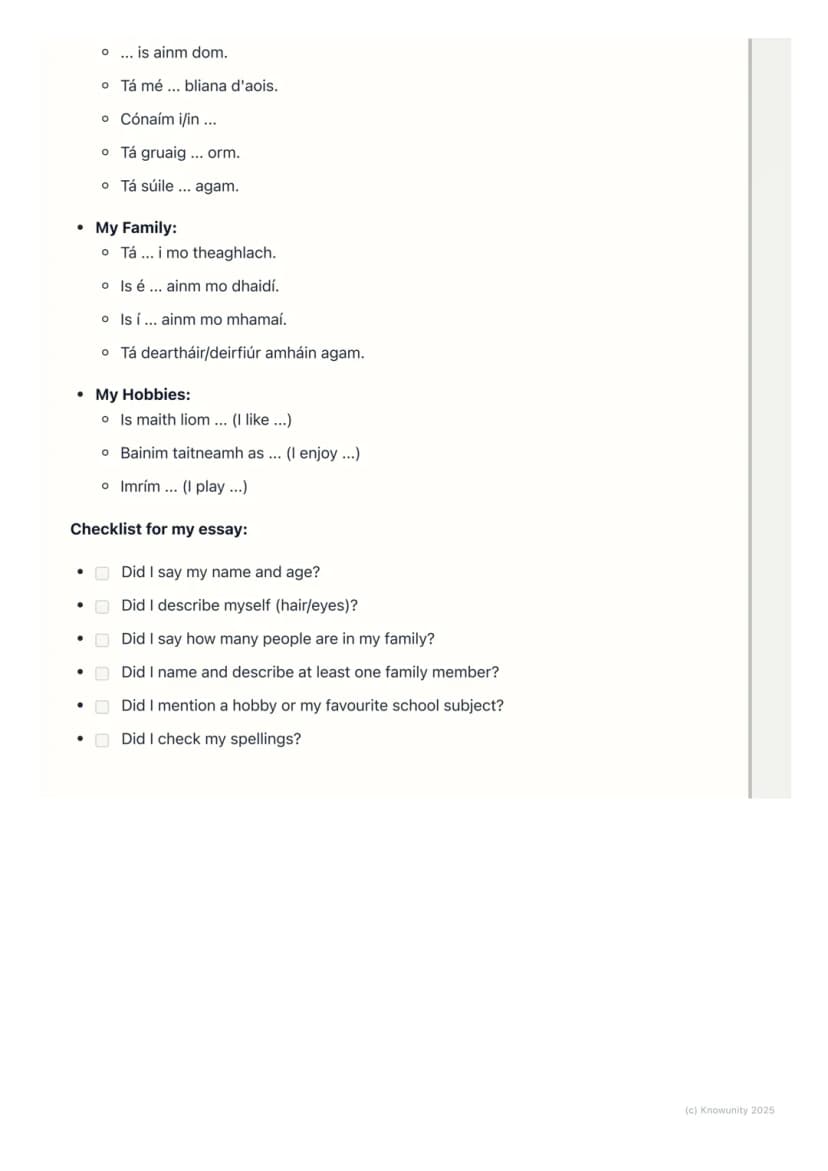
Your revision checklist should cover the essential sentence starters you'll use constantly: "... is ainm dom," "Tá mé... bliana d'aois," and "Cónaím i/in..." These form the backbone of almost every personal description.
For family topics, master "Tá ... i mo theaghlach" and "Is é/í ... ainm mo..." - these patterns work for any family member. Don't forget hobby expressions like "Is maith liom" (I like) and "Bainim taitneamh as" (I enjoy).
Your essay checklist ensures you hit all the key points examiners look for: personal details, physical description, family information, and interests. Missing any of these means missing easy marks!
Final Tip: Practice writing complete paragraphs rather than just learning individual sentences - it'll make your Irish sound much more natural and confident!
The beauty of this topic is that once you've learned it properly, you can adapt and expand it for loads of different exam questions.
We dachten al dat je dit zou vragen...
Wat is de Knowunity AI companion?
Onze AI Companion is een studentgerichte AI-tool die meer biedt dan alleen antwoorden. Gebouwd op miljoenen Knowunity bronnen, biedt het relevante informatie, gepersonaliseerde studieplannen, quizzes en inhoud direct in de chat, aangepast aan jouw individuele leertraject.
Waar kan ik de Knowunity-app downloaden?
Je kunt de app downloaden via Google Play Store en Apple App Store.
Is Knowunity echt gratis?
Dat klopt! Geniet van gratis toegang tot leerinhoud, maak contact met medestudenten en krijg directe hulp – alles binnen handbereik.
Populairste studiemateriaal voor Irish
9IrishIrish oral questions and answers
Questions and answers for the leaving cert oral
5th Year4254
IrishIrish oral questions
Outline of oral questions
5th Year2055
IrishGaeilge Grammar Office
All the basics you need to know on Irish grammar.
6th Year863
IrishIrish poetry 2027
Iníon + Dínit an Bhróin
5th Year1123
IrishMé Féin & Mo Chlann (Myself & My Family)
Students will learn vocabulary to describe themselves, their family members, and daily routines. This helps in personal introductions and discussions.
TY291
IrishAn Gaeilge Aiste
Irish Language essay
6th Year1250
IrishLC HL notes- Iníon (poem)
Includes poem in English and Irish, theme, key words & phrases
5th Year2234
IrishIníon- le hÁine Durkin
Aine Durkin’s poem, Iníon: Themes & summary
5th Year840
IrishIrish notes- Drama: Gleann Alain
Includes key words from the scenes, themes, characters and exam questions
1st Year1301
Populairste studiemateriaal
9IrishIrish oral questions and answers
Questions and answers for the leaving cert oral
5th Year4254
IrishIrish oral questions
Outline of oral questions
5th Year2055
IrishGaeilge Grammar Office
All the basics you need to know on Irish grammar.
6th Year863
 English
Key Quotes : Sive
Key Quotes and explanations: Sive
6th Year2131
IrishAn Gaeilge Aiste
Irish Language essay
6th Year1250
IrishIrish poetry 2027
Iníon + Dínit an Bhróin
5th Year1123
IrishMé Féin & Mo Chlann (Myself & My Family)
Students will learn vocabulary to describe themselves, their family members, and daily routines. This helps in personal introductions and discussions.
TY291
IrishLC HL notes- Iníon (poem)
Includes poem in English and Irish, theme, key words & phrases
5th Year2234
 Geography
Territory, economic activities in Paris basin
essay
6th Year80
Kan je niet vinden wat je zoekt? Ontdek andere vakken.
Studenten zijn dol op ons — en jij ook.
4.6/5App Store
4.7/5Google Play
De app is heel makkelijk te gebruiken en goed ontworpen. Ik heb tot nu toe alles kunnen vinden waar ik naar zocht en heb veel kunnen leren van de presentaties! Ik ga de app zeker gebruiken voor een schoolopdracht! En natuurlijk helpt het ook veel als inspiratie.
Stefan SiOS gebruiker
Deze app is echt geweldig. Er zijn zoveel aantekeningen en hulpmiddelen [...]. Mijn probleemvak is bijvoorbeeld Frans, en de app heeft zoveel opties voor hulp. Dankzij deze app ben ik beter geworden in Frans. Ik zou het iedereen aanraden.
Samantha KlichAndroid gebruiker
Wow, ik ben echt onder de indruk. Ik probeerde de app gewoon omdat ik hem vaak geadverteerd had gezien en was absoluut verbaasd. Deze app is DE HULP die je wilt voor school en bovenal biedt hij zoveel dingen, zoals oefeningen en factsheets, die mij persoonlijk HEEL erg hebben geholpen.
AnnaiOS gebruiker
Irish24 weergaven·Bijgewerkt May 18, 2026·6 pagina'sMé Féin agus Mo Theaghlach - Gach Rud Fúinn
Learning to talk about yourself and your family in Irish is absolutely essential - it's one of the most tested topics in exams and oral assessments. This guide will help you master the key vocabulary, sentence structures, and examples you... Meer weergeven
1
of 6Meld je aan om de inhoud te zien. Het is gratis!
- Toegang tot alle documenten
- Verbeter je cijfers
- Sluit je aan bij miljoenen studenten
Getting Started with Personal Details
You'll use these personal details constantly in Irish class, so getting them right is brilliant for boosting your confidence! The most important phrase to master is "... is ainm dom" (My name is...), which you'll use in nearly every conversation.
When talking about your age, remember to use "Tá mé ... bliana d'aois" - this translates to "I am ... years old." For where you live, use "Cónaím i/in" followed by your town or city.
Top Tip: Practice saying your personal introduction out loud every day - it'll become automatic and help massively with your oral exam!
The key is to link these phrases together smoothly: "Pádraig is ainm dom. Tá mé dhá bhliain déag d'aois. Cónaím i mBaile Átha Cliath."
2
of 6Meld je aan om de inhoud te zien. Het is gratis!
- Toegang tot alle documenten
- Verbeter je cijfers
- Sluit je aan bij miljoenen studenten
Family Members and Descriptions
Learning family vocabulary is straightforward once you know the pattern! Start with the basics: Mamaí/Máthair , Daidí/Athair , deartháir (brother), and deirfiúr (sister).
Here's the tricky bit that trips up loads of students: when you put "mo" (my) before family words, it sometimes changes the first letter. This is called séimhiú. So "máthair" becomes "mo mháthair" - notice the extra 'h'!
For describing people, you need two different patterns. For hair, use "Tá gruaig ... orm" (I have ... hair), but for eyes, use "Tá súile ... agam" (I have ... eyes). The endings change - "orm" for hair, "agam" for eyes.
Remember: Don't panic about séimhiú - even if you forget it occasionally, you'll still be understood perfectly!
3
of 6Meld je aan om de inhoud te zien. Het is gratis!
- Toegang tot alle documenten
- Verbeter je cijfers
- Sluit je aan bij miljoenen studenten
Introducing Yourself Like a Pro
Getting your personal introduction spot-on is like having a secret weapon for Irish exams! Follow this simple five-step formula and you'll nail it every time.
Start strong with your name and age: "Síle is ainm dom. Tá mé aon bhliain déag d'aois." Then add where you live: "Cónaím i gCorcaigh." Next, describe your appearance using the patterns you've learned: "Tá gruaig rua orm agus tá súile glasa agam."
When talking about your family size, use "Tá ... i mo theaghlach" (There are ... in my family). Then list everyone: "Tá mo mhamaí, mo dhaidí, mo dheirfiúr amháin agus mé féin ann."
Confidence Booster: Once you master this formula, you can adapt it for any family situation - it's that flexible!
Don't forget to add personality details or jobs to make your introduction more interesting and show off your vocabulary knowledge.
4
of 6Meld je aan om de inhoud te zien. Het is gratis!
- Toegang tot alle documenten
- Verbeter je cijfers
- Sluit je aan bij miljoenen studenten
Daily Routines and Putting It All Together
Your daily routine vocabulary is perfect for showing off longer sentences in exams! Structure it by time periods: "ar maidin" (in the morning), "san iarnóin" (in the afternoon), and "sa tráthnóna" (in the evening).
Morning activities include "Dúisím ag a seacht a chlog" (I wake up at 7 o'clock) and "Siúlaim ar scoil" (I walk to school). Afternoon and evening activities like "Déanaim m'obair bhaile" (I do my homework) and "Féachaim ar an teilifís" (I watch television) show you can handle different topics.
The example paragraphs show you exactly how to link sentences together naturally. Notice how they flow from personal details to family descriptions to daily activities - this structure works brilliantly in exams.
Exam Success: These complete paragraph examples are gold for revision - read them aloud until they feel natural!
5
of 6Meld je aan om de inhoud te zien. Het is gratis!
- Toegang tot alle documenten
- Verbeter je cijfers
- Sluit je aan bij miljoenen studenten
Grammar Rules That Actually Matter
The Tá vs Is rule seems complicated but it's actually quite logical once you get it! Use "Tá" for describing temporary things, feelings, or locations: "Tá mé tuirseach" (I am tired). Use "Is" for defining what someone or something actually is: "Is dalta mé" (I am a pupil).
Remember the different patterns for "I have": "Tá súile ... agam" for eyes but "Tá gruaig ... orm" for hair. This catches out loads of students, so getting it right will definitely impress your teacher!
Spelling matters too, especially for similar-looking words like "deartháir" and "deirfiúr." The key is regular practice rather than trying to memorise everything at once.
Study Smart: Focus on the patterns rather than individual words - once you know the system, everything else falls into place!
6
of 6Meld je aan om de inhoud te zien. Het is gratis!
- Toegang tot alle documenten
- Verbeter je cijfers
- Sluit je aan bij miljoenen studenten
Quick Revision and Exam Success
Your revision checklist should cover the essential sentence starters you'll use constantly: "... is ainm dom," "Tá mé... bliana d'aois," and "Cónaím i/in..." These form the backbone of almost every personal description.
For family topics, master "Tá ... i mo theaghlach" and "Is é/í ... ainm mo..." - these patterns work for any family member. Don't forget hobby expressions like "Is maith liom" (I like) and "Bainim taitneamh as" (I enjoy).
Your essay checklist ensures you hit all the key points examiners look for: personal details, physical description, family information, and interests. Missing any of these means missing easy marks!
Final Tip: Practice writing complete paragraphs rather than just learning individual sentences - it'll make your Irish sound much more natural and confident!
The beauty of this topic is that once you've learned it properly, you can adapt and expand it for loads of different exam questions.
We dachten al dat je dit zou vragen...
Wat is de Knowunity AI companion?
Onze AI Companion is een studentgerichte AI-tool die meer biedt dan alleen antwoorden. Gebouwd op miljoenen Knowunity bronnen, biedt het relevante informatie, gepersonaliseerde studieplannen, quizzes en inhoud direct in de chat, aangepast aan jouw individuele leertraject.
Waar kan ik de Knowunity-app downloaden?
Je kunt de app downloaden via Google Play Store en Apple App Store.
Is Knowunity echt gratis?
Dat klopt! Geniet van gratis toegang tot leerinhoud, maak contact met medestudenten en krijg directe hulp – alles binnen handbereik.
Populairste studiemateriaal voor Irish
9IrishIrish oral questions and answers
Questions and answers for the leaving cert oral
5th Year4254
IrishIrish oral questions
Outline of oral questions
5th Year2055
IrishGaeilge Grammar Office
All the basics you need to know on Irish grammar.
6th Year863
IrishIrish poetry 2027
Iníon + Dínit an Bhróin
5th Year1123
IrishMé Féin & Mo Chlann (Myself & My Family)
Students will learn vocabulary to describe themselves, their family members, and daily routines. This helps in personal introductions and discussions.
TY291
IrishAn Gaeilge Aiste
Irish Language essay
6th Year1250
IrishLC HL notes- Iníon (poem)
Includes poem in English and Irish, theme, key words & phrases
5th Year2234
IrishIníon- le hÁine Durkin
Aine Durkin’s poem, Iníon: Themes & summary
5th Year840
IrishIrish notes- Drama: Gleann Alain
Includes key words from the scenes, themes, characters and exam questions
1st Year1301
Populairste studiemateriaal
9IrishIrish oral questions and answers
Questions and answers for the leaving cert oral
5th Year4254
IrishIrish oral questions
Outline of oral questions
5th Year2055
IrishGaeilge Grammar Office
All the basics you need to know on Irish grammar.
6th Year863
EnglishKey Quotes : Sive
Key Quotes and explanations: Sive
6th Year2131
IrishAn Gaeilge Aiste
Irish Language essay
6th Year1250
IrishIrish poetry 2027
Iníon + Dínit an Bhróin
5th Year1123
IrishMé Féin & Mo Chlann (Myself & My Family)
Students will learn vocabulary to describe themselves, their family members, and daily routines. This helps in personal introductions and discussions.
TY291
IrishLC HL notes- Iníon (poem)
Includes poem in English and Irish, theme, key words & phrases
5th Year2234
GeographyTerritory, economic activities in Paris basin
essay
6th Year80
Kan je niet vinden wat je zoekt? Ontdek andere vakken.
Studenten zijn dol op ons — en jij ook.
4.6/5App Store
4.7/5Google Play
De app is heel makkelijk te gebruiken en goed ontworpen. Ik heb tot nu toe alles kunnen vinden waar ik naar zocht en heb veel kunnen leren van de presentaties! Ik ga de app zeker gebruiken voor een schoolopdracht! En natuurlijk helpt het ook veel als inspiratie.
Stefan SiOS gebruiker
Deze app is echt geweldig. Er zijn zoveel aantekeningen en hulpmiddelen [...]. Mijn probleemvak is bijvoorbeeld Frans, en de app heeft zoveel opties voor hulp. Dankzij deze app ben ik beter geworden in Frans. Ik zou het iedereen aanraden.
Samantha KlichAndroid gebruiker
Wow, ik ben echt onder de indruk. Ik probeerde de app gewoon omdat ik hem vaak geadverteerd had gezien en was absoluut verbaasd. Deze app is DE HULP die je wilt voor school en bovenal biedt hij zoveel dingen, zoals oefeningen en factsheets, die mij persoonlijk HEEL erg hebben geholpen.
AnnaiOS gebruiker