
Ever wondered why some athletes crumble under pressure whilst others...
 LCPE4 weergaven·Bijgewerkt Jun 15, 2026·5 pagina's
Understanding Arousal and Anxiety: Effects on Performance
1 / 5
1
of 5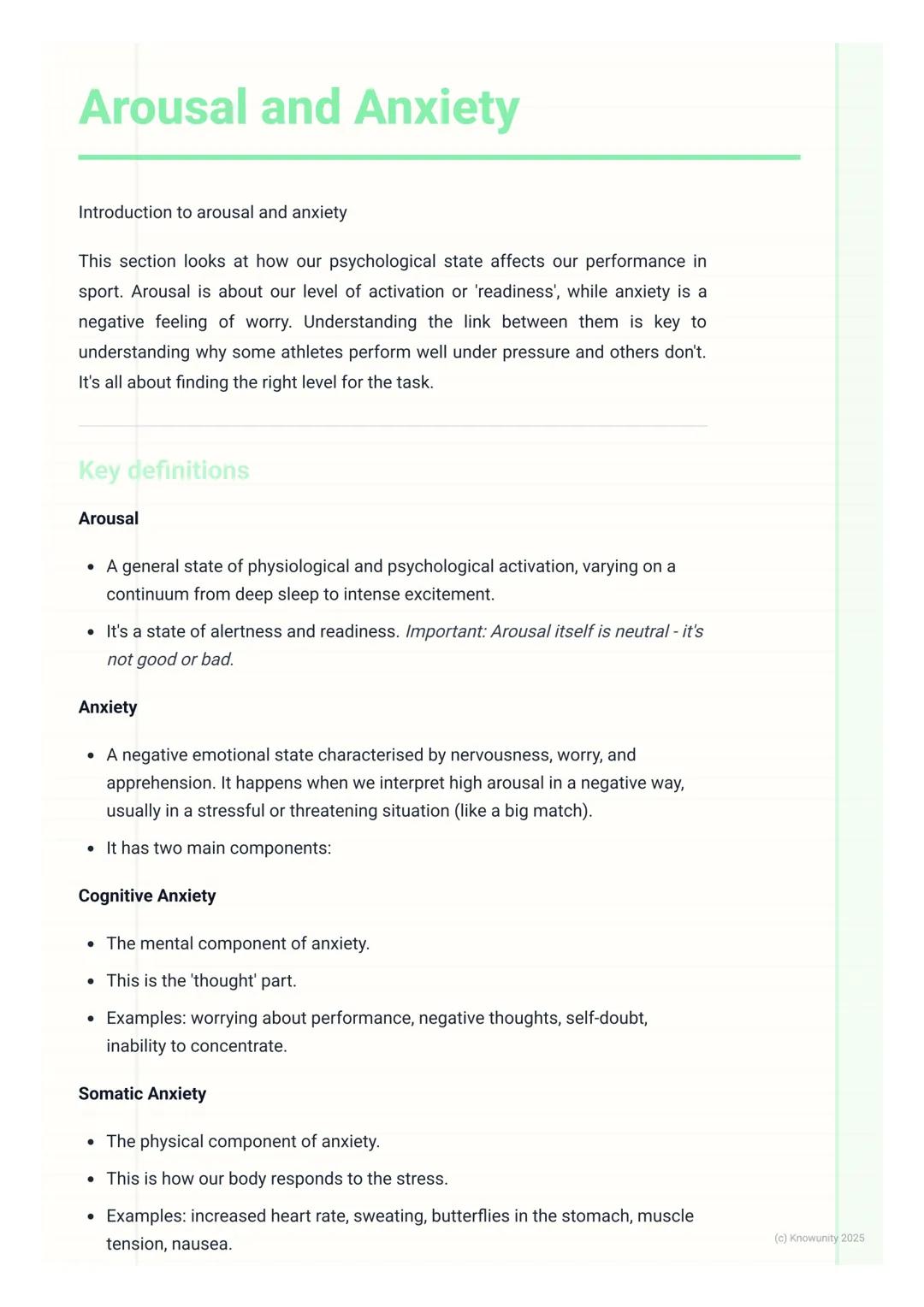
Understanding Arousal and Anxiety
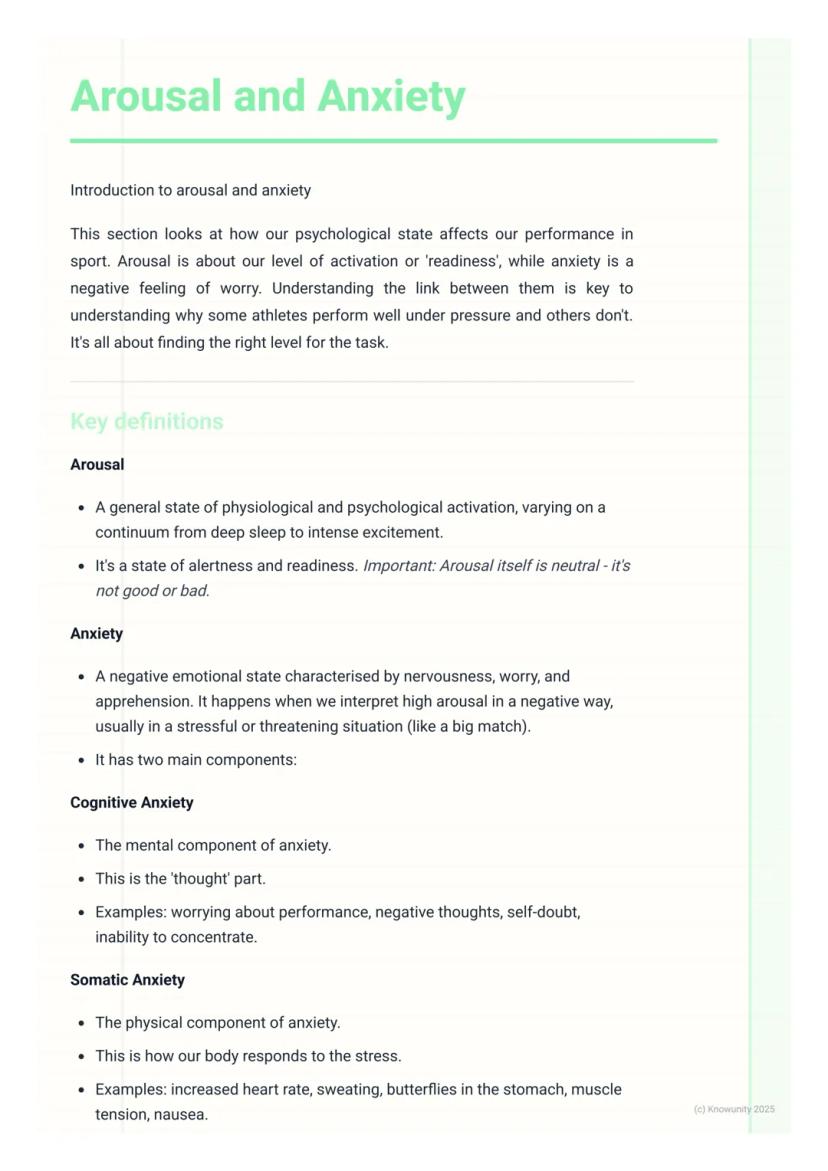
Think of arousal as your body's engine revving up - it's simply your level of alertness and readiness, ranging from being half-asleep to buzzing with excitement. Here's the crucial bit: arousal isn't good or bad, it's completely neutral.
Anxiety, however, is when things go wrong. It's that horrible feeling of worry and nervousness that hits when you interpret high arousal negatively - like when you're about to take a crucial penalty in front of thousands of people.
Anxiety shows up in two ways. Cognitive anxiety messes with your head - think negative thoughts, worrying about failing, or losing concentration. Somatic anxiety attacks your body with symptoms like sweating, butterflies in your stomach, shaking hands, or your heart pounding out of your chest.
Quick Check: Remember that arousal is neutral energy, whilst anxiety is when that energy becomes negative and starts working against you.
2
of 5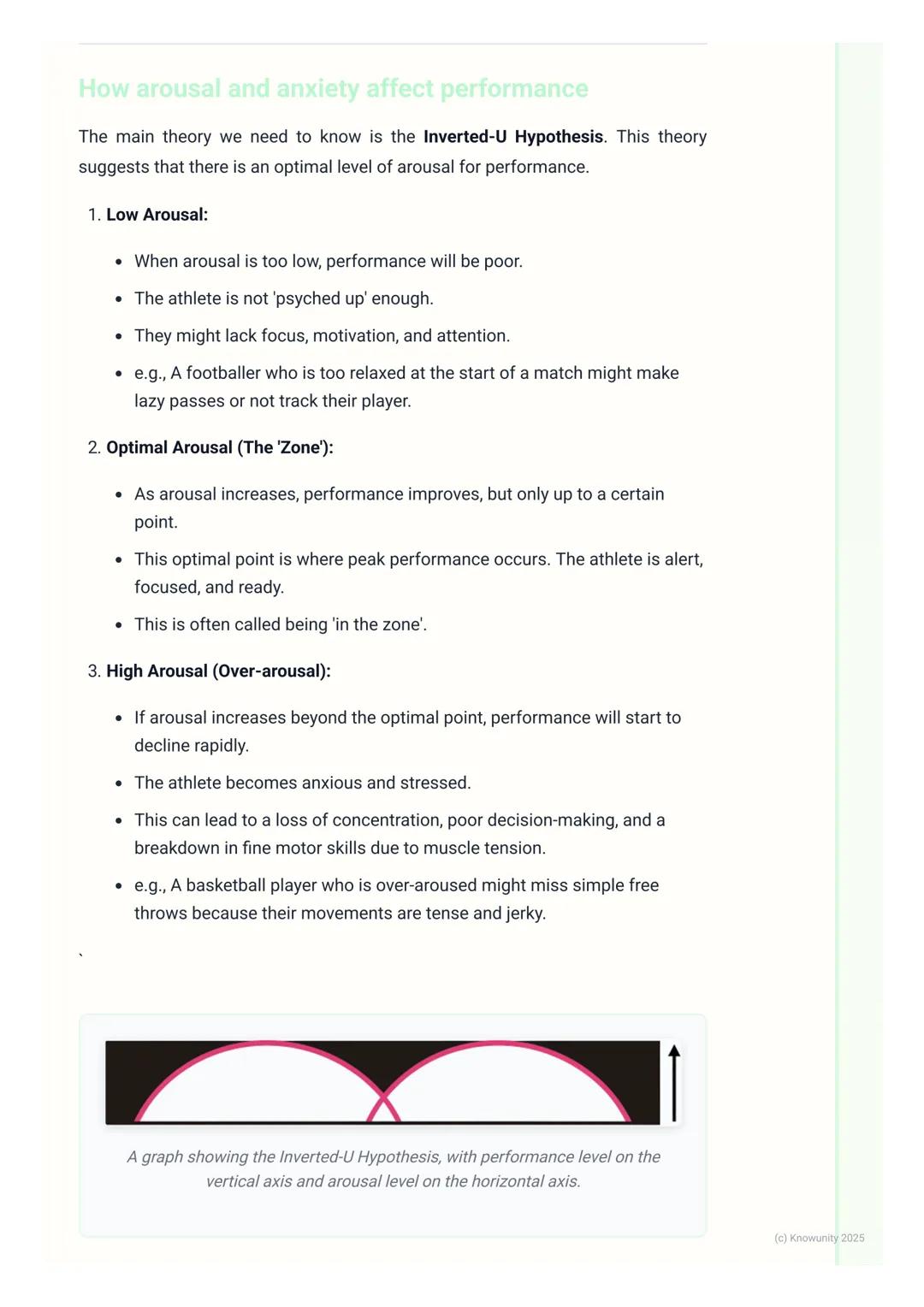
The Inverted-U Hypothesis
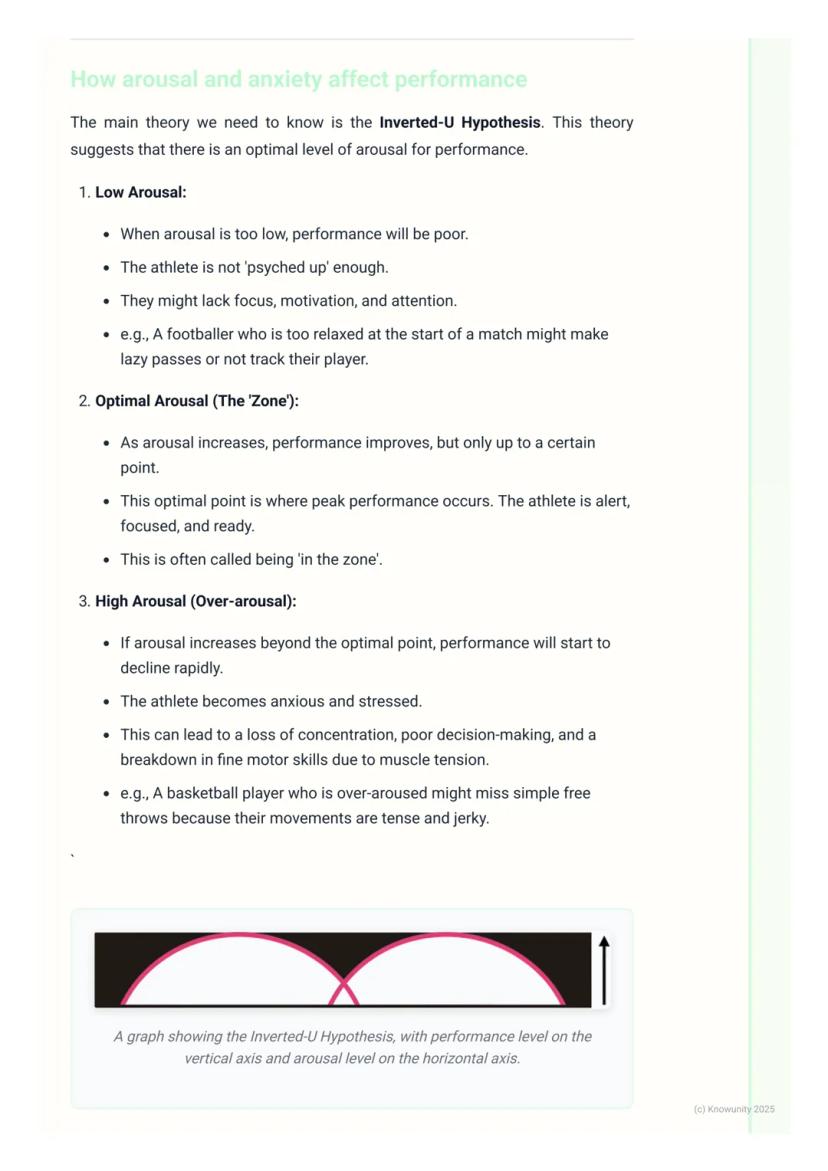
This theory is absolutely essential for understanding sports performance. Picture an upside-down U shape - that's how arousal affects your performance, and it explains why finding the sweet spot matters so much.
When arousal is too low, you'll perform poorly because you're not mentally switched on. You might lack focus or motivation - like a footballer making lazy passes because they're not properly warmed up mentally.
At optimal arousal (the magic zone), you hit peak performance. You're alert, focused, and everything clicks into place. This is what athletes mean when they talk about being "in the zone" - it's genuinely the best feeling in sport.
But push arousal too high and you'll crash spectacularly. Over-arousal triggers anxiety, causing poor decision-making, loss of concentration, and tense muscles that ruin your technique. Think of a basketball player missing simple free throws because they're too wound up.
Performance Tip: Your optimal arousal level isn't fixed - it changes depending on what sport you're playing and how experienced you are.
3
of 5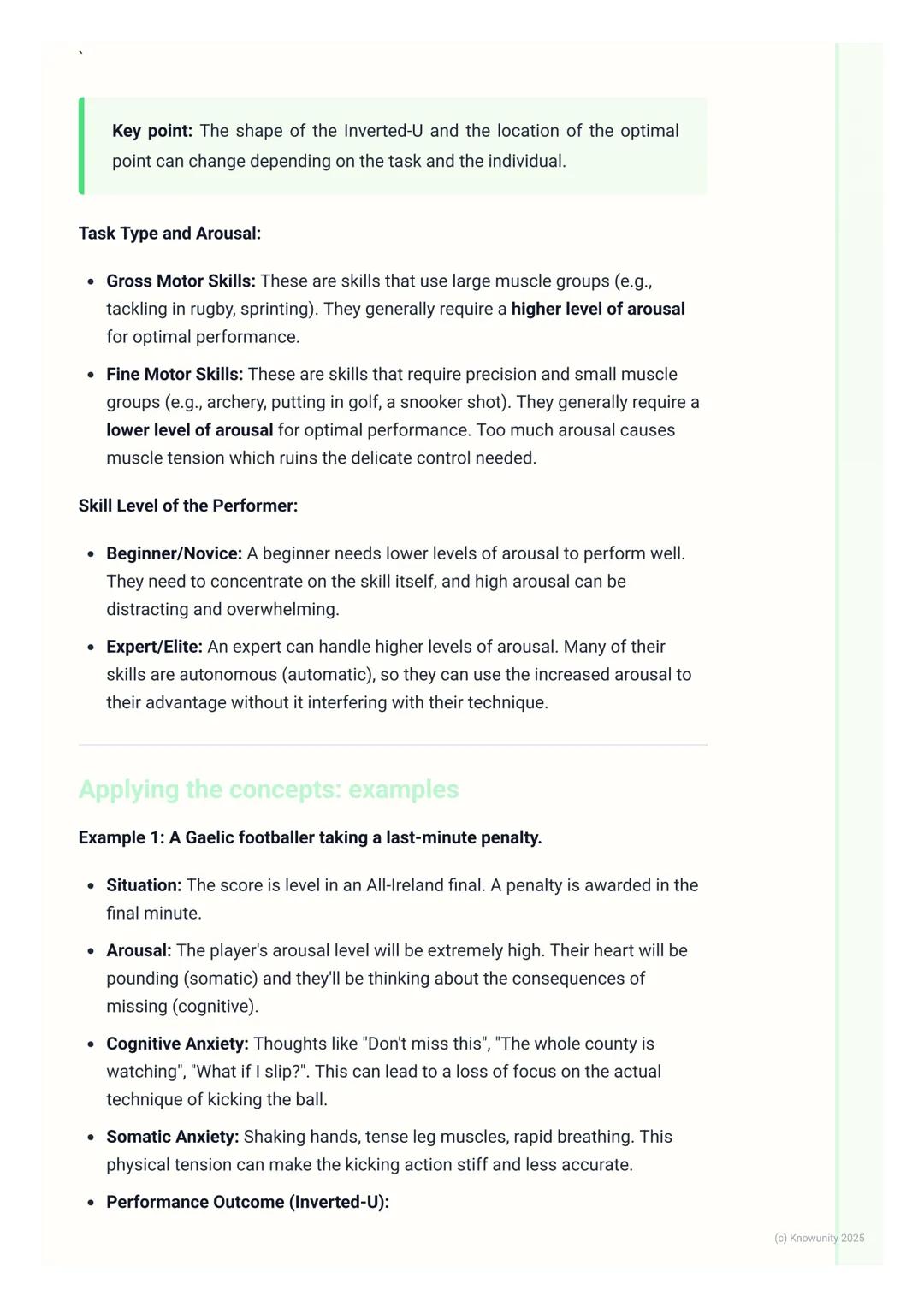
What Affects Your Optimal Arousal Level
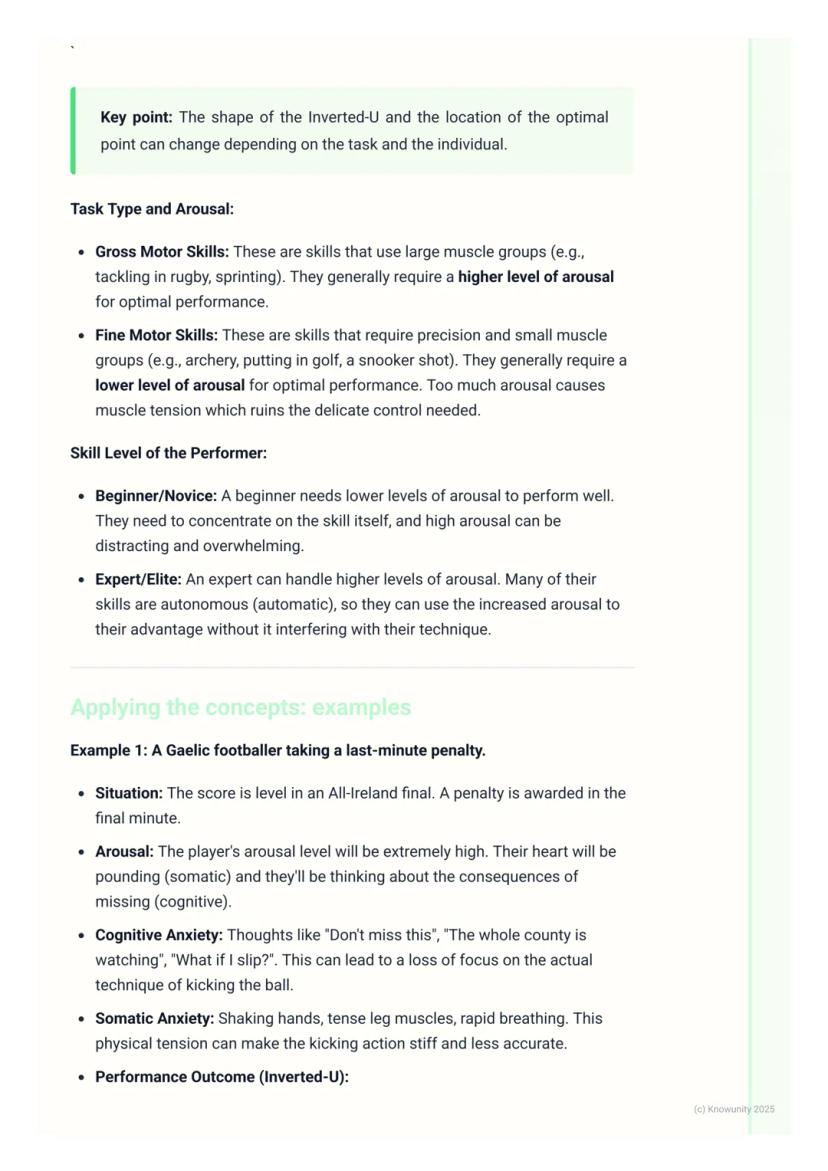
Not all sports need the same arousal level, and this is where understanding task types becomes crucial for your performance.
Gross motor skills use big muscle groups - like tackling in rugby or sprinting. These activities can handle much higher arousal levels because the movements are powerful and explosive. Getting properly fired up actually helps your performance here.
Fine motor skills require precision and small muscle control - think archery, putting in golf, or taking a snooker shot. These need much lower arousal levels because too much energy creates muscle tension that destroys the delicate control you need.
Your skill level also matters massively. Beginners need lower arousal to concentrate on learning the basic technique - high arousal just becomes overwhelming and distracting. Expert athletes can handle much higher arousal because their skills are automatic, so they can channel that extra energy positively.
Exam Gold: Always mention both task type and skill level when applying the Inverted-U hypothesis to examples.
4
of 5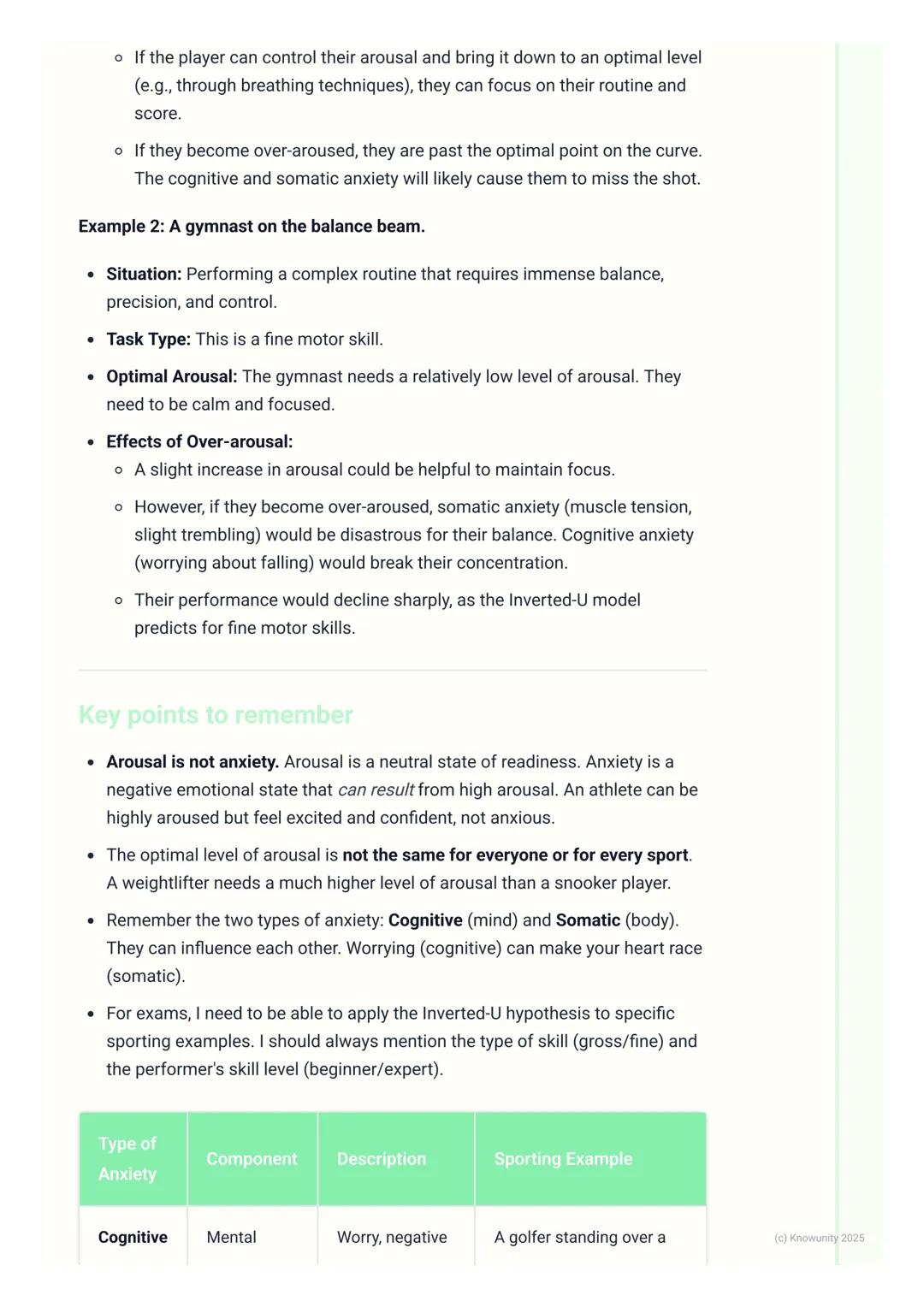
Real-World Examples
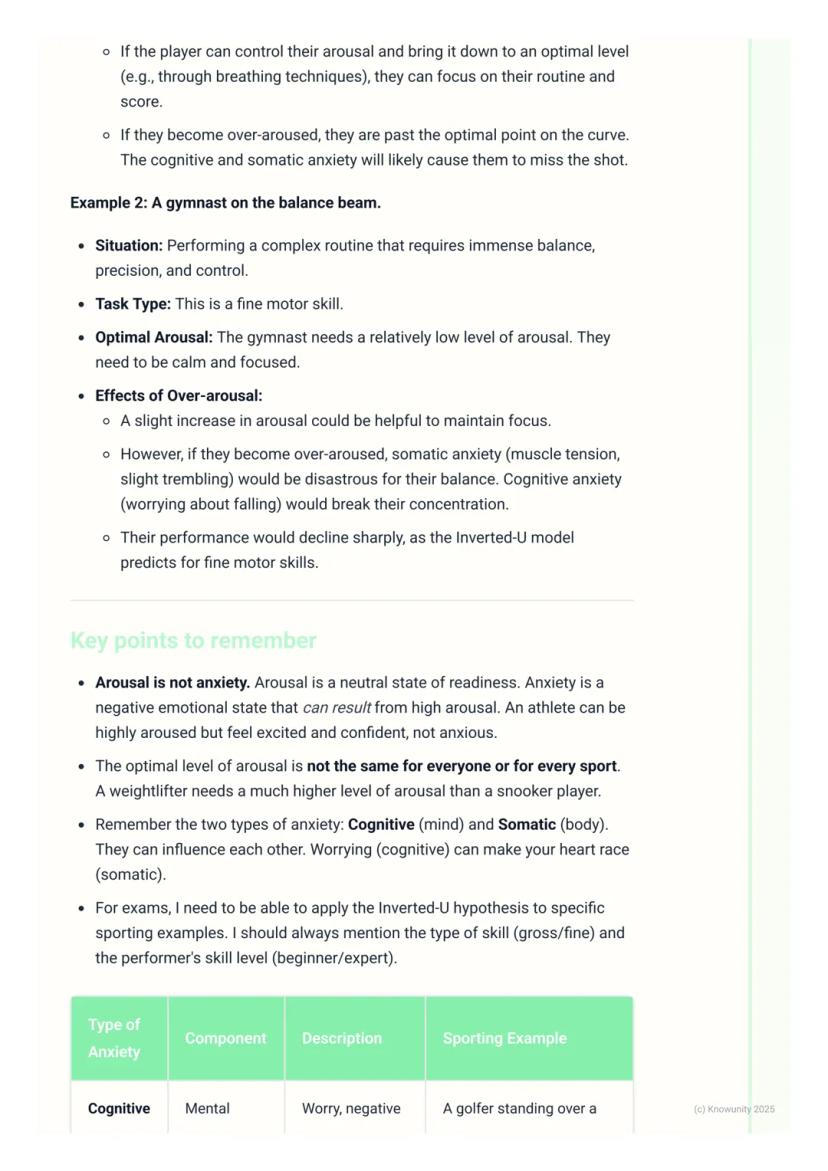
Picture a Gaelic footballer taking a last-minute penalty in an All-Ireland final. Their arousal will be through the roof - heart pounding (somatic anxiety) whilst thinking "don't miss this, everyone's watching" (cognitive anxiety).
If they can control that arousal through breathing techniques and focus on their routine, they'll likely score. But if they become over-aroused, the muscle tension and negative thoughts will probably cause them to miss - they've gone past their optimal point on the curve.
Now consider a gymnast on the balance beam. This fine motor skill needs relatively low arousal for the precision and control required. A slight increase might help focus, but over-arousal would be disastrous - muscle tension would ruin their balance, whilst worrying about falling would shatter their concentration.
The key difference? The footballer can potentially use higher arousal (gross motor skill), whilst the gymnast needs to stay much calmer (fine motor skill). Both need to find their sweet spot, but those spots are in completely different places.
Remember: Arousal and anxiety aren't the same thing - you can be highly aroused but feel excited and confident, not anxious.
5
of 5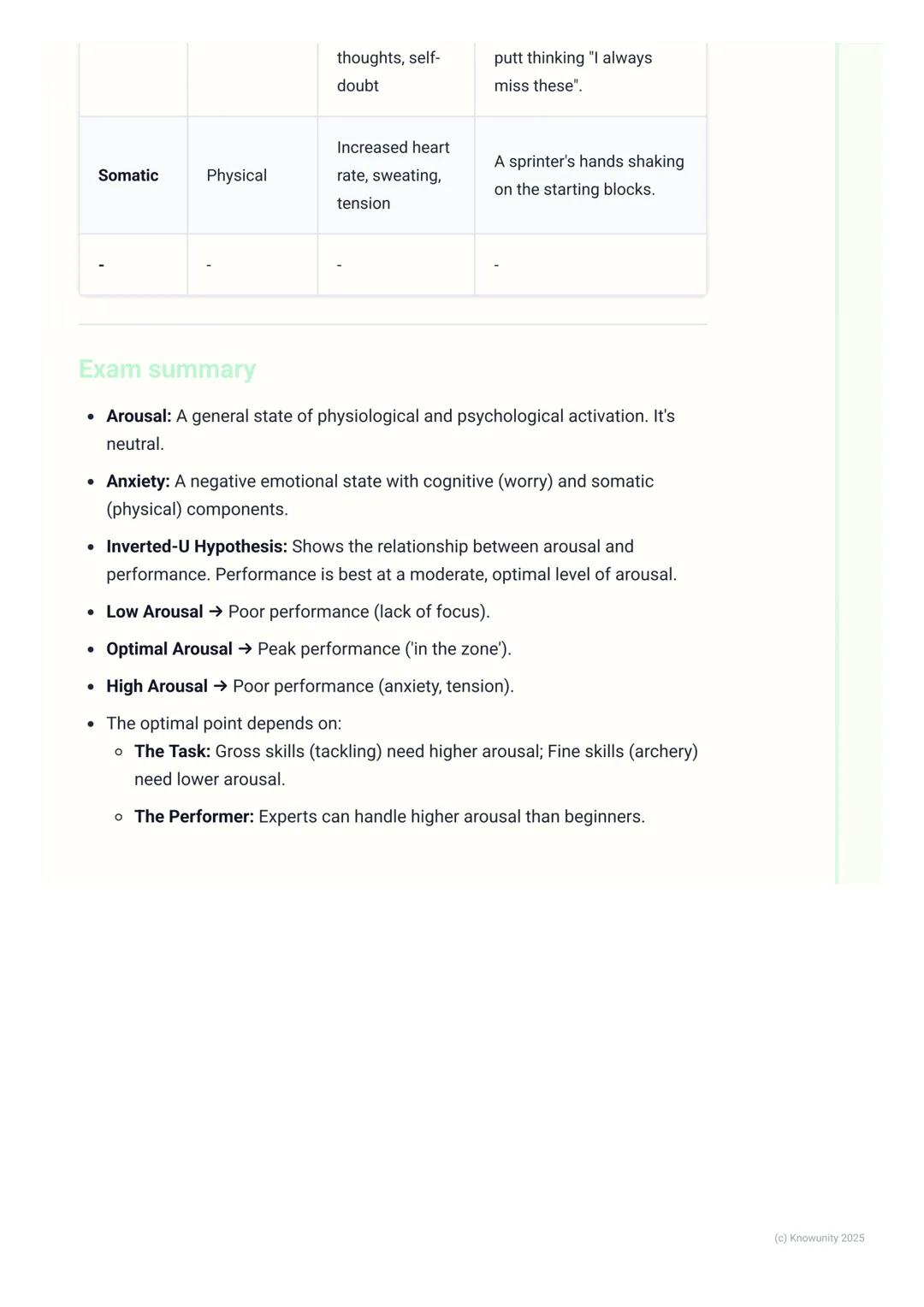
Exam Summary
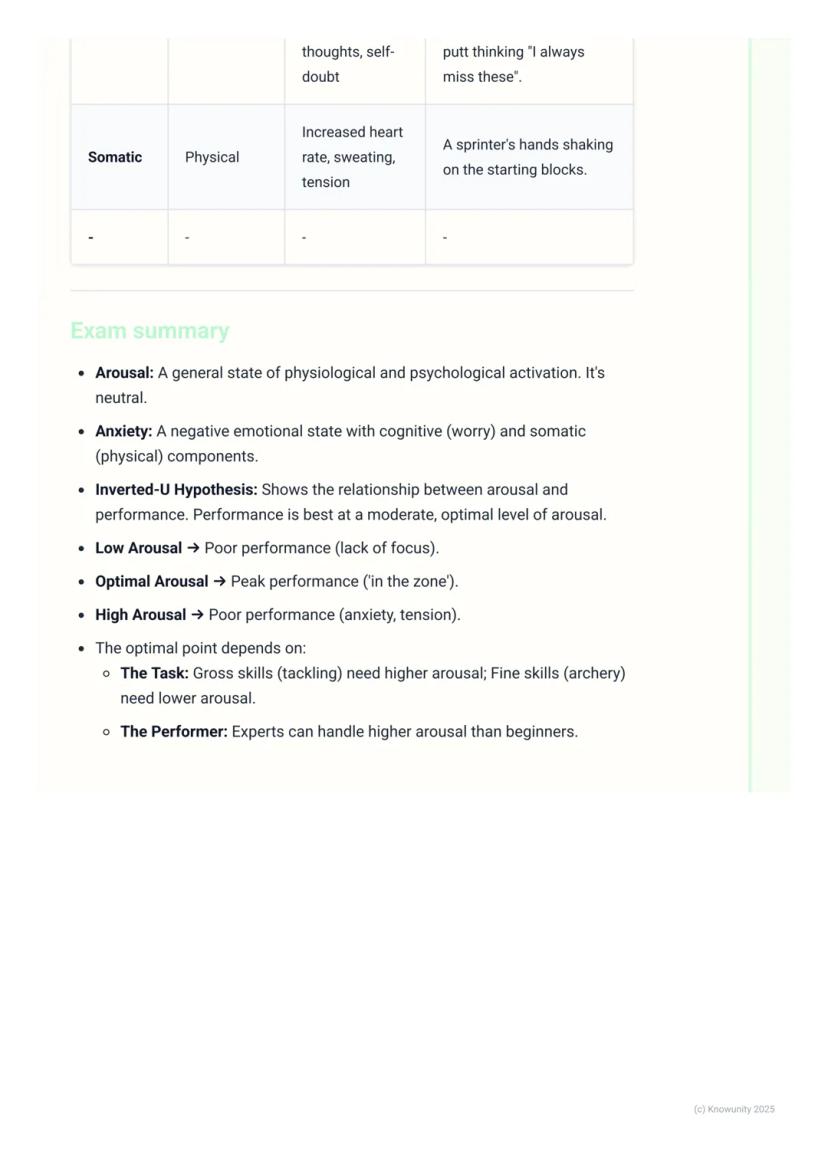
Arousal is your neutral state of activation - think of it as your psychological and physical readiness level. Anxiety is when high arousal turns negative, creating worry (cognitive anxiety) and physical symptoms like sweating or shaking (somatic anxiety).
The Inverted-U Hypothesis shows that performance peaks at moderate arousal levels. Too low means poor focus, optimal means peak performance, and too high creates anxiety that destroys performance.
Your optimal arousal depends on two key factors. Task type matters - gross motor skills (tackling) can handle higher arousal, whilst fine motor skills (archery) need lower levels. Performer level also counts - experts can cope with higher arousal than beginners.
For your exams, always apply these concepts to specific sporting examples. Mention whether it's a gross or fine motor skill, consider the performer's experience level, and explain how different arousal levels would affect their performance using the Inverted-U model.
Exam Success: Practice applying the Inverted-U hypothesis to different sports scenarios - it's a guaranteed way to pick up marks and show you truly understand the concept.
We dachten al dat je dit zou vragen...
Wat is de Knowunity AI companion?
Onze AI Companion is een studentgerichte AI-tool die meer biedt dan alleen antwoorden. Gebouwd op miljoenen Knowunity bronnen, biedt het relevante informatie, gepersonaliseerde studieplannen, quizzes en inhoud direct in de chat, aangepast aan jouw individuele leertraject.
Waar kan ik de Knowunity-app downloaden?
Je kunt de app downloaden via Google Play Store en Apple App Store.
Is Knowunity echt gratis?
Dat klopt! Geniet van gratis toegang tot leerinhoud, maak contact met medestudenten en krijg directe hulp – alles binnen handbereik.
Populairste studiemateriaal voor LCPE
4LCPEHealthy Eating Guidelines
This section explores national healthy eating guidelines, such as the food pyramid or healthy eating plate, to promote balanced dietary choices.
5th Year50
LCPEBiomechanics of Movement
Applying fundamental biomechanical principles such as force, motion, levers, and stability to analyse and improve human movement efficiency and performance in sport.
6th Year200
LCPEFactors effecting sports psychology ( confidence and self efficacy)
Higher Level LCPE psychological preprration notes
5th Year230
LCPETechnology in Sport
Investigating how technology is used in areas such as performance analysis, equipment design, officiating, and athlete monitoring to enhance training and competition.
6th Year50
Populairste studiemateriaal
9 Irish
IrishIrish oral questions and answers
Questions and answers for the leaving cert oral
5th Year4264
 English
Key Quotes : Sive
Key Quotes and explanations: Sive
6th Year2842
IrishIrish oral questions
Outline of oral questions
5th Year2055
IrishIníon- le hÁine Durkin
Aine Durkin’s poem, Iníon: Themes & summary
5th Year890
IrishIrish poetry 2027
Iníon + Dínit an Bhróin
5th Year1153
IrishLC HL notes- Iníon (poem)
Includes poem in English and Irish, theme, key words & phrases
5th Year2304
EnglishCultural Context : Shawshank Redemption : Sive : Small Things Like These
Comparative Study : Cultural Context : Shawshank Redemption, Sive and Small Things Like These
6th Year1430
IrishMo Ghrá-sa (Idir Lúibíní)
Notes on mo ghrá-sa
5th Year380
IrishAn Gaeilge Aiste
Irish Language essay
6th Year1320
Kan je niet vinden wat je zoekt? Ontdek andere vakken.
Studenten zijn dol op ons — en jij ook.
4.6/5App Store
4.7/5Google Play
De app is heel makkelijk te gebruiken en goed ontworpen. Ik heb tot nu toe alles kunnen vinden waar ik naar zocht en heb veel kunnen leren van de presentaties! Ik ga de app zeker gebruiken voor een schoolopdracht! En natuurlijk helpt het ook veel als inspiratie.
Stefan SiOS gebruiker
Deze app is echt geweldig. Er zijn zoveel aantekeningen en hulpmiddelen [...]. Mijn probleemvak is bijvoorbeeld Frans, en de app heeft zoveel opties voor hulp. Dankzij deze app ben ik beter geworden in Frans. Ik zou het iedereen aanraden.
Samantha KlichAndroid gebruiker
Wow, ik ben echt onder de indruk. Ik probeerde de app gewoon omdat ik hem vaak geadverteerd had gezien en was absoluut verbaasd. Deze app is DE HULP die je wilt voor school en bovenal biedt hij zoveel dingen, zoals oefeningen en factsheets, die mij persoonlijk HEEL erg hebben geholpen.
AnnaiOS gebruiker
LCPE4 weergaven·Bijgewerkt Jun 15, 2026·5 pagina'sUnderstanding Arousal and Anxiety: Effects on Performance
Ever wondered why some athletes crumble under pressure whilst others thrive? It's all about understanding arousal and anxiety- two psychological states that can make or break your sporting performance. Getting the balance right is the difference between being "in...
1
of 5
Meld je aan om de inhoud te zien. Het is gratis!
- Toegang tot alle documenten
- Verbeter je cijfers
- Sluit je aan bij miljoenen studenten
Understanding Arousal and Anxiety
Think of arousal as your body's engine revving up - it's simply your level of alertness and readiness, ranging from being half-asleep to buzzing with excitement. Here's the crucial bit: arousal isn't good or bad, it's completely neutral.
Anxiety, however, is when things go wrong. It's that horrible feeling of worry and nervousness that hits when you interpret high arousal negatively - like when you're about to take a crucial penalty in front of thousands of people.
Anxiety shows up in two ways. Cognitive anxiety messes with your head - think negative thoughts, worrying about failing, or losing concentration. Somatic anxiety attacks your body with symptoms like sweating, butterflies in your stomach, shaking hands, or your heart pounding out of your chest.
Quick Check: Remember that arousal is neutral energy, whilst anxiety is when that energy becomes negative and starts working against you.
2
of 5Meld je aan om de inhoud te zien. Het is gratis!
- Toegang tot alle documenten
- Verbeter je cijfers
- Sluit je aan bij miljoenen studenten
The Inverted-U Hypothesis
This theory is absolutely essential for understanding sports performance. Picture an upside-down U shape - that's how arousal affects your performance, and it explains why finding the sweet spot matters so much.
When arousal is too low, you'll perform poorly because you're not mentally switched on. You might lack focus or motivation - like a footballer making lazy passes because they're not properly warmed up mentally.
At optimal arousal (the magic zone), you hit peak performance. You're alert, focused, and everything clicks into place. This is what athletes mean when they talk about being "in the zone" - it's genuinely the best feeling in sport.
But push arousal too high and you'll crash spectacularly. Over-arousal triggers anxiety, causing poor decision-making, loss of concentration, and tense muscles that ruin your technique. Think of a basketball player missing simple free throws because they're too wound up.
Performance Tip: Your optimal arousal level isn't fixed - it changes depending on what sport you're playing and how experienced you are.
3
of 5Meld je aan om de inhoud te zien. Het is gratis!
- Toegang tot alle documenten
- Verbeter je cijfers
- Sluit je aan bij miljoenen studenten
What Affects Your Optimal Arousal Level
Not all sports need the same arousal level, and this is where understanding task types becomes crucial for your performance.
Gross motor skills use big muscle groups - like tackling in rugby or sprinting. These activities can handle much higher arousal levels because the movements are powerful and explosive. Getting properly fired up actually helps your performance here.
Fine motor skills require precision and small muscle control - think archery, putting in golf, or taking a snooker shot. These need much lower arousal levels because too much energy creates muscle tension that destroys the delicate control you need.
Your skill level also matters massively. Beginners need lower arousal to concentrate on learning the basic technique - high arousal just becomes overwhelming and distracting. Expert athletes can handle much higher arousal because their skills are automatic, so they can channel that extra energy positively.
Exam Gold: Always mention both task type and skill level when applying the Inverted-U hypothesis to examples.
4
of 5Meld je aan om de inhoud te zien. Het is gratis!
- Toegang tot alle documenten
- Verbeter je cijfers
- Sluit je aan bij miljoenen studenten
Real-World Examples
Picture a Gaelic footballer taking a last-minute penalty in an All-Ireland final. Their arousal will be through the roof - heart pounding (somatic anxiety) whilst thinking "don't miss this, everyone's watching" (cognitive anxiety).
If they can control that arousal through breathing techniques and focus on their routine, they'll likely score. But if they become over-aroused, the muscle tension and negative thoughts will probably cause them to miss - they've gone past their optimal point on the curve.
Now consider a gymnast on the balance beam. This fine motor skill needs relatively low arousal for the precision and control required. A slight increase might help focus, but over-arousal would be disastrous - muscle tension would ruin their balance, whilst worrying about falling would shatter their concentration.
The key difference? The footballer can potentially use higher arousal (gross motor skill), whilst the gymnast needs to stay much calmer (fine motor skill). Both need to find their sweet spot, but those spots are in completely different places.
Remember: Arousal and anxiety aren't the same thing - you can be highly aroused but feel excited and confident, not anxious.
5
of 5Meld je aan om de inhoud te zien. Het is gratis!
- Toegang tot alle documenten
- Verbeter je cijfers
- Sluit je aan bij miljoenen studenten
Exam Summary
Arousal is your neutral state of activation - think of it as your psychological and physical readiness level. Anxiety is when high arousal turns negative, creating worry (cognitive anxiety) and physical symptoms like sweating or shaking (somatic anxiety).
The Inverted-U Hypothesis shows that performance peaks at moderate arousal levels. Too low means poor focus, optimal means peak performance, and too high creates anxiety that destroys performance.
Your optimal arousal depends on two key factors. Task type matters - gross motor skills (tackling) can handle higher arousal, whilst fine motor skills (archery) need lower levels. Performer level also counts - experts can cope with higher arousal than beginners.
For your exams, always apply these concepts to specific sporting examples. Mention whether it's a gross or fine motor skill, consider the performer's experience level, and explain how different arousal levels would affect their performance using the Inverted-U model.
Exam Success: Practice applying the Inverted-U hypothesis to different sports scenarios - it's a guaranteed way to pick up marks and show you truly understand the concept.
We dachten al dat je dit zou vragen...
Wat is de Knowunity AI companion?
Onze AI Companion is een studentgerichte AI-tool die meer biedt dan alleen antwoorden. Gebouwd op miljoenen Knowunity bronnen, biedt het relevante informatie, gepersonaliseerde studieplannen, quizzes en inhoud direct in de chat, aangepast aan jouw individuele leertraject.
Waar kan ik de Knowunity-app downloaden?
Je kunt de app downloaden via Google Play Store en Apple App Store.
Is Knowunity echt gratis?
Dat klopt! Geniet van gratis toegang tot leerinhoud, maak contact met medestudenten en krijg directe hulp – alles binnen handbereik.
Populairste studiemateriaal voor LCPE
4LCPEHealthy Eating Guidelines
This section explores national healthy eating guidelines, such as the food pyramid or healthy eating plate, to promote balanced dietary choices.
5th Year50
LCPEBiomechanics of Movement
Applying fundamental biomechanical principles such as force, motion, levers, and stability to analyse and improve human movement efficiency and performance in sport.
6th Year200
LCPEFactors effecting sports psychology ( confidence and self efficacy)
Higher Level LCPE psychological preprration notes
5th Year230
LCPETechnology in Sport
Investigating how technology is used in areas such as performance analysis, equipment design, officiating, and athlete monitoring to enhance training and competition.
6th Year50
Populairste studiemateriaal
9IrishIrish oral questions and answers
Questions and answers for the leaving cert oral
5th Year4264
EnglishKey Quotes : Sive
Key Quotes and explanations: Sive
6th Year2842
IrishIrish oral questions
Outline of oral questions
5th Year2055
IrishIníon- le hÁine Durkin
Aine Durkin’s poem, Iníon: Themes & summary
5th Year890
IrishIrish poetry 2027
Iníon + Dínit an Bhróin
5th Year1153
IrishLC HL notes- Iníon (poem)
Includes poem in English and Irish, theme, key words & phrases
5th Year2304
EnglishCultural Context : Shawshank Redemption : Sive : Small Things Like These
Comparative Study : Cultural Context : Shawshank Redemption, Sive and Small Things Like These
6th Year1430
IrishMo Ghrá-sa (Idir Lúibíní)
Notes on mo ghrá-sa
5th Year380
IrishAn Gaeilge Aiste
Irish Language essay
6th Year1320
Kan je niet vinden wat je zoekt? Ontdek andere vakken.
Studenten zijn dol op ons — en jij ook.
4.6/5App Store
4.7/5Google Play
De app is heel makkelijk te gebruiken en goed ontworpen. Ik heb tot nu toe alles kunnen vinden waar ik naar zocht en heb veel kunnen leren van de presentaties! Ik ga de app zeker gebruiken voor een schoolopdracht! En natuurlijk helpt het ook veel als inspiratie.
Stefan SiOS gebruiker
Deze app is echt geweldig. Er zijn zoveel aantekeningen en hulpmiddelen [...]. Mijn probleemvak is bijvoorbeeld Frans, en de app heeft zoveel opties voor hulp. Dankzij deze app ben ik beter geworden in Frans. Ik zou het iedereen aanraden.
Samantha KlichAndroid gebruiker
Wow, ik ben echt onder de indruk. Ik probeerde de app gewoon omdat ik hem vaak geadverteerd had gezien en was absoluut verbaasd. Deze app is DE HULP die je wilt voor school en bovenal biedt hij zoveel dingen, zoals oefeningen en factsheets, die mij persoonlijk HEEL erg hebben geholpen.
AnnaiOS gebruiker