
Leadership and coaching are game-changers in sport and physical activity....
 LCPE3 weergaven·Bijgewerkt Jun 18, 2026·7 pagina's
Mastering Leadership and Coaching in Physical Activity
1 / 7
1
of 7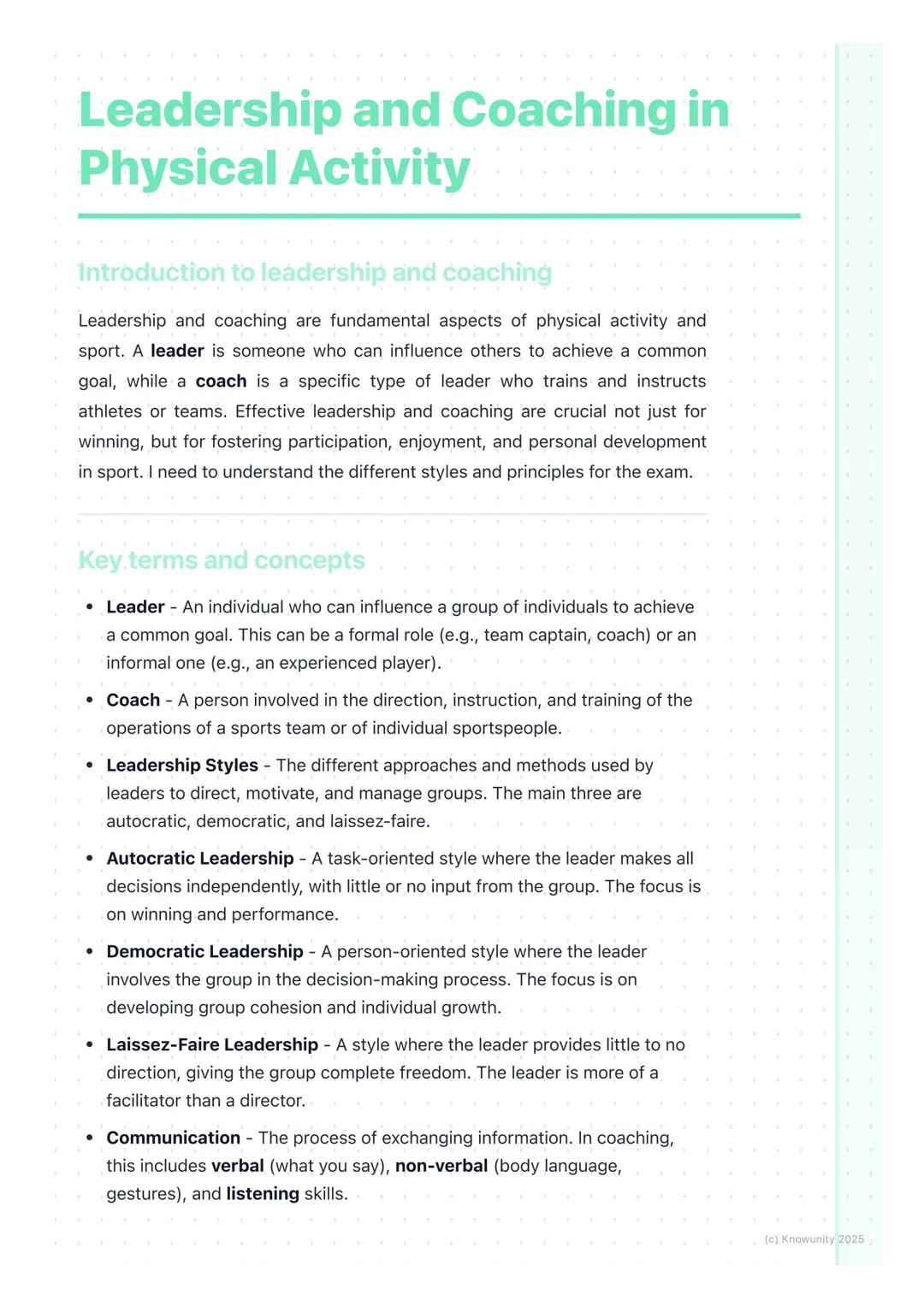
Introduction to Leadership and Coaching
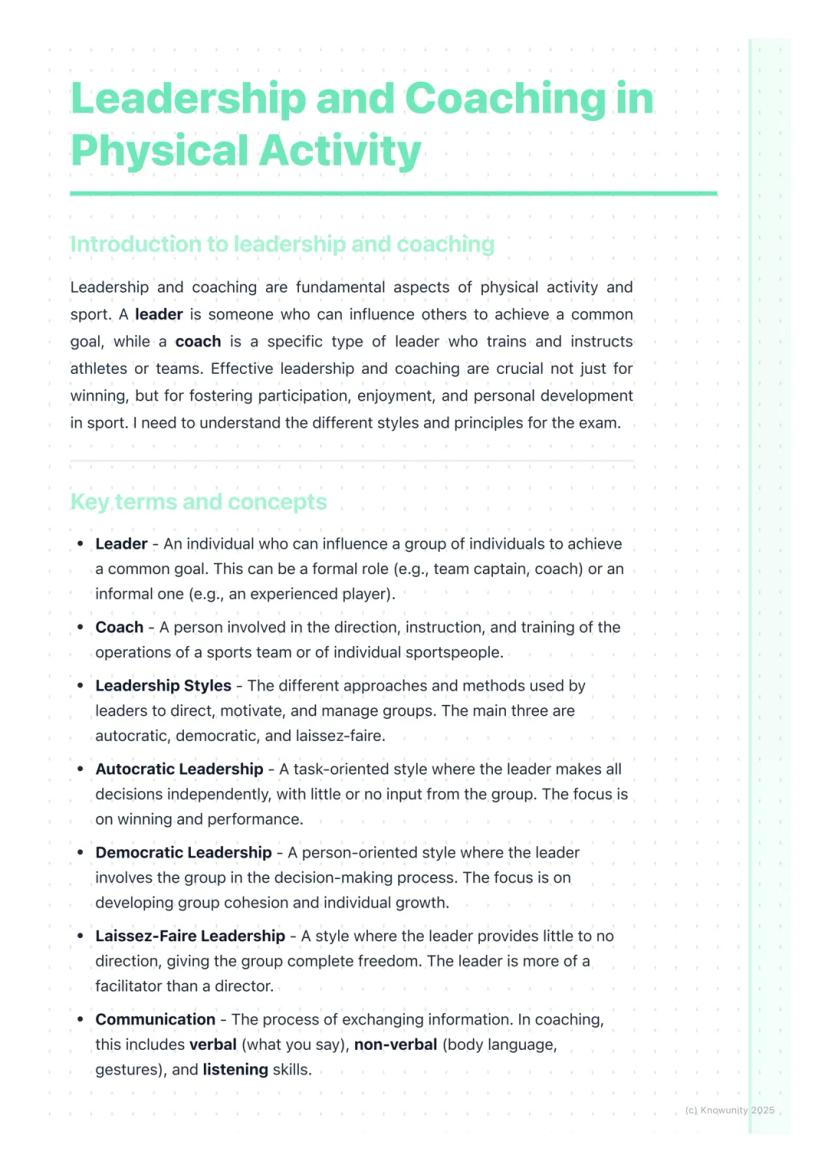
Think about the best coach or team leader you've ever had - what made them so effective? Leadership is all about influencing others to achieve common goals, whilst coaching is a specific type of leadership focused on training and developing athletes.
These skills aren't just about winning matches. Great leaders and coaches create environments where everyone feels valued, develops their abilities, and actually enjoys what they're doing. That's what builds lifelong participation in sport.
The key is understanding that there's no one-size-fits-all approach. Different situations call for different leadership styles, and the best leaders know how to adapt their approach based on who they're working with and what they're trying to achieve.
Remember: A leader can be formal (like a captain) or informal (like an experienced player who naturally guides others).
2
of 7
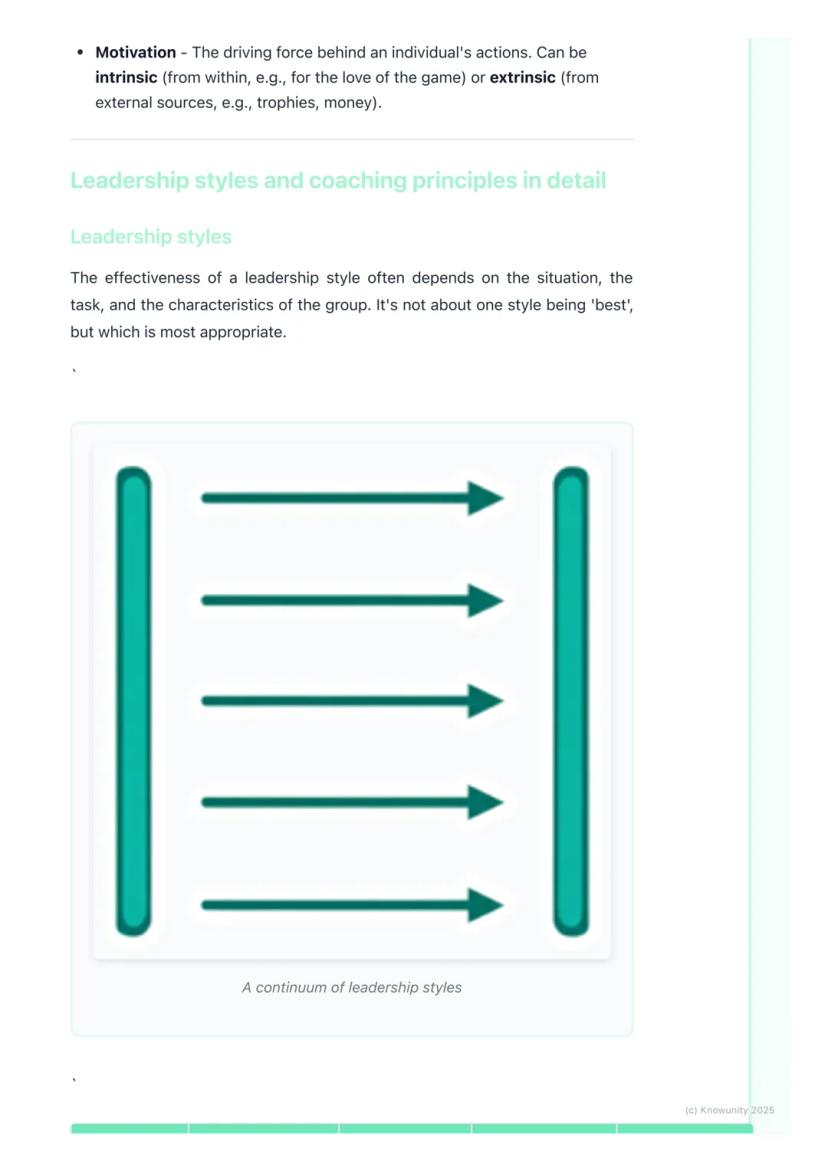
Understanding Leadership Styles
There are three main leadership styles you need to know, and each has its place depending on the situation. Autocratic leadership is task-oriented - the leader makes all decisions with little input from the group. It's brilliant for quick decisions and maintaining control.
Democratic leadership is person-oriented and involves the group in decision-making. This builds stronger relationships and keeps everyone engaged, though it can slow things down when quick decisions are needed.
Laissez-faire leadership gives the group almost complete freedom, with the leader acting more as a facilitator. This works brilliantly with highly skilled, self-motivated athletes but can lead to chaos with less experienced groups.
The secret is knowing when to use each style. You might be autocratic during safety briefings but democratic when planning team tactics.
Key Point: Effective leaders switch between styles based on the situation, not personal preference.
3
of 7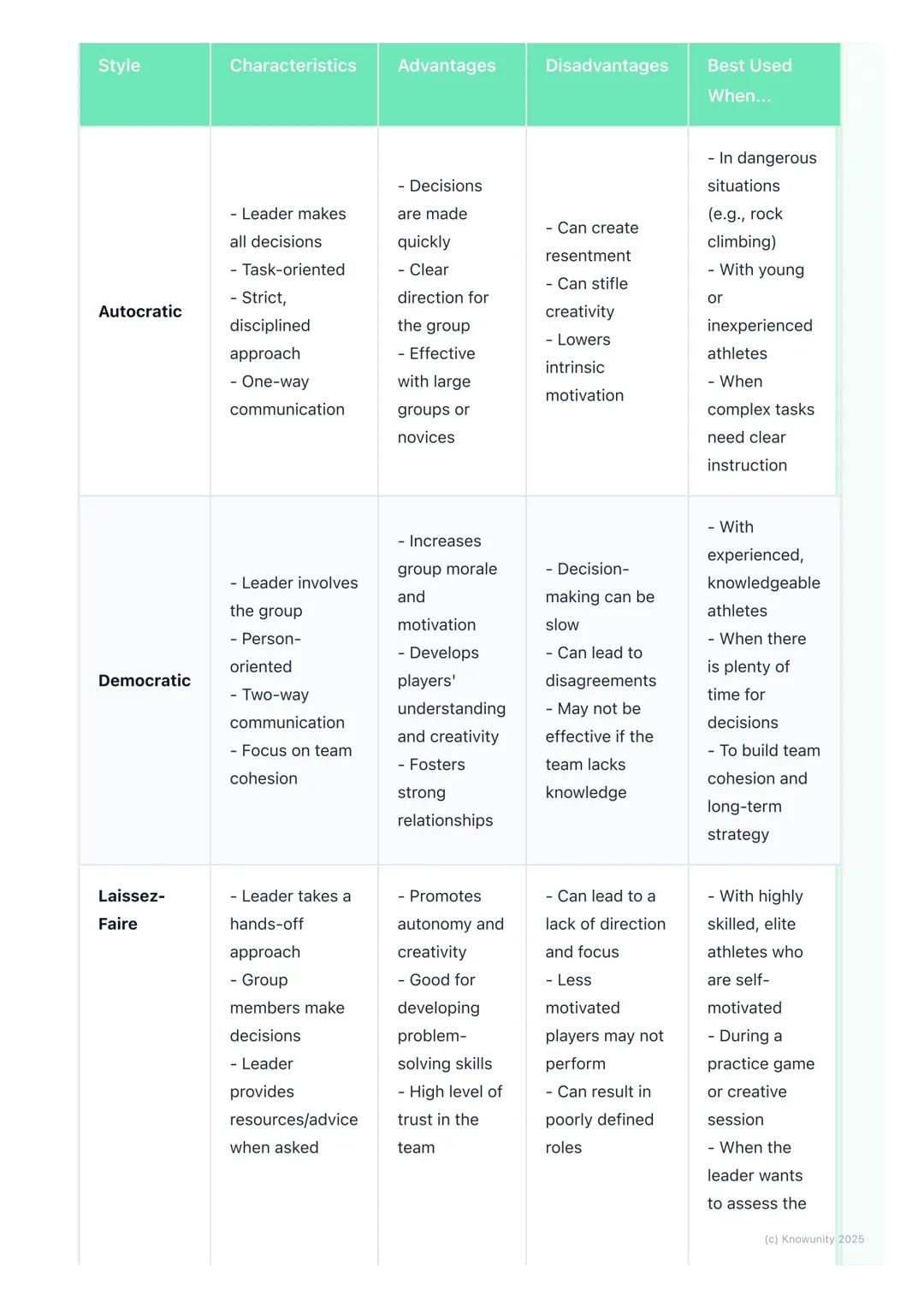
When to Use Each Leadership Style
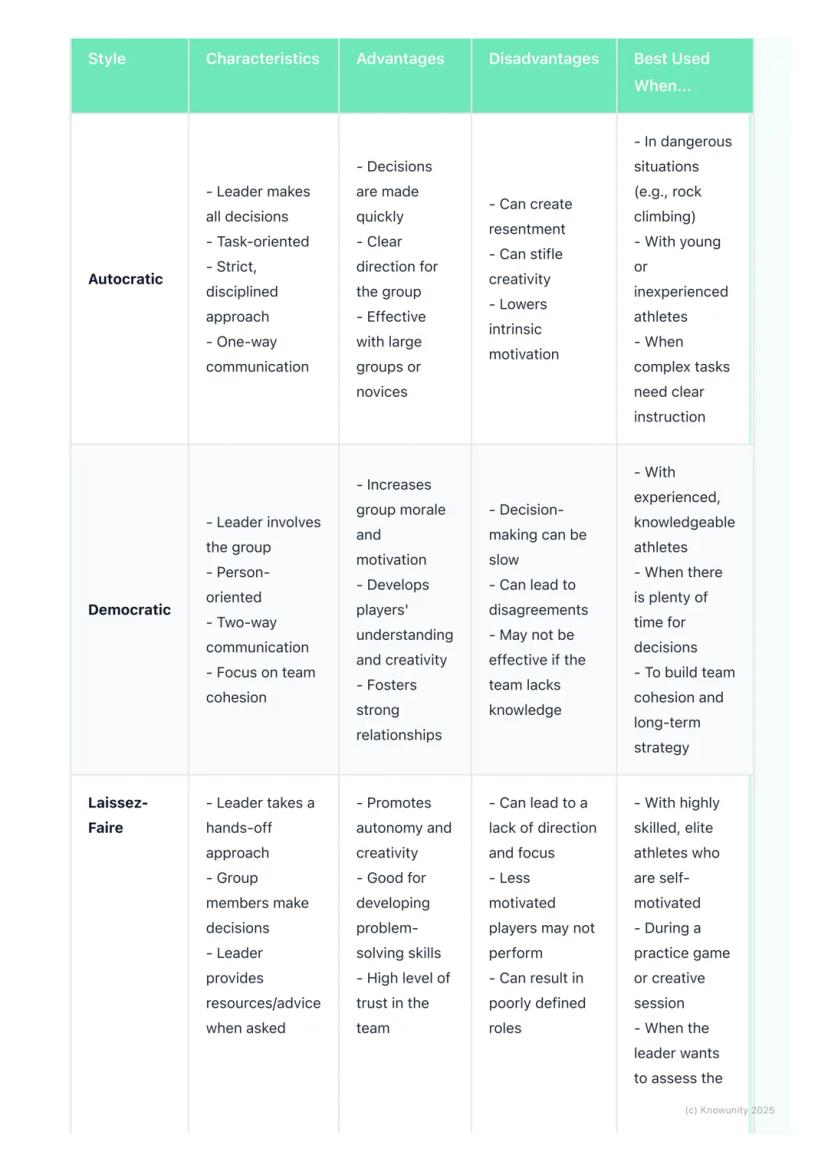
Autocratic leadership shines in dangerous situations (think rock climbing), with young or inexperienced athletes, or when complex tasks need crystal-clear instruction. Decisions happen quickly and everyone knows exactly what's expected, though it can sometimes stifle creativity.
Democratic leadership works best with experienced, knowledgeable athletes who can contribute meaningfully to decisions. It's perfect when you have time to discuss options and want to build team cohesion for the long term.
Laissez-faire leadership suits elite, highly skilled athletes who are self-motivated and know what they're doing. It promotes creativity and problem-solving skills but can leave less motivated players feeling lost without direction.
The trick is reading your group and the situation. A successful coach might use autocratic instruction for safety, democratic discussion for tactics, and laissez-faire observation during practice games.
Smart Tip: In your exams, always justify why you'd choose a particular style - link it to the athletes' skill level, the situation, and the desired outcome.
4
of 7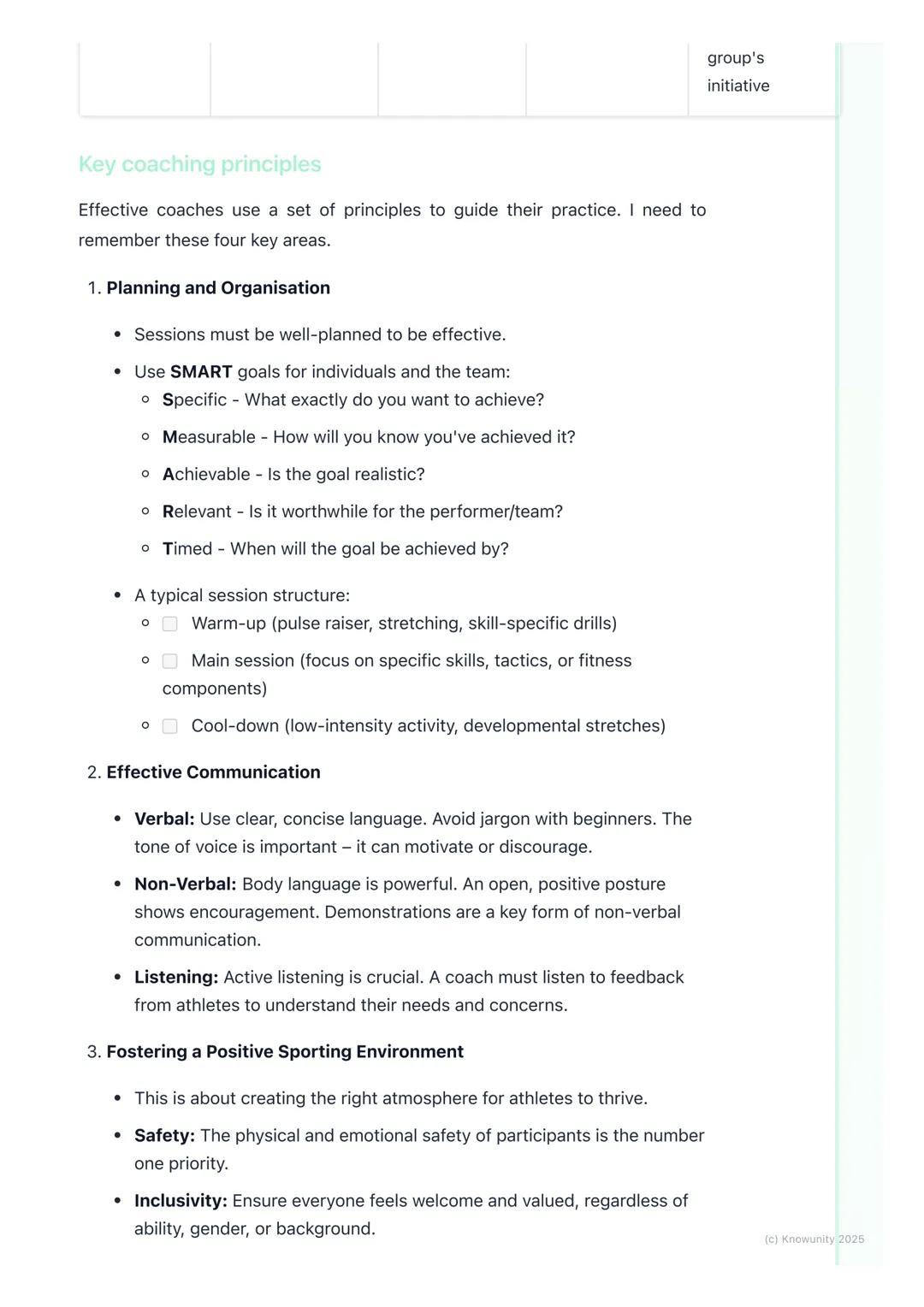
Key Coaching Principles: Planning and Communication
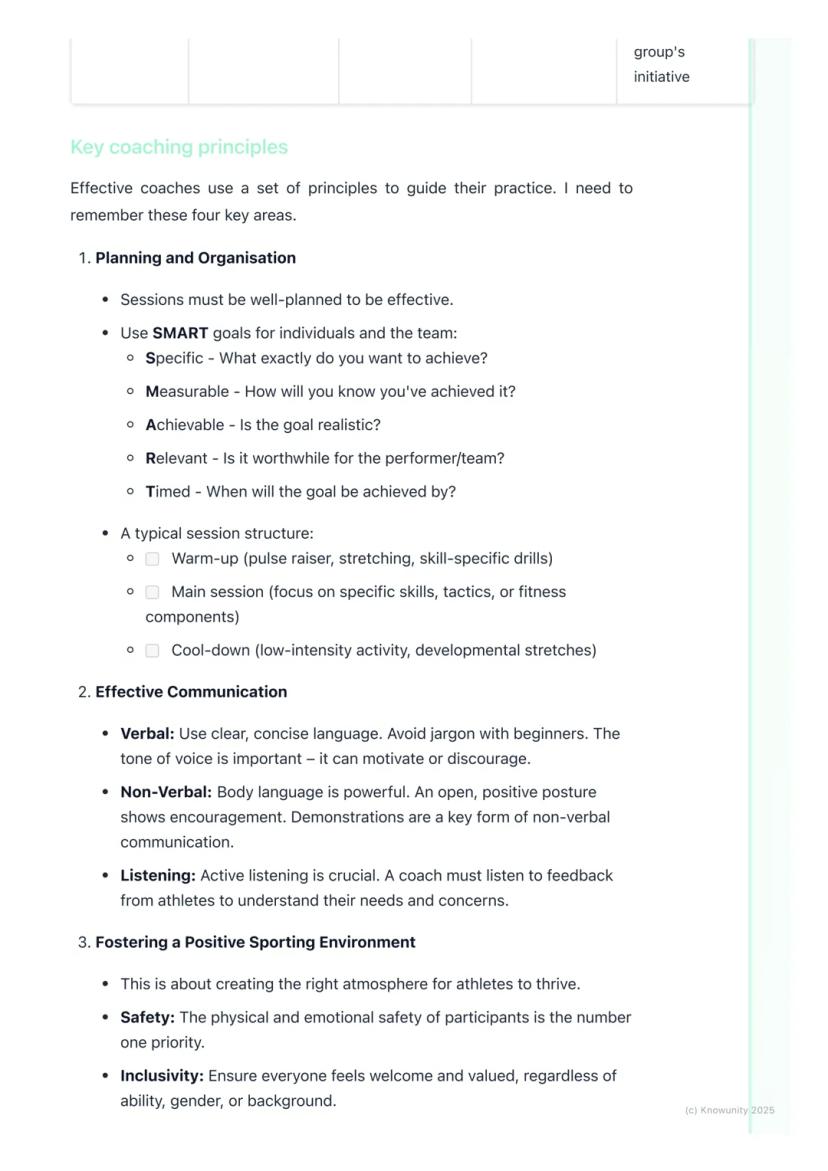
Brilliant coaching starts with smart planning and organisation. Every session needs structure: a proper warm-up, focused main activity, and cool-down. SMART goals are your best friend here - Specific, Measurable, Achievable, Relevant, and Timed objectives that give everyone clear targets.
Effective communication involves much more than just talking. Your verbal communication needs to be clear and appropriate for your audience - avoid jargon with beginners but you can use more technical language with experienced players.
Non-verbal communication is equally powerful. Your body language, facial expressions, and demonstrations often say more than words. An encouraging smile or open posture can boost confidence, whilst crossed arms might make athletes feel defensive.
Don't forget active listening - truly hearing what your athletes are telling you about their needs, concerns, and feedback. This builds trust and helps you adapt your approach to get the best from everyone.
Communication Hack: Match your communication style to your audience - what works for county-level players might overwhelm complete beginners.
5
of 7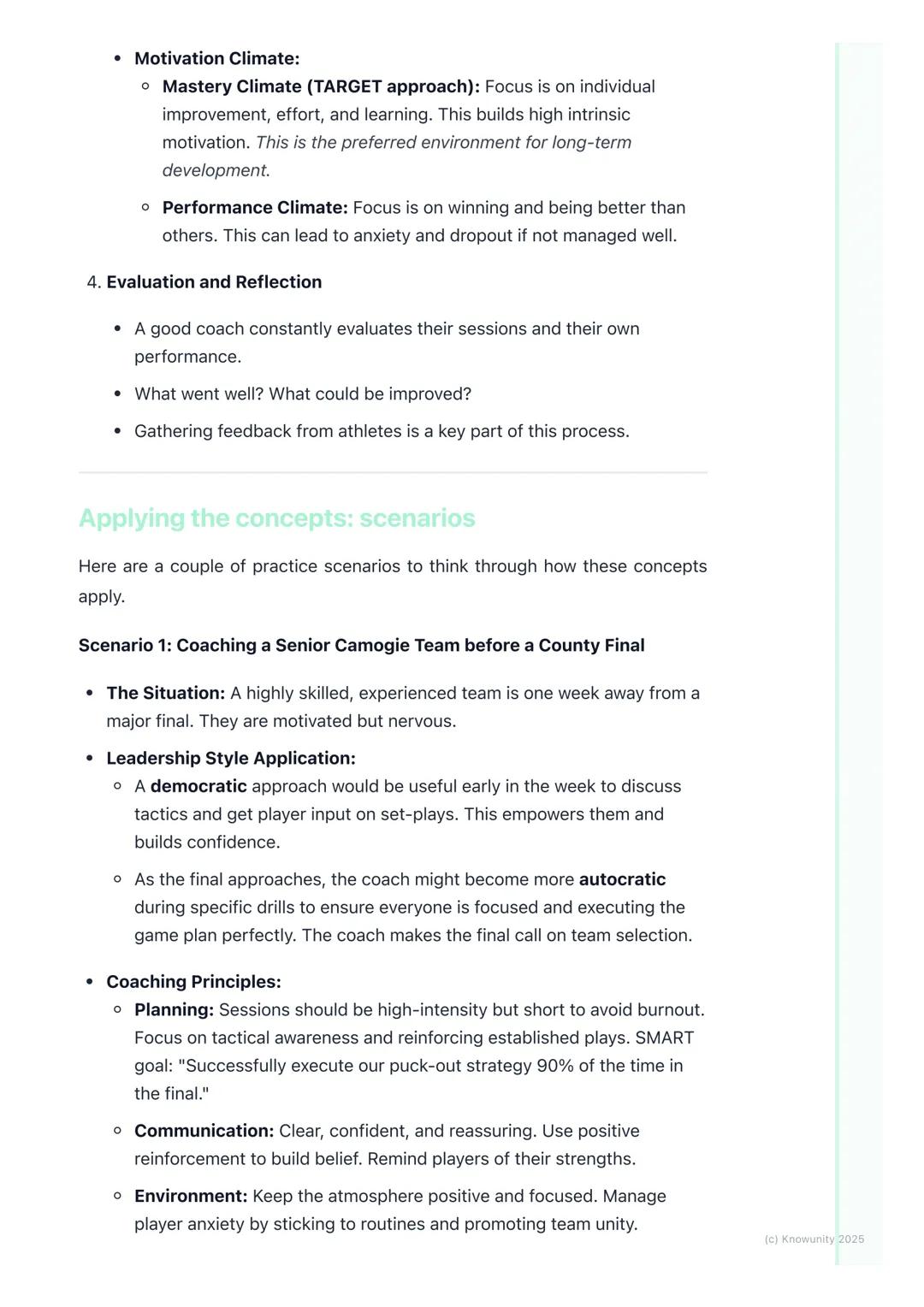
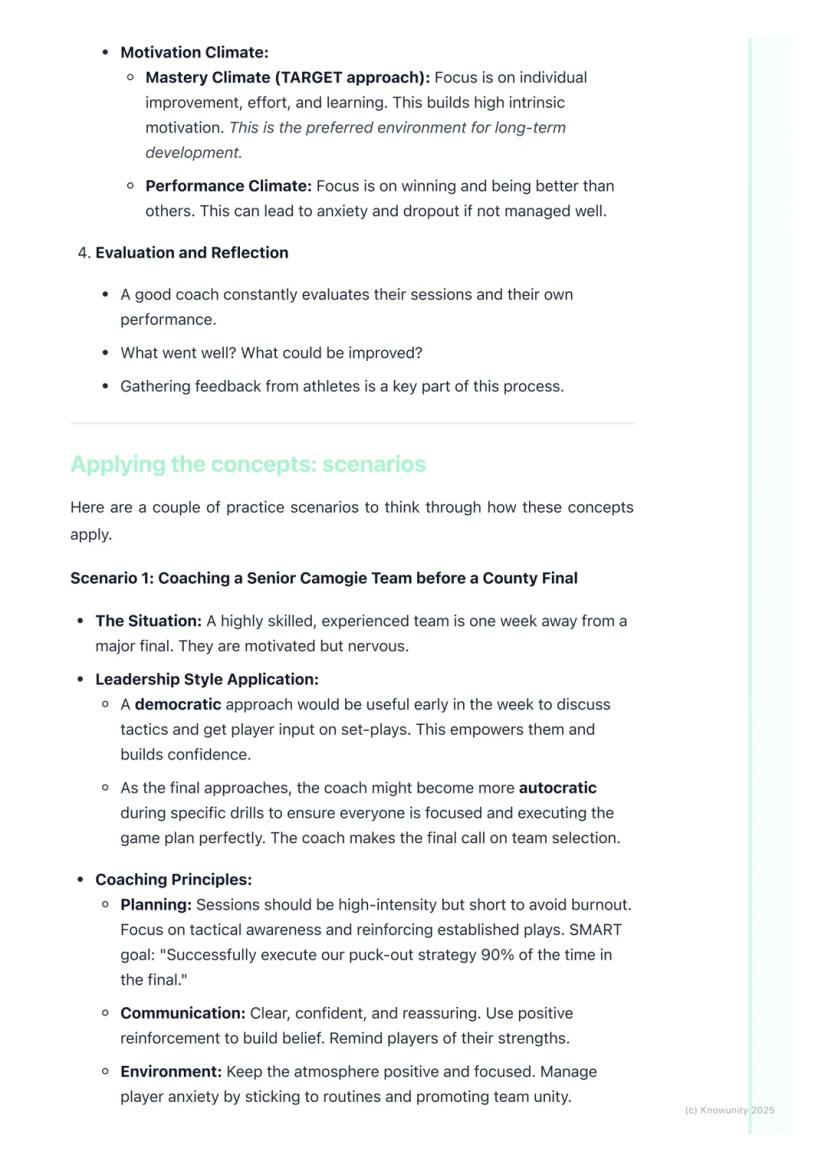
Creating Positive Environments and Evaluation
Creating a positive sporting environment is absolutely crucial for long-term success. Safety comes first - both physical and emotional. Everyone needs to feel welcome regardless of their ability level, background, or experience.
The motivational climate you create makes a huge difference. A mastery climate focuses on individual improvement, effort, and learning - this builds intrinsic motivation that lasts. A performance climate emphasises winning and comparison with others, which can create anxiety and lead to dropout.
Evaluation and reflection separate good coaches from great ones. Constantly ask yourself: what went well, what could improve, and how did the athletes respond? Getting feedback from your athletes is essential - they'll tell you what's working and what isn't.
Think about practical scenarios: coaching a senior team before a county final requires different approaches than leading a 'come and try' day for 10-year-olds. The principles stay the same, but how you apply them changes completely.
Golden Rule: Always create a mastery-focused environment where effort and improvement are celebrated more than just results.
6
of 7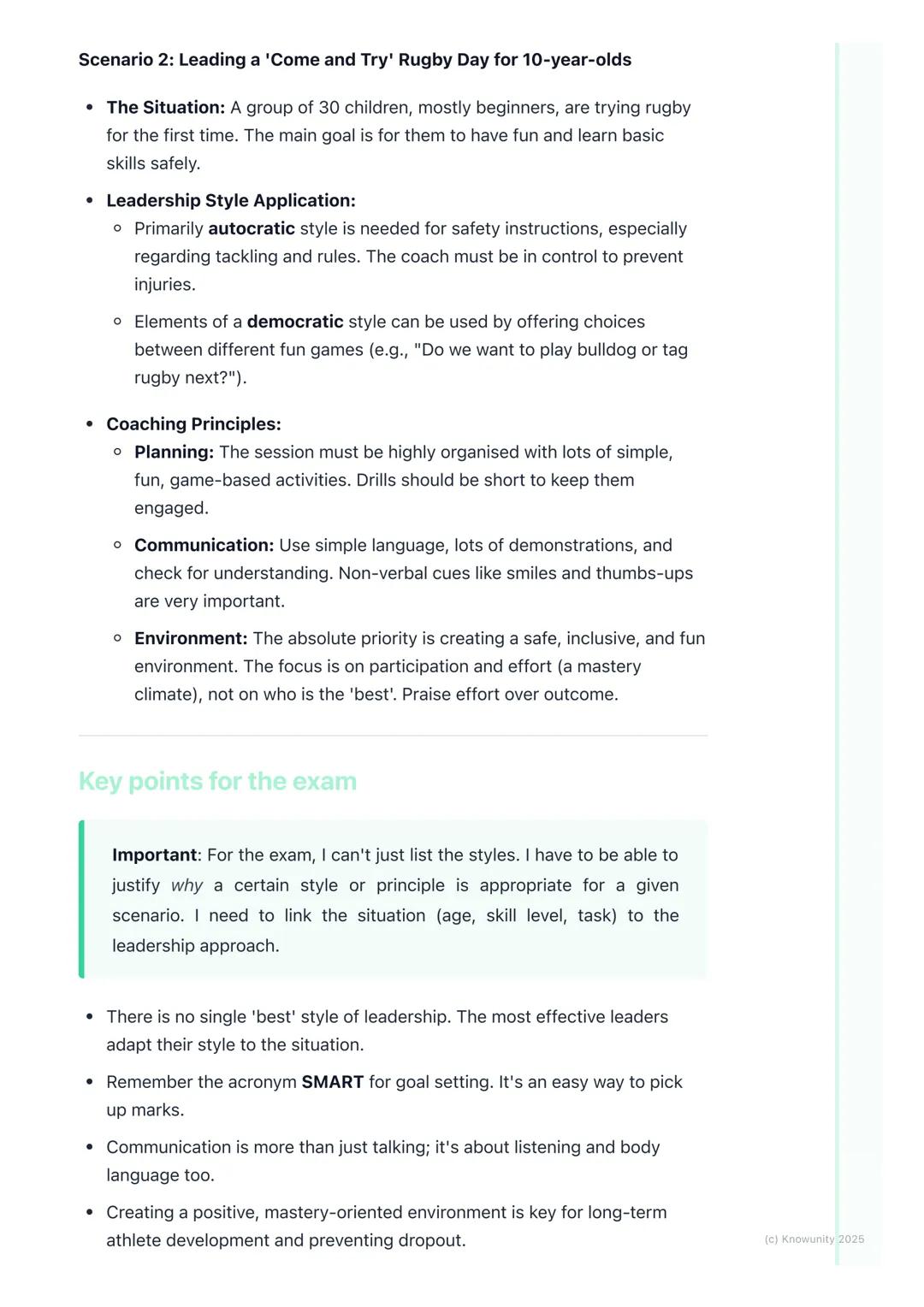
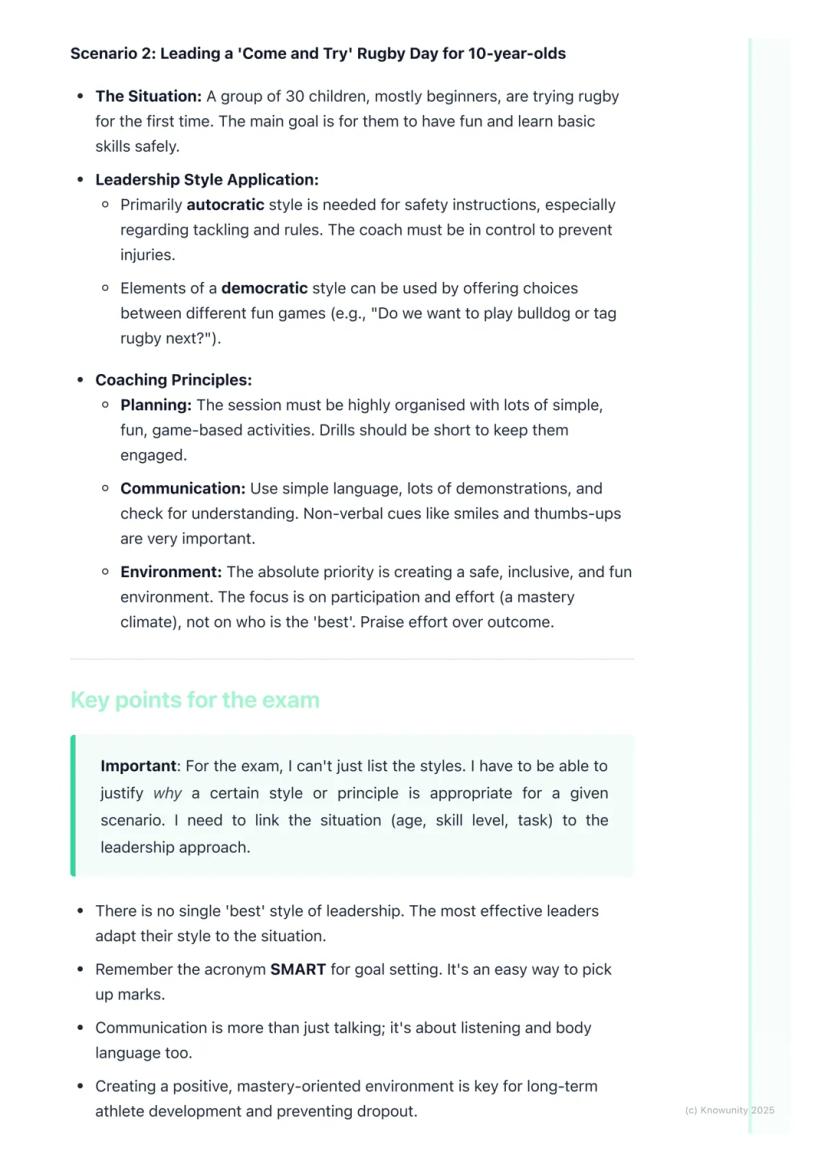
Applying Leadership in Real Scenarios
Let's put this into practice with real examples. Coaching a senior camogie team before a county final means working with skilled, motivated but nervous players. You'd use democratic leadership early in the week for tactical discussions, then become more autocratic closer to the final for focused execution of game plans.
Leading a 'come and try' rugby day for beginners requires a completely different approach. Safety instructions need autocratic leadership, but you can offer democratic choices between fun activities. The focus shifts entirely to creating a safe, inclusive, fun environment where participation matters more than performance.
Your communication style changes dramatically too. Senior players can handle technical feedback and tactical complexity, whilst beginners need simple language, lots of demonstrations, and constant encouragement through smiles and positive body language.
The key skill for exam success is justification - don't just state which style you'd use, explain why it's appropriate for that specific situation, age group, and skill level.
Exam Strategy: Always link your leadership choices back to their impact on the performers - explain how your approach will improve safety, motivation, or skill development.
7
of 7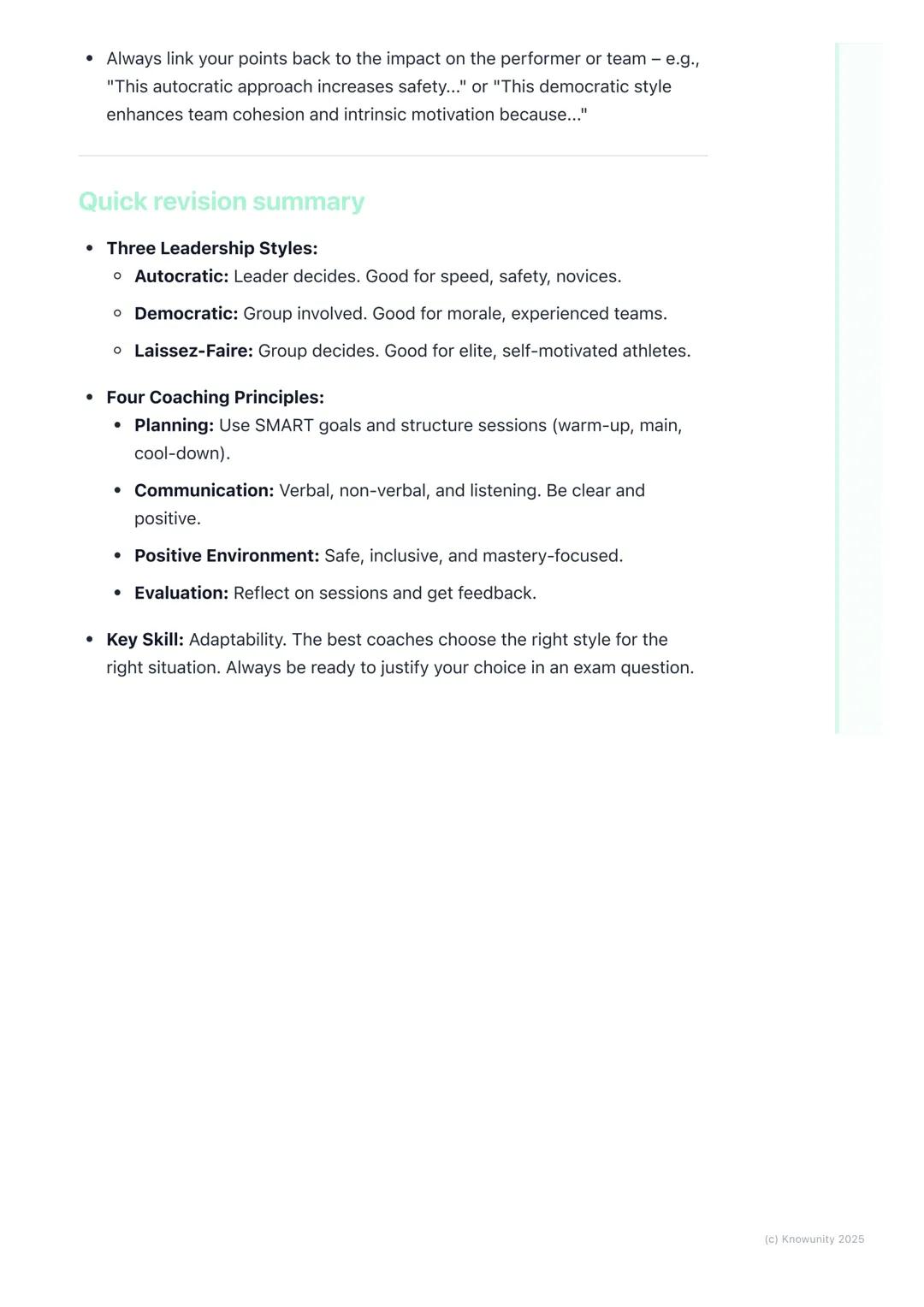
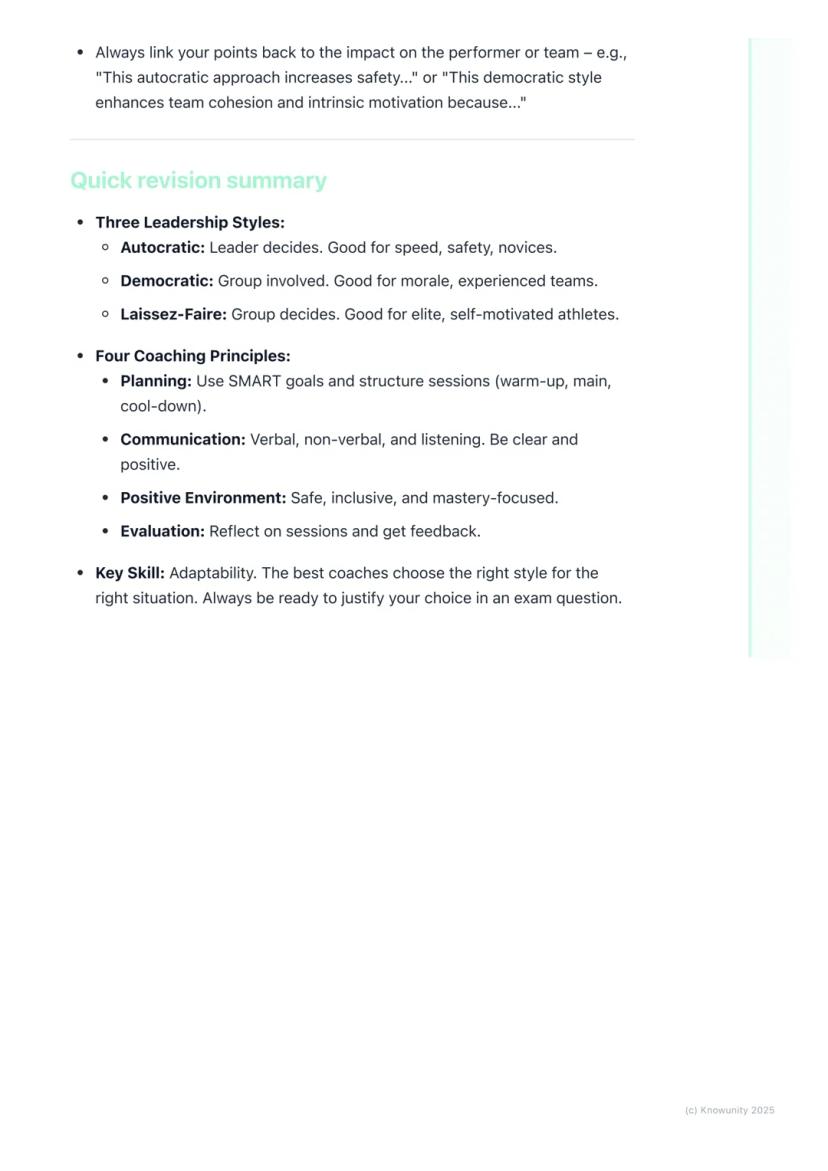
Quick Revision Summary
Three Leadership Styles: Autocratic , Democratic , Laissez-faire .
Four Coaching Principles: Planning with SMART goals and structured sessions; Communication through verbal, non-verbal, and listening skills; Positive Environment that's safe, inclusive, and mastery-focused; Evaluation through reflection and athlete feedback.
Key Exam Skill: Adaptability is everything. The best coaches match their leadership style to the situation, and you need to justify these choices clearly. Always explain how your approach will benefit the performers specifically.
Remember, there's no perfect leadership style - only the right style for the right situation. Master this concept and you'll excel in both your exams and any real coaching situations you encounter.
Final Tip: Practice applying these concepts to different scenarios - youth coaching, elite performance, team sports, individual activities. The more examples you can work through, the better prepared you'll be.
We dachten al dat je dit zou vragen...
Wat is de Knowunity AI companion?
Onze AI Companion is een studentgerichte AI-tool die meer biedt dan alleen antwoorden. Gebouwd op miljoenen Knowunity bronnen, biedt het relevante informatie, gepersonaliseerde studieplannen, quizzes en inhoud direct in de chat, aangepast aan jouw individuele leertraject.
Waar kan ik de Knowunity-app downloaden?
Je kunt de app downloaden via Google Play Store en Apple App Store.
Is Knowunity echt gratis?
Dat klopt! Geniet van gratis toegang tot leerinhoud, maak contact met medestudenten en krijg directe hulp – alles binnen handbereik.
Populairste studiemateriaal voor LCPE
4LCPEHealthy Eating Guidelines
This section explores national healthy eating guidelines, such as the food pyramid or healthy eating plate, to promote balanced dietary choices.
5th Year50
LCPEBiomechanics of Movement
Applying fundamental biomechanical principles such as force, motion, levers, and stability to analyse and improve human movement efficiency and performance in sport.
6th Year200
LCPEFactors effecting sports psychology ( confidence and self efficacy)
Higher Level LCPE psychological preprration notes
5th Year230
LCPETechnology in Sport
Investigating how technology is used in areas such as performance analysis, equipment design, officiating, and athlete monitoring to enhance training and competition.
6th Year50
Populairste studiemateriaal
9 Irish
IrishIrish oral questions and answers
Questions and answers for the leaving cert oral
5th Year4264
 English
Key Quotes : Sive
Key Quotes and explanations: Sive
6th Year2842
IrishIrish oral questions
Outline of oral questions
5th Year2055
IrishIníon- le hÁine Durkin
Aine Durkin’s poem, Iníon: Themes & summary
5th Year890
IrishIrish poetry 2027
Iníon + Dínit an Bhróin
5th Year1153
IrishLC HL notes- Iníon (poem)
Includes poem in English and Irish, theme, key words & phrases
5th Year2304
EnglishCultural Context : Shawshank Redemption : Sive : Small Things Like These
Comparative Study : Cultural Context : Shawshank Redemption, Sive and Small Things Like These
6th Year1430
IrishMo Ghrá-sa (Idir Lúibíní)
Notes on mo ghrá-sa
5th Year380
IrishAn Gaeilge Aiste
Irish Language essay
6th Year1320
Kan je niet vinden wat je zoekt? Ontdek andere vakken.
Studenten zijn dol op ons — en jij ook.
4.6/5App Store
4.7/5Google Play
De app is heel makkelijk te gebruiken en goed ontworpen. Ik heb tot nu toe alles kunnen vinden waar ik naar zocht en heb veel kunnen leren van de presentaties! Ik ga de app zeker gebruiken voor een schoolopdracht! En natuurlijk helpt het ook veel als inspiratie.
Stefan SiOS gebruiker
Deze app is echt geweldig. Er zijn zoveel aantekeningen en hulpmiddelen [...]. Mijn probleemvak is bijvoorbeeld Frans, en de app heeft zoveel opties voor hulp. Dankzij deze app ben ik beter geworden in Frans. Ik zou het iedereen aanraden.
Samantha KlichAndroid gebruiker
Wow, ik ben echt onder de indruk. Ik probeerde de app gewoon omdat ik hem vaak geadverteerd had gezien en was absoluut verbaasd. Deze app is DE HULP die je wilt voor school en bovenal biedt hij zoveel dingen, zoals oefeningen en factsheets, die mij persoonlijk HEEL erg hebben geholpen.
AnnaiOS gebruiker
LCPE3 weergaven·Bijgewerkt Jun 18, 2026·7 pagina'sMastering Leadership and Coaching in Physical Activity
Leadership and coaching are game-changers in sport and physical activity. Whether you're captaining your school team or coaching younger students, understanding different leadership styles and coaching principles can make the difference between a group that just shows up and one...
1
of 7
Meld je aan om de inhoud te zien. Het is gratis!
- Toegang tot alle documenten
- Verbeter je cijfers
- Sluit je aan bij miljoenen studenten
Introduction to Leadership and Coaching
Think about the best coach or team leader you've ever had - what made them so effective? Leadership is all about influencing others to achieve common goals, whilst coaching is a specific type of leadership focused on training and developing athletes.
These skills aren't just about winning matches. Great leaders and coaches create environments where everyone feels valued, develops their abilities, and actually enjoys what they're doing. That's what builds lifelong participation in sport.
The key is understanding that there's no one-size-fits-all approach. Different situations call for different leadership styles, and the best leaders know how to adapt their approach based on who they're working with and what they're trying to achieve.
Remember: A leader can be formal (like a captain) or informal (like an experienced player who naturally guides others).
2
of 7Meld je aan om de inhoud te zien. Het is gratis!
- Toegang tot alle documenten
- Verbeter je cijfers
- Sluit je aan bij miljoenen studenten
Understanding Leadership Styles
There are three main leadership styles you need to know, and each has its place depending on the situation. Autocratic leadership is task-oriented - the leader makes all decisions with little input from the group. It's brilliant for quick decisions and maintaining control.
Democratic leadership is person-oriented and involves the group in decision-making. This builds stronger relationships and keeps everyone engaged, though it can slow things down when quick decisions are needed.
Laissez-faire leadership gives the group almost complete freedom, with the leader acting more as a facilitator. This works brilliantly with highly skilled, self-motivated athletes but can lead to chaos with less experienced groups.
The secret is knowing when to use each style. You might be autocratic during safety briefings but democratic when planning team tactics.
Key Point: Effective leaders switch between styles based on the situation, not personal preference.
3
of 7Meld je aan om de inhoud te zien. Het is gratis!
- Toegang tot alle documenten
- Verbeter je cijfers
- Sluit je aan bij miljoenen studenten
When to Use Each Leadership Style
Autocratic leadership shines in dangerous situations (think rock climbing), with young or inexperienced athletes, or when complex tasks need crystal-clear instruction. Decisions happen quickly and everyone knows exactly what's expected, though it can sometimes stifle creativity.
Democratic leadership works best with experienced, knowledgeable athletes who can contribute meaningfully to decisions. It's perfect when you have time to discuss options and want to build team cohesion for the long term.
Laissez-faire leadership suits elite, highly skilled athletes who are self-motivated and know what they're doing. It promotes creativity and problem-solving skills but can leave less motivated players feeling lost without direction.
The trick is reading your group and the situation. A successful coach might use autocratic instruction for safety, democratic discussion for tactics, and laissez-faire observation during practice games.
Smart Tip: In your exams, always justify why you'd choose a particular style - link it to the athletes' skill level, the situation, and the desired outcome.
4
of 7Meld je aan om de inhoud te zien. Het is gratis!
- Toegang tot alle documenten
- Verbeter je cijfers
- Sluit je aan bij miljoenen studenten
Key Coaching Principles: Planning and Communication
Brilliant coaching starts with smart planning and organisation. Every session needs structure: a proper warm-up, focused main activity, and cool-down. SMART goals are your best friend here - Specific, Measurable, Achievable, Relevant, and Timed objectives that give everyone clear targets.
Effective communication involves much more than just talking. Your verbal communication needs to be clear and appropriate for your audience - avoid jargon with beginners but you can use more technical language with experienced players.
Non-verbal communication is equally powerful. Your body language, facial expressions, and demonstrations often say more than words. An encouraging smile or open posture can boost confidence, whilst crossed arms might make athletes feel defensive.
Don't forget active listening - truly hearing what your athletes are telling you about their needs, concerns, and feedback. This builds trust and helps you adapt your approach to get the best from everyone.
Communication Hack: Match your communication style to your audience - what works for county-level players might overwhelm complete beginners.
5
of 7Meld je aan om de inhoud te zien. Het is gratis!
- Toegang tot alle documenten
- Verbeter je cijfers
- Sluit je aan bij miljoenen studenten
Creating Positive Environments and Evaluation
Creating a positive sporting environment is absolutely crucial for long-term success. Safety comes first - both physical and emotional. Everyone needs to feel welcome regardless of their ability level, background, or experience.
The motivational climate you create makes a huge difference. A mastery climate focuses on individual improvement, effort, and learning - this builds intrinsic motivation that lasts. A performance climate emphasises winning and comparison with others, which can create anxiety and lead to dropout.
Evaluation and reflection separate good coaches from great ones. Constantly ask yourself: what went well, what could improve, and how did the athletes respond? Getting feedback from your athletes is essential - they'll tell you what's working and what isn't.
Think about practical scenarios: coaching a senior team before a county final requires different approaches than leading a 'come and try' day for 10-year-olds. The principles stay the same, but how you apply them changes completely.
Golden Rule: Always create a mastery-focused environment where effort and improvement are celebrated more than just results.
6
of 7Meld je aan om de inhoud te zien. Het is gratis!
- Toegang tot alle documenten
- Verbeter je cijfers
- Sluit je aan bij miljoenen studenten
Applying Leadership in Real Scenarios
Let's put this into practice with real examples. Coaching a senior camogie team before a county final means working with skilled, motivated but nervous players. You'd use democratic leadership early in the week for tactical discussions, then become more autocratic closer to the final for focused execution of game plans.
Leading a 'come and try' rugby day for beginners requires a completely different approach. Safety instructions need autocratic leadership, but you can offer democratic choices between fun activities. The focus shifts entirely to creating a safe, inclusive, fun environment where participation matters more than performance.
Your communication style changes dramatically too. Senior players can handle technical feedback and tactical complexity, whilst beginners need simple language, lots of demonstrations, and constant encouragement through smiles and positive body language.
The key skill for exam success is justification - don't just state which style you'd use, explain why it's appropriate for that specific situation, age group, and skill level.
Exam Strategy: Always link your leadership choices back to their impact on the performers - explain how your approach will improve safety, motivation, or skill development.
7
of 7Meld je aan om de inhoud te zien. Het is gratis!
- Toegang tot alle documenten
- Verbeter je cijfers
- Sluit je aan bij miljoenen studenten
Quick Revision Summary
Three Leadership Styles: Autocratic , Democratic , Laissez-faire .
Four Coaching Principles: Planning with SMART goals and structured sessions; Communication through verbal, non-verbal, and listening skills; Positive Environment that's safe, inclusive, and mastery-focused; Evaluation through reflection and athlete feedback.
Key Exam Skill: Adaptability is everything. The best coaches match their leadership style to the situation, and you need to justify these choices clearly. Always explain how your approach will benefit the performers specifically.
Remember, there's no perfect leadership style - only the right style for the right situation. Master this concept and you'll excel in both your exams and any real coaching situations you encounter.
Final Tip: Practice applying these concepts to different scenarios - youth coaching, elite performance, team sports, individual activities. The more examples you can work through, the better prepared you'll be.
We dachten al dat je dit zou vragen...
Wat is de Knowunity AI companion?
Onze AI Companion is een studentgerichte AI-tool die meer biedt dan alleen antwoorden. Gebouwd op miljoenen Knowunity bronnen, biedt het relevante informatie, gepersonaliseerde studieplannen, quizzes en inhoud direct in de chat, aangepast aan jouw individuele leertraject.
Waar kan ik de Knowunity-app downloaden?
Je kunt de app downloaden via Google Play Store en Apple App Store.
Is Knowunity echt gratis?
Dat klopt! Geniet van gratis toegang tot leerinhoud, maak contact met medestudenten en krijg directe hulp – alles binnen handbereik.
Populairste studiemateriaal voor LCPE
4LCPEHealthy Eating Guidelines
This section explores national healthy eating guidelines, such as the food pyramid or healthy eating plate, to promote balanced dietary choices.
5th Year50
LCPEBiomechanics of Movement
Applying fundamental biomechanical principles such as force, motion, levers, and stability to analyse and improve human movement efficiency and performance in sport.
6th Year200
LCPEFactors effecting sports psychology ( confidence and self efficacy)
Higher Level LCPE psychological preprration notes
5th Year230
LCPETechnology in Sport
Investigating how technology is used in areas such as performance analysis, equipment design, officiating, and athlete monitoring to enhance training and competition.
6th Year50
Populairste studiemateriaal
9IrishIrish oral questions and answers
Questions and answers for the leaving cert oral
5th Year4264
EnglishKey Quotes : Sive
Key Quotes and explanations: Sive
6th Year2842
IrishIrish oral questions
Outline of oral questions
5th Year2055
IrishIníon- le hÁine Durkin
Aine Durkin’s poem, Iníon: Themes & summary
5th Year890
IrishIrish poetry 2027
Iníon + Dínit an Bhróin
5th Year1153
IrishLC HL notes- Iníon (poem)
Includes poem in English and Irish, theme, key words & phrases
5th Year2304
EnglishCultural Context : Shawshank Redemption : Sive : Small Things Like These
Comparative Study : Cultural Context : Shawshank Redemption, Sive and Small Things Like These
6th Year1430
IrishMo Ghrá-sa (Idir Lúibíní)
Notes on mo ghrá-sa
5th Year380
IrishAn Gaeilge Aiste
Irish Language essay
6th Year1320
Kan je niet vinden wat je zoekt? Ontdek andere vakken.
Studenten zijn dol op ons — en jij ook.
4.6/5App Store
4.7/5Google Play
De app is heel makkelijk te gebruiken en goed ontworpen. Ik heb tot nu toe alles kunnen vinden waar ik naar zocht en heb veel kunnen leren van de presentaties! Ik ga de app zeker gebruiken voor een schoolopdracht! En natuurlijk helpt het ook veel als inspiratie.
Stefan SiOS gebruiker
Deze app is echt geweldig. Er zijn zoveel aantekeningen en hulpmiddelen [...]. Mijn probleemvak is bijvoorbeeld Frans, en de app heeft zoveel opties voor hulp. Dankzij deze app ben ik beter geworden in Frans. Ik zou het iedereen aanraden.
Samantha KlichAndroid gebruiker
Wow, ik ben echt onder de indruk. Ik probeerde de app gewoon omdat ik hem vaak geadverteerd had gezien en was absoluut verbaasd. Deze app is DE HULP die je wilt voor school en bovenal biedt hij zoveel dingen, zoals oefeningen en factsheets, die mij persoonlijk HEEL erg hebben geholpen.
AnnaiOS gebruiker