
Ever wondered what everything around you is actually made of?... Meer weergeven
 Science
 Irish
Irish English
 Geography
Meld je aan om de inhoud te zienHet is gratis!
Toegang tot alle documenten
Verbeter je cijfers
Sluit je aan bij miljoenen studenten
Knowunity AI
Vakken
Triangle Congruence and Similarity Theorems
Triangle Properties and Classification
Linear Equations and Graphs
Geometric Angle Relationships
Trigonometric Functions and Identities
Equation Solving Techniques
Circle Geometry Fundamentals
Division Operations and Methods
Basic Differentiation Rules
Exponent and Logarithm Properties
Alle onderwerpen weergeven
Human Organ Systems
Reproductive Cell Cycles
Biological Sciences Subdisciplines
Cellular Energy Metabolism
Autotrophic Energy Processes
Inheritance Patterns and Principles
Biomolecular Structure and Organization
Cell Cycle and Division Mechanics
Cellular Organization and Development
Biological Structural Organization
Alle onderwerpen weergeven
Chemical Sciences and Applications
Atomic Structure and Composition
Molecular Electron Structure Representation
Atomic Electron Behavior
Matter Properties and Water
Mole Concept and Calculations
Gas Laws and Behavior
Periodic Table Organization
Chemical Thermodynamics Fundamentals
Chemical Bond Types and Properties
Alle onderwerpen weergeven
European Renaissance and Enlightenment
European Cultural Movements 800-1920
American Revolution Era 1763-1797
American Civil War 1861-1865
Global Imperial Systems
Mongol and Chinese Dynasties
U.S. Presidents and World Leaders
Historical Sources and Documentation
World Wars Era and Impact
World Religious Systems
Alle onderwerpen weergeven
Classic and Contemporary Novels
Literary Character Analysis
Rhetorical Theory and Practice
Classic Literary Narratives
Reading Analysis and Interpretation
Narrative Structure and Techniques
English Language Components
Influential English-Language Authors
Basic Sentence Structure
Narrative Voice and Perspective
Alle onderwerpen weergeven
4
•
Bijgewerkt May 8, 2026
•
Ever wondered what everything around you is actually made of?... Meer weergeven
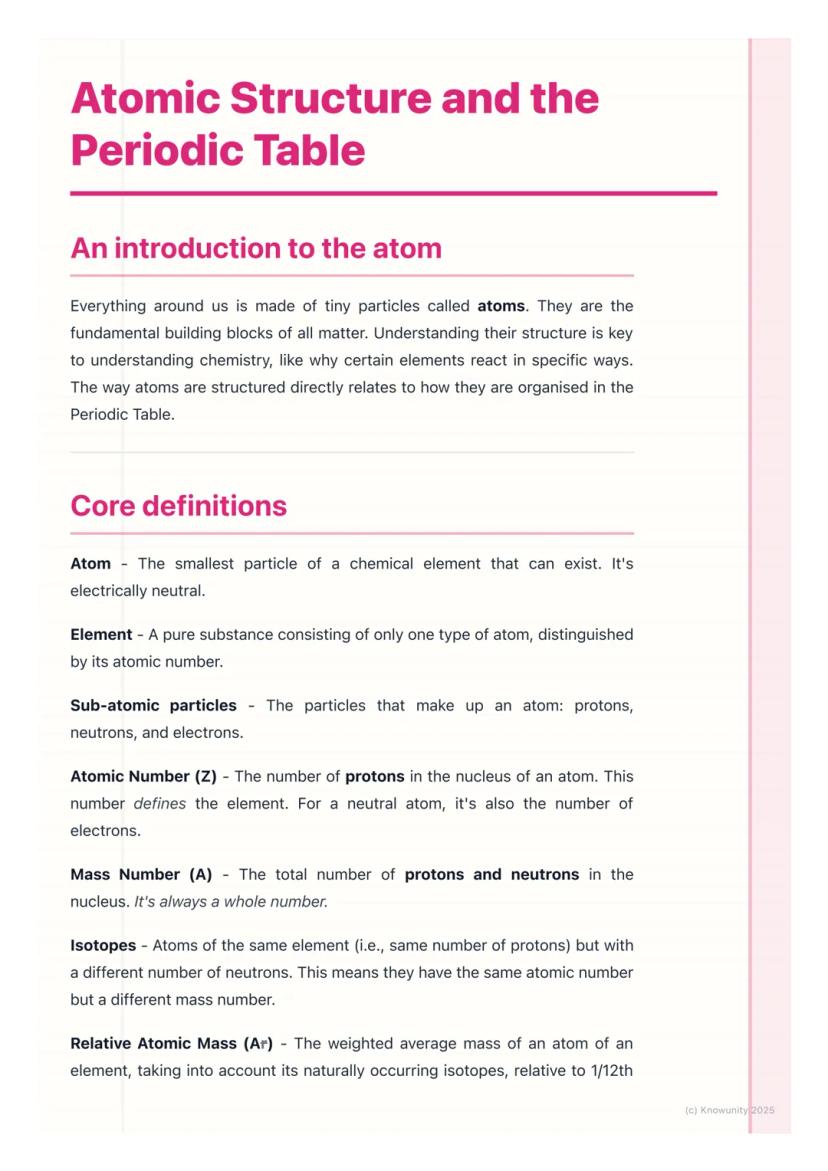

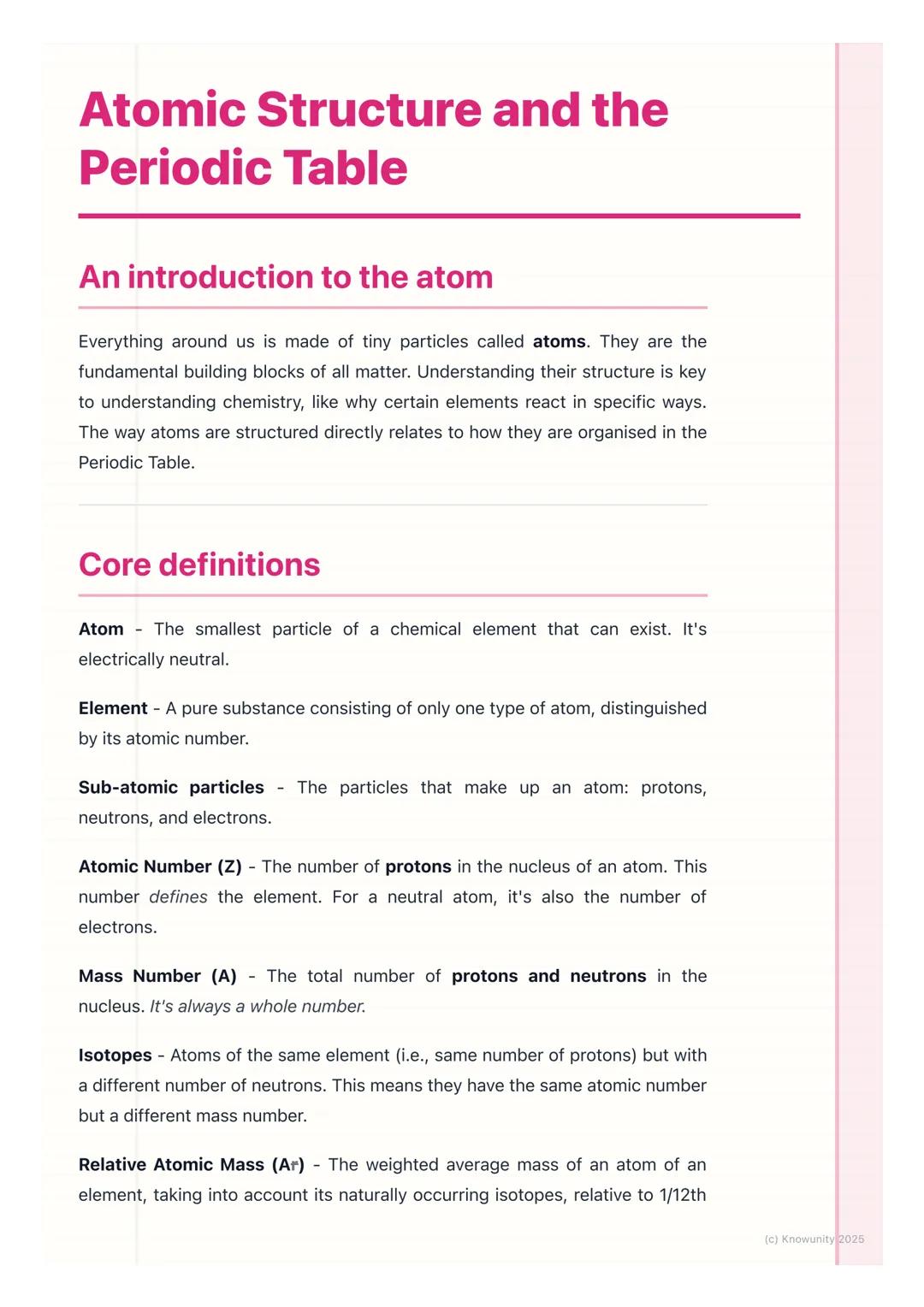
Think of atoms as the LEGO blocks of the universe - they're the smallest pieces that still keep all the properties of an element. Every single thing you can touch, see, or breathe is made up of these incredibly tiny particles.
What makes atoms really clever is that they're mostly empty space with a super dense centre called the nucleus. Around this nucleus, electrons zoom about in specific areas called shells. It's a bit like planets orbiting the sun, but way more exciting because it determines how elements will react with each other.
The brilliant thing about atoms is that they're electrically neutral - they have equal amounts of positive and negative charges that balance each other out perfectly. This balance is what keeps matter stable and predictable.
Quick Tip: Remember that atoms are the smallest particles of an element that still act like that element - break them down further and you lose what makes oxygen "oxygen" or gold "gold"!
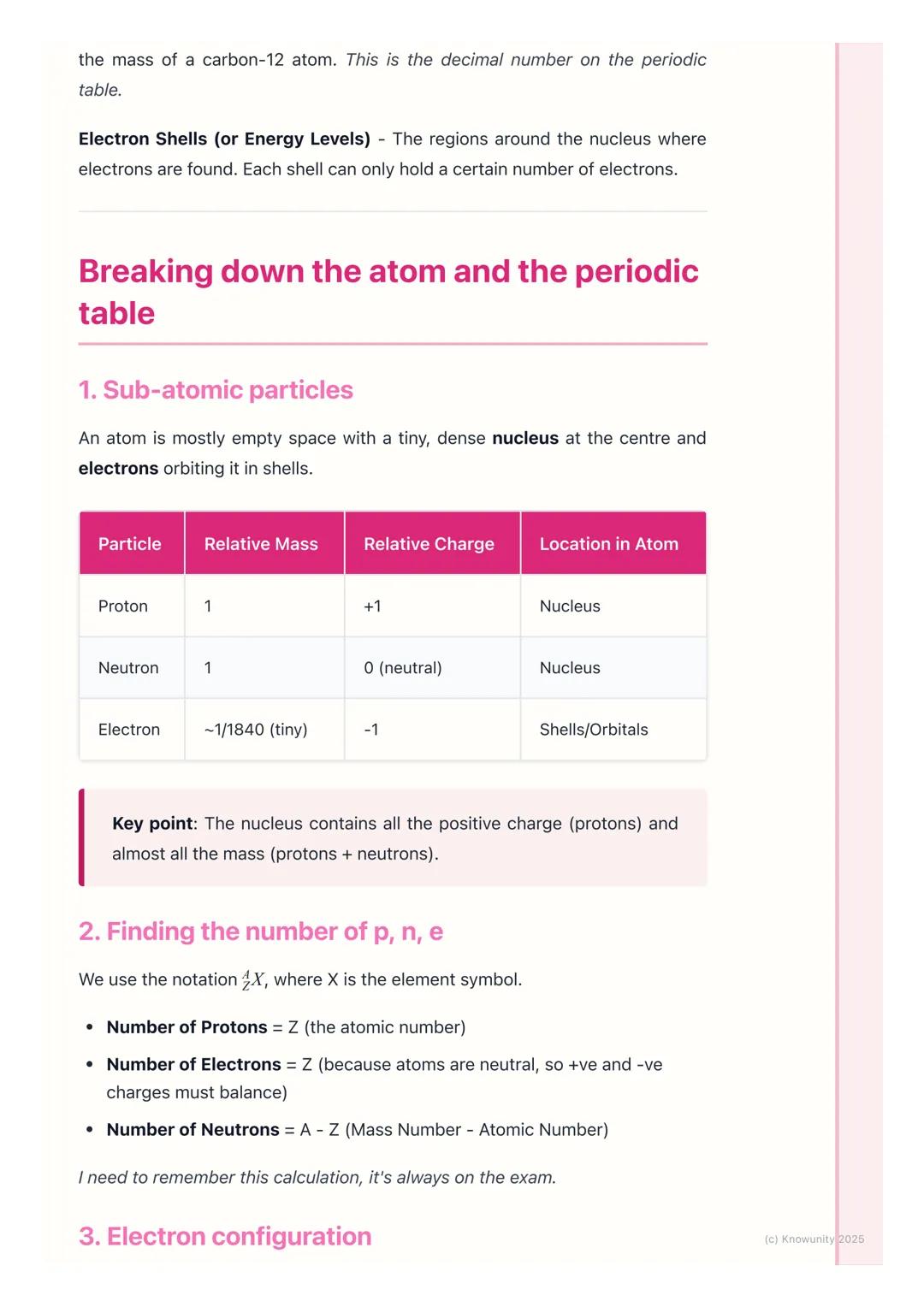
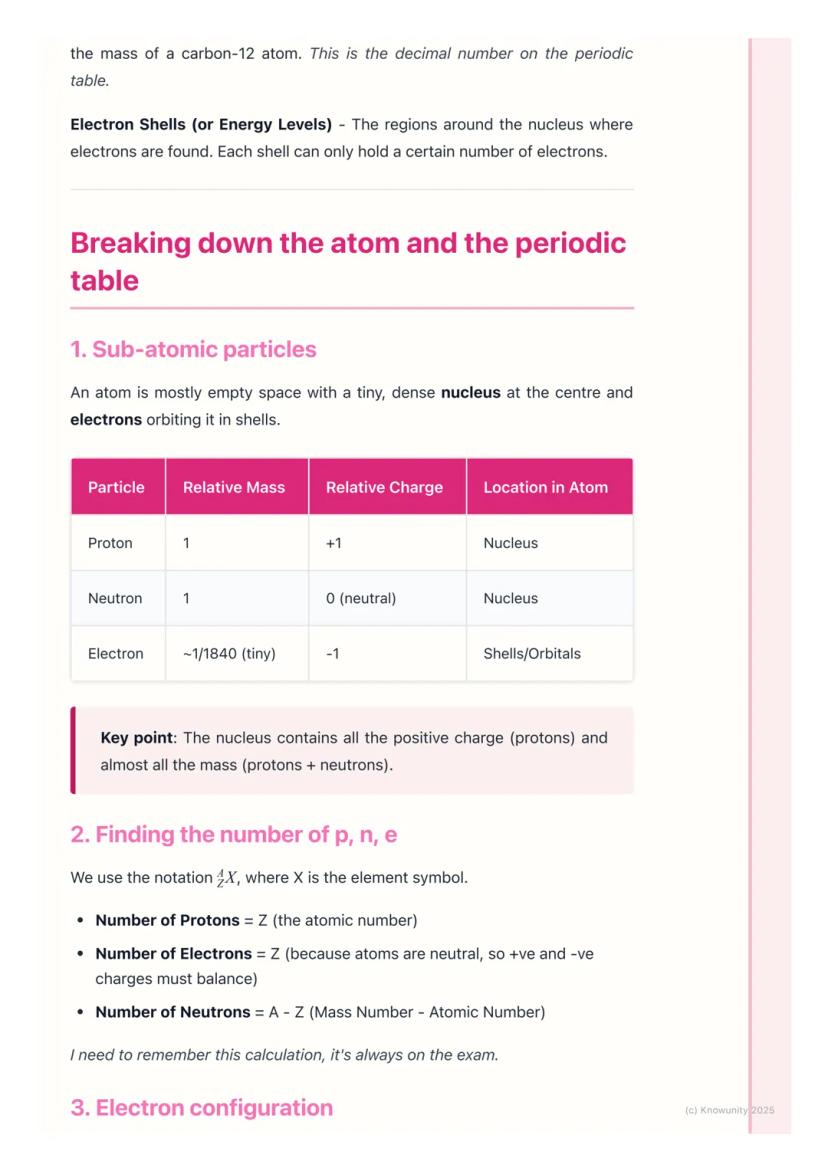
Inside every atom, you'll find three main players: protons, neutrons, and electrons. Protons carry a positive charge and live in the nucleus with neutrons (which are neutral). Electrons, with their negative charge, whiz around the nucleus in shells.
Here's what you need to remember: protons have a relative mass of 1 and a +1 charge, neutrons also have a mass of 1 but no charge, and electrons are incredibly light with a -1 charge.
The atomic number (Z) tells you how many protons an element has - this is like its ID card because it never changes for that element. The mass number (A) is the total of protons plus neutrons in the nucleus.
To find the number of particles, use this dead simple formula: protons = Z, electrons = Z (for neutral atoms), and neutrons = A - Z. Master this calculation because it's guaranteed to show up on your exams.
Exam Alert: The notation ᴬ/ᴢX always appears on tests - A is the big number on top (mass number), Z is the small number below (atomic number), and X is the element symbol.
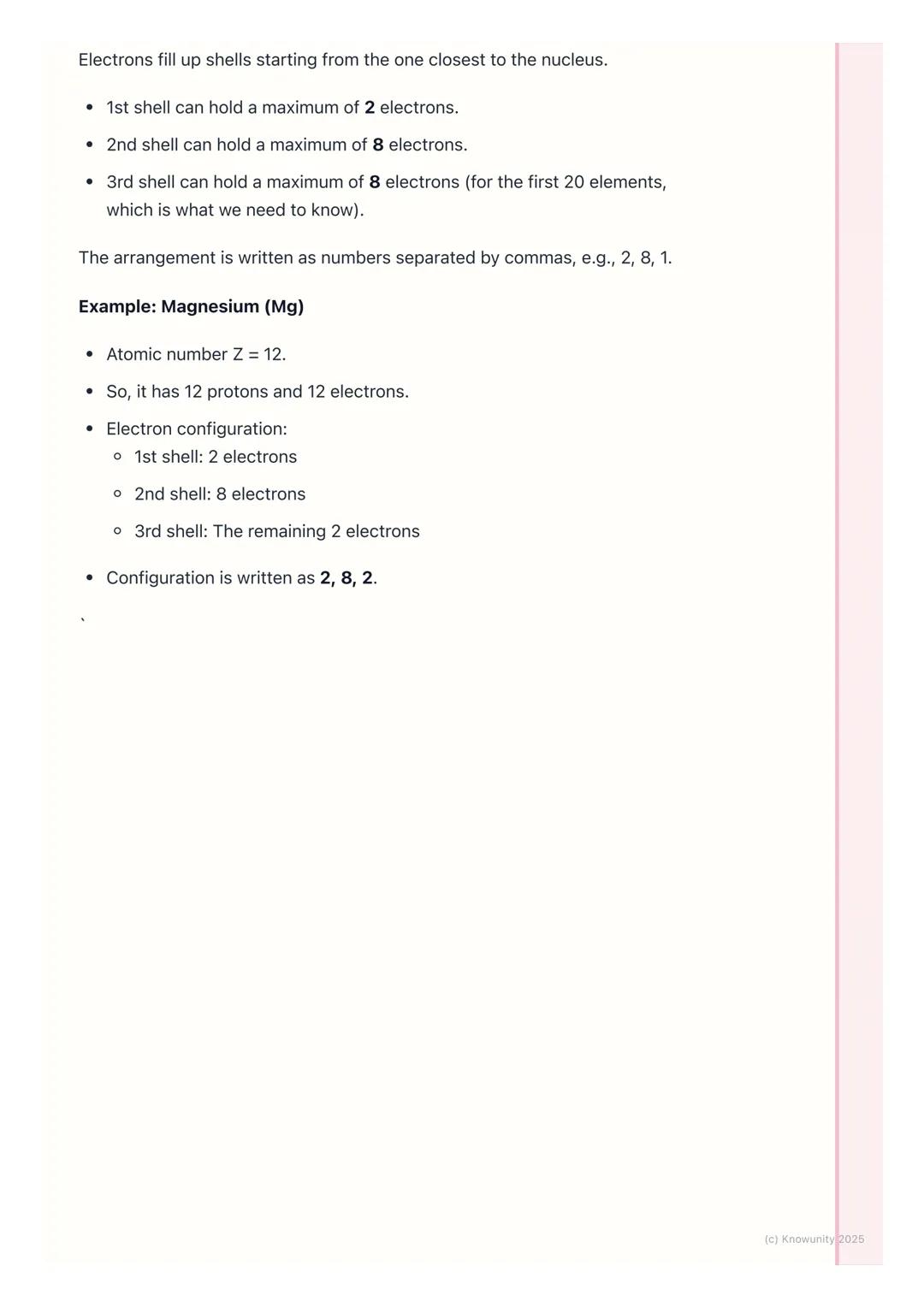
Electrons don't just randomly float around the nucleus - they follow strict rules about where they can live. Think of electron shells as different floors of a building, and electrons fill up from the ground floor upwards.
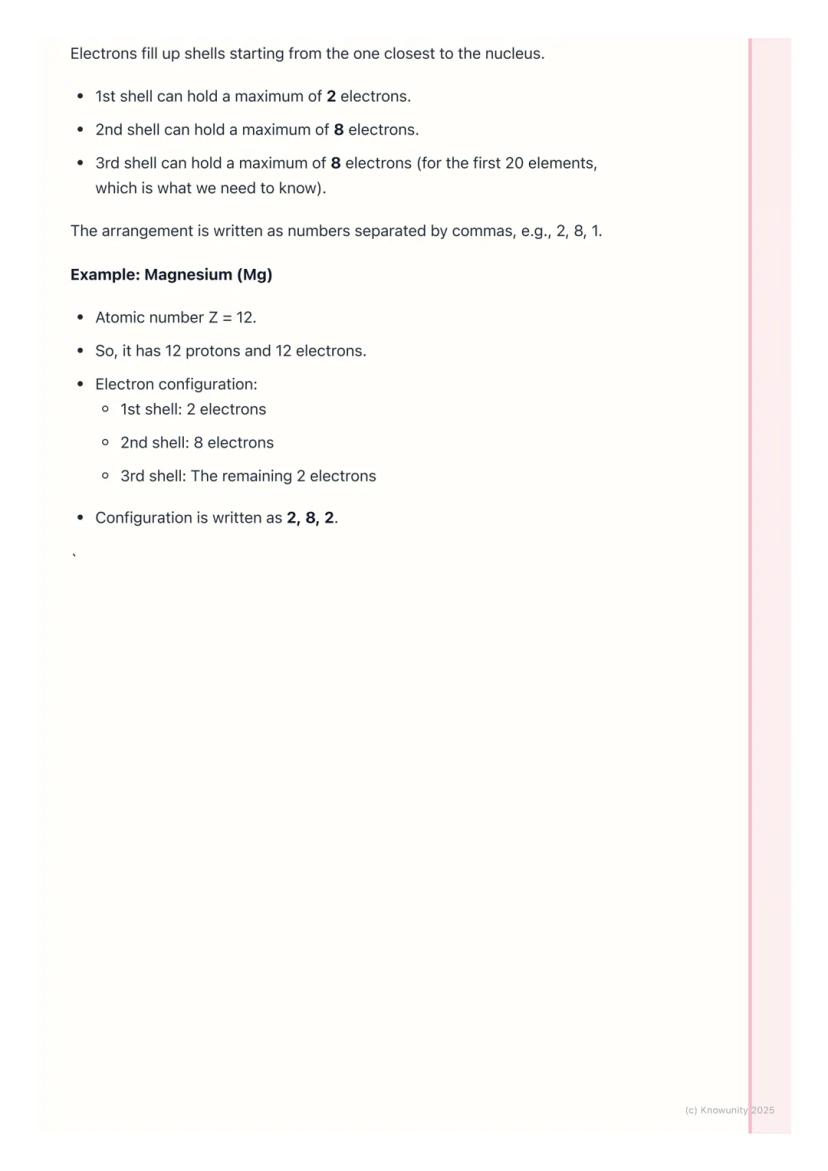
The first shell (closest to the nucleus) can only hold 2 electrons maximum. The second shell can hold up to 8 electrons, and for the first 20 elements you need to know, the third shell also holds a maximum of 8 electrons.
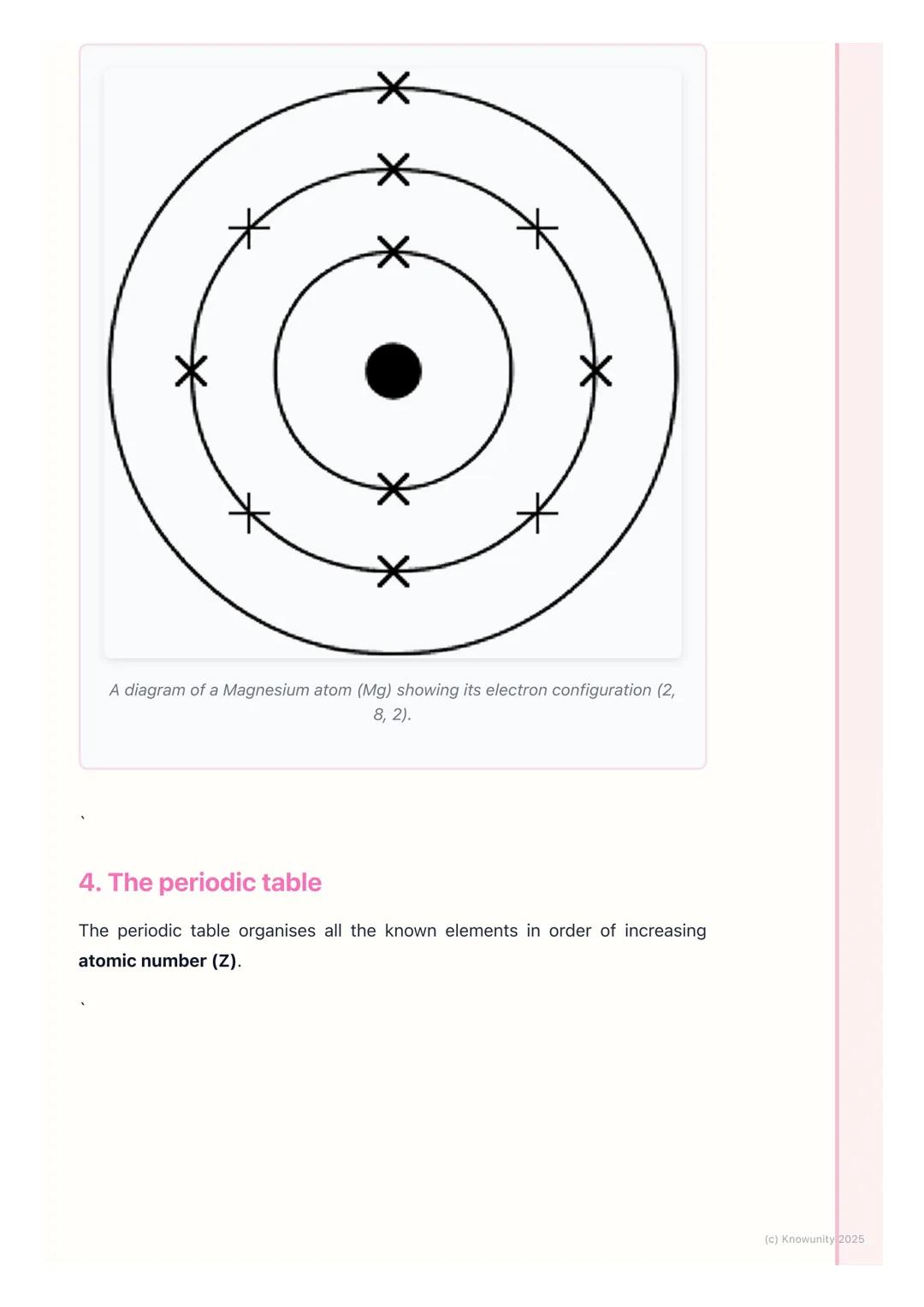
Let's use magnesium as an example. It has an atomic number of 12, so it has 12 electrons. These get arranged as: 2 electrons in the first shell, 8 in the second shell, and the remaining 2 in the third shell. We write this as 2, 8, 2.
Getting electron configuration right is crucial because it directly links to how elements are organised in the periodic table and explains why certain elements behave similarly to others.
Memory Trick: For the first 20 elements, shells fill in the pattern 2, 8, 8 - like a simple countdown that helps you work out any element's electron arrangement!
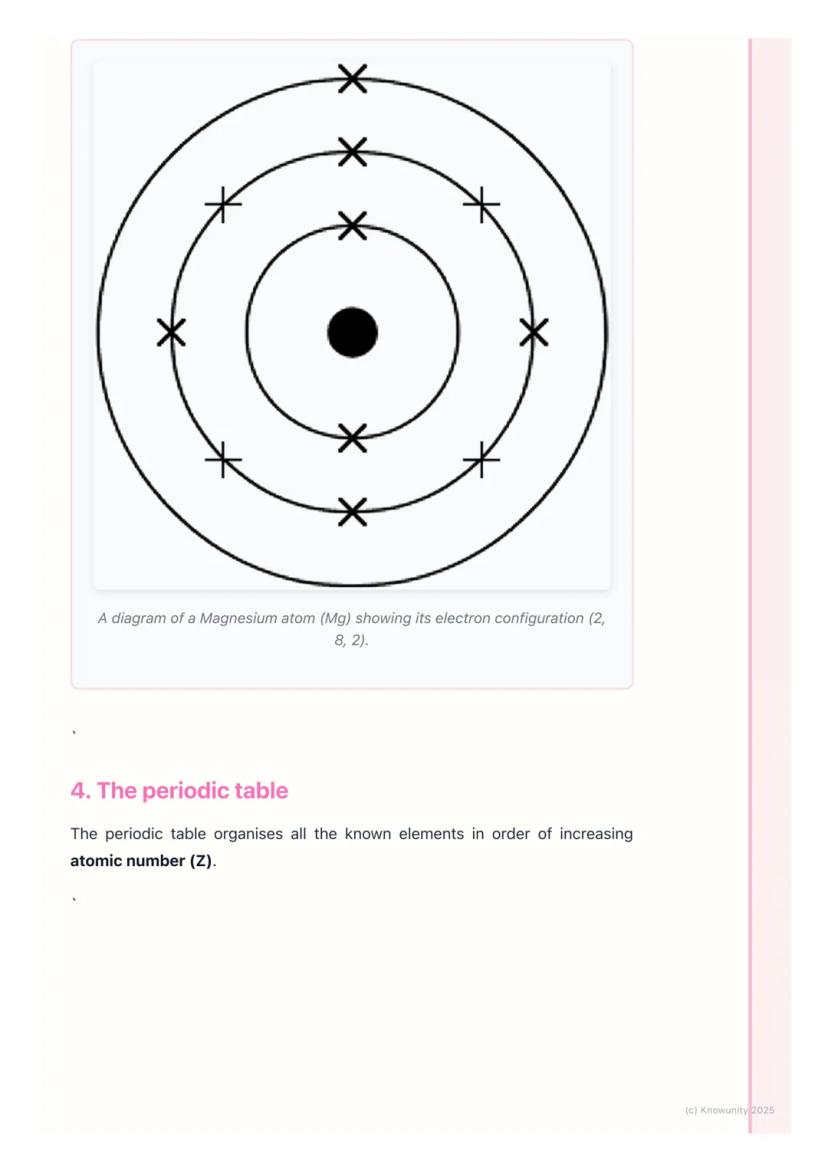
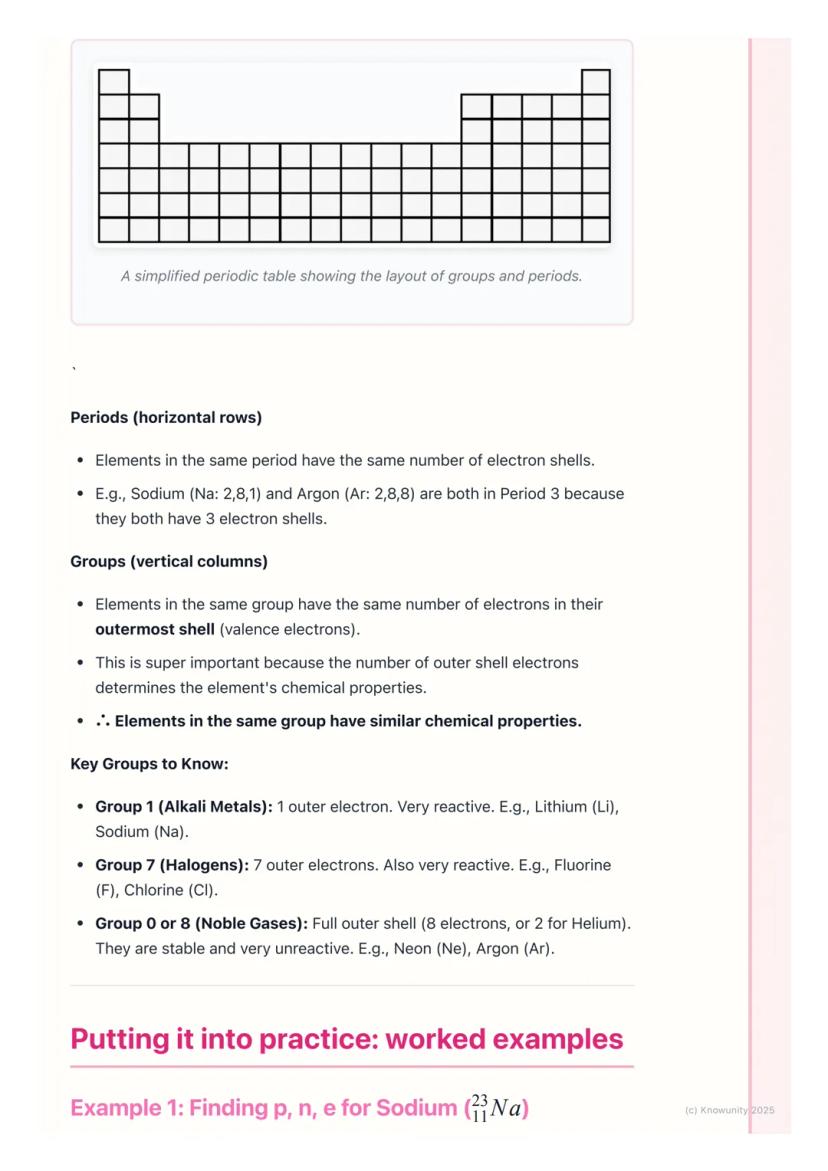
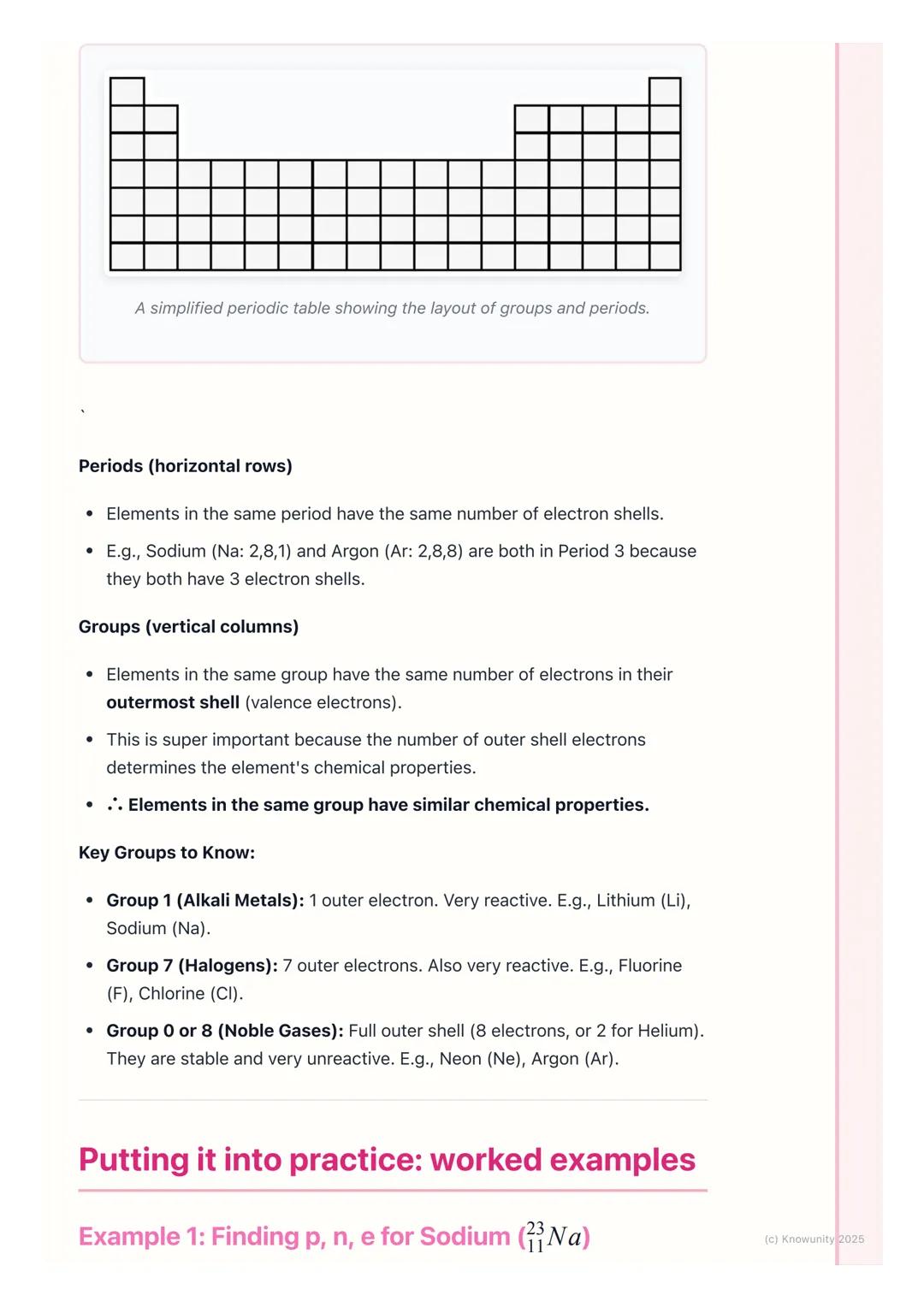
The periodic table isn't just a random list of elements - it's actually a brilliant map that shows you exactly how atoms are structured. Elements are arranged in order of increasing atomic number, which means more and more protons as you move from left to right.
Periods are the horizontal rows, and here's the key insight: all elements in the same period have the same number of electron shells. So sodium (2,8,1) and argon (2,8,8) are both in period 3 because they both have exactly 3 electron shells.
Groups are the vertical columns, and this is where it gets really interesting. Elements in the same group have the same number of electrons in their outermost shell, which means they behave very similarly in chemical reactions.
The outermost electrons (called valence electrons) are like the element's personality - they determine how it will react with other elements. Same number of outer electrons equals similar chemical behaviour.
Key Insight: The periodic table is basically a cheat sheet for predicting how elements will behave - once you understand the pattern, chemistry becomes much more logical!
Group 1 (Alkali Metals) elements have just 1 electron in their outer shell, making them incredibly reactive - they desperately want to lose that lone electron. Think lithium, sodium, and potassium - they all react explosively with water.
Group 7 (Halogens) have 7 outer electrons and are equally reactive, but for the opposite reason - they're desperate to gain 1 more electron to fill their outer shell. Fluorine and chlorine are classic examples that form salts when they react with metals.
Group 0 (Noble Gases) are the chilled-out elements with full outer shells - helium has 2 electrons, while neon and argon have 8. Because their outer shells are complete, they're incredibly stable and rarely react with anything.
Understanding these groups helps you predict reactions before they happen. Elements in the same group will generally react in similar ways because they have the same outer electron arrangement.
Exam Focus: You'll definitely need to identify which group an element belongs to from its electron configuration - the number of outer electrons equals the group number (except for Group 0)!
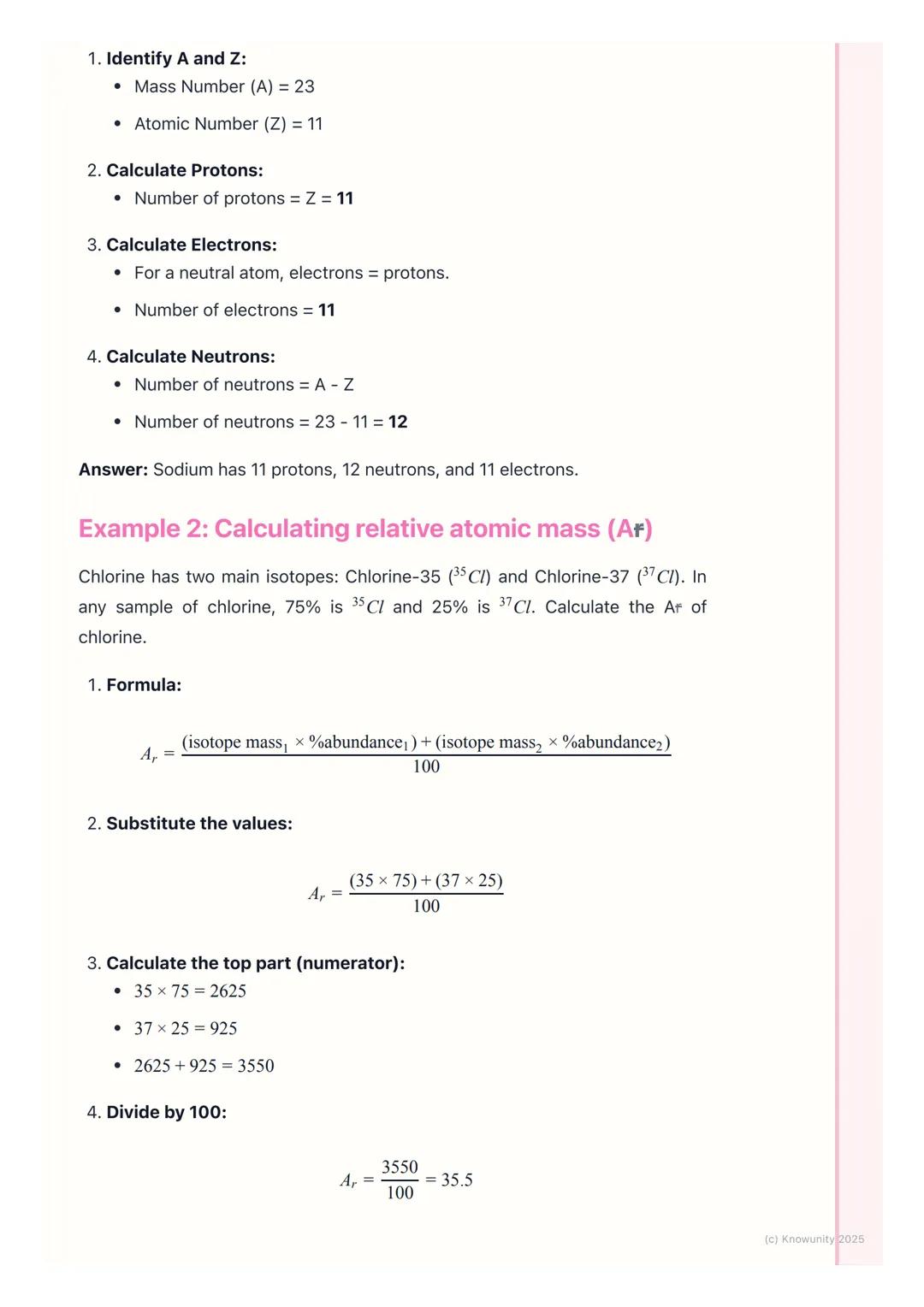
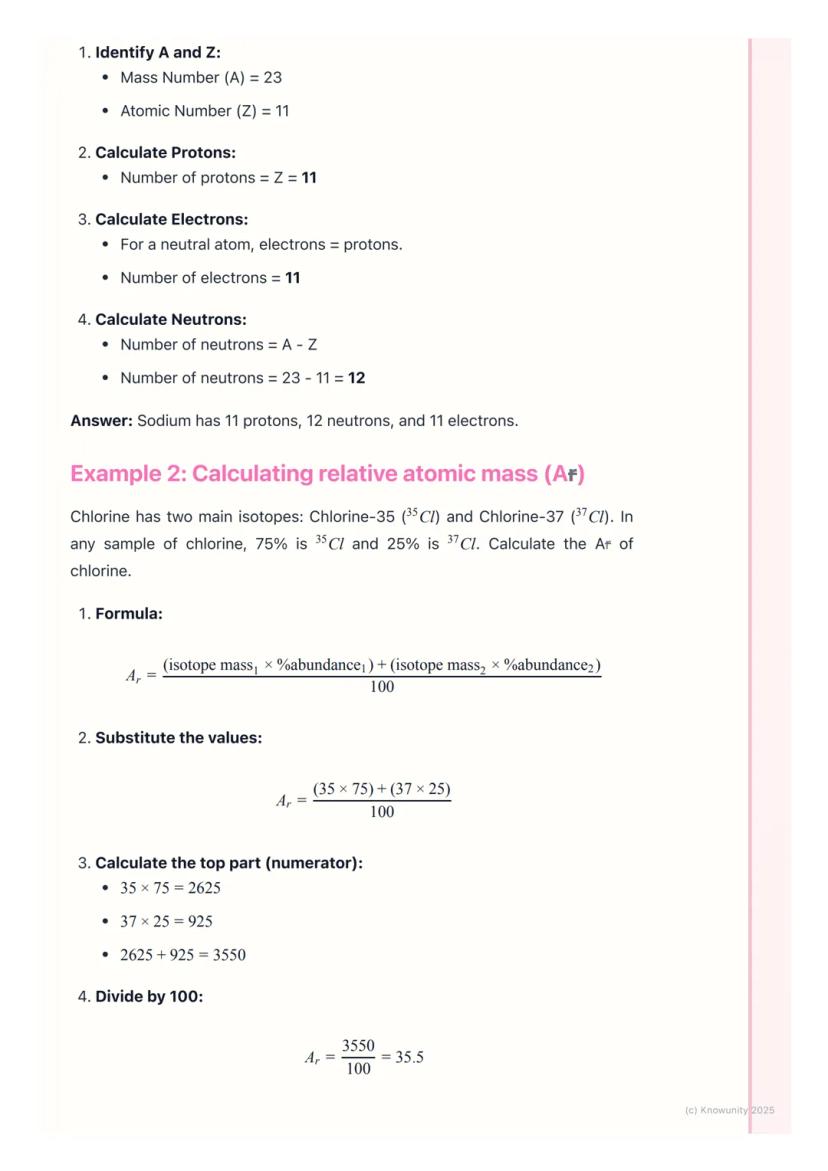
Let's work through sodium (²³₁₁Na) step by step. The mass number A = 23 and atomic number Z = 11. This means: protons = 11, electrons = 11 (same as protons for neutral atoms), and neutrons = 23 - 11 = 12.
For relative atomic mass calculations, you need to account for isotopes - atoms of the same element with different numbers of neutrons. Chlorine exists as 75% chlorine-35 and 25% chlorine-37.
The calculation is: Ar = [(35 × 75) + (37 × 25)] ÷ 100 = [2625 + 925] ÷ 100 = 35.5. This matches the decimal number you see on the periodic table for chlorine.
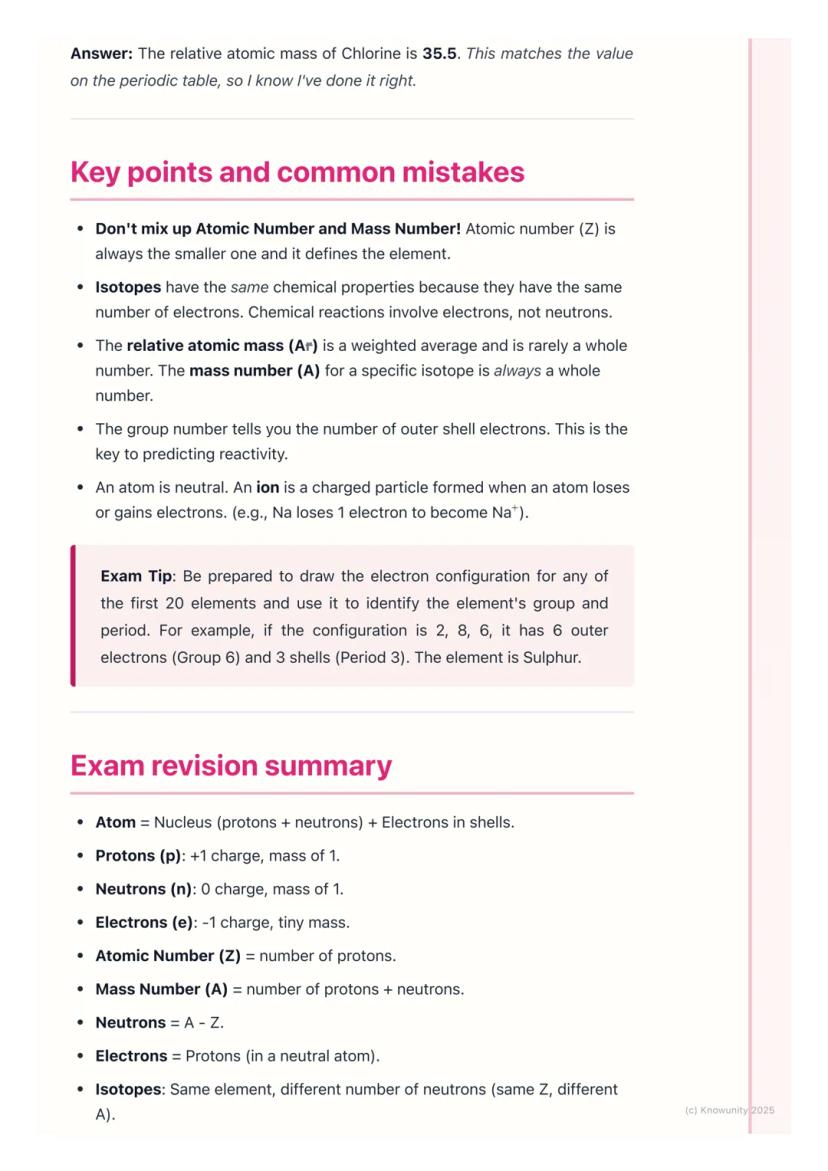
Isotopes are crucial to understand - they're the same element (same number of protons) but with different neutrons, so they have different mass numbers but identical chemical properties.
Calculation Tip: Always double-check your relative atomic mass answer against the periodic table - if they don't match, you've made an error in your working!
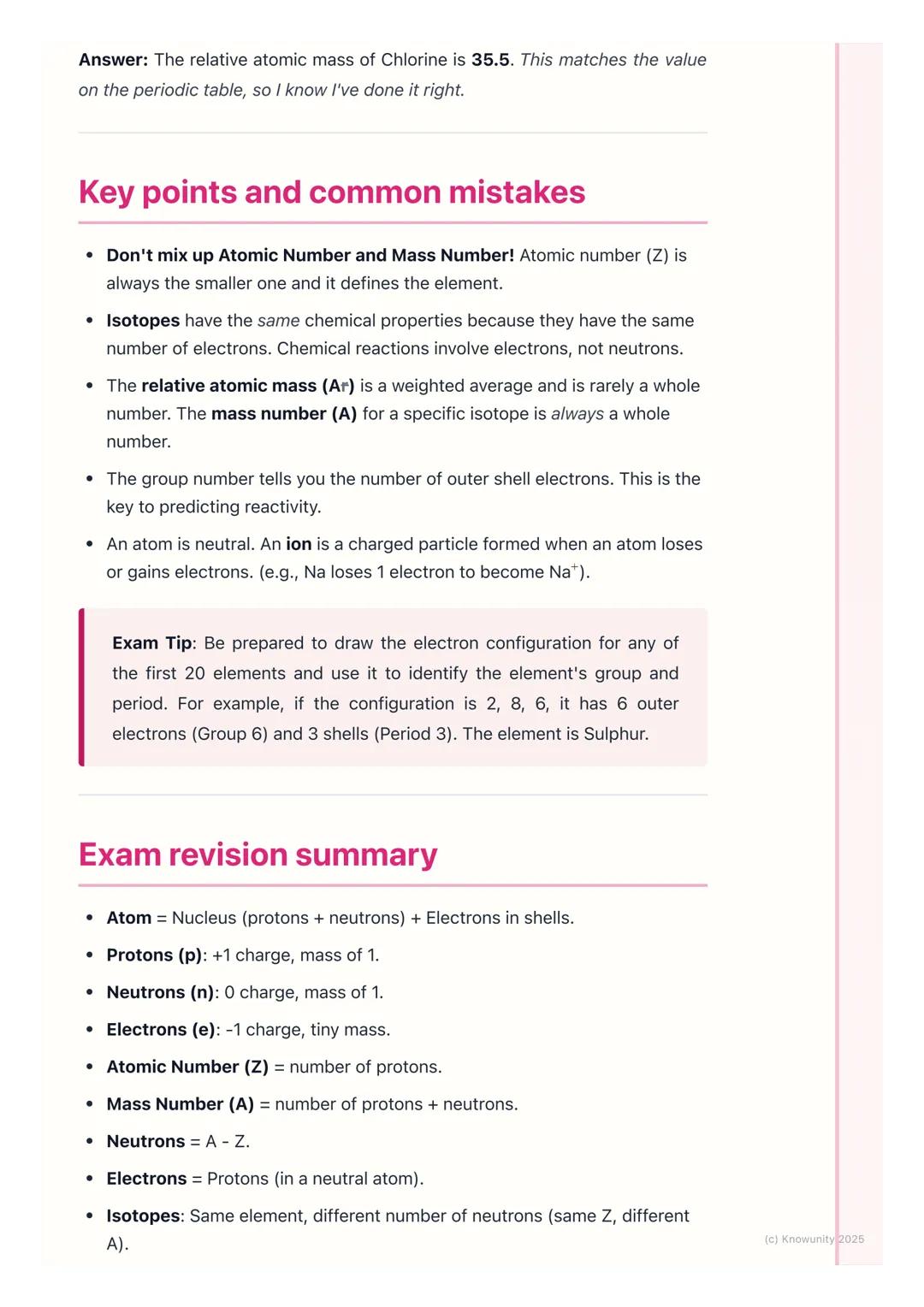
Don't mix up atomic number and mass number - the atomic number is always smaller and defines what element you're dealing with. The mass number tells you the total particles in the nucleus.
Remember that isotopes have identical chemical properties because chemical reactions involve electrons, not neutrons. Different neutron numbers only affect the atomic mass, not how the element behaves chemically.
The relative atomic mass on the periodic table is usually a decimal because it's a weighted average of all naturally occurring isotopes. However, the mass number for any specific isotope is always a whole number.
Group numbers directly tell you the outer electron count, which is your key to predicting reactivity patterns. Master this connection and you'll find chemistry much more logical.
Final Exam Tip: Practice drawing electron configurations for the first 20 elements until you can do it in your sleep - this skill unlocks so many other chemistry concepts!

Onze AI Companion is een studentgerichte AI-tool die meer biedt dan alleen antwoorden. Gebouwd op miljoenen Knowunity bronnen, biedt het relevante informatie, gepersonaliseerde studieplannen, quizzes en inhoud direct in de chat, aangepast aan jouw individuele leertraject.
Je kunt de app downloaden via Google Play Store en Apple App Store.
Dat klopt! Geniet van gratis toegang tot leerinhoud, maak contact met medestudenten en krijg directe hulp – alles binnen handbereik.
App Store
Google Play
De app is heel makkelijk te gebruiken en goed ontworpen. Ik heb tot nu toe alles kunnen vinden waar ik naar zocht en heb veel kunnen leren van de presentaties! Ik ga de app zeker gebruiken voor een schoolopdracht! En natuurlijk helpt het ook veel als inspiratie.
Stefan S
iOS gebruiker
Deze app is echt geweldig. Er zijn zoveel aantekeningen en hulpmiddelen [...]. Mijn probleemvak is bijvoorbeeld Frans, en de app heeft zoveel opties voor hulp. Dankzij deze app ben ik beter geworden in Frans. Ik zou het iedereen aanraden.
Samantha Klich
Android gebruiker
Wow, ik ben echt onder de indruk. Ik probeerde de app gewoon omdat ik hem vaak geadverteerd had gezien en was absoluut verbaasd. Deze app is DE HULP die je wilt voor school en bovenal biedt hij zoveel dingen, zoals oefeningen en factsheets, die mij persoonlijk HEEL erg hebben geholpen.
Anna
iOS gebruiker
Beste app ter wereld! geen woorden want het is te goed
Thomas R
iOS gebruiker
Gewoon geweldig. Laat me 10x beter leren, deze app is een vlotte 10/10. Ik raad het iedereen aan. Ik kan aantekeningen bekijken en zoeken. Ik kan ze opslaan in de vakmap. Ik kan ze altijd herhalen als ik terugkom. Als je deze app nog niet hebt geprobeerd, mis je echt iets.
Basil
Android gebruiker
Deze app heeft me zoveel zekerder gemaakt over mijn examenvoorbereiding, niet alleen door mijn zelfvertrouwen te boosten met functies waarmee je contact kunt maken met anderen en je minder alleen voelt, maar ook door de manier waarop de app zelf erop gericht is je beter te laten voelen. Het is makkelijk om doorheen te navigeren, leuk om te gebruiken, en nuttig voor iedereen die op welke manier dan ook worstelt.
David K
iOS gebruiker
De app is gewoon geweldig! Ik hoef alleen maar het onderwerp in de zoekbalk in te voeren en ik krijg supersnel antwoord. Ik hoef geen 10 YouTube-video's te kijken om iets te begrijpen, dus ik bespaar tijd. Zeer aanbevolen!
Sudenaz Ocak
Android gebruiker
Op school was ik echt slecht in wiskunde, maar dankzij de app gaat het nu veel beter. Ik ben zo dankbaar dat jullie de app hebben gemaakt.
Greenlight Bonnie
Android gebruiker
zeer betrouwbare app om je ideeën over wiskunde, Engels en andere gerelateerde onderwerpen in je werk te helpen en te ontwikkelen. gebruik deze app alsjeblieft als je ergens moeite mee hebt, deze app is essentieel daarvoor. had ik maar eerder een review geschreven. en het is ook gratis dus maak je daar geen zorgen over.
Rohan U
Android gebruiker
Ik weet dat veel apps nepaccounts gebruiken om hun reviews op te krikken maar deze app verdient het allemaal. Eerst haalde ik een 4 voor mijn Engels examens en deze keer kreeg ik een 7. Ik wist niet eens van deze app tot drie dagen voor het examen en het heeft ENORM geholpen. Vertrouw me alsjeblieft en gebruik het want ik weet zeker dat jij ook vooruitgang zult zien.
Xander S
iOS gebruiker
DE QUIZZES EN FLASHCARDS ZIJN ZO HANDIG EN IK HOU VAN Knowunity AI. HET IS OOK LETTERLIJK ZOALS CHATGPT MAAR SLIMMER!! HEEFT ME GEHOLPEN MET MIJN MASCARA PROBLEMEN OOK!! EN MET MIJN ECHTE VAKKEN! NATUURLIJK 😍😁😲🤑💗✨🎀😮
Elisha
iOS gebruiker
Deze app is echt de beste. Ik vind herhaling zo saai maar deze app maakt het zo makkelijk om alles te organiseren en dan kun je de gratis AI vragen om jezelf te testen, zo goed en je kunt makkelijk je eigen spullen uploaden. raad het zeker aan als iemand die nu proefexamens doet
Paul T
iOS gebruiker
De app is heel makkelijk te gebruiken en goed ontworpen. Ik heb tot nu toe alles kunnen vinden waar ik naar zocht en heb veel kunnen leren van de presentaties! Ik ga de app zeker gebruiken voor een schoolopdracht! En natuurlijk helpt het ook veel als inspiratie.
Stefan S
iOS gebruiker
Deze app is echt geweldig. Er zijn zoveel aantekeningen en hulpmiddelen [...]. Mijn probleemvak is bijvoorbeeld Frans, en de app heeft zoveel opties voor hulp. Dankzij deze app ben ik beter geworden in Frans. Ik zou het iedereen aanraden.
Samantha Klich
Android gebruiker
Wow, ik ben echt onder de indruk. Ik probeerde de app gewoon omdat ik hem vaak geadverteerd had gezien en was absoluut verbaasd. Deze app is DE HULP die je wilt voor school en bovenal biedt hij zoveel dingen, zoals oefeningen en factsheets, die mij persoonlijk HEEL erg hebben geholpen.
Anna
iOS gebruiker
Beste app ter wereld! geen woorden want het is te goed
Thomas R
iOS gebruiker
Gewoon geweldig. Laat me 10x beter leren, deze app is een vlotte 10/10. Ik raad het iedereen aan. Ik kan aantekeningen bekijken en zoeken. Ik kan ze opslaan in de vakmap. Ik kan ze altijd herhalen als ik terugkom. Als je deze app nog niet hebt geprobeerd, mis je echt iets.
Basil
Android gebruiker
Deze app heeft me zoveel zekerder gemaakt over mijn examenvoorbereiding, niet alleen door mijn zelfvertrouwen te boosten met functies waarmee je contact kunt maken met anderen en je minder alleen voelt, maar ook door de manier waarop de app zelf erop gericht is je beter te laten voelen. Het is makkelijk om doorheen te navigeren, leuk om te gebruiken, en nuttig voor iedereen die op welke manier dan ook worstelt.
David K
iOS gebruiker
De app is gewoon geweldig! Ik hoef alleen maar het onderwerp in de zoekbalk in te voeren en ik krijg supersnel antwoord. Ik hoef geen 10 YouTube-video's te kijken om iets te begrijpen, dus ik bespaar tijd. Zeer aanbevolen!
Sudenaz Ocak
Android gebruiker
Op school was ik echt slecht in wiskunde, maar dankzij de app gaat het nu veel beter. Ik ben zo dankbaar dat jullie de app hebben gemaakt.
Greenlight Bonnie
Android gebruiker
zeer betrouwbare app om je ideeën over wiskunde, Engels en andere gerelateerde onderwerpen in je werk te helpen en te ontwikkelen. gebruik deze app alsjeblieft als je ergens moeite mee hebt, deze app is essentieel daarvoor. had ik maar eerder een review geschreven. en het is ook gratis dus maak je daar geen zorgen over.
Rohan U
Android gebruiker
Ik weet dat veel apps nepaccounts gebruiken om hun reviews op te krikken maar deze app verdient het allemaal. Eerst haalde ik een 4 voor mijn Engels examens en deze keer kreeg ik een 7. Ik wist niet eens van deze app tot drie dagen voor het examen en het heeft ENORM geholpen. Vertrouw me alsjeblieft en gebruik het want ik weet zeker dat jij ook vooruitgang zult zien.
Xander S
iOS gebruiker
DE QUIZZES EN FLASHCARDS ZIJN ZO HANDIG EN IK HOU VAN Knowunity AI. HET IS OOK LETTERLIJK ZOALS CHATGPT MAAR SLIMMER!! HEEFT ME GEHOLPEN MET MIJN MASCARA PROBLEMEN OOK!! EN MET MIJN ECHTE VAKKEN! NATUURLIJK 😍😁😲🤑💗✨🎀😮
Elisha
iOS gebruiker
Deze app is echt de beste. Ik vind herhaling zo saai maar deze app maakt het zo makkelijk om alles te organiseren en dan kun je de gratis AI vragen om jezelf te testen, zo goed en je kunt makkelijk je eigen spullen uploaden. raad het zeker aan als iemand die nu proefexamens doet
Paul T
iOS gebruiker
Ever wondered what everything around you is actually made of? It all comes down to atoms- tiny building blocks that make up absolutely everything, from your phone to the air you breathe. Understanding how atoms work is the key... Meer weergeven
Toegang tot alle documenten
Verbeter je cijfers
Sluit je aan bij miljoenen studenten
Think of atoms as the LEGO blocks of the universe - they're the smallest pieces that still keep all the properties of an element. Every single thing you can touch, see, or breathe is made up of these incredibly tiny particles.
What makes atoms really clever is that they're mostly empty space with a super dense centre called the nucleus. Around this nucleus, electrons zoom about in specific areas called shells. It's a bit like planets orbiting the sun, but way more exciting because it determines how elements will react with each other.
The brilliant thing about atoms is that they're electrically neutral - they have equal amounts of positive and negative charges that balance each other out perfectly. This balance is what keeps matter stable and predictable.
Quick Tip: Remember that atoms are the smallest particles of an element that still act like that element - break them down further and you lose what makes oxygen "oxygen" or gold "gold"!
Toegang tot alle documenten
Verbeter je cijfers
Sluit je aan bij miljoenen studenten
Inside every atom, you'll find three main players: protons, neutrons, and electrons. Protons carry a positive charge and live in the nucleus with neutrons (which are neutral). Electrons, with their negative charge, whiz around the nucleus in shells.
Here's what you need to remember: protons have a relative mass of 1 and a +1 charge, neutrons also have a mass of 1 but no charge, and electrons are incredibly light with a -1 charge.
The atomic number (Z) tells you how many protons an element has - this is like its ID card because it never changes for that element. The mass number (A) is the total of protons plus neutrons in the nucleus.
To find the number of particles, use this dead simple formula: protons = Z, electrons = Z (for neutral atoms), and neutrons = A - Z. Master this calculation because it's guaranteed to show up on your exams.
Exam Alert: The notation ᴬ/ᴢX always appears on tests - A is the big number on top (mass number), Z is the small number below (atomic number), and X is the element symbol.
Toegang tot alle documenten
Verbeter je cijfers
Sluit je aan bij miljoenen studenten
Electrons don't just randomly float around the nucleus - they follow strict rules about where they can live. Think of electron shells as different floors of a building, and electrons fill up from the ground floor upwards.
The first shell (closest to the nucleus) can only hold 2 electrons maximum. The second shell can hold up to 8 electrons, and for the first 20 elements you need to know, the third shell also holds a maximum of 8 electrons.
Let's use magnesium as an example. It has an atomic number of 12, so it has 12 electrons. These get arranged as: 2 electrons in the first shell, 8 in the second shell, and the remaining 2 in the third shell. We write this as 2, 8, 2.
Getting electron configuration right is crucial because it directly links to how elements are organised in the periodic table and explains why certain elements behave similarly to others.
Memory Trick: For the first 20 elements, shells fill in the pattern 2, 8, 8 - like a simple countdown that helps you work out any element's electron arrangement!
Toegang tot alle documenten
Verbeter je cijfers
Sluit je aan bij miljoenen studenten
The periodic table isn't just a random list of elements - it's actually a brilliant map that shows you exactly how atoms are structured. Elements are arranged in order of increasing atomic number, which means more and more protons as you move from left to right.
Periods are the horizontal rows, and here's the key insight: all elements in the same period have the same number of electron shells. So sodium (2,8,1) and argon (2,8,8) are both in period 3 because they both have exactly 3 electron shells.
Groups are the vertical columns, and this is where it gets really interesting. Elements in the same group have the same number of electrons in their outermost shell, which means they behave very similarly in chemical reactions.
The outermost electrons (called valence electrons) are like the element's personality - they determine how it will react with other elements. Same number of outer electrons equals similar chemical behaviour.
Key Insight: The periodic table is basically a cheat sheet for predicting how elements will behave - once you understand the pattern, chemistry becomes much more logical!
Toegang tot alle documenten
Verbeter je cijfers
Sluit je aan bij miljoenen studenten
Group 1 (Alkali Metals) elements have just 1 electron in their outer shell, making them incredibly reactive - they desperately want to lose that lone electron. Think lithium, sodium, and potassium - they all react explosively with water.
Group 7 (Halogens) have 7 outer electrons and are equally reactive, but for the opposite reason - they're desperate to gain 1 more electron to fill their outer shell. Fluorine and chlorine are classic examples that form salts when they react with metals.
Group 0 (Noble Gases) are the chilled-out elements with full outer shells - helium has 2 electrons, while neon and argon have 8. Because their outer shells are complete, they're incredibly stable and rarely react with anything.
Understanding these groups helps you predict reactions before they happen. Elements in the same group will generally react in similar ways because they have the same outer electron arrangement.
Exam Focus: You'll definitely need to identify which group an element belongs to from its electron configuration - the number of outer electrons equals the group number (except for Group 0)!
Toegang tot alle documenten
Verbeter je cijfers
Sluit je aan bij miljoenen studenten
Let's work through sodium (²³₁₁Na) step by step. The mass number A = 23 and atomic number Z = 11. This means: protons = 11, electrons = 11 (same as protons for neutral atoms), and neutrons = 23 - 11 = 12.
For relative atomic mass calculations, you need to account for isotopes - atoms of the same element with different numbers of neutrons. Chlorine exists as 75% chlorine-35 and 25% chlorine-37.
The calculation is: Ar = [(35 × 75) + (37 × 25)] ÷ 100 = [2625 + 925] ÷ 100 = 35.5. This matches the decimal number you see on the periodic table for chlorine.
Isotopes are crucial to understand - they're the same element (same number of protons) but with different neutrons, so they have different mass numbers but identical chemical properties.
Calculation Tip: Always double-check your relative atomic mass answer against the periodic table - if they don't match, you've made an error in your working!
Toegang tot alle documenten
Verbeter je cijfers
Sluit je aan bij miljoenen studenten
Don't mix up atomic number and mass number - the atomic number is always smaller and defines what element you're dealing with. The mass number tells you the total particles in the nucleus.
Remember that isotopes have identical chemical properties because chemical reactions involve electrons, not neutrons. Different neutron numbers only affect the atomic mass, not how the element behaves chemically.
The relative atomic mass on the periodic table is usually a decimal because it's a weighted average of all naturally occurring isotopes. However, the mass number for any specific isotope is always a whole number.
Group numbers directly tell you the outer electron count, which is your key to predicting reactivity patterns. Master this connection and you'll find chemistry much more logical.
Final Exam Tip: Practice drawing electron configurations for the first 20 elements until you can do it in your sleep - this skill unlocks so many other chemistry concepts!
Toegang tot alle documenten
Verbeter je cijfers
Sluit je aan bij miljoenen studenten
Onze AI Companion is een studentgerichte AI-tool die meer biedt dan alleen antwoorden. Gebouwd op miljoenen Knowunity bronnen, biedt het relevante informatie, gepersonaliseerde studieplannen, quizzes en inhoud direct in de chat, aangepast aan jouw individuele leertraject.
Je kunt de app downloaden via Google Play Store en Apple App Store.
Dat klopt! Geniet van gratis toegang tot leerinhoud, maak contact met medestudenten en krijg directe hulp – alles binnen handbereik.
1
Slimme Tools NIEUW
Zet deze aantekening om in: ✓ 50+ Oefenvragen ✓ Interactieve Flashcards ✓ Volledig proefexamen ✓ Essay Outlines
App Store
Google Play
De app is heel makkelijk te gebruiken en goed ontworpen. Ik heb tot nu toe alles kunnen vinden waar ik naar zocht en heb veel kunnen leren van de presentaties! Ik ga de app zeker gebruiken voor een schoolopdracht! En natuurlijk helpt het ook veel als inspiratie.
Stefan S
iOS gebruiker
Deze app is echt geweldig. Er zijn zoveel aantekeningen en hulpmiddelen [...]. Mijn probleemvak is bijvoorbeeld Frans, en de app heeft zoveel opties voor hulp. Dankzij deze app ben ik beter geworden in Frans. Ik zou het iedereen aanraden.
Samantha Klich
Android gebruiker
Wow, ik ben echt onder de indruk. Ik probeerde de app gewoon omdat ik hem vaak geadverteerd had gezien en was absoluut verbaasd. Deze app is DE HULP die je wilt voor school en bovenal biedt hij zoveel dingen, zoals oefeningen en factsheets, die mij persoonlijk HEEL erg hebben geholpen.
Anna
iOS gebruiker
Beste app ter wereld! geen woorden want het is te goed
Thomas R
iOS gebruiker
Gewoon geweldig. Laat me 10x beter leren, deze app is een vlotte 10/10. Ik raad het iedereen aan. Ik kan aantekeningen bekijken en zoeken. Ik kan ze opslaan in de vakmap. Ik kan ze altijd herhalen als ik terugkom. Als je deze app nog niet hebt geprobeerd, mis je echt iets.
Basil
Android gebruiker
Deze app heeft me zoveel zekerder gemaakt over mijn examenvoorbereiding, niet alleen door mijn zelfvertrouwen te boosten met functies waarmee je contact kunt maken met anderen en je minder alleen voelt, maar ook door de manier waarop de app zelf erop gericht is je beter te laten voelen. Het is makkelijk om doorheen te navigeren, leuk om te gebruiken, en nuttig voor iedereen die op welke manier dan ook worstelt.
David K
iOS gebruiker
De app is gewoon geweldig! Ik hoef alleen maar het onderwerp in de zoekbalk in te voeren en ik krijg supersnel antwoord. Ik hoef geen 10 YouTube-video's te kijken om iets te begrijpen, dus ik bespaar tijd. Zeer aanbevolen!
Sudenaz Ocak
Android gebruiker
Op school was ik echt slecht in wiskunde, maar dankzij de app gaat het nu veel beter. Ik ben zo dankbaar dat jullie de app hebben gemaakt.
Greenlight Bonnie
Android gebruiker
zeer betrouwbare app om je ideeën over wiskunde, Engels en andere gerelateerde onderwerpen in je werk te helpen en te ontwikkelen. gebruik deze app alsjeblieft als je ergens moeite mee hebt, deze app is essentieel daarvoor. had ik maar eerder een review geschreven. en het is ook gratis dus maak je daar geen zorgen over.
Rohan U
Android gebruiker
Ik weet dat veel apps nepaccounts gebruiken om hun reviews op te krikken maar deze app verdient het allemaal. Eerst haalde ik een 4 voor mijn Engels examens en deze keer kreeg ik een 7. Ik wist niet eens van deze app tot drie dagen voor het examen en het heeft ENORM geholpen. Vertrouw me alsjeblieft en gebruik het want ik weet zeker dat jij ook vooruitgang zult zien.
Xander S
iOS gebruiker
DE QUIZZES EN FLASHCARDS ZIJN ZO HANDIG EN IK HOU VAN Knowunity AI. HET IS OOK LETTERLIJK ZOALS CHATGPT MAAR SLIMMER!! HEEFT ME GEHOLPEN MET MIJN MASCARA PROBLEMEN OOK!! EN MET MIJN ECHTE VAKKEN! NATUURLIJK 😍😁😲🤑💗✨🎀😮
Elisha
iOS gebruiker
Deze app is echt de beste. Ik vind herhaling zo saai maar deze app maakt het zo makkelijk om alles te organiseren en dan kun je de gratis AI vragen om jezelf te testen, zo goed en je kunt makkelijk je eigen spullen uploaden. raad het zeker aan als iemand die nu proefexamens doet
Paul T
iOS gebruiker
De app is heel makkelijk te gebruiken en goed ontworpen. Ik heb tot nu toe alles kunnen vinden waar ik naar zocht en heb veel kunnen leren van de presentaties! Ik ga de app zeker gebruiken voor een schoolopdracht! En natuurlijk helpt het ook veel als inspiratie.
Stefan S
iOS gebruiker
Deze app is echt geweldig. Er zijn zoveel aantekeningen en hulpmiddelen [...]. Mijn probleemvak is bijvoorbeeld Frans, en de app heeft zoveel opties voor hulp. Dankzij deze app ben ik beter geworden in Frans. Ik zou het iedereen aanraden.
Samantha Klich
Android gebruiker
Wow, ik ben echt onder de indruk. Ik probeerde de app gewoon omdat ik hem vaak geadverteerd had gezien en was absoluut verbaasd. Deze app is DE HULP die je wilt voor school en bovenal biedt hij zoveel dingen, zoals oefeningen en factsheets, die mij persoonlijk HEEL erg hebben geholpen.
Anna
iOS gebruiker
Beste app ter wereld! geen woorden want het is te goed
Thomas R
iOS gebruiker
Gewoon geweldig. Laat me 10x beter leren, deze app is een vlotte 10/10. Ik raad het iedereen aan. Ik kan aantekeningen bekijken en zoeken. Ik kan ze opslaan in de vakmap. Ik kan ze altijd herhalen als ik terugkom. Als je deze app nog niet hebt geprobeerd, mis je echt iets.
Basil
Android gebruiker
Deze app heeft me zoveel zekerder gemaakt over mijn examenvoorbereiding, niet alleen door mijn zelfvertrouwen te boosten met functies waarmee je contact kunt maken met anderen en je minder alleen voelt, maar ook door de manier waarop de app zelf erop gericht is je beter te laten voelen. Het is makkelijk om doorheen te navigeren, leuk om te gebruiken, en nuttig voor iedereen die op welke manier dan ook worstelt.
David K
iOS gebruiker
De app is gewoon geweldig! Ik hoef alleen maar het onderwerp in de zoekbalk in te voeren en ik krijg supersnel antwoord. Ik hoef geen 10 YouTube-video's te kijken om iets te begrijpen, dus ik bespaar tijd. Zeer aanbevolen!
Sudenaz Ocak
Android gebruiker
Op school was ik echt slecht in wiskunde, maar dankzij de app gaat het nu veel beter. Ik ben zo dankbaar dat jullie de app hebben gemaakt.
Greenlight Bonnie
Android gebruiker
zeer betrouwbare app om je ideeën over wiskunde, Engels en andere gerelateerde onderwerpen in je werk te helpen en te ontwikkelen. gebruik deze app alsjeblieft als je ergens moeite mee hebt, deze app is essentieel daarvoor. had ik maar eerder een review geschreven. en het is ook gratis dus maak je daar geen zorgen over.
Rohan U
Android gebruiker
Ik weet dat veel apps nepaccounts gebruiken om hun reviews op te krikken maar deze app verdient het allemaal. Eerst haalde ik een 4 voor mijn Engels examens en deze keer kreeg ik een 7. Ik wist niet eens van deze app tot drie dagen voor het examen en het heeft ENORM geholpen. Vertrouw me alsjeblieft en gebruik het want ik weet zeker dat jij ook vooruitgang zult zien.
Xander S
iOS gebruiker
DE QUIZZES EN FLASHCARDS ZIJN ZO HANDIG EN IK HOU VAN Knowunity AI. HET IS OOK LETTERLIJK ZOALS CHATGPT MAAR SLIMMER!! HEEFT ME GEHOLPEN MET MIJN MASCARA PROBLEMEN OOK!! EN MET MIJN ECHTE VAKKEN! NATUURLIJK 😍😁😲🤑💗✨🎀😮
Elisha
iOS gebruiker
Deze app is echt de beste. Ik vind herhaling zo saai maar deze app maakt het zo makkelijk om alles te organiseren en dan kun je de gratis AI vragen om jezelf te testen, zo goed en je kunt makkelijk je eigen spullen uploaden. raad het zeker aan als iemand die nu proefexamens doet
Paul T
iOS gebruiker