
Every living thing on Earth is made up of cells... Meer weergeven
 Science
 Irish
Irish English
 Geography
Meld je aan om de inhoud te zienHet is gratis!
Toegang tot alle documenten
Verbeter je cijfers
Sluit je aan bij miljoenen studenten
Knowunity AI
Vakken
Triangle Congruence and Similarity Theorems
Triangle Properties and Classification
Linear Equations and Graphs
Geometric Angle Relationships
Trigonometric Functions and Identities
Equation Solving Techniques
Circle Geometry Fundamentals
Division Operations and Methods
Basic Differentiation Rules
Exponent and Logarithm Properties
Alle onderwerpen weergeven
Human Organ Systems
Reproductive Cell Cycles
Biological Sciences Subdisciplines
Cellular Energy Metabolism
Autotrophic Energy Processes
Inheritance Patterns and Principles
Biomolecular Structure and Organization
Cell Cycle and Division Mechanics
Cellular Organization and Development
Biological Structural Organization
Alle onderwerpen weergeven
Chemical Sciences and Applications
Atomic Structure and Composition
Molecular Electron Structure Representation
Atomic Electron Behavior
Matter Properties and Water
Mole Concept and Calculations
Gas Laws and Behavior
Periodic Table Organization
Chemical Thermodynamics Fundamentals
Chemical Bond Types and Properties
Alle onderwerpen weergeven
European Renaissance and Enlightenment
European Cultural Movements 800-1920
American Revolution Era 1763-1797
American Civil War 1861-1865
Global Imperial Systems
Mongol and Chinese Dynasties
U.S. Presidents and World Leaders
Historical Sources and Documentation
World Wars Era and Impact
World Religious Systems
Alle onderwerpen weergeven
Classic and Contemporary Novels
Literary Character Analysis
Rhetorical Theory and Practice
Classic Literary Narratives
Reading Analysis and Interpretation
Narrative Structure and Techniques
English Language Components
Influential English-Language Authors
Basic Sentence Structure
Narrative Voice and Perspective
Alle onderwerpen weergeven
2
•
Bijgewerkt May 4, 2026
•
Every living thing on Earth is made up of cells... Meer weergeven
You're constantly surrounded by trillions of cells - they're literally everywhere, including the roughly 37 trillion that make up your own body! Cells are the fundamental building blocks of all living organisms, and every single life process happens at the cellular level.
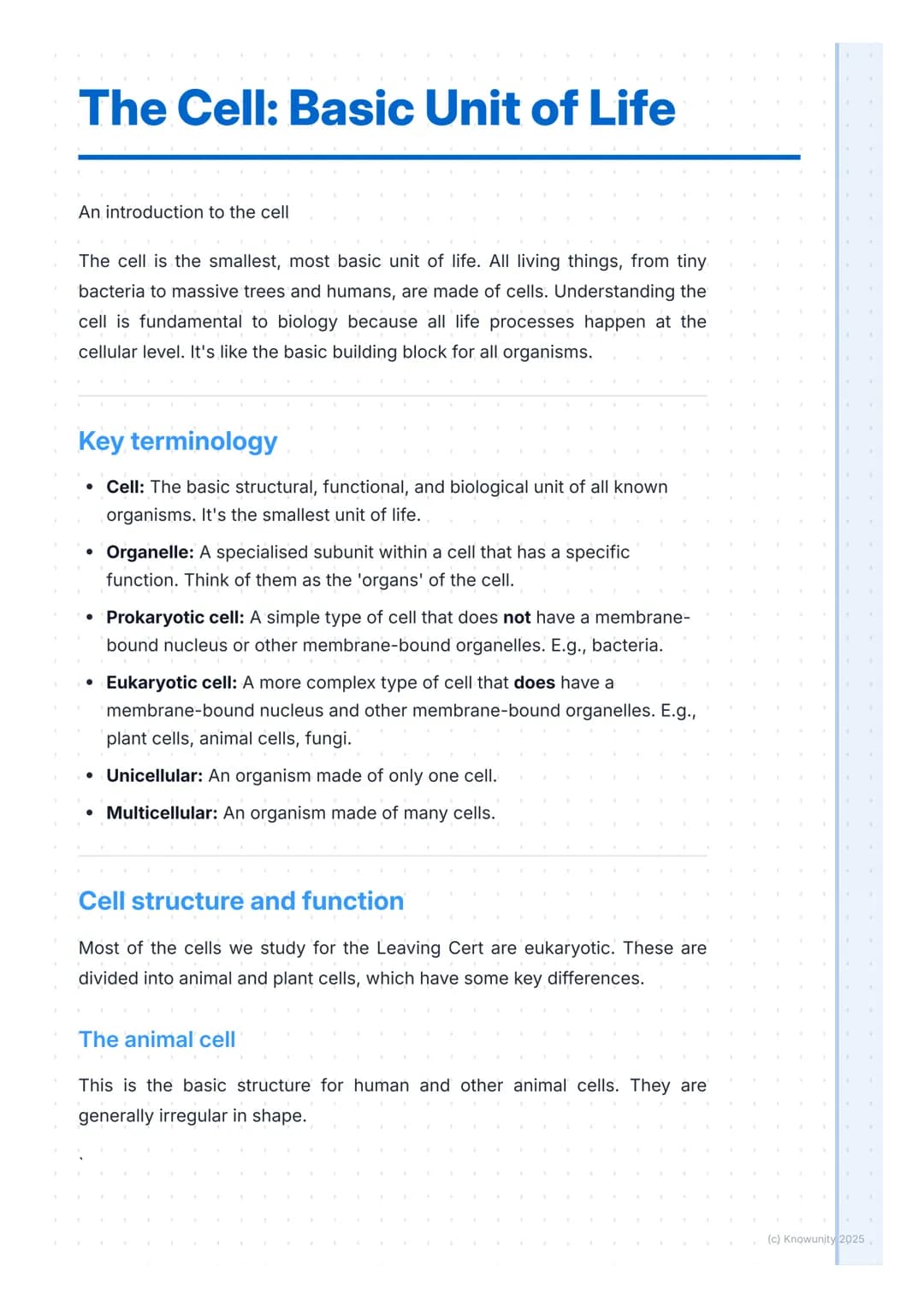
There are two main types of cells you need to know. Prokaryotic cells are the simple ones - think bacteria - that don't have a proper nucleus or organised compartments. Eukaryotic cells are the complex ones that make up plants, animals, and fungi, complete with a nucleus and specialised compartments called organelles.
Living things can be unicellular (made of just one cell, like bacteria) or multicellular (made of many cells working together, like you). For your Leaving Cert, you'll mainly focus on eukaryotic cells, particularly plant and animal cells.
Remember: Organelles are like the "organs" of a cell - each one has a specific job to keep the cell functioning properly.
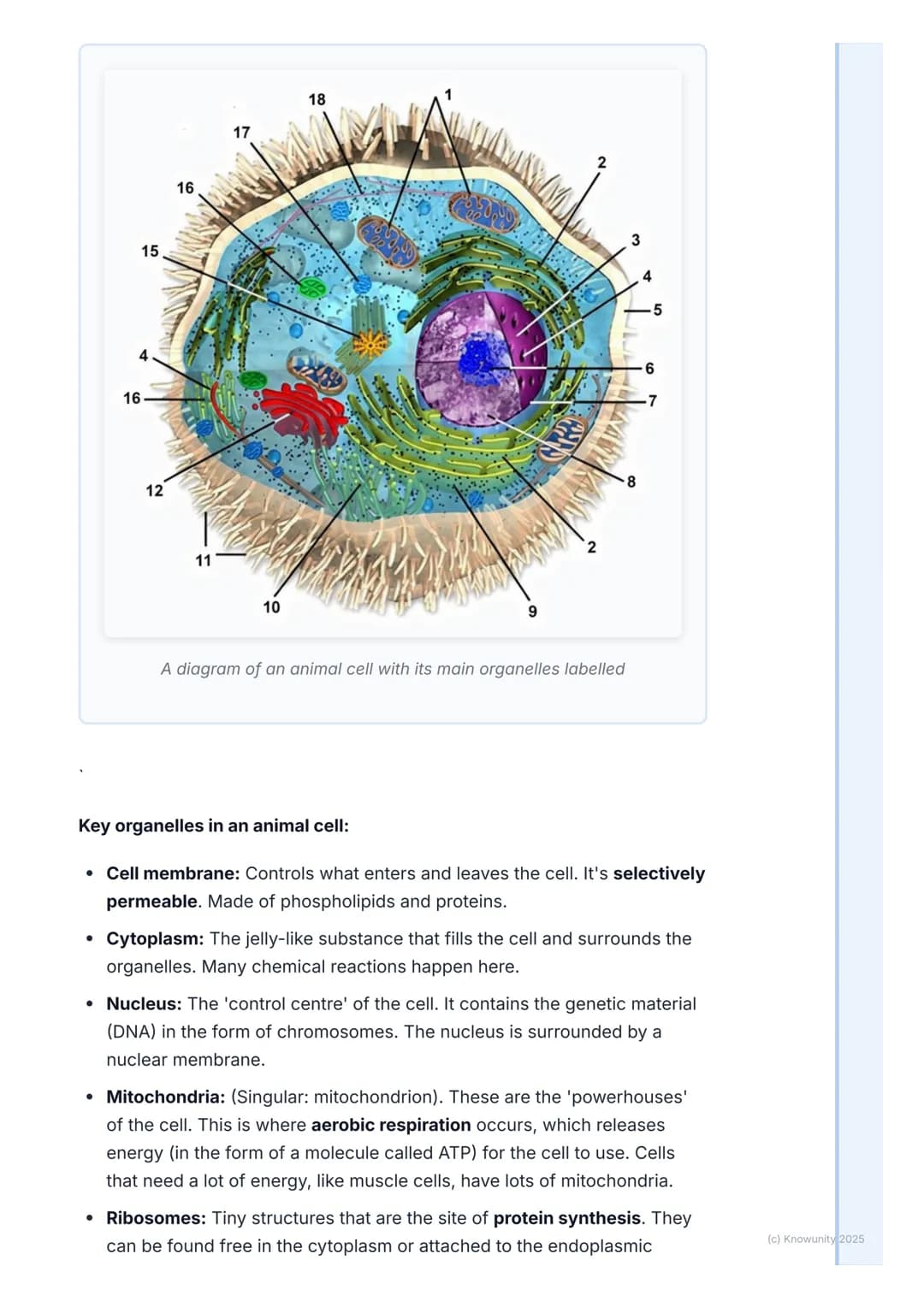
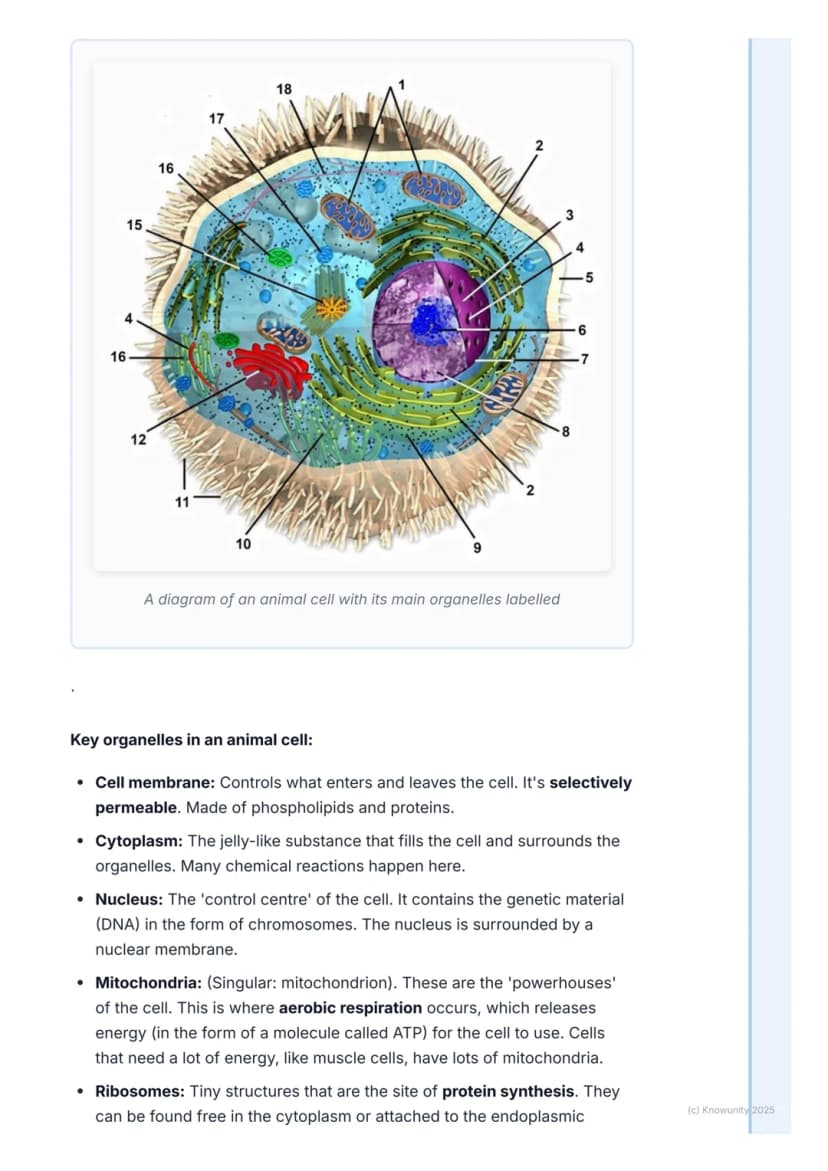
Animal cells are your basic cellular template - they're usually round or irregular in shape and packed with amazing tiny machines. The cell membrane acts like a bouncer at a club, deciding what gets in and out of the cell using its selective permeability.
Inside, the cytoplasm is like a jelly-filled workspace where loads of chemical reactions happen. The nucleus is absolutely crucial - it's the control centre containing all your genetic material (DNA) wrapped up in chromosomes, surrounded by its own protective membrane.
Mitochondria are the real heroes here - they're often called the "powerhouses" because they carry out respiration to release energy as ATP. Muscle cells are packed with these because they need loads of energy! Ribosomes are tiny protein-making factories that can float freely or attach to the endoplasmic reticulum.
Top Tip: Cells that need more energy (like heart muscle cells) contain way more mitochondria - this shows how structure relates to function!
The endoplasmic reticulum (ER) is like the cell's internal highway system for transporting materials. There are two types: rough ER (covered in ribosomes, looks bumpy) handles proteins, whilst smooth ER (no ribosomes) deals with lipids and other substances.
Vesicles are like tiny delivery vans - small membrane-bound sacs that transport substances around the cell. They're constantly moving materials from one place to another, keeping everything organised.
These organelles work together like a well-oiled machine. When you understand how each part contributes to the whole system, cell biology starts making perfect sense!
Exam Smart: Remember that animal cells can have small, temporary vacuoles, but they're nothing like the massive ones in plant cells.
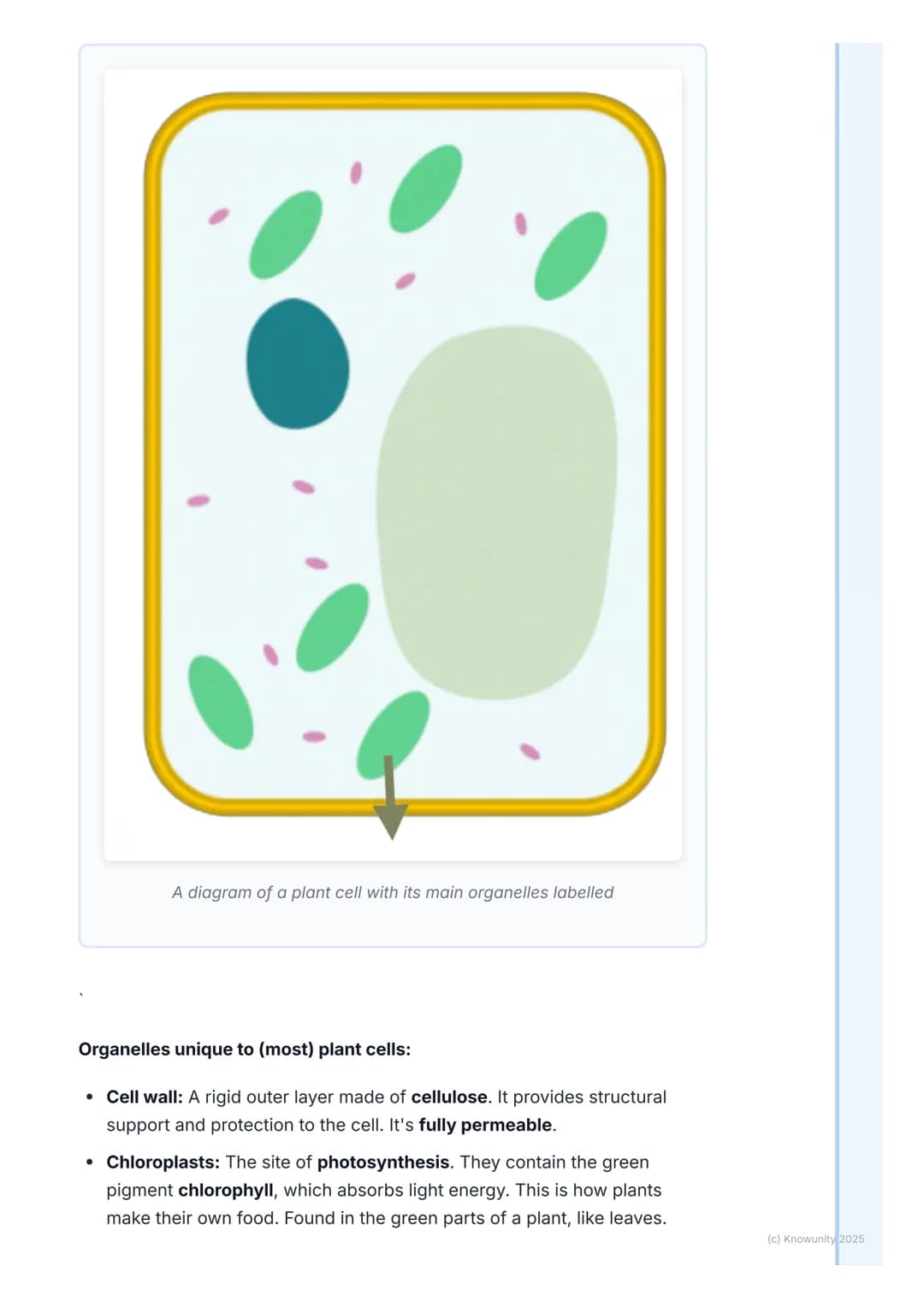
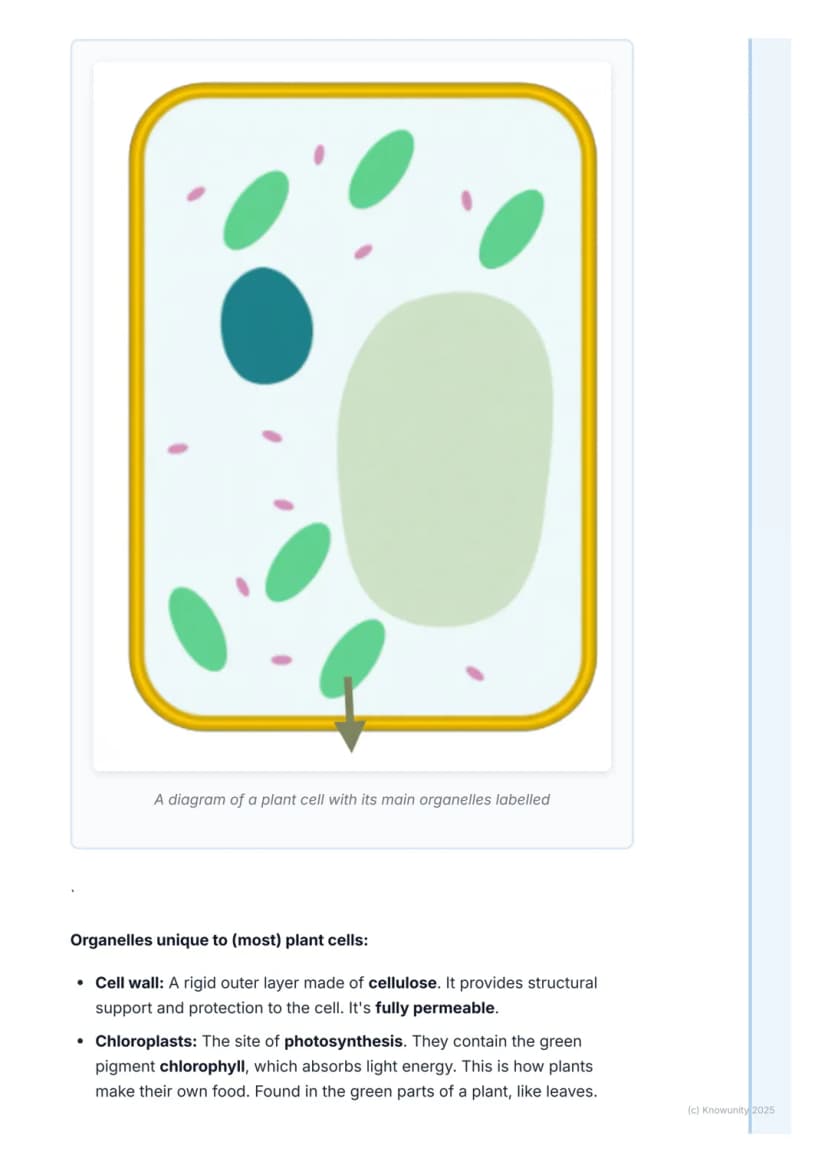
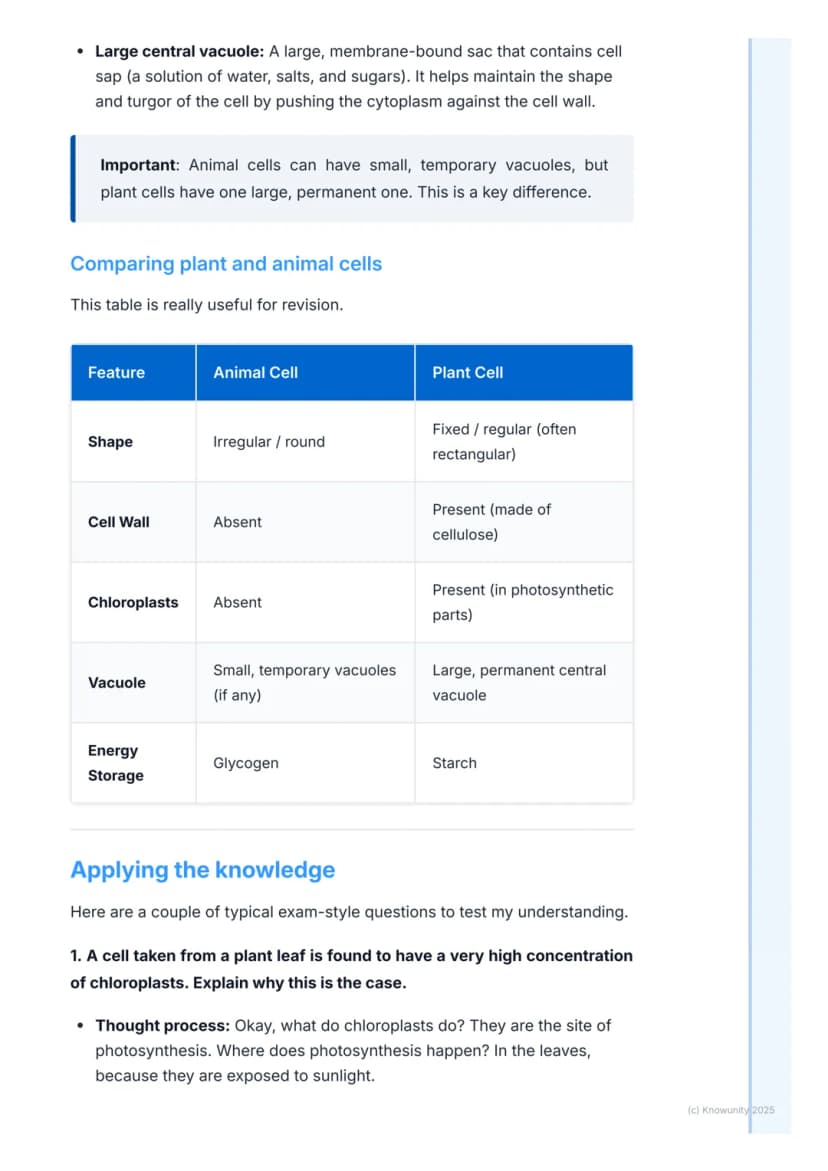
Plant cells are like upgraded animal cells with some brilliant extras that help them make their own food and stand upright. They typically have a more fixed, rectangular shape thanks to their rigid cell wall made of cellulose.
The cell wall is the plant's suit of armour - it provides structural support and protection whilst being fully permeable (unlike the selective cell membrane). This is why plants can grow so tall without collapsing!
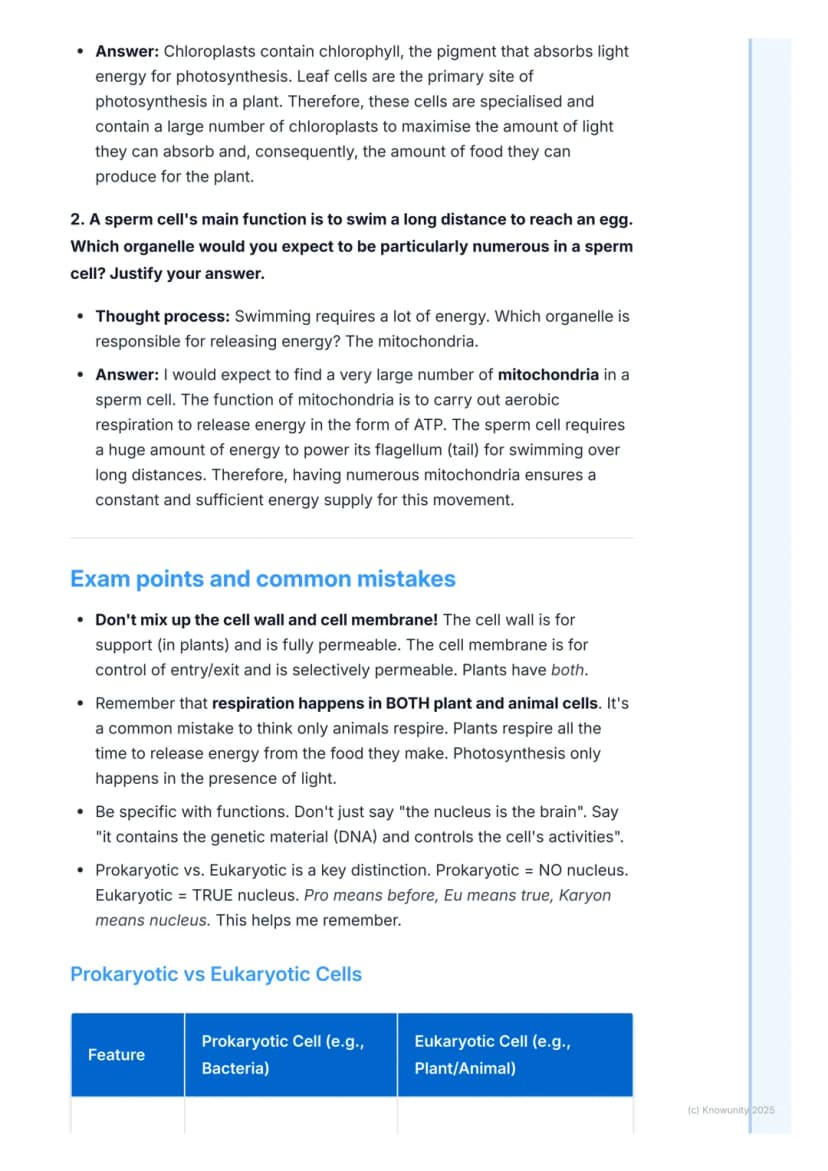
Chloroplasts are the green magic-makers containing chlorophyll, the pigment that captures sunlight for photosynthesis. You'll find loads of these in leaf cells because that's where most photosynthesis happens. They're basically the plant's solar panels!
Key Point: Plant cells have all the same organelles as animal cells PLUS the cell wall, chloroplasts, and a large central vacuole.
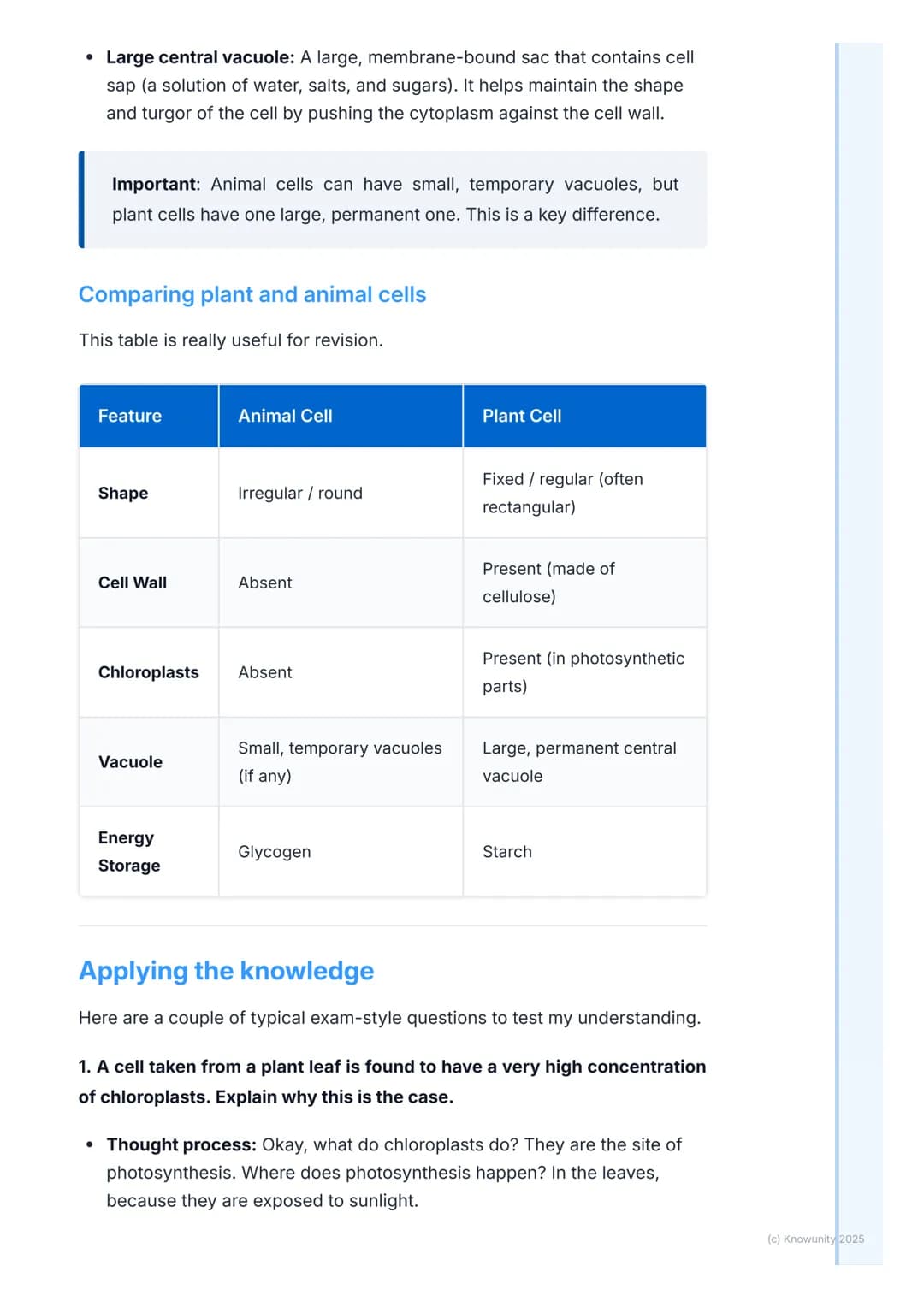
The large central vacuole is like a plant cell's storage tank and support system rolled into one. It's filled with cell sap (water, salts, and sugars) and helps maintain the cell's shape by pushing outwards against the cell wall - this is called turgor pressure.
Here's a handy comparison: animal cells are irregular and flexible, whilst plant cells are fixed and rectangular. Animal cells store energy as glycogen, plants use starch. Most importantly, plants can photosynthesise thanks to their chloroplasts, whilst animals must get their energy by eating other organisms.
When tackling exam questions, think about structure matching function. Leaf cells packed with chloroplasts? Perfect for photosynthesis. Sperm cells loaded with mitochondria? Ideal for that energy-demanding swim to reach an egg!
Exam Tip: Don't confuse the cell wall (structural support, fully permeable) with the cell membrane - plants have both!
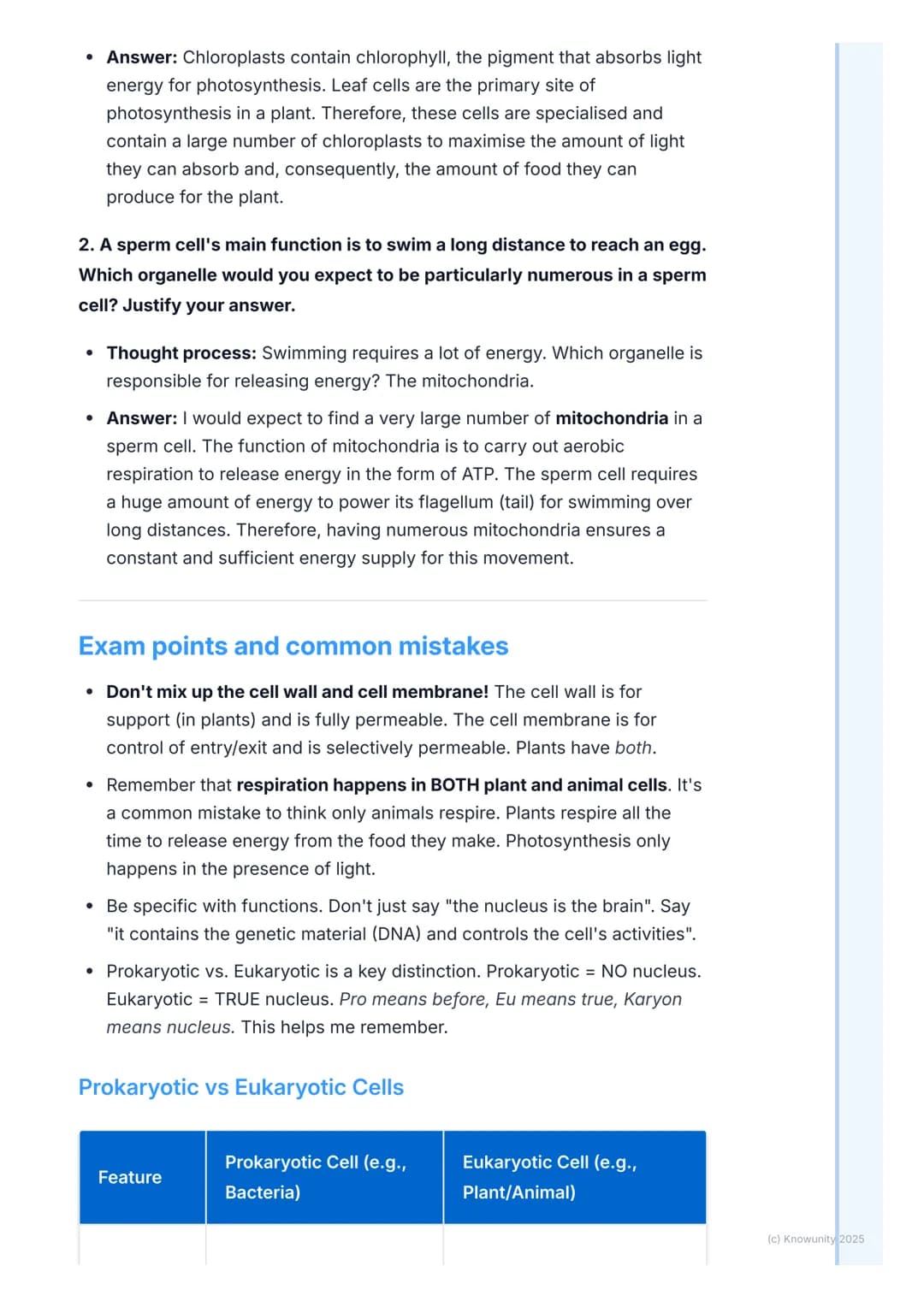
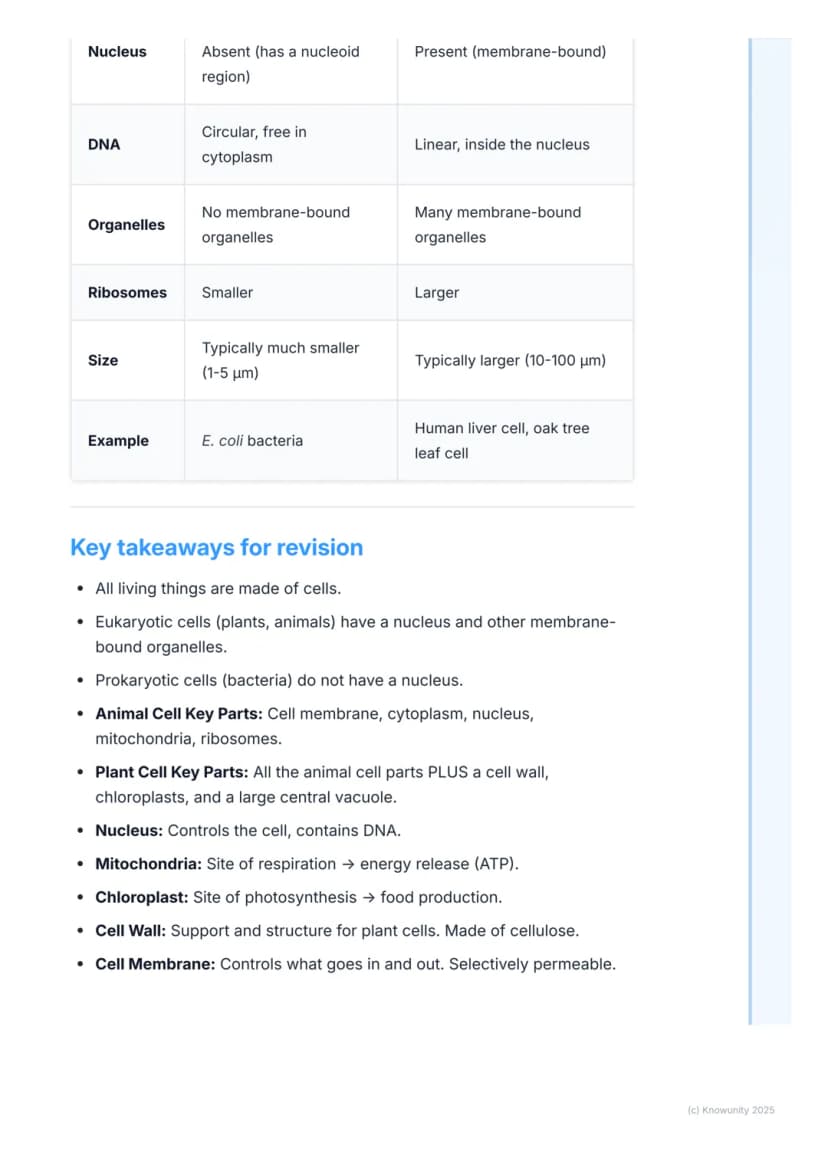
Understanding the difference between prokaryotic and eukaryotic cells is absolutely essential for your exams. Prokaryotic cells (like bacteria) are the minimalists of the cell world - no nucleus, no membrane-bound organelles, just DNA floating freely in a region called the nucleoid.
Eukaryotic cells are the complete opposite - they've got a proper nucleus with DNA neatly packaged inside, plus loads of specialised organelles doing different jobs. They're also much larger than prokaryotic cells .
Remember the word origins: "pro" means before, "eu" means true, and "karyon" means nucleus. So prokaryotic = "before nucleus" (evolved first, no proper nucleus) and eukaryotic = "true nucleus" (evolved later, has a proper nucleus).
Memory Trick: Think of prokaryotic cells as studio apartments (everything in one space) and eukaryotic cells as mansions (lots of separate rooms with specific purposes).
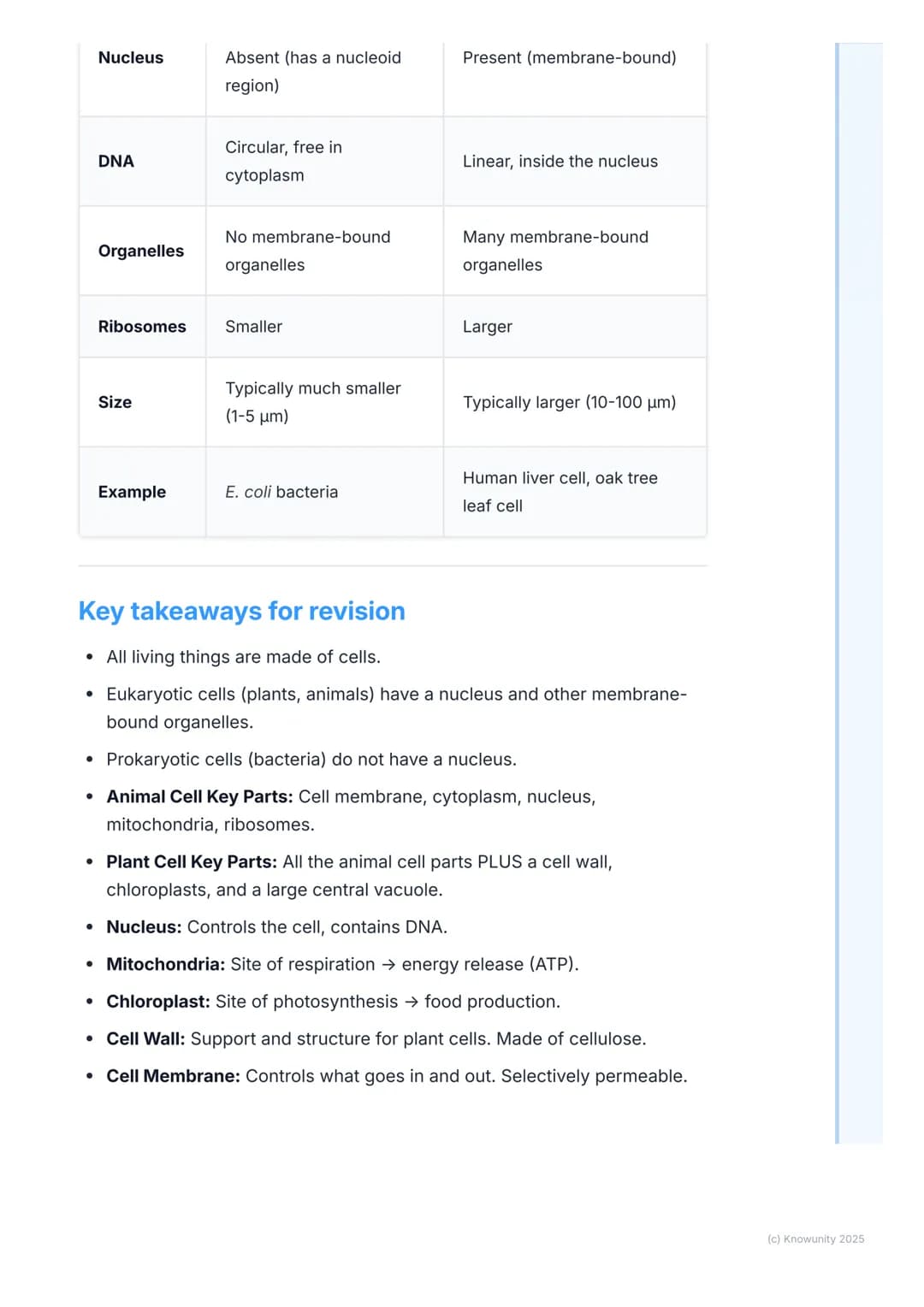
Here's what you absolutely must remember: all living things are made of cells, and there are two main types - prokaryotic (bacteria) and eukaryotic (plants, animals, fungi). Animal cells have the basic kit: cell membrane, cytoplasm, nucleus, mitochondria, and ribosomes.
Plant cells have everything animal cells have, plus three crucial extras: a cell wall for support, chloroplasts for photosynthesis, and a large central vacuole for storage and structure. Each organelle has a specific job that matches its structure perfectly.
Common exam mistakes to avoid: don't mix up cell walls and cell membranes, remember that plants DO respire (they need energy too!), and always be specific about functions rather than using vague terms like "the nucleus is the brain."
Final Tip: When answering exam questions, always explain WHY a cell has certain organelles by linking structure to function - this shows real understanding!
Onze AI Companion is een studentgerichte AI-tool die meer biedt dan alleen antwoorden. Gebouwd op miljoenen Knowunity bronnen, biedt het relevante informatie, gepersonaliseerde studieplannen, quizzes en inhoud direct in de chat, aangepast aan jouw individuele leertraject.
Je kunt de app downloaden via Google Play Store en Apple App Store.
Dat klopt! Geniet van gratis toegang tot leerinhoud, maak contact met medestudenten en krijg directe hulp – alles binnen handbereik.
App Store
Google Play
De app is heel makkelijk te gebruiken en goed ontworpen. Ik heb tot nu toe alles kunnen vinden waar ik naar zocht en heb veel kunnen leren van de presentaties! Ik ga de app zeker gebruiken voor een schoolopdracht! En natuurlijk helpt het ook veel als inspiratie.
Stefan S
iOS gebruiker
Deze app is echt geweldig. Er zijn zoveel aantekeningen en hulpmiddelen [...]. Mijn probleemvak is bijvoorbeeld Frans, en de app heeft zoveel opties voor hulp. Dankzij deze app ben ik beter geworden in Frans. Ik zou het iedereen aanraden.
Samantha Klich
Android gebruiker
Wow, ik ben echt onder de indruk. Ik probeerde de app gewoon omdat ik hem vaak geadverteerd had gezien en was absoluut verbaasd. Deze app is DE HULP die je wilt voor school en bovenal biedt hij zoveel dingen, zoals oefeningen en factsheets, die mij persoonlijk HEEL erg hebben geholpen.
Anna
iOS gebruiker
Beste app ter wereld! geen woorden want het is te goed
Thomas R
iOS gebruiker
Gewoon geweldig. Laat me 10x beter leren, deze app is een vlotte 10/10. Ik raad het iedereen aan. Ik kan aantekeningen bekijken en zoeken. Ik kan ze opslaan in de vakmap. Ik kan ze altijd herhalen als ik terugkom. Als je deze app nog niet hebt geprobeerd, mis je echt iets.
Basil
Android gebruiker
Deze app heeft me zoveel zekerder gemaakt over mijn examenvoorbereiding, niet alleen door mijn zelfvertrouwen te boosten met functies waarmee je contact kunt maken met anderen en je minder alleen voelt, maar ook door de manier waarop de app zelf erop gericht is je beter te laten voelen. Het is makkelijk om doorheen te navigeren, leuk om te gebruiken, en nuttig voor iedereen die op welke manier dan ook worstelt.
David K
iOS gebruiker
De app is gewoon geweldig! Ik hoef alleen maar het onderwerp in de zoekbalk in te voeren en ik krijg supersnel antwoord. Ik hoef geen 10 YouTube-video's te kijken om iets te begrijpen, dus ik bespaar tijd. Zeer aanbevolen!
Sudenaz Ocak
Android gebruiker
Op school was ik echt slecht in wiskunde, maar dankzij de app gaat het nu veel beter. Ik ben zo dankbaar dat jullie de app hebben gemaakt.
Greenlight Bonnie
Android gebruiker
zeer betrouwbare app om je ideeën over wiskunde, Engels en andere gerelateerde onderwerpen in je werk te helpen en te ontwikkelen. gebruik deze app alsjeblieft als je ergens moeite mee hebt, deze app is essentieel daarvoor. had ik maar eerder een review geschreven. en het is ook gratis dus maak je daar geen zorgen over.
Rohan U
Android gebruiker
Ik weet dat veel apps nepaccounts gebruiken om hun reviews op te krikken maar deze app verdient het allemaal. Eerst haalde ik een 4 voor mijn Engels examens en deze keer kreeg ik een 7. Ik wist niet eens van deze app tot drie dagen voor het examen en het heeft ENORM geholpen. Vertrouw me alsjeblieft en gebruik het want ik weet zeker dat jij ook vooruitgang zult zien.
Xander S
iOS gebruiker
DE QUIZZES EN FLASHCARDS ZIJN ZO HANDIG EN IK HOU VAN Knowunity AI. HET IS OOK LETTERLIJK ZOALS CHATGPT MAAR SLIMMER!! HEEFT ME GEHOLPEN MET MIJN MASCARA PROBLEMEN OOK!! EN MET MIJN ECHTE VAKKEN! NATUURLIJK 😍😁😲🤑💗✨🎀😮
Elisha
iOS gebruiker
Deze app is echt de beste. Ik vind herhaling zo saai maar deze app maakt het zo makkelijk om alles te organiseren en dan kun je de gratis AI vragen om jezelf te testen, zo goed en je kunt makkelijk je eigen spullen uploaden. raad het zeker aan als iemand die nu proefexamens doet
Paul T
iOS gebruiker
De app is heel makkelijk te gebruiken en goed ontworpen. Ik heb tot nu toe alles kunnen vinden waar ik naar zocht en heb veel kunnen leren van de presentaties! Ik ga de app zeker gebruiken voor een schoolopdracht! En natuurlijk helpt het ook veel als inspiratie.
Stefan S
iOS gebruiker
Deze app is echt geweldig. Er zijn zoveel aantekeningen en hulpmiddelen [...]. Mijn probleemvak is bijvoorbeeld Frans, en de app heeft zoveel opties voor hulp. Dankzij deze app ben ik beter geworden in Frans. Ik zou het iedereen aanraden.
Samantha Klich
Android gebruiker
Wow, ik ben echt onder de indruk. Ik probeerde de app gewoon omdat ik hem vaak geadverteerd had gezien en was absoluut verbaasd. Deze app is DE HULP die je wilt voor school en bovenal biedt hij zoveel dingen, zoals oefeningen en factsheets, die mij persoonlijk HEEL erg hebben geholpen.
Anna
iOS gebruiker
Beste app ter wereld! geen woorden want het is te goed
Thomas R
iOS gebruiker
Gewoon geweldig. Laat me 10x beter leren, deze app is een vlotte 10/10. Ik raad het iedereen aan. Ik kan aantekeningen bekijken en zoeken. Ik kan ze opslaan in de vakmap. Ik kan ze altijd herhalen als ik terugkom. Als je deze app nog niet hebt geprobeerd, mis je echt iets.
Basil
Android gebruiker
Deze app heeft me zoveel zekerder gemaakt over mijn examenvoorbereiding, niet alleen door mijn zelfvertrouwen te boosten met functies waarmee je contact kunt maken met anderen en je minder alleen voelt, maar ook door de manier waarop de app zelf erop gericht is je beter te laten voelen. Het is makkelijk om doorheen te navigeren, leuk om te gebruiken, en nuttig voor iedereen die op welke manier dan ook worstelt.
David K
iOS gebruiker
De app is gewoon geweldig! Ik hoef alleen maar het onderwerp in de zoekbalk in te voeren en ik krijg supersnel antwoord. Ik hoef geen 10 YouTube-video's te kijken om iets te begrijpen, dus ik bespaar tijd. Zeer aanbevolen!
Sudenaz Ocak
Android gebruiker
Op school was ik echt slecht in wiskunde, maar dankzij de app gaat het nu veel beter. Ik ben zo dankbaar dat jullie de app hebben gemaakt.
Greenlight Bonnie
Android gebruiker
zeer betrouwbare app om je ideeën over wiskunde, Engels en andere gerelateerde onderwerpen in je werk te helpen en te ontwikkelen. gebruik deze app alsjeblieft als je ergens moeite mee hebt, deze app is essentieel daarvoor. had ik maar eerder een review geschreven. en het is ook gratis dus maak je daar geen zorgen over.
Rohan U
Android gebruiker
Ik weet dat veel apps nepaccounts gebruiken om hun reviews op te krikken maar deze app verdient het allemaal. Eerst haalde ik een 4 voor mijn Engels examens en deze keer kreeg ik een 7. Ik wist niet eens van deze app tot drie dagen voor het examen en het heeft ENORM geholpen. Vertrouw me alsjeblieft en gebruik het want ik weet zeker dat jij ook vooruitgang zult zien.
Xander S
iOS gebruiker
DE QUIZZES EN FLASHCARDS ZIJN ZO HANDIG EN IK HOU VAN Knowunity AI. HET IS OOK LETTERLIJK ZOALS CHATGPT MAAR SLIMMER!! HEEFT ME GEHOLPEN MET MIJN MASCARA PROBLEMEN OOK!! EN MET MIJN ECHTE VAKKEN! NATUURLIJK 😍😁😲🤑💗✨🎀😮
Elisha
iOS gebruiker
Deze app is echt de beste. Ik vind herhaling zo saai maar deze app maakt het zo makkelijk om alles te organiseren en dan kun je de gratis AI vragen om jezelf te testen, zo goed en je kunt makkelijk je eigen spullen uploaden. raad het zeker aan als iemand die nu proefexamens doet
Paul T
iOS gebruiker
Every living thing on Earth is made up of cells - from the tiniest bacteria to massive whales and towering oak trees. Think of cells as the LEGO blocks of life: they're the smallest units that can actually be called... Meer weergeven
Toegang tot alle documenten
Verbeter je cijfers
Sluit je aan bij miljoenen studenten
You're constantly surrounded by trillions of cells - they're literally everywhere, including the roughly 37 trillion that make up your own body! Cells are the fundamental building blocks of all living organisms, and every single life process happens at the cellular level.
There are two main types of cells you need to know. Prokaryotic cells are the simple ones - think bacteria - that don't have a proper nucleus or organised compartments. Eukaryotic cells are the complex ones that make up plants, animals, and fungi, complete with a nucleus and specialised compartments called organelles.
Living things can be unicellular (made of just one cell, like bacteria) or multicellular (made of many cells working together, like you). For your Leaving Cert, you'll mainly focus on eukaryotic cells, particularly plant and animal cells.
Remember: Organelles are like the "organs" of a cell - each one has a specific job to keep the cell functioning properly.
Toegang tot alle documenten
Verbeter je cijfers
Sluit je aan bij miljoenen studenten
Animal cells are your basic cellular template - they're usually round or irregular in shape and packed with amazing tiny machines. The cell membrane acts like a bouncer at a club, deciding what gets in and out of the cell using its selective permeability.
Inside, the cytoplasm is like a jelly-filled workspace where loads of chemical reactions happen. The nucleus is absolutely crucial - it's the control centre containing all your genetic material (DNA) wrapped up in chromosomes, surrounded by its own protective membrane.
Mitochondria are the real heroes here - they're often called the "powerhouses" because they carry out respiration to release energy as ATP. Muscle cells are packed with these because they need loads of energy! Ribosomes are tiny protein-making factories that can float freely or attach to the endoplasmic reticulum.
Top Tip: Cells that need more energy (like heart muscle cells) contain way more mitochondria - this shows how structure relates to function!
Toegang tot alle documenten
Verbeter je cijfers
Sluit je aan bij miljoenen studenten
The endoplasmic reticulum (ER) is like the cell's internal highway system for transporting materials. There are two types: rough ER (covered in ribosomes, looks bumpy) handles proteins, whilst smooth ER (no ribosomes) deals with lipids and other substances.
Vesicles are like tiny delivery vans - small membrane-bound sacs that transport substances around the cell. They're constantly moving materials from one place to another, keeping everything organised.
These organelles work together like a well-oiled machine. When you understand how each part contributes to the whole system, cell biology starts making perfect sense!
Exam Smart: Remember that animal cells can have small, temporary vacuoles, but they're nothing like the massive ones in plant cells.
Toegang tot alle documenten
Verbeter je cijfers
Sluit je aan bij miljoenen studenten
Plant cells are like upgraded animal cells with some brilliant extras that help them make their own food and stand upright. They typically have a more fixed, rectangular shape thanks to their rigid cell wall made of cellulose.
The cell wall is the plant's suit of armour - it provides structural support and protection whilst being fully permeable (unlike the selective cell membrane). This is why plants can grow so tall without collapsing!
Chloroplasts are the green magic-makers containing chlorophyll, the pigment that captures sunlight for photosynthesis. You'll find loads of these in leaf cells because that's where most photosynthesis happens. They're basically the plant's solar panels!
Key Point: Plant cells have all the same organelles as animal cells PLUS the cell wall, chloroplasts, and a large central vacuole.
Toegang tot alle documenten
Verbeter je cijfers
Sluit je aan bij miljoenen studenten
The large central vacuole is like a plant cell's storage tank and support system rolled into one. It's filled with cell sap (water, salts, and sugars) and helps maintain the cell's shape by pushing outwards against the cell wall - this is called turgor pressure.
Here's a handy comparison: animal cells are irregular and flexible, whilst plant cells are fixed and rectangular. Animal cells store energy as glycogen, plants use starch. Most importantly, plants can photosynthesise thanks to their chloroplasts, whilst animals must get their energy by eating other organisms.
When tackling exam questions, think about structure matching function. Leaf cells packed with chloroplasts? Perfect for photosynthesis. Sperm cells loaded with mitochondria? Ideal for that energy-demanding swim to reach an egg!
Exam Tip: Don't confuse the cell wall (structural support, fully permeable) with the cell membrane - plants have both!
Toegang tot alle documenten
Verbeter je cijfers
Sluit je aan bij miljoenen studenten
Understanding the difference between prokaryotic and eukaryotic cells is absolutely essential for your exams. Prokaryotic cells (like bacteria) are the minimalists of the cell world - no nucleus, no membrane-bound organelles, just DNA floating freely in a region called the nucleoid.
Eukaryotic cells are the complete opposite - they've got a proper nucleus with DNA neatly packaged inside, plus loads of specialised organelles doing different jobs. They're also much larger than prokaryotic cells .
Remember the word origins: "pro" means before, "eu" means true, and "karyon" means nucleus. So prokaryotic = "before nucleus" (evolved first, no proper nucleus) and eukaryotic = "true nucleus" (evolved later, has a proper nucleus).
Memory Trick: Think of prokaryotic cells as studio apartments (everything in one space) and eukaryotic cells as mansions (lots of separate rooms with specific purposes).
Toegang tot alle documenten
Verbeter je cijfers
Sluit je aan bij miljoenen studenten
Here's what you absolutely must remember: all living things are made of cells, and there are two main types - prokaryotic (bacteria) and eukaryotic (plants, animals, fungi). Animal cells have the basic kit: cell membrane, cytoplasm, nucleus, mitochondria, and ribosomes.
Plant cells have everything animal cells have, plus three crucial extras: a cell wall for support, chloroplasts for photosynthesis, and a large central vacuole for storage and structure. Each organelle has a specific job that matches its structure perfectly.
Common exam mistakes to avoid: don't mix up cell walls and cell membranes, remember that plants DO respire (they need energy too!), and always be specific about functions rather than using vague terms like "the nucleus is the brain."
Final Tip: When answering exam questions, always explain WHY a cell has certain organelles by linking structure to function - this shows real understanding!
Onze AI Companion is een studentgerichte AI-tool die meer biedt dan alleen antwoorden. Gebouwd op miljoenen Knowunity bronnen, biedt het relevante informatie, gepersonaliseerde studieplannen, quizzes en inhoud direct in de chat, aangepast aan jouw individuele leertraject.
Je kunt de app downloaden via Google Play Store en Apple App Store.
Dat klopt! Geniet van gratis toegang tot leerinhoud, maak contact met medestudenten en krijg directe hulp – alles binnen handbereik.
0
Slimme Tools NIEUW
Zet deze aantekening om in: ✓ 50+ Oefenvragen ✓ Interactieve Flashcards ✓ Volledig proefexamen ✓ Essay Outlines
App Store
Google Play
De app is heel makkelijk te gebruiken en goed ontworpen. Ik heb tot nu toe alles kunnen vinden waar ik naar zocht en heb veel kunnen leren van de presentaties! Ik ga de app zeker gebruiken voor een schoolopdracht! En natuurlijk helpt het ook veel als inspiratie.
Stefan S
iOS gebruiker
Deze app is echt geweldig. Er zijn zoveel aantekeningen en hulpmiddelen [...]. Mijn probleemvak is bijvoorbeeld Frans, en de app heeft zoveel opties voor hulp. Dankzij deze app ben ik beter geworden in Frans. Ik zou het iedereen aanraden.
Samantha Klich
Android gebruiker
Wow, ik ben echt onder de indruk. Ik probeerde de app gewoon omdat ik hem vaak geadverteerd had gezien en was absoluut verbaasd. Deze app is DE HULP die je wilt voor school en bovenal biedt hij zoveel dingen, zoals oefeningen en factsheets, die mij persoonlijk HEEL erg hebben geholpen.
Anna
iOS gebruiker
Beste app ter wereld! geen woorden want het is te goed
Thomas R
iOS gebruiker
Gewoon geweldig. Laat me 10x beter leren, deze app is een vlotte 10/10. Ik raad het iedereen aan. Ik kan aantekeningen bekijken en zoeken. Ik kan ze opslaan in de vakmap. Ik kan ze altijd herhalen als ik terugkom. Als je deze app nog niet hebt geprobeerd, mis je echt iets.
Basil
Android gebruiker
Deze app heeft me zoveel zekerder gemaakt over mijn examenvoorbereiding, niet alleen door mijn zelfvertrouwen te boosten met functies waarmee je contact kunt maken met anderen en je minder alleen voelt, maar ook door de manier waarop de app zelf erop gericht is je beter te laten voelen. Het is makkelijk om doorheen te navigeren, leuk om te gebruiken, en nuttig voor iedereen die op welke manier dan ook worstelt.
David K
iOS gebruiker
De app is gewoon geweldig! Ik hoef alleen maar het onderwerp in de zoekbalk in te voeren en ik krijg supersnel antwoord. Ik hoef geen 10 YouTube-video's te kijken om iets te begrijpen, dus ik bespaar tijd. Zeer aanbevolen!
Sudenaz Ocak
Android gebruiker
Op school was ik echt slecht in wiskunde, maar dankzij de app gaat het nu veel beter. Ik ben zo dankbaar dat jullie de app hebben gemaakt.
Greenlight Bonnie
Android gebruiker
zeer betrouwbare app om je ideeën over wiskunde, Engels en andere gerelateerde onderwerpen in je werk te helpen en te ontwikkelen. gebruik deze app alsjeblieft als je ergens moeite mee hebt, deze app is essentieel daarvoor. had ik maar eerder een review geschreven. en het is ook gratis dus maak je daar geen zorgen over.
Rohan U
Android gebruiker
Ik weet dat veel apps nepaccounts gebruiken om hun reviews op te krikken maar deze app verdient het allemaal. Eerst haalde ik een 4 voor mijn Engels examens en deze keer kreeg ik een 7. Ik wist niet eens van deze app tot drie dagen voor het examen en het heeft ENORM geholpen. Vertrouw me alsjeblieft en gebruik het want ik weet zeker dat jij ook vooruitgang zult zien.
Xander S
iOS gebruiker
DE QUIZZES EN FLASHCARDS ZIJN ZO HANDIG EN IK HOU VAN Knowunity AI. HET IS OOK LETTERLIJK ZOALS CHATGPT MAAR SLIMMER!! HEEFT ME GEHOLPEN MET MIJN MASCARA PROBLEMEN OOK!! EN MET MIJN ECHTE VAKKEN! NATUURLIJK 😍😁😲🤑💗✨🎀😮
Elisha
iOS gebruiker
Deze app is echt de beste. Ik vind herhaling zo saai maar deze app maakt het zo makkelijk om alles te organiseren en dan kun je de gratis AI vragen om jezelf te testen, zo goed en je kunt makkelijk je eigen spullen uploaden. raad het zeker aan als iemand die nu proefexamens doet
Paul T
iOS gebruiker
De app is heel makkelijk te gebruiken en goed ontworpen. Ik heb tot nu toe alles kunnen vinden waar ik naar zocht en heb veel kunnen leren van de presentaties! Ik ga de app zeker gebruiken voor een schoolopdracht! En natuurlijk helpt het ook veel als inspiratie.
Stefan S
iOS gebruiker
Deze app is echt geweldig. Er zijn zoveel aantekeningen en hulpmiddelen [...]. Mijn probleemvak is bijvoorbeeld Frans, en de app heeft zoveel opties voor hulp. Dankzij deze app ben ik beter geworden in Frans. Ik zou het iedereen aanraden.
Samantha Klich
Android gebruiker
Wow, ik ben echt onder de indruk. Ik probeerde de app gewoon omdat ik hem vaak geadverteerd had gezien en was absoluut verbaasd. Deze app is DE HULP die je wilt voor school en bovenal biedt hij zoveel dingen, zoals oefeningen en factsheets, die mij persoonlijk HEEL erg hebben geholpen.
Anna
iOS gebruiker
Beste app ter wereld! geen woorden want het is te goed
Thomas R
iOS gebruiker
Gewoon geweldig. Laat me 10x beter leren, deze app is een vlotte 10/10. Ik raad het iedereen aan. Ik kan aantekeningen bekijken en zoeken. Ik kan ze opslaan in de vakmap. Ik kan ze altijd herhalen als ik terugkom. Als je deze app nog niet hebt geprobeerd, mis je echt iets.
Basil
Android gebruiker
Deze app heeft me zoveel zekerder gemaakt over mijn examenvoorbereiding, niet alleen door mijn zelfvertrouwen te boosten met functies waarmee je contact kunt maken met anderen en je minder alleen voelt, maar ook door de manier waarop de app zelf erop gericht is je beter te laten voelen. Het is makkelijk om doorheen te navigeren, leuk om te gebruiken, en nuttig voor iedereen die op welke manier dan ook worstelt.
David K
iOS gebruiker
De app is gewoon geweldig! Ik hoef alleen maar het onderwerp in de zoekbalk in te voeren en ik krijg supersnel antwoord. Ik hoef geen 10 YouTube-video's te kijken om iets te begrijpen, dus ik bespaar tijd. Zeer aanbevolen!
Sudenaz Ocak
Android gebruiker
Op school was ik echt slecht in wiskunde, maar dankzij de app gaat het nu veel beter. Ik ben zo dankbaar dat jullie de app hebben gemaakt.
Greenlight Bonnie
Android gebruiker
zeer betrouwbare app om je ideeën over wiskunde, Engels en andere gerelateerde onderwerpen in je werk te helpen en te ontwikkelen. gebruik deze app alsjeblieft als je ergens moeite mee hebt, deze app is essentieel daarvoor. had ik maar eerder een review geschreven. en het is ook gratis dus maak je daar geen zorgen over.
Rohan U
Android gebruiker
Ik weet dat veel apps nepaccounts gebruiken om hun reviews op te krikken maar deze app verdient het allemaal. Eerst haalde ik een 4 voor mijn Engels examens en deze keer kreeg ik een 7. Ik wist niet eens van deze app tot drie dagen voor het examen en het heeft ENORM geholpen. Vertrouw me alsjeblieft en gebruik het want ik weet zeker dat jij ook vooruitgang zult zien.
Xander S
iOS gebruiker
DE QUIZZES EN FLASHCARDS ZIJN ZO HANDIG EN IK HOU VAN Knowunity AI. HET IS OOK LETTERLIJK ZOALS CHATGPT MAAR SLIMMER!! HEEFT ME GEHOLPEN MET MIJN MASCARA PROBLEMEN OOK!! EN MET MIJN ECHTE VAKKEN! NATUURLIJK 😍😁😲🤑💗✨🎀😮
Elisha
iOS gebruiker
Deze app is echt de beste. Ik vind herhaling zo saai maar deze app maakt het zo makkelijk om alles te organiseren en dan kun je de gratis AI vragen om jezelf te testen, zo goed en je kunt makkelijk je eigen spullen uploaden. raad het zeker aan als iemand die nu proefexamens doet
Paul T
iOS gebruiker