
Ever wondered what's floating around out there in space? The...
 Science8 weergaven·Bijgewerkt Jun 17, 2026·5 pagina's
Exploring the Wonders of Our Solar System
1 / 5
1
of 5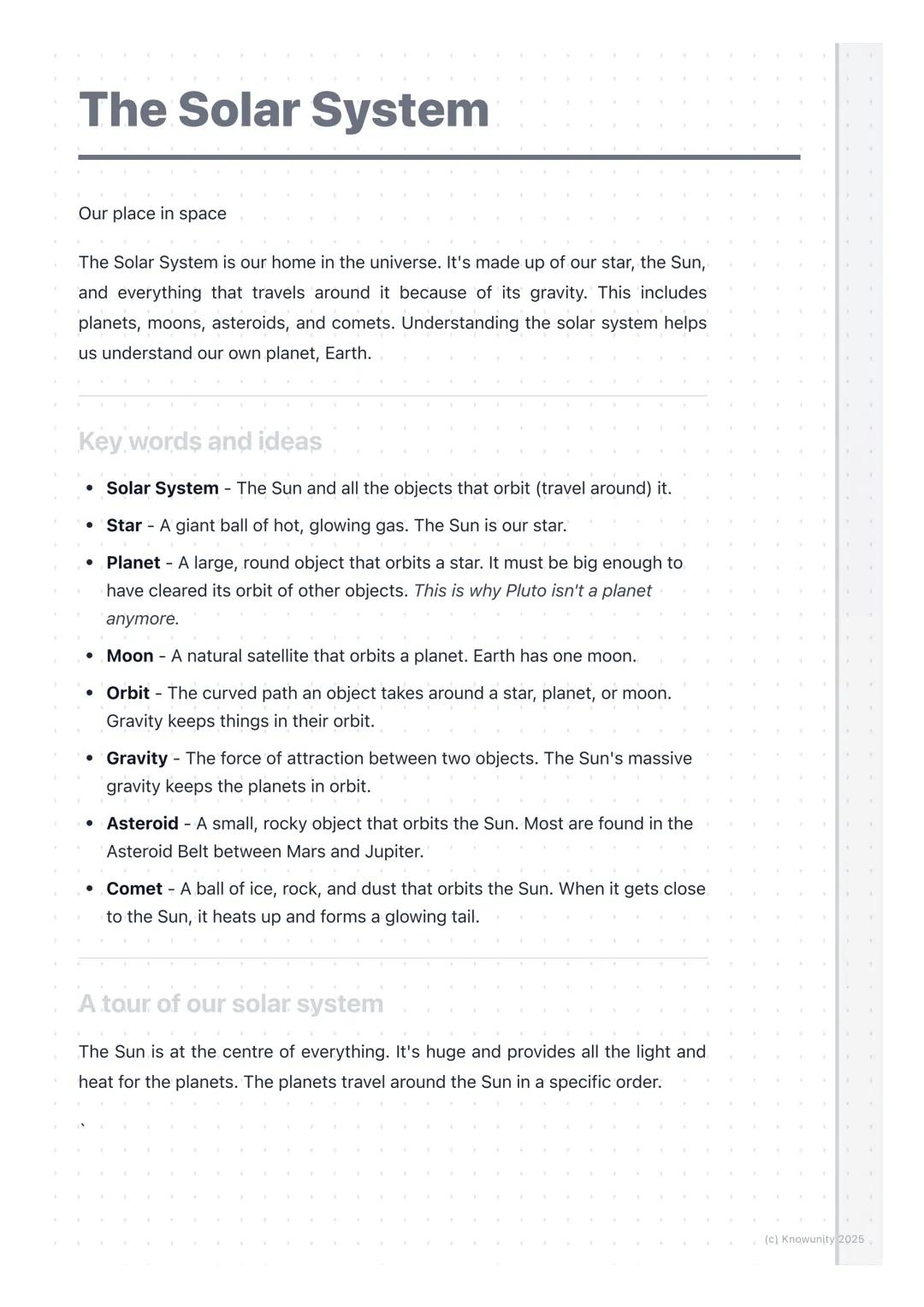
Our Place in Space
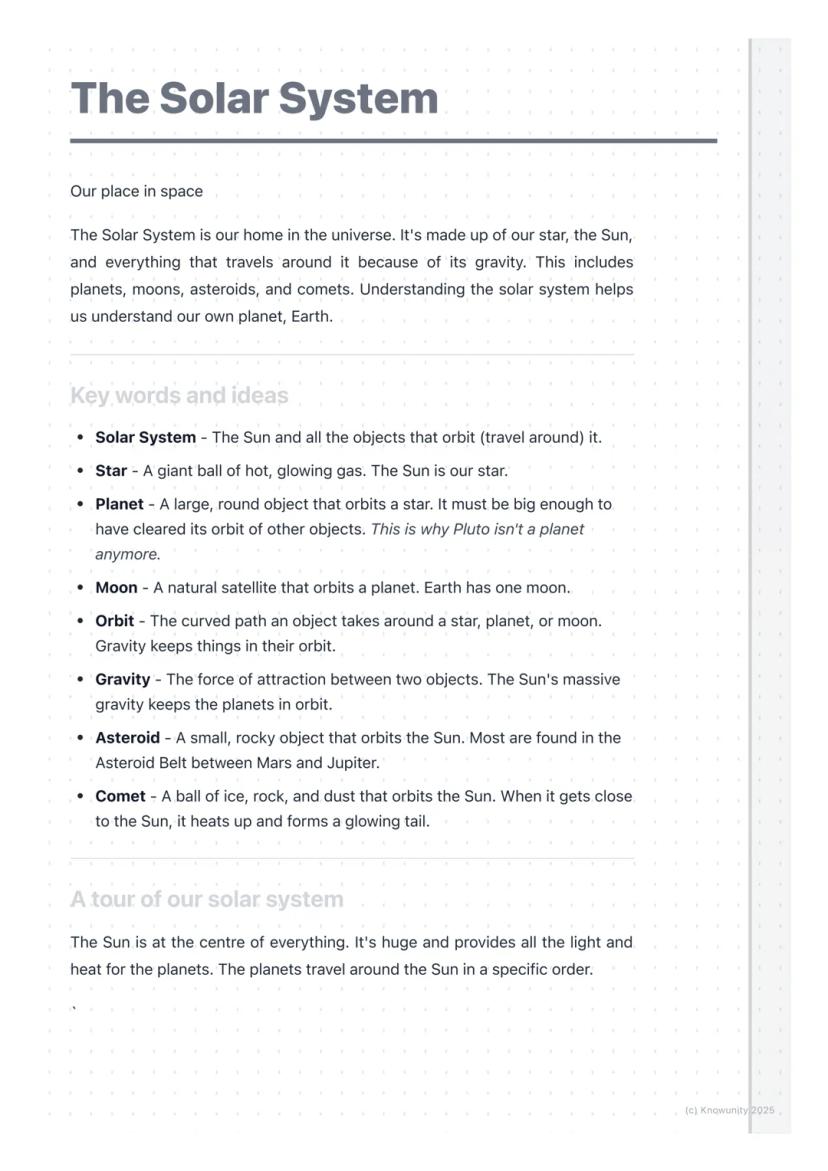
You're living on a planet that's part of something massive called the Solar System. Think of it as our cosmic address - we've got the Sun at the centre, acting like a giant magnet that keeps everything spinning around it.
The Sun isn't just a big yellow circle in the sky - it's actually a star, which means it's a huge ball of incredibly hot, glowing gas. Without it, we'd have no light, no heat, and definitely no life on Earth. Everything else in our solar system exists because of the Sun's powerful gravity.
Gravity is basically the invisible force that keeps you stuck to the ground and keeps all the planets travelling in their orbits around the Sun. It's like having an invisible rope that never breaks - the bigger the object, the stronger its gravitational pull.
Quick Tip: An orbit is just the curved path that objects take as they travel around something bigger - like how the Moon goes around Earth, or how Earth goes around the Sun!
2
of 5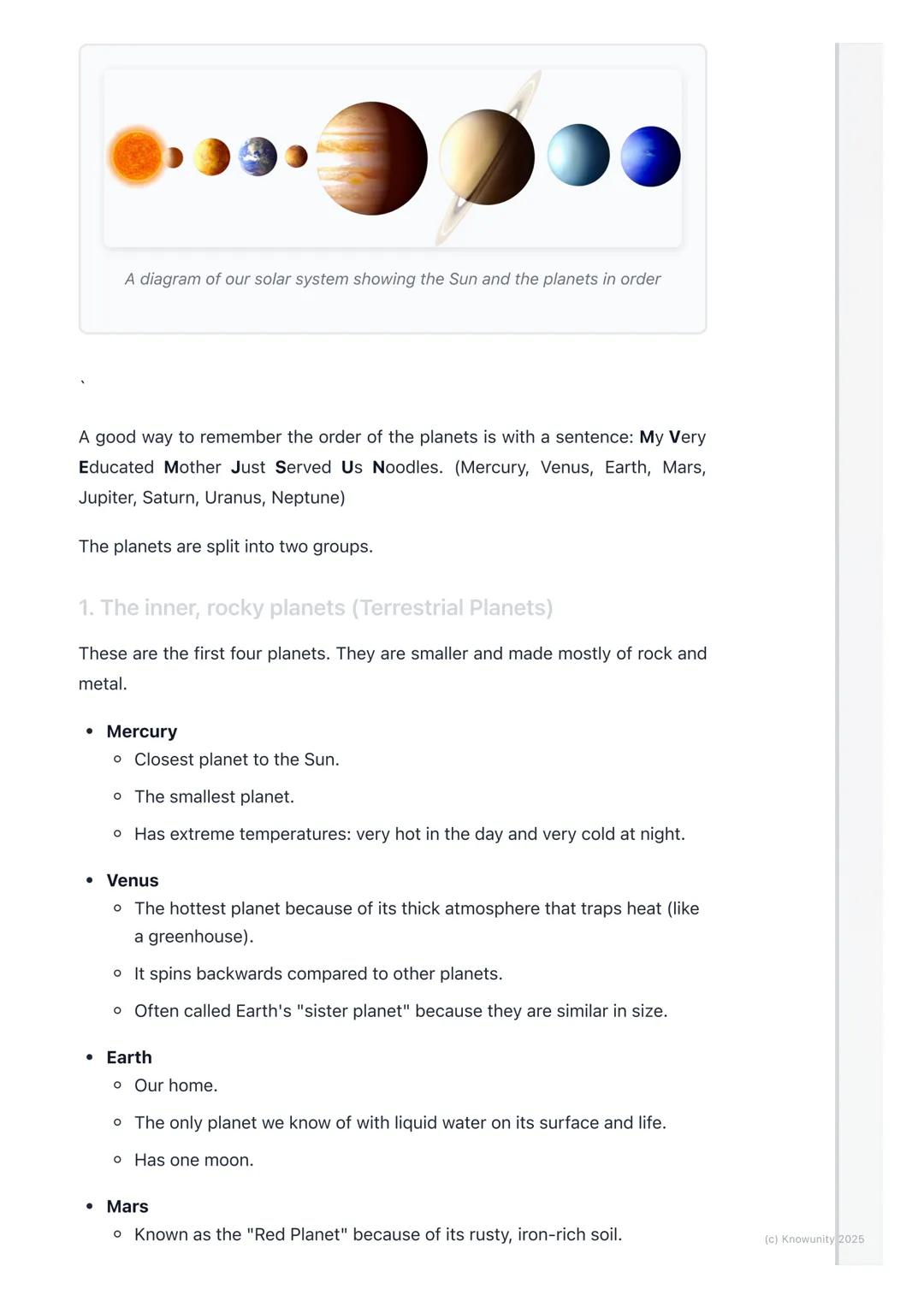
The Inner Rocky Planets
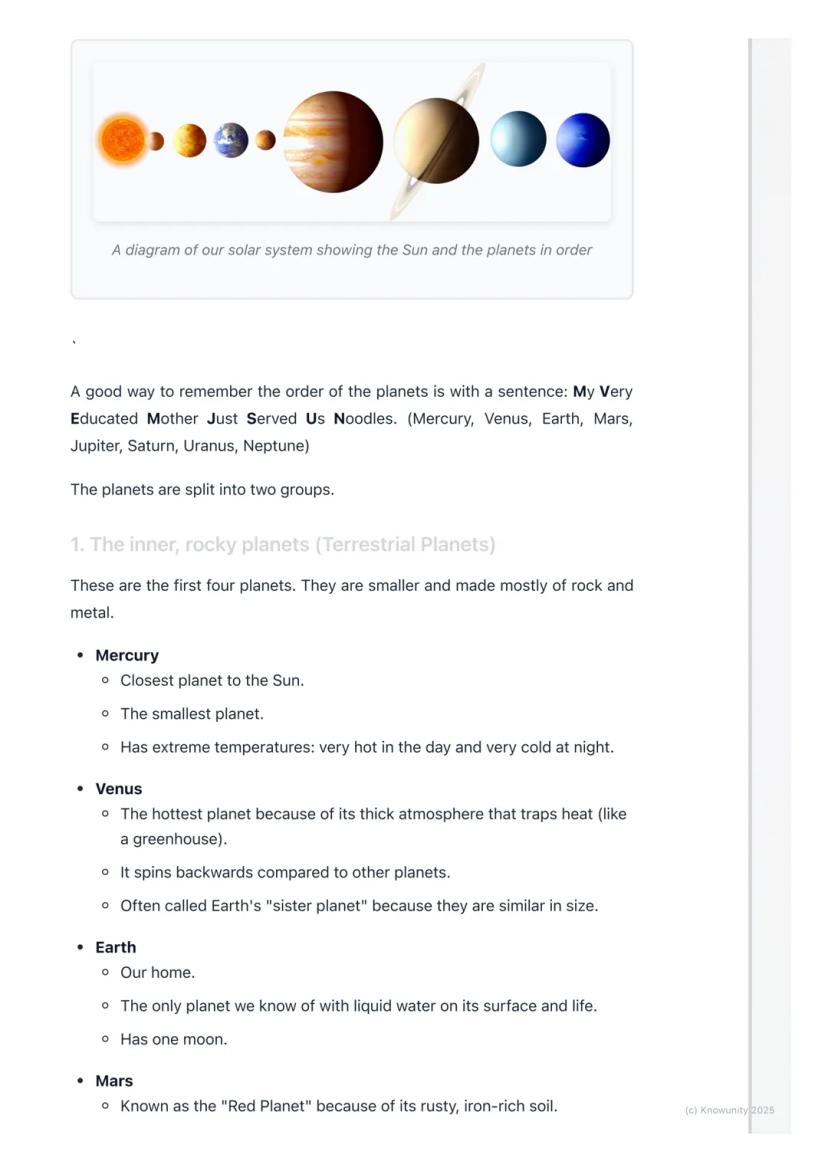
The first four planets from the Sun are called the terrestrial planets, and they're all made mostly of rock and metal. Here's a handy way to remember the order: "My Very Educated Mother Just Served Us Noodles" (Mercury, Venus, Earth, Mars, Jupiter, Saturn, Uranus, Neptune).
Mercury is the smallest planet and sits closest to the Sun, which means it gets absolutely roasted during the day but freezing cold at night. Venus is Earth's "sister planet" because they're similar in size, but it's actually the hottest planet thanks to its thick atmosphere that traps heat like a greenhouse.
Earth is obviously special - it's the only planet we know of with liquid water on its surface and life. We've got one moon (a natural satellite) that orbits around us. Mars gets called the "Red Planet" because of its rusty, iron-rich soil, and it's got the biggest volcano in the solar system called Olympus Mons.
Between Mars and Jupiter, there's the Asteroid Belt - imagine a massive ring of rocky chunks floating in space. This belt separates the inner rocky planets from the outer giants.
Did You Know: Venus spins backwards compared to all the other planets - scientists think a massive collision might have knocked it the wrong way!
3
of 5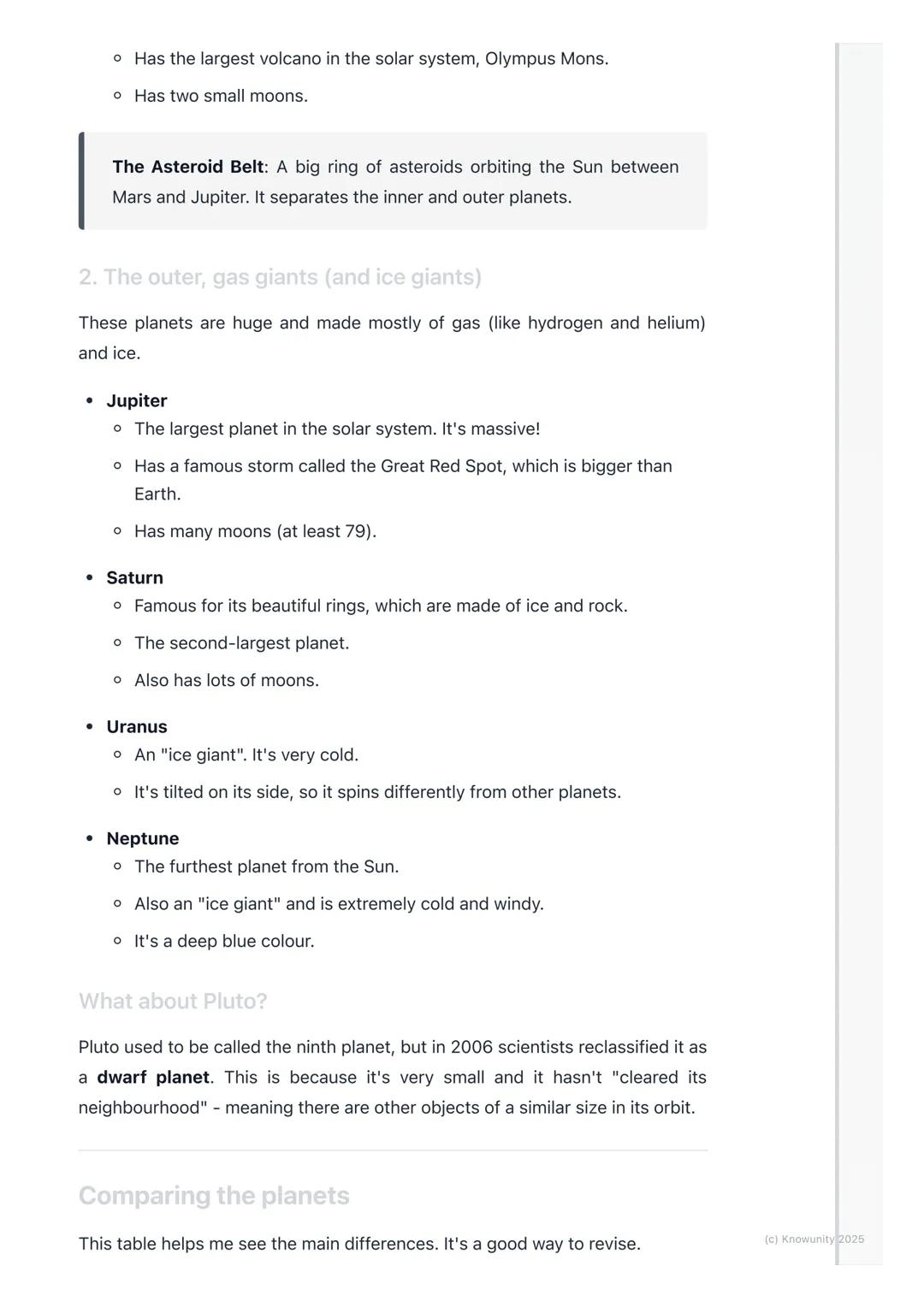
The Outer Giants
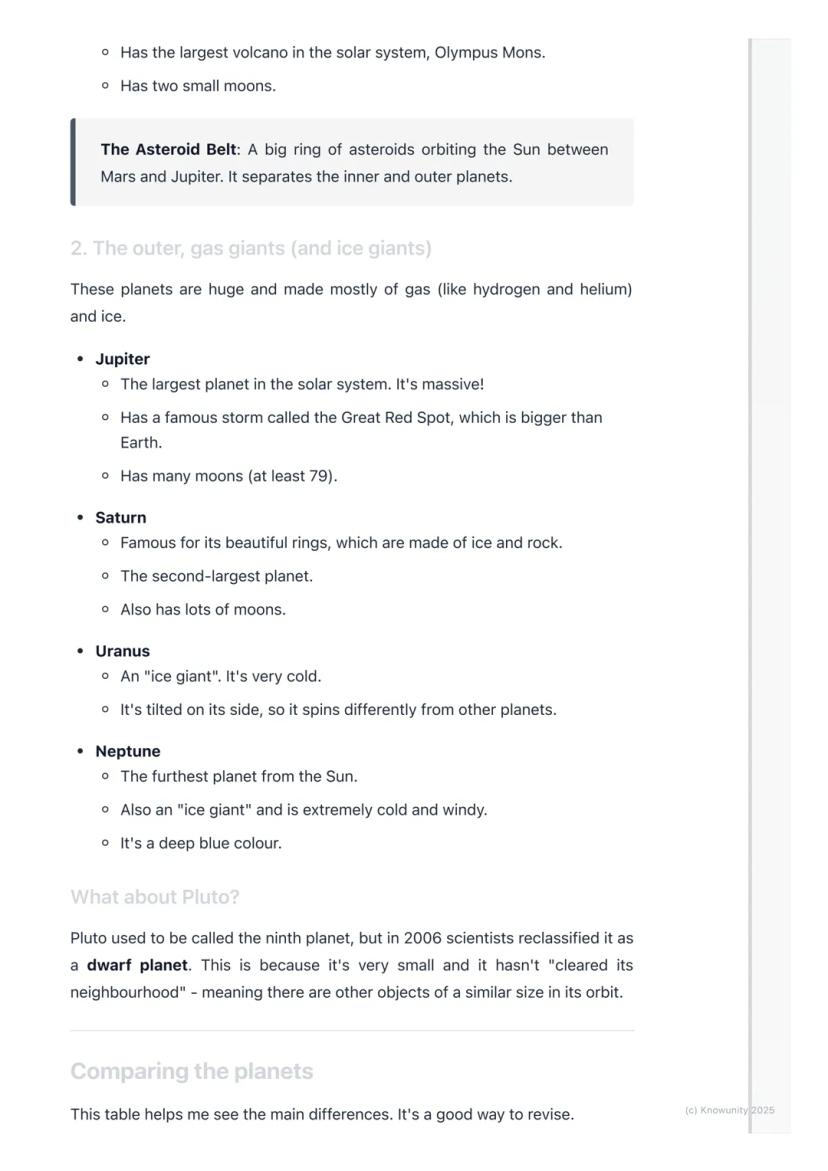
The outer planets are completely different from the inner ones - they're absolutely massive and made mostly of gas and ice rather than solid rock. These gas giants and ice giants are like the heavyweight champions of our solar system.
Jupiter is the absolute unit of planets - it's so massive that all the other planets could fit inside it. It's got this famous storm called the Great Red Spot that's been raging for centuries and is bigger than our entire Earth. Saturn is probably the most recognisable planet thanks to its stunning rings made of ice and rock particles.
Uranus and Neptune are the ice giants - they're incredibly cold and far from the Sun. Uranus is basically lying on its side (probably got knocked over by something massive), whilst Neptune is this beautiful deep blue colour and has some of the strongest winds in the solar system.
What about Pluto? It used to be called the ninth planet, but scientists reclassified it as a dwarf planet in 2006 because it's tiny and hasn't "cleared its neighbourhood" of other objects.
Fun Fact: Saturn's rings are so thin that if you could shrink them down to the size of a piece of paper, they'd be thinner than tissue paper!
4
of 5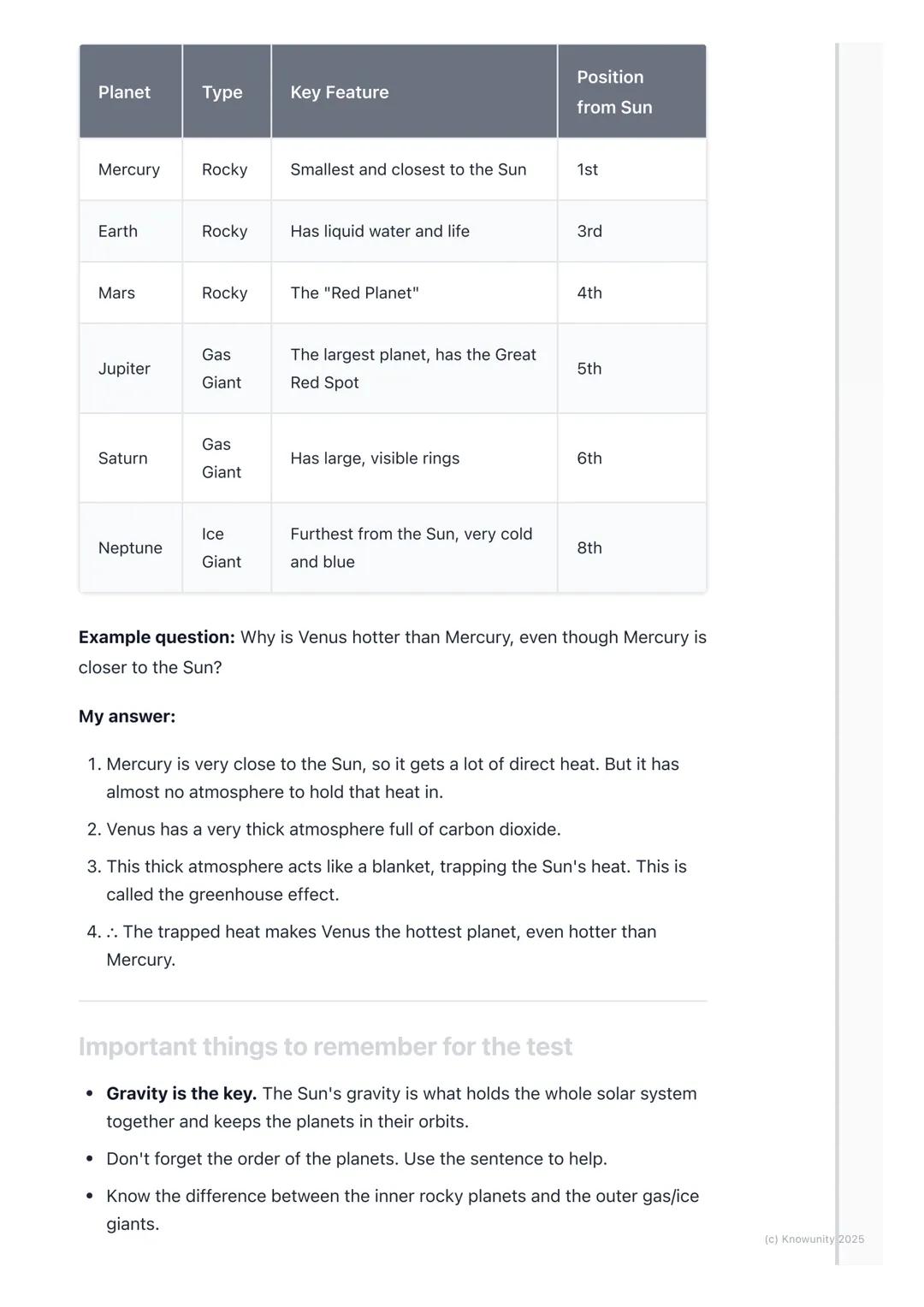
Understanding Planet Differences
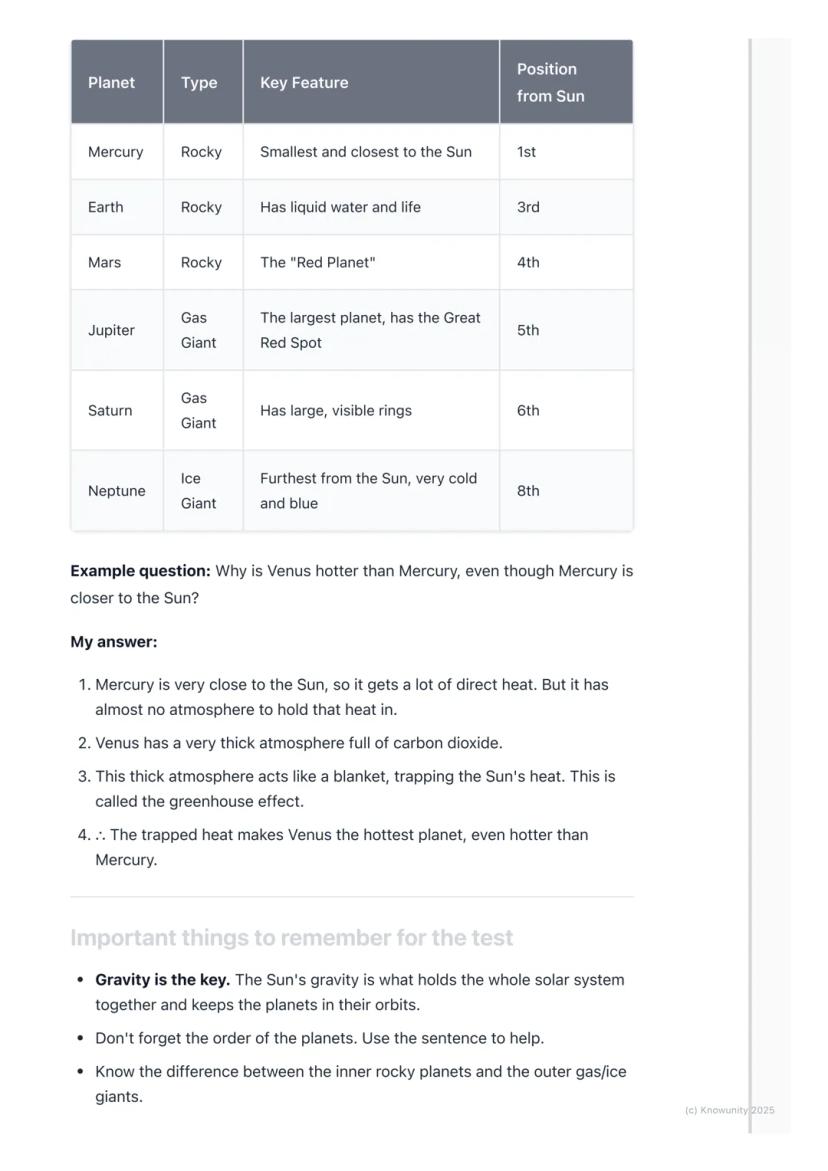
Here's something that might surprise you: Venus is actually hotter than Mercury, even though Mercury is closer to the Sun. This happens because Venus has a super thick atmosphere full of carbon dioxide that acts like a blanket, trapping all the Sun's heat through the greenhouse effect.
The key difference between inner and outer planets comes down to temperature and materials. The inner planets (Mercury, Venus, Earth, Mars) are smaller, rockier, and warmer because they formed closer to the Sun. The outer planets (Jupiter, Saturn, Uranus, Neptune) are massive, gassy or icy, and freezing cold because they're so far away.
Gravity from the Sun is what keeps this whole system working. Without it, all the planets would just float off into space instead of staying in their neat orbits. The Sun is so massive that its gravitational pull reaches all the way out to Neptune and beyond.
Don't mix up rotation and revolution - rotation is when a planet spins on its axis (giving us day and night), whilst revolution is when it orbits around the Sun (giving us a year).
Memory Trick: Think of revolution like a revolving door - the planet is moving around something else (the Sun), whilst rotation is like spinning on the spot!
5
of 5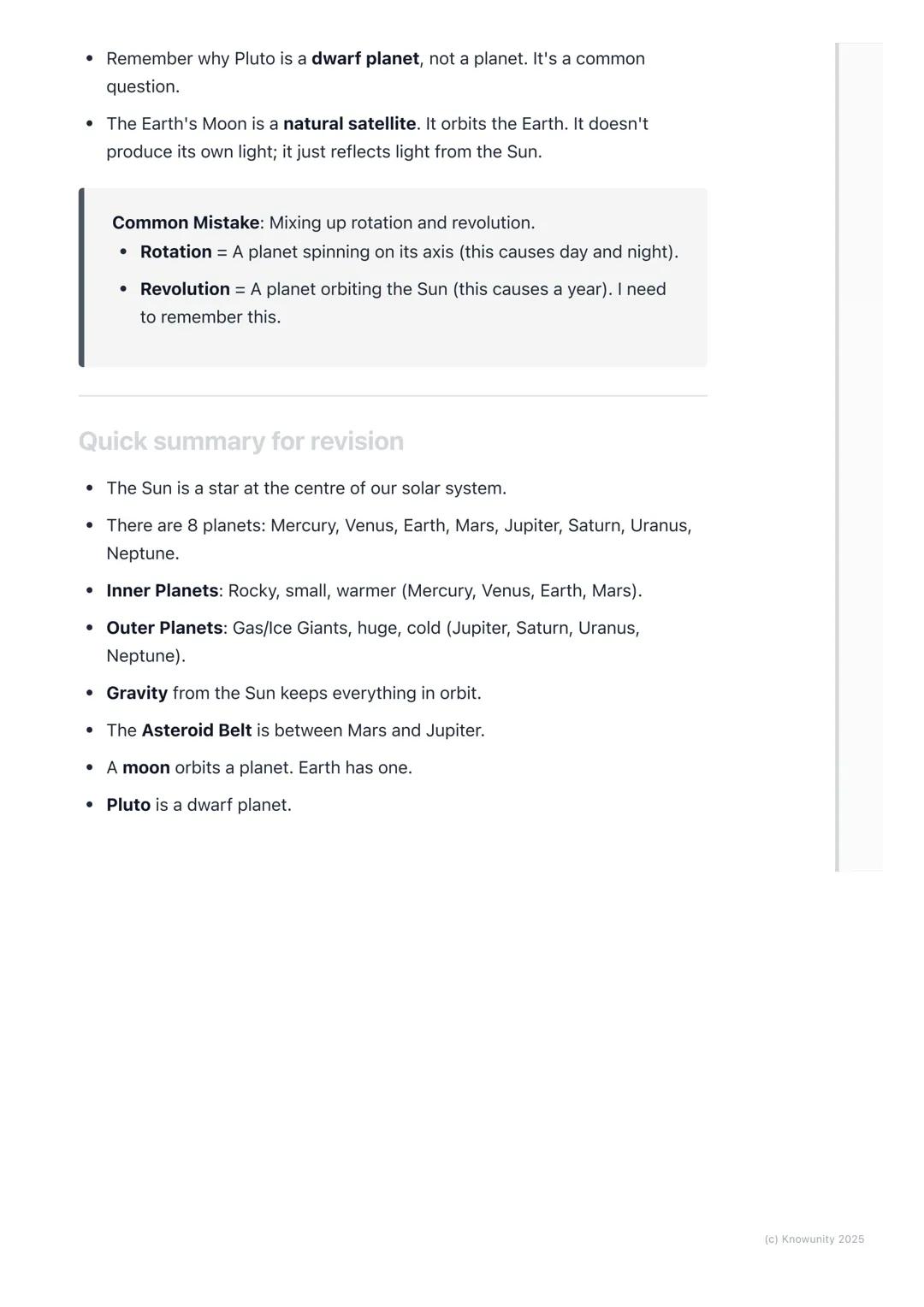
Quick Revision Summary
You've now got the complete picture of our Solar System - from tiny Mercury right out to distant Neptune. The Sun sits at the centre as our local star, keeping eight planets in perfect orbits through its massive gravity.
Remember the two main groups: the inner rocky planets (Mercury, Venus, Earth, Mars) that are smaller and warmer, and the outer gas giants and ice giants (Jupiter, Saturn, Uranus, Neptune) that are massive and freezing. The Asteroid Belt sits between these two groups like a cosmic dividing line.
Earth's Moon is our natural satellite - it doesn't make its own light but reflects sunlight back to us. Pluto is now classified as a dwarf planet because it's too small and hasn't cleared other objects from its orbital path.
The most important thing to remember is that gravity holds everything together. Without the Sun's gravitational pull, none of this cosmic dance would work, and we wouldn't be here to study it.
Test Tip: Questions about why Venus is hotter than Mercury despite being further from the Sun are really common - it's all about that thick atmosphere creating a greenhouse effect!
We dachten al dat je dit zou vragen...
Wat is de Knowunity AI companion?
Onze AI Companion is een studentgerichte AI-tool die meer biedt dan alleen antwoorden. Gebouwd op miljoenen Knowunity bronnen, biedt het relevante informatie, gepersonaliseerde studieplannen, quizzes en inhoud direct in de chat, aangepast aan jouw individuele leertraject.
Waar kan ik de Knowunity-app downloaden?
Je kunt de app downloaden via Google Play Store en Apple App Store.
Is Knowunity echt gratis?
Dat klopt! Geniet van gratis toegang tot leerinhoud, maak contact met medestudenten en krijg directe hulp – alles binnen handbereik.
Populairste studiemateriaal voor Science
7ScienceScience/Physics notes - Speed, density, work
Speed density work formulas
3rd Year81
ScienceAtomic Structure and the Periodic Table
Students will learn about the structure of atoms, including protons, neutrons, and electrons, and how elements are organised and classified in the Periodic Table based on their electronic configuration and chemical properties.
5th Year41
ScienceHuman Body Systems
An introduction to major human body systems such as the digestive, circulatory, respiratory, and nervous systems, understanding their basic functions.
2nd Year131
ScienceJunior Cert Science Notes: The Cell
Notes on the Cell
3rd Year261
ScienceCells
Junior cert science cells summary
1st Year611
ScienceHuman Reproductive System
A basic overview of the male and female reproductive systems, including their main structures and functions.
TY191
ScienceLight and Optics
Exploring the properties of light, including how it travels, reflects, and refracts, and how we perceive colours.
2nd Year50
Populairste studiemateriaal
9 Irish
IrishIrish oral questions and answers
Questions and answers for the leaving cert oral
5th Year4264
 English
Key Quotes : Sive
Key Quotes and explanations: Sive
6th Year2842
IrishIrish oral questions
Outline of oral questions
5th Year2055
IrishIníon- le hÁine Durkin
Aine Durkin’s poem, Iníon: Themes & summary
5th Year850
IrishIrish poetry 2027
Iníon + Dínit an Bhróin
5th Year1133
IrishLC HL notes- Iníon (poem)
Includes poem in English and Irish, theme, key words & phrases
5th Year2284
EnglishCultural Context : Shawshank Redemption : Sive : Small Things Like These
Comparative Study : Cultural Context : Shawshank Redemption, Sive and Small Things Like These
6th Year1430
IrishMo Ghrá-sa (Idir Lúibíní)
Notes on mo ghrá-sa
5th Year380
IrishAn Gaeilge Aiste
Irish Language essay
6th Year1320
Kan je niet vinden wat je zoekt? Ontdek andere vakken.
Studenten zijn dol op ons — en jij ook.
4.6/5App Store
4.7/5Google Play
De app is heel makkelijk te gebruiken en goed ontworpen. Ik heb tot nu toe alles kunnen vinden waar ik naar zocht en heb veel kunnen leren van de presentaties! Ik ga de app zeker gebruiken voor een schoolopdracht! En natuurlijk helpt het ook veel als inspiratie.
Stefan SiOS gebruiker
Deze app is echt geweldig. Er zijn zoveel aantekeningen en hulpmiddelen [...]. Mijn probleemvak is bijvoorbeeld Frans, en de app heeft zoveel opties voor hulp. Dankzij deze app ben ik beter geworden in Frans. Ik zou het iedereen aanraden.
Samantha KlichAndroid gebruiker
Wow, ik ben echt onder de indruk. Ik probeerde de app gewoon omdat ik hem vaak geadverteerd had gezien en was absoluut verbaasd. Deze app is DE HULP die je wilt voor school en bovenal biedt hij zoveel dingen, zoals oefeningen en factsheets, die mij persoonlijk HEEL erg hebben geholpen.
AnnaiOS gebruiker
Science8 weergaven·Bijgewerkt Jun 17, 2026·5 pagina'sExploring the Wonders of Our Solar System
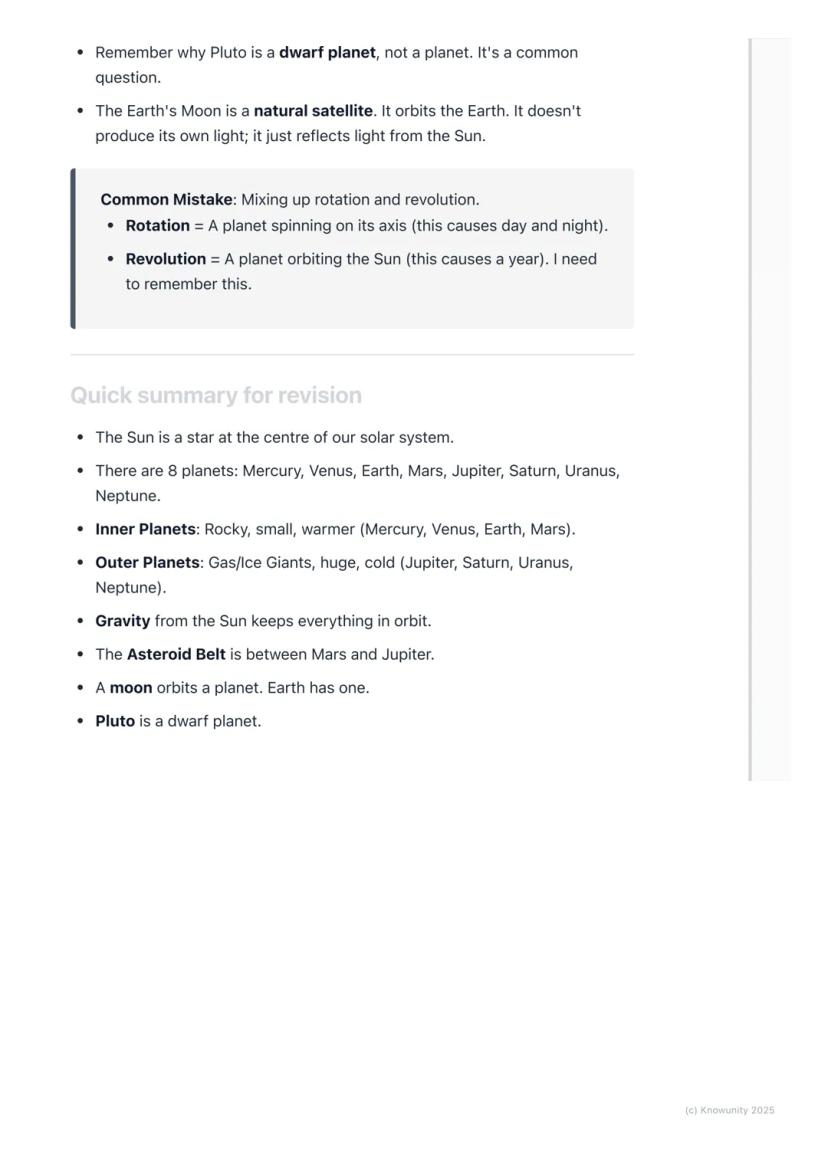
Ever wondered what's floating around out there in space? The Solar System is basically our cosmic neighbourhood - it's the Sun and everything that travels around it because of gravity. Understanding how our solar system works helps you make sense...
1
of 5
Meld je aan om de inhoud te zien. Het is gratis!
- Toegang tot alle documenten
- Verbeter je cijfers
- Sluit je aan bij miljoenen studenten
Our Place in Space
You're living on a planet that's part of something massive called the Solar System. Think of it as our cosmic address - we've got the Sun at the centre, acting like a giant magnet that keeps everything spinning around it.
The Sun isn't just a big yellow circle in the sky - it's actually a star, which means it's a huge ball of incredibly hot, glowing gas. Without it, we'd have no light, no heat, and definitely no life on Earth. Everything else in our solar system exists because of the Sun's powerful gravity.
Gravity is basically the invisible force that keeps you stuck to the ground and keeps all the planets travelling in their orbits around the Sun. It's like having an invisible rope that never breaks - the bigger the object, the stronger its gravitational pull.
Quick Tip: An orbit is just the curved path that objects take as they travel around something bigger - like how the Moon goes around Earth, or how Earth goes around the Sun!
2
of 5Meld je aan om de inhoud te zien. Het is gratis!
- Toegang tot alle documenten
- Verbeter je cijfers
- Sluit je aan bij miljoenen studenten
The Inner Rocky Planets
The first four planets from the Sun are called the terrestrial planets, and they're all made mostly of rock and metal. Here's a handy way to remember the order: "My Very Educated Mother Just Served Us Noodles" (Mercury, Venus, Earth, Mars, Jupiter, Saturn, Uranus, Neptune).
Mercury is the smallest planet and sits closest to the Sun, which means it gets absolutely roasted during the day but freezing cold at night. Venus is Earth's "sister planet" because they're similar in size, but it's actually the hottest planet thanks to its thick atmosphere that traps heat like a greenhouse.
Earth is obviously special - it's the only planet we know of with liquid water on its surface and life. We've got one moon (a natural satellite) that orbits around us. Mars gets called the "Red Planet" because of its rusty, iron-rich soil, and it's got the biggest volcano in the solar system called Olympus Mons.
Between Mars and Jupiter, there's the Asteroid Belt - imagine a massive ring of rocky chunks floating in space. This belt separates the inner rocky planets from the outer giants.
Did You Know: Venus spins backwards compared to all the other planets - scientists think a massive collision might have knocked it the wrong way!
3
of 5Meld je aan om de inhoud te zien. Het is gratis!
- Toegang tot alle documenten
- Verbeter je cijfers
- Sluit je aan bij miljoenen studenten
The Outer Giants
The outer planets are completely different from the inner ones - they're absolutely massive and made mostly of gas and ice rather than solid rock. These gas giants and ice giants are like the heavyweight champions of our solar system.
Jupiter is the absolute unit of planets - it's so massive that all the other planets could fit inside it. It's got this famous storm called the Great Red Spot that's been raging for centuries and is bigger than our entire Earth. Saturn is probably the most recognisable planet thanks to its stunning rings made of ice and rock particles.
Uranus and Neptune are the ice giants - they're incredibly cold and far from the Sun. Uranus is basically lying on its side (probably got knocked over by something massive), whilst Neptune is this beautiful deep blue colour and has some of the strongest winds in the solar system.
What about Pluto? It used to be called the ninth planet, but scientists reclassified it as a dwarf planet in 2006 because it's tiny and hasn't "cleared its neighbourhood" of other objects.
Fun Fact: Saturn's rings are so thin that if you could shrink them down to the size of a piece of paper, they'd be thinner than tissue paper!
4
of 5Meld je aan om de inhoud te zien. Het is gratis!
- Toegang tot alle documenten
- Verbeter je cijfers
- Sluit je aan bij miljoenen studenten
Understanding Planet Differences
Here's something that might surprise you: Venus is actually hotter than Mercury, even though Mercury is closer to the Sun. This happens because Venus has a super thick atmosphere full of carbon dioxide that acts like a blanket, trapping all the Sun's heat through the greenhouse effect.
The key difference between inner and outer planets comes down to temperature and materials. The inner planets (Mercury, Venus, Earth, Mars) are smaller, rockier, and warmer because they formed closer to the Sun. The outer planets (Jupiter, Saturn, Uranus, Neptune) are massive, gassy or icy, and freezing cold because they're so far away.
Gravity from the Sun is what keeps this whole system working. Without it, all the planets would just float off into space instead of staying in their neat orbits. The Sun is so massive that its gravitational pull reaches all the way out to Neptune and beyond.
Don't mix up rotation and revolution - rotation is when a planet spins on its axis (giving us day and night), whilst revolution is when it orbits around the Sun (giving us a year).
Memory Trick: Think of revolution like a revolving door - the planet is moving around something else (the Sun), whilst rotation is like spinning on the spot!
5
of 5Meld je aan om de inhoud te zien. Het is gratis!
- Toegang tot alle documenten
- Verbeter je cijfers
- Sluit je aan bij miljoenen studenten
Quick Revision Summary
You've now got the complete picture of our Solar System - from tiny Mercury right out to distant Neptune. The Sun sits at the centre as our local star, keeping eight planets in perfect orbits through its massive gravity.
Remember the two main groups: the inner rocky planets (Mercury, Venus, Earth, Mars) that are smaller and warmer, and the outer gas giants and ice giants (Jupiter, Saturn, Uranus, Neptune) that are massive and freezing. The Asteroid Belt sits between these two groups like a cosmic dividing line.
Earth's Moon is our natural satellite - it doesn't make its own light but reflects sunlight back to us. Pluto is now classified as a dwarf planet because it's too small and hasn't cleared other objects from its orbital path.
The most important thing to remember is that gravity holds everything together. Without the Sun's gravitational pull, none of this cosmic dance would work, and we wouldn't be here to study it.
Test Tip: Questions about why Venus is hotter than Mercury despite being further from the Sun are really common - it's all about that thick atmosphere creating a greenhouse effect!
We dachten al dat je dit zou vragen...
Wat is de Knowunity AI companion?
Onze AI Companion is een studentgerichte AI-tool die meer biedt dan alleen antwoorden. Gebouwd op miljoenen Knowunity bronnen, biedt het relevante informatie, gepersonaliseerde studieplannen, quizzes en inhoud direct in de chat, aangepast aan jouw individuele leertraject.
Waar kan ik de Knowunity-app downloaden?
Je kunt de app downloaden via Google Play Store en Apple App Store.
Is Knowunity echt gratis?
Dat klopt! Geniet van gratis toegang tot leerinhoud, maak contact met medestudenten en krijg directe hulp – alles binnen handbereik.
Populairste studiemateriaal voor Science
7ScienceScience/Physics notes - Speed, density, work
Speed density work formulas
3rd Year81
ScienceAtomic Structure and the Periodic Table
Students will learn about the structure of atoms, including protons, neutrons, and electrons, and how elements are organised and classified in the Periodic Table based on their electronic configuration and chemical properties.
5th Year41
ScienceHuman Body Systems
An introduction to major human body systems such as the digestive, circulatory, respiratory, and nervous systems, understanding their basic functions.
2nd Year131
ScienceJunior Cert Science Notes: The Cell
Notes on the Cell
3rd Year261
ScienceCells
Junior cert science cells summary
1st Year611
ScienceHuman Reproductive System
A basic overview of the male and female reproductive systems, including their main structures and functions.
TY191
ScienceLight and Optics
Exploring the properties of light, including how it travels, reflects, and refracts, and how we perceive colours.
2nd Year50
Populairste studiemateriaal
9IrishIrish oral questions and answers
Questions and answers for the leaving cert oral
5th Year4264
EnglishKey Quotes : Sive
Key Quotes and explanations: Sive
6th Year2842
IrishIrish oral questions
Outline of oral questions
5th Year2055
IrishIníon- le hÁine Durkin
Aine Durkin’s poem, Iníon: Themes & summary
5th Year850
IrishIrish poetry 2027
Iníon + Dínit an Bhróin
5th Year1133
IrishLC HL notes- Iníon (poem)
Includes poem in English and Irish, theme, key words & phrases
5th Year2284
EnglishCultural Context : Shawshank Redemption : Sive : Small Things Like These
Comparative Study : Cultural Context : Shawshank Redemption, Sive and Small Things Like These
6th Year1430
IrishMo Ghrá-sa (Idir Lúibíní)
Notes on mo ghrá-sa
5th Year380
IrishAn Gaeilge Aiste
Irish Language essay
6th Year1320
Kan je niet vinden wat je zoekt? Ontdek andere vakken.
Studenten zijn dol op ons — en jij ook.
4.6/5App Store
4.7/5Google Play
De app is heel makkelijk te gebruiken en goed ontworpen. Ik heb tot nu toe alles kunnen vinden waar ik naar zocht en heb veel kunnen leren van de presentaties! Ik ga de app zeker gebruiken voor een schoolopdracht! En natuurlijk helpt het ook veel als inspiratie.
Stefan SiOS gebruiker
Deze app is echt geweldig. Er zijn zoveel aantekeningen en hulpmiddelen [...]. Mijn probleemvak is bijvoorbeeld Frans, en de app heeft zoveel opties voor hulp. Dankzij deze app ben ik beter geworden in Frans. Ik zou het iedereen aanraden.
Samantha KlichAndroid gebruiker
Wow, ik ben echt onder de indruk. Ik probeerde de app gewoon omdat ik hem vaak geadverteerd had gezien en was absoluut verbaasd. Deze app is DE HULP die je wilt voor school en bovenal biedt hij zoveel dingen, zoals oefeningen en factsheets, die mij persoonlijk HEEL erg hebben geholpen.
AnnaiOS gebruiker