
Ever wondered why we use letters in maths? Algebraic expressions... Meer weergeven
 Mathematics13 weergaven·Bijgewerkt Jun 8, 2026·5 pagina's
Understanding and Simplifying Algebraic Expressions
1 / 5
1
of 5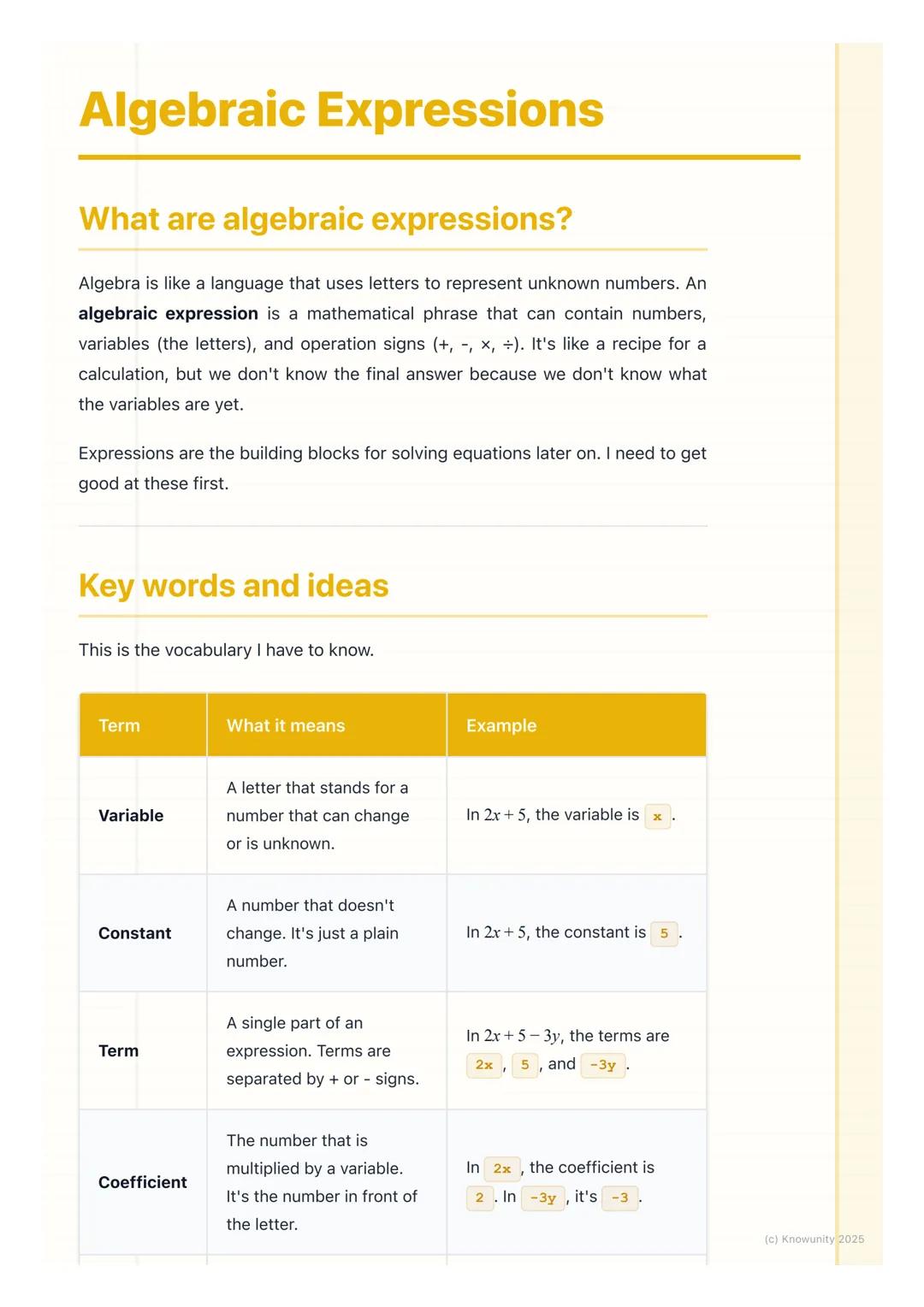
What are Algebraic Expressions?
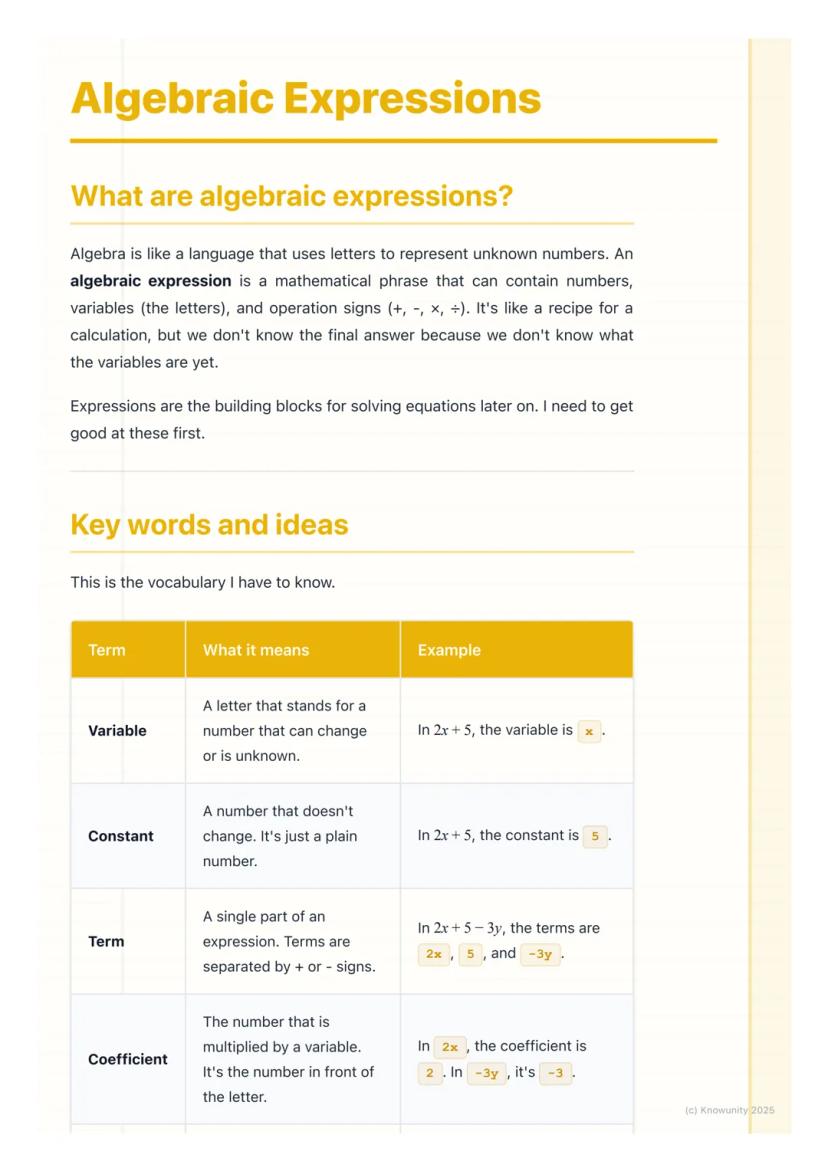
Think of algebraic expressions as mathematical phrases that mix numbers, letters, and operation signs (+, -, ×, ÷). Unlike equations, expressions don't have an equals sign - they're just a collection of mathematical terms waiting to be worked with.
The letters in expressions are called variables, and they represent unknown numbers. A term is each separate part of an expression, like 4x, -5y, or just 8 on its own.
Like terms are terms that have exactly the same variable part, including any powers. For example, 3x and -5x are like terms because they both have just 'x'. However, 3x and 3x² are NOT like terms because one has x and the other has x².
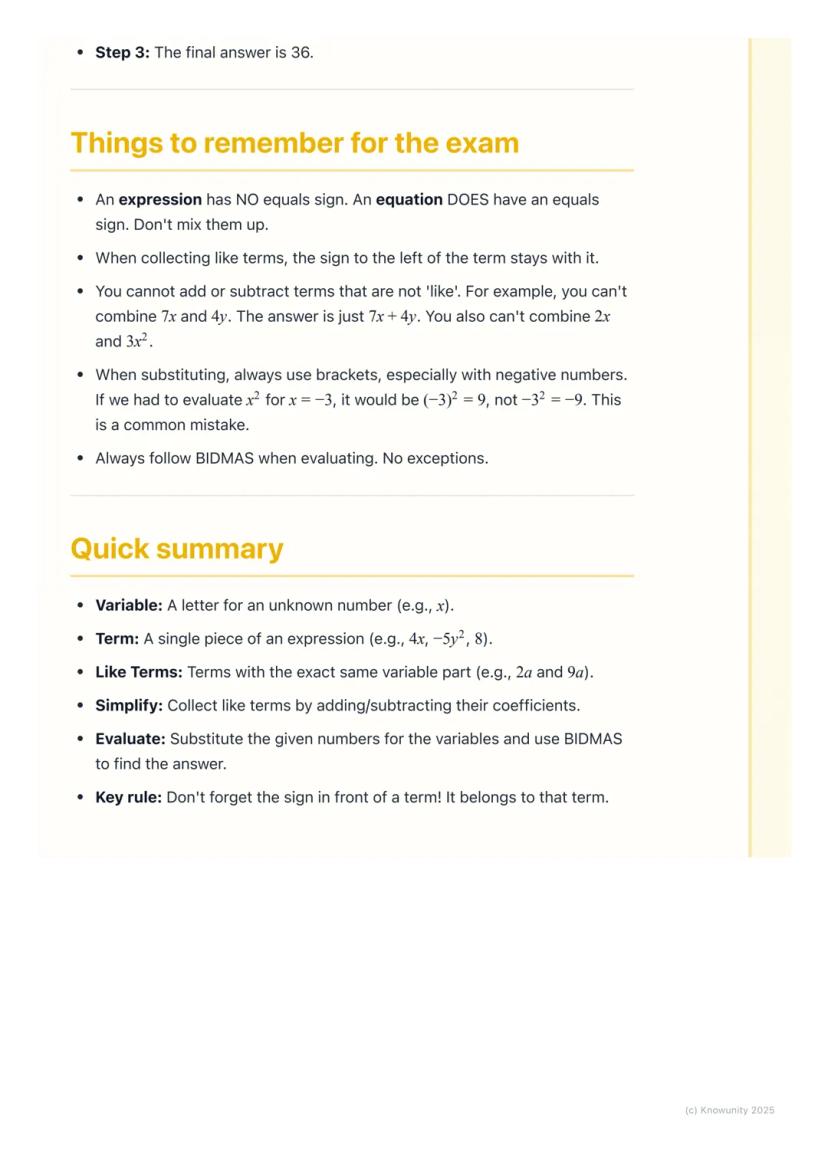
Remember: Expressions are the foundation for solving equations later, so getting comfortable with these basics now will make your life much easier!
2
of 5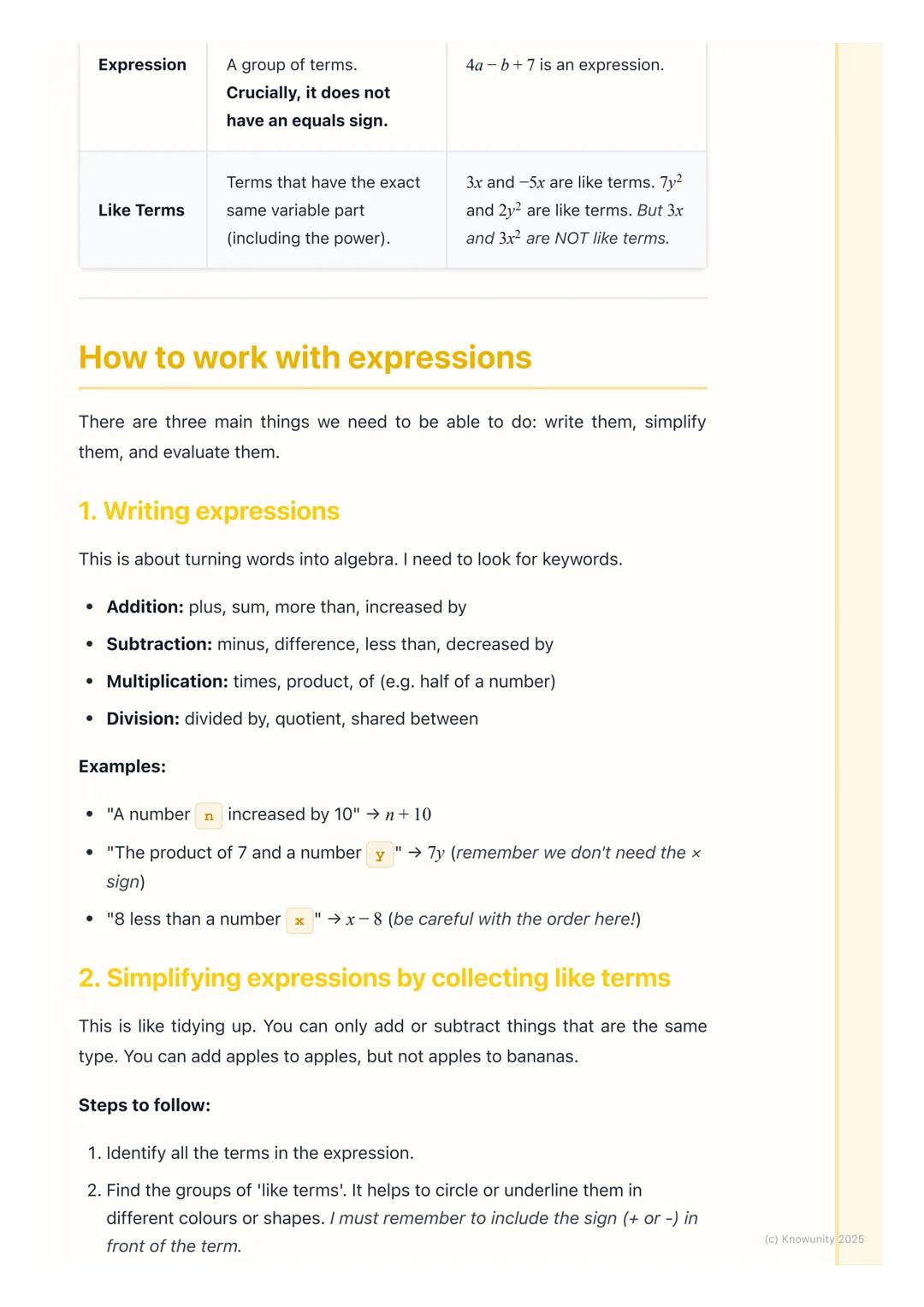
Writing Expressions from Words
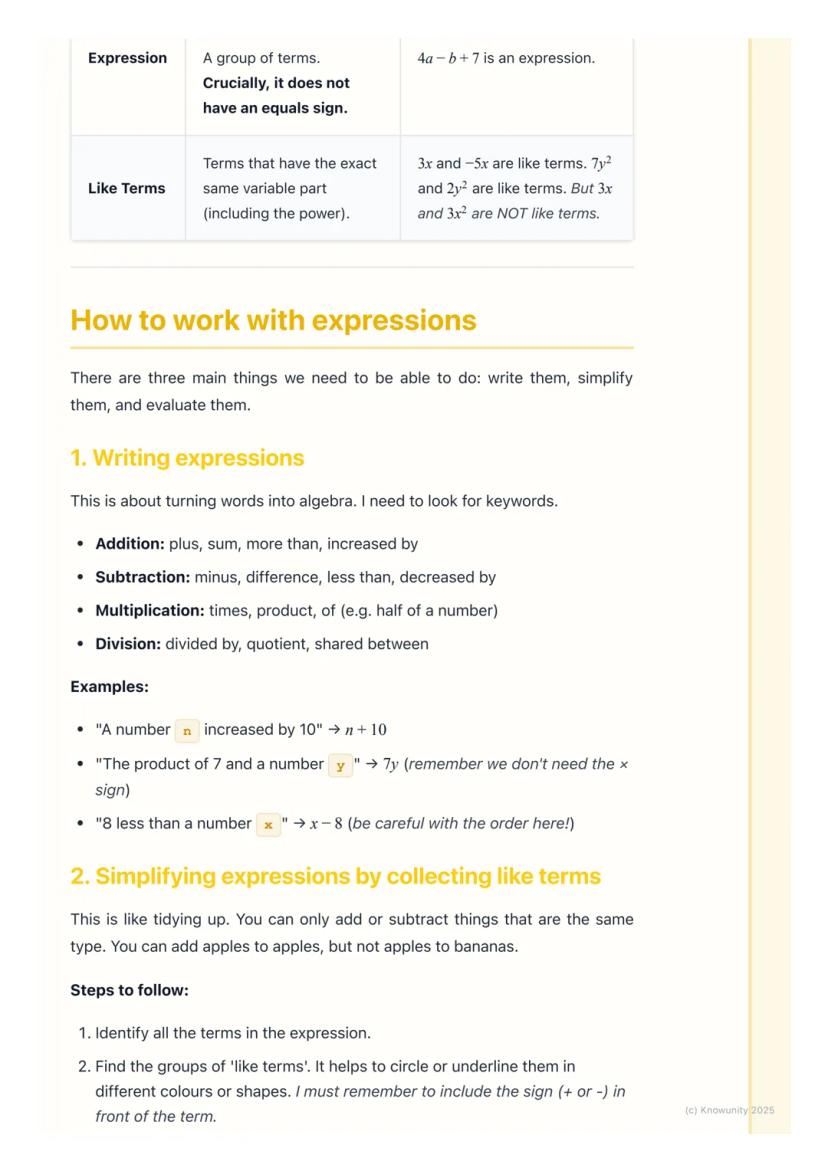
Converting word problems into algebraic expressions is all about spotting the right keywords. Once you know what to look for, it becomes like translating from English to maths.
Addition keywords: plus, sum, more than, increased by
Subtraction keywords: minus, difference, less than, decreased by
Multiplication keywords: times, product, of (like "half of a number")
Division keywords: divided by, quotient, shared between
Watch out for tricky phrases like "8 less than a number x" - this becomes x - 8, not 8 - x. The order matters! "A number n increased by 10" simply becomes n + 10, while "the product of 7 and a number y" becomes 7y (no multiplication sign needed).
Top tip: Always double-check the order, especially with subtraction. "Less than" flips the order around!
3
of 5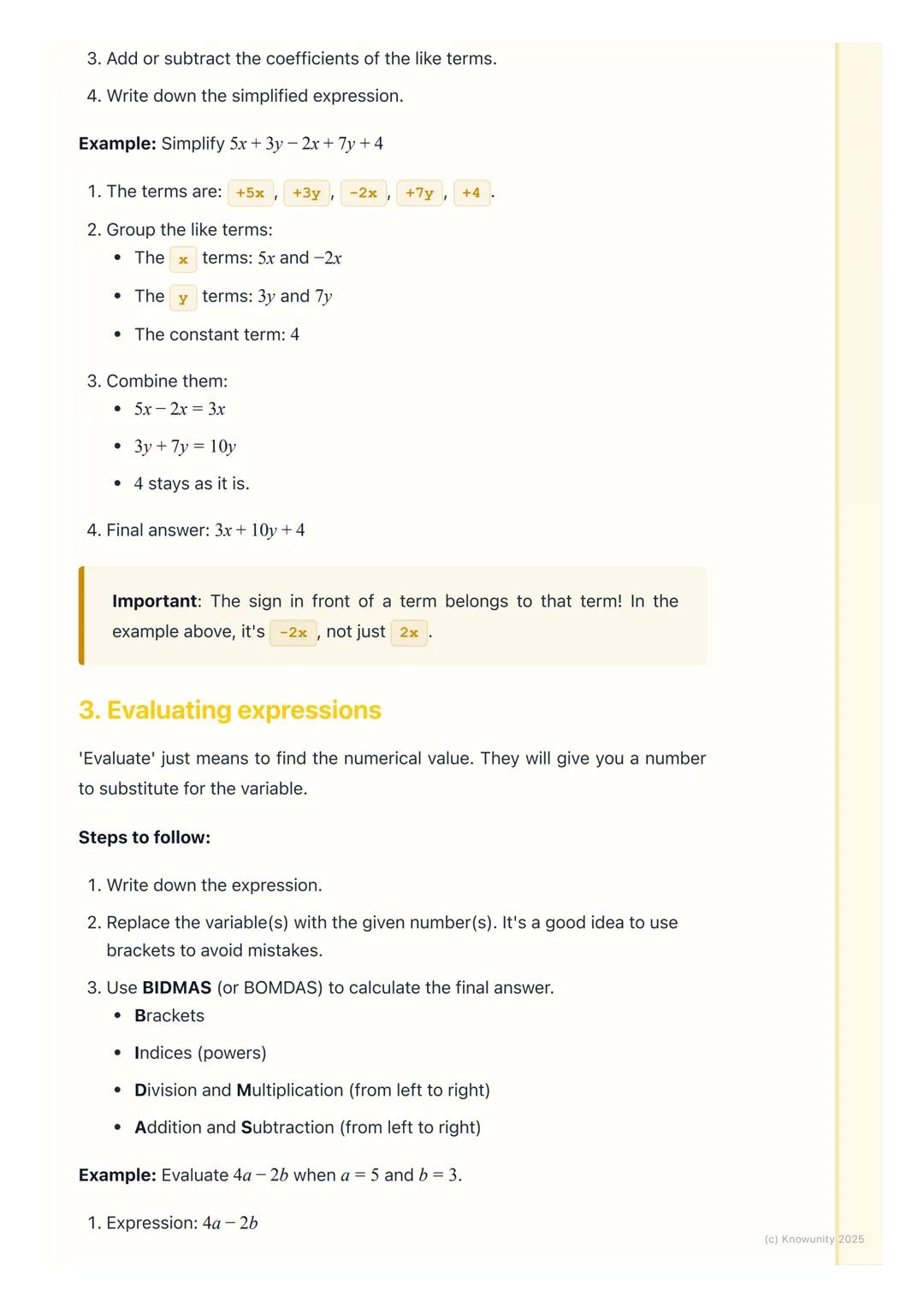
Simplifying by Collecting Like Terms
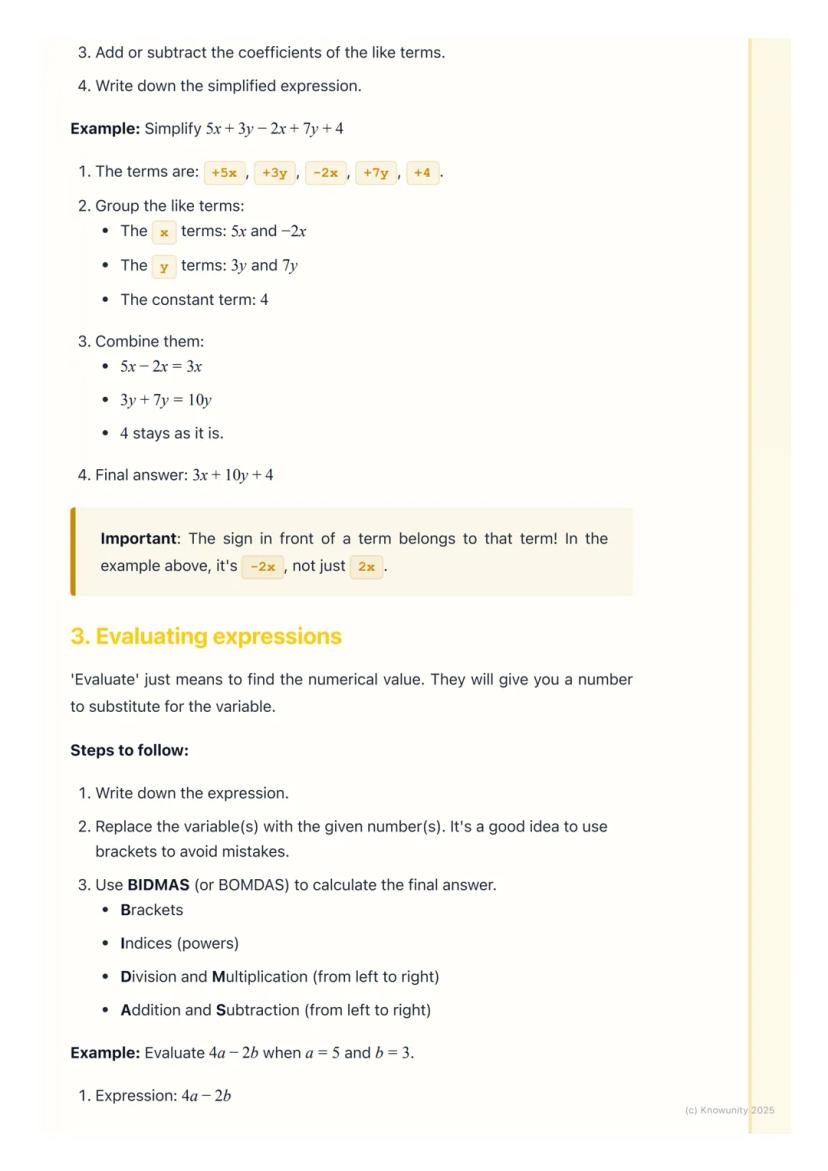
Simplifying expressions is like tidying your room - you group similar things together. You can only combine terms that are exactly the same type, just like you can add apples to apples but not apples to oranges.
Here's your step-by-step process: First, identify all the terms in the expression. Next, find groups of like terms - it helps to circle them in different colours. Remember to include the + or - sign with each term!
Then add or subtract the coefficients (the numbers in front) of like terms. Finally, write your simplified expression.
Let's try: 5x + 3y - 2x + 7y + 4. Group the x terms , the y terms (3y and 7y), and the constant (4). Combine: 5x - 2x = 3x, 3y + 7y = 10y, and 4 stays as is. Your answer: 3x + 10y + 4.
Watch out: The sign in front of a term belongs to that term! So -2x means negative 2x, not positive 2x that you subtract later.
4
of 5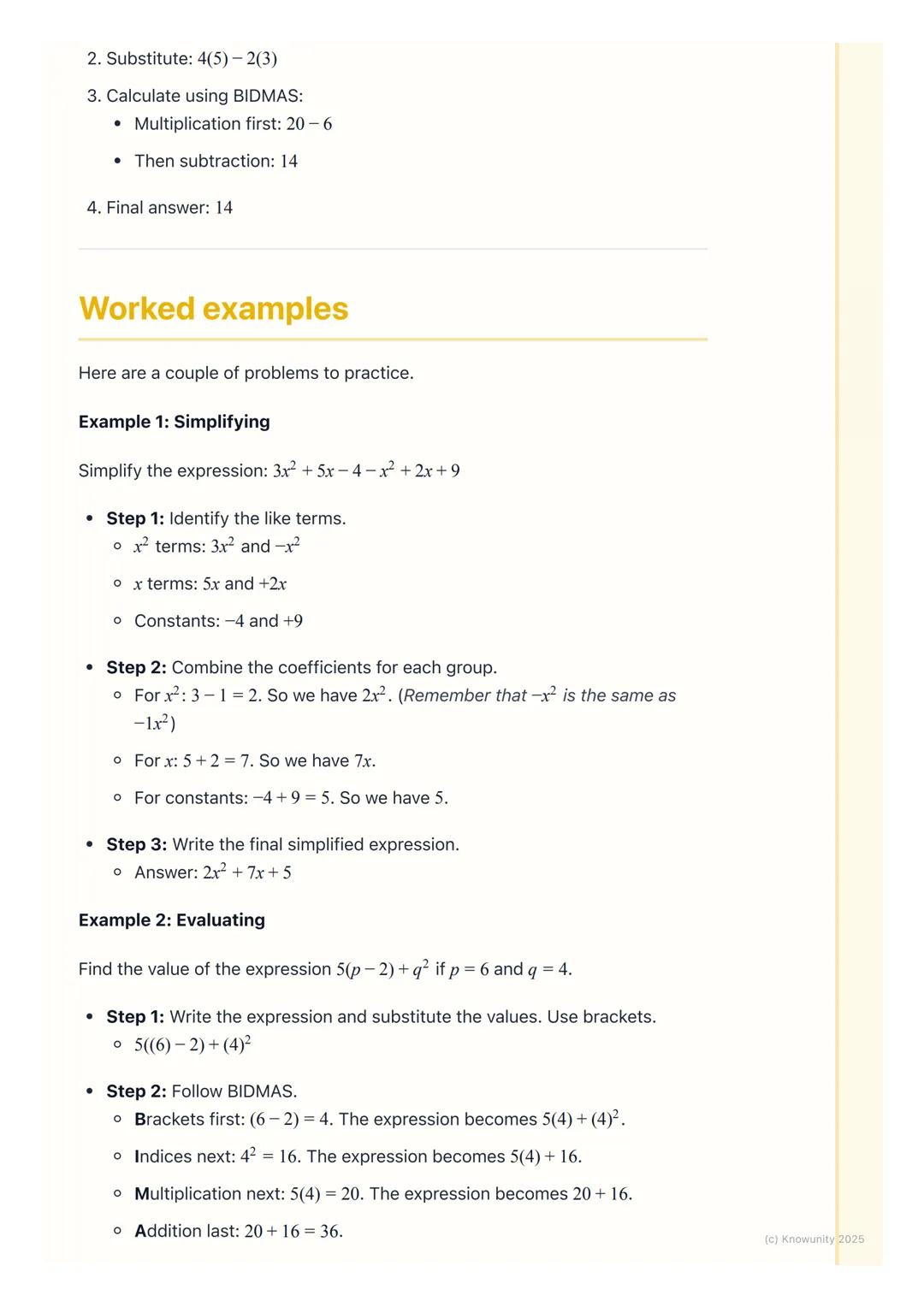
Evaluating Expressions
Evaluating expressions means finding the actual number value when you're given specific values for the variables. It's like following a recipe when you finally know all the ingredients.
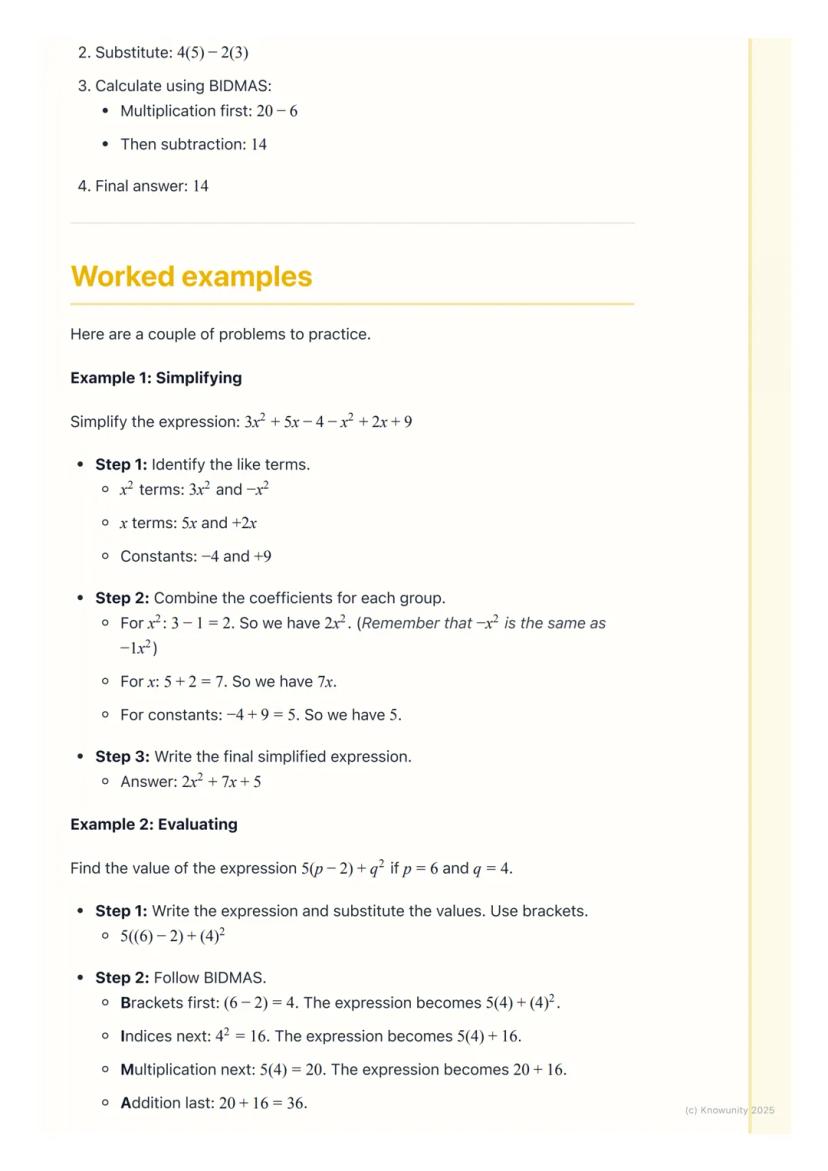
Your method is simple: write the expression, replace each variable with its given number (use brackets to avoid mistakes!), then use BIDMAS to calculate your final answer.
BIDMAS stands for: Brackets, Indices (powers), Division and Multiplication (left to right), Addition and Subtraction (left to right).
Example: Evaluate 4a - 2b when a = 5 and b = 3. Substitute: 4(5) - 2(3). Calculate: 20 - 6 = 14.
Pro tip: Always use brackets when substituting, especially with negative numbers. If x = -3, then x² = (-3)² = 9, not -3² = -9!
5
of 5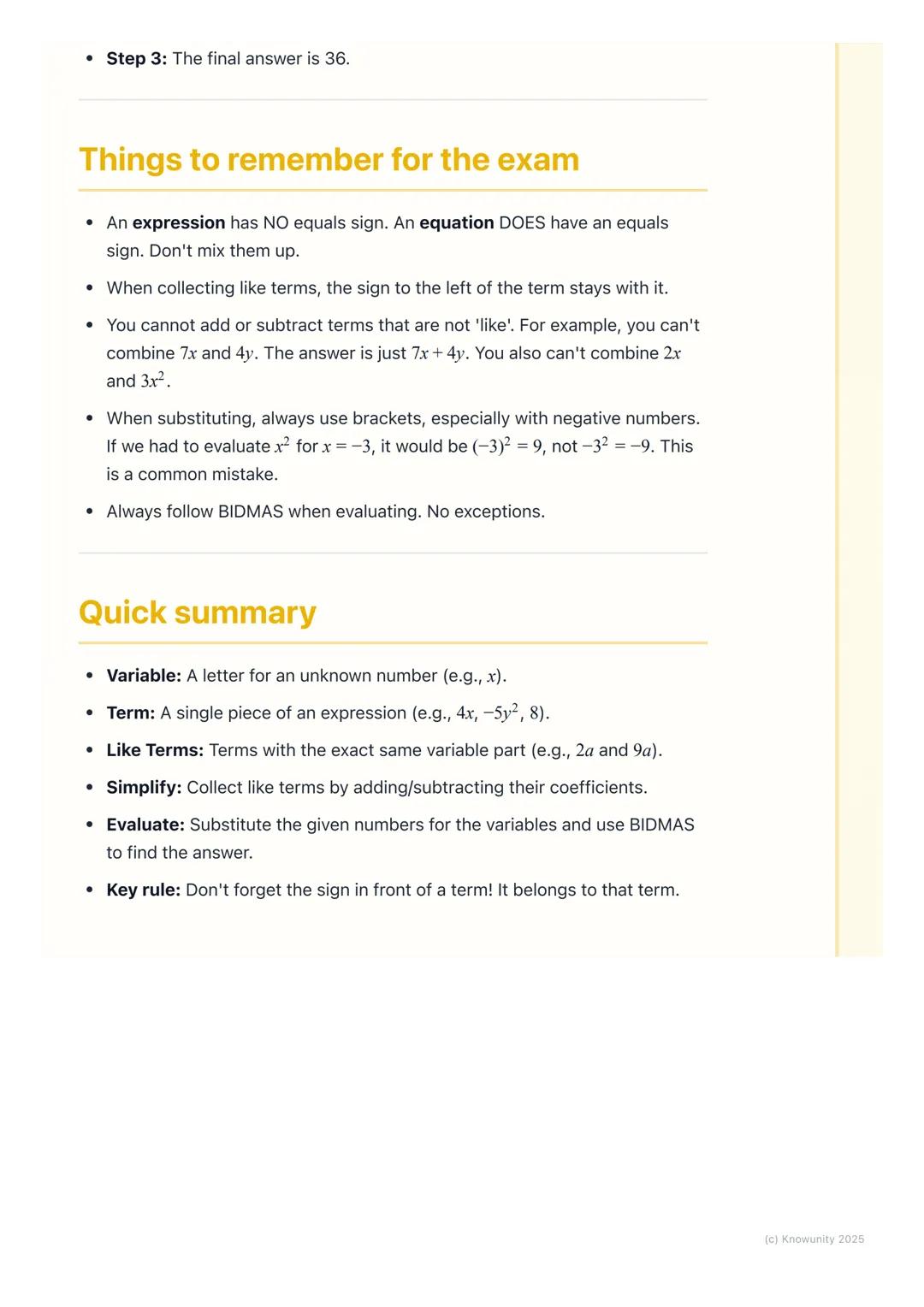
Key Points for Success
The most important thing to remember is that expressions have no equals sign, while equations do. Don't mix them up in exams!
When collecting like terms, that + or - sign stays with its term. You can't combine terms that aren't alike - 7x and 4y stay as 7x + 4y, and 2x and 3x² can't be combined either.
Always use brackets when substituting values, and never skip BIDMAS when evaluating. These simple rules will save you from most common mistakes.
Quick recap: Variables are letters for unknown numbers, terms are the separate parts of expressions, like terms have identical variable parts, simplifying means collecting like terms, and evaluating means substituting numbers and calculating.
Exam success: Master these basics now, and algebraic expressions will become your mathematical superpower for tackling more complex problems later!
We dachten al dat je dit zou vragen...
Wat is de Knowunity AI companion?
Onze AI Companion is een studentgerichte AI-tool die meer biedt dan alleen antwoorden. Gebouwd op miljoenen Knowunity bronnen, biedt het relevante informatie, gepersonaliseerde studieplannen, quizzes en inhoud direct in de chat, aangepast aan jouw individuele leertraject.
Waar kan ik de Knowunity-app downloaden?
Je kunt de app downloaden via Google Play Store en Apple App Store.
Is Knowunity echt gratis?
Dat klopt! Geniet van gratis toegang tot leerinhoud, maak contact met medestudenten en krijg directe hulp – alles binnen handbereik.
Populairste studiemateriaal voor Mathematics
8MathematicsAlgebra
Algebra
5th Year91
MathematicsAlgebra 2
Algebra notes focusing on the factor theorem, completing the square, -b formula, graphs of polynomials
5th Year130
MathematicsSolving Equations
This section focuses on solving one-step and two-step linear equations to find the value of an unknown variable.
1st Year131
MathematicsArithmetic sequences and series
With examples
5th Year130
MathematicsIntroduction to Probability
This topic introduces basic probability concepts, including calculating the probability of simple events and understanding the difference between experimental and theoretical probability.
2nd Year91
MathematicsMaths jc algebra
Maths jc
1st Year230
MathematicsNatural Numbers and Integers
Students will learn about positive whole numbers, zero, and negative whole numbers, and how to add, subtract, multiply, and divide them correctly.
1st Year131
MathematicsDifferential Calculus
Calculus is a topic that comes up nearly everywhere on your maths LC. This is just starter notes that could be useful end of 5th year or start of 6th year
5th Year271
Populairste studiemateriaal
9 Irish
IrishIrish oral questions and answers
Questions and answers for the leaving cert oral
5th Year4264
 English
Key Quotes : Sive
Key Quotes and explanations: Sive
6th Year2842
IrishIrish oral questions
Outline of oral questions
5th Year2055
IrishIníon- le hÁine Durkin
Aine Durkin’s poem, Iníon: Themes & summary
5th Year850
IrishIrish poetry 2027
Iníon + Dínit an Bhróin
5th Year1133
IrishLC HL notes- Iníon (poem)
Includes poem in English and Irish, theme, key words & phrases
5th Year2284
EnglishCultural Context : Shawshank Redemption : Sive : Small Things Like These
Comparative Study : Cultural Context : Shawshank Redemption, Sive and Small Things Like These
6th Year1430
IrishMo Ghrá-sa (Idir Lúibíní)
Notes on mo ghrá-sa
5th Year380
IrishAn Gaeilge Aiste
Irish Language essay
6th Year1320
Kan je niet vinden wat je zoekt? Ontdek andere vakken.
Studenten zijn dol op ons — en jij ook.
4.6/5App Store
4.7/5Google Play
De app is heel makkelijk te gebruiken en goed ontworpen. Ik heb tot nu toe alles kunnen vinden waar ik naar zocht en heb veel kunnen leren van de presentaties! Ik ga de app zeker gebruiken voor een schoolopdracht! En natuurlijk helpt het ook veel als inspiratie.
Stefan SiOS gebruiker
Deze app is echt geweldig. Er zijn zoveel aantekeningen en hulpmiddelen [...]. Mijn probleemvak is bijvoorbeeld Frans, en de app heeft zoveel opties voor hulp. Dankzij deze app ben ik beter geworden in Frans. Ik zou het iedereen aanraden.
Samantha KlichAndroid gebruiker
Wow, ik ben echt onder de indruk. Ik probeerde de app gewoon omdat ik hem vaak geadverteerd had gezien en was absoluut verbaasd. Deze app is DE HULP die je wilt voor school en bovenal biedt hij zoveel dingen, zoals oefeningen en factsheets, die mij persoonlijk HEEL erg hebben geholpen.
AnnaiOS gebruiker
Mathematics13 weergaven·Bijgewerkt Jun 8, 2026·5 pagina'sUnderstanding and Simplifying Algebraic Expressions
Ever wondered why we use letters in maths? Algebraic expressions are like mathematical recipes that use letters (called variables) to represent unknown numbers. They're the building blocks you'll need to master before tackling equations, and once you get the hang... Meer weergeven
1
of 5Meld je aan om de inhoud te zien. Het is gratis!
- Toegang tot alle documenten
- Verbeter je cijfers
- Sluit je aan bij miljoenen studenten
What are Algebraic Expressions?
Think of algebraic expressions as mathematical phrases that mix numbers, letters, and operation signs (+, -, ×, ÷). Unlike equations, expressions don't have an equals sign - they're just a collection of mathematical terms waiting to be worked with.
The letters in expressions are called variables, and they represent unknown numbers. A term is each separate part of an expression, like 4x, -5y, or just 8 on its own.
Like terms are terms that have exactly the same variable part, including any powers. For example, 3x and -5x are like terms because they both have just 'x'. However, 3x and 3x² are NOT like terms because one has x and the other has x².
Remember: Expressions are the foundation for solving equations later, so getting comfortable with these basics now will make your life much easier!
2
of 5Meld je aan om de inhoud te zien. Het is gratis!
- Toegang tot alle documenten
- Verbeter je cijfers
- Sluit je aan bij miljoenen studenten
Writing Expressions from Words
Converting word problems into algebraic expressions is all about spotting the right keywords. Once you know what to look for, it becomes like translating from English to maths.
Addition keywords: plus, sum, more than, increased by
Subtraction keywords: minus, difference, less than, decreased by
Multiplication keywords: times, product, of (like "half of a number")
Division keywords: divided by, quotient, shared between
Watch out for tricky phrases like "8 less than a number x" - this becomes x - 8, not 8 - x. The order matters! "A number n increased by 10" simply becomes n + 10, while "the product of 7 and a number y" becomes 7y (no multiplication sign needed).
Top tip: Always double-check the order, especially with subtraction. "Less than" flips the order around!
3
of 5Meld je aan om de inhoud te zien. Het is gratis!
- Toegang tot alle documenten
- Verbeter je cijfers
- Sluit je aan bij miljoenen studenten
Simplifying by Collecting Like Terms
Simplifying expressions is like tidying your room - you group similar things together. You can only combine terms that are exactly the same type, just like you can add apples to apples but not apples to oranges.
Here's your step-by-step process: First, identify all the terms in the expression. Next, find groups of like terms - it helps to circle them in different colours. Remember to include the + or - sign with each term!
Then add or subtract the coefficients (the numbers in front) of like terms. Finally, write your simplified expression.
Let's try: 5x + 3y - 2x + 7y + 4. Group the x terms , the y terms (3y and 7y), and the constant (4). Combine: 5x - 2x = 3x, 3y + 7y = 10y, and 4 stays as is. Your answer: 3x + 10y + 4.
Watch out: The sign in front of a term belongs to that term! So -2x means negative 2x, not positive 2x that you subtract later.
4
of 5Meld je aan om de inhoud te zien. Het is gratis!
- Toegang tot alle documenten
- Verbeter je cijfers
- Sluit je aan bij miljoenen studenten
Evaluating Expressions
Evaluating expressions means finding the actual number value when you're given specific values for the variables. It's like following a recipe when you finally know all the ingredients.
Your method is simple: write the expression, replace each variable with its given number (use brackets to avoid mistakes!), then use BIDMAS to calculate your final answer.
BIDMAS stands for: Brackets, Indices (powers), Division and Multiplication (left to right), Addition and Subtraction (left to right).
Example: Evaluate 4a - 2b when a = 5 and b = 3. Substitute: 4(5) - 2(3). Calculate: 20 - 6 = 14.
Pro tip: Always use brackets when substituting, especially with negative numbers. If x = -3, then x² = (-3)² = 9, not -3² = -9!
5
of 5Meld je aan om de inhoud te zien. Het is gratis!
- Toegang tot alle documenten
- Verbeter je cijfers
- Sluit je aan bij miljoenen studenten
Key Points for Success
The most important thing to remember is that expressions have no equals sign, while equations do. Don't mix them up in exams!
When collecting like terms, that + or - sign stays with its term. You can't combine terms that aren't alike - 7x and 4y stay as 7x + 4y, and 2x and 3x² can't be combined either.
Always use brackets when substituting values, and never skip BIDMAS when evaluating. These simple rules will save you from most common mistakes.
Quick recap: Variables are letters for unknown numbers, terms are the separate parts of expressions, like terms have identical variable parts, simplifying means collecting like terms, and evaluating means substituting numbers and calculating.
Exam success: Master these basics now, and algebraic expressions will become your mathematical superpower for tackling more complex problems later!
We dachten al dat je dit zou vragen...
Wat is de Knowunity AI companion?
Onze AI Companion is een studentgerichte AI-tool die meer biedt dan alleen antwoorden. Gebouwd op miljoenen Knowunity bronnen, biedt het relevante informatie, gepersonaliseerde studieplannen, quizzes en inhoud direct in de chat, aangepast aan jouw individuele leertraject.
Waar kan ik de Knowunity-app downloaden?
Je kunt de app downloaden via Google Play Store en Apple App Store.
Is Knowunity echt gratis?
Dat klopt! Geniet van gratis toegang tot leerinhoud, maak contact met medestudenten en krijg directe hulp – alles binnen handbereik.
Populairste studiemateriaal voor Mathematics
8MathematicsAlgebra
Algebra
5th Year91
MathematicsAlgebra 2
Algebra notes focusing on the factor theorem, completing the square, -b formula, graphs of polynomials
5th Year130
MathematicsSolving Equations
This section focuses on solving one-step and two-step linear equations to find the value of an unknown variable.
1st Year131
MathematicsArithmetic sequences and series
With examples
5th Year130
MathematicsIntroduction to Probability
This topic introduces basic probability concepts, including calculating the probability of simple events and understanding the difference between experimental and theoretical probability.
2nd Year91
MathematicsMaths jc algebra
Maths jc
1st Year230
MathematicsNatural Numbers and Integers
Students will learn about positive whole numbers, zero, and negative whole numbers, and how to add, subtract, multiply, and divide them correctly.
1st Year131
MathematicsDifferential Calculus
Calculus is a topic that comes up nearly everywhere on your maths LC. This is just starter notes that could be useful end of 5th year or start of 6th year
5th Year271
Populairste studiemateriaal
9IrishIrish oral questions and answers
Questions and answers for the leaving cert oral
5th Year4264
EnglishKey Quotes : Sive
Key Quotes and explanations: Sive
6th Year2842
IrishIrish oral questions
Outline of oral questions
5th Year2055
IrishIníon- le hÁine Durkin
Aine Durkin’s poem, Iníon: Themes & summary
5th Year850
IrishIrish poetry 2027
Iníon + Dínit an Bhróin
5th Year1133
IrishLC HL notes- Iníon (poem)
Includes poem in English and Irish, theme, key words & phrases
5th Year2284
EnglishCultural Context : Shawshank Redemption : Sive : Small Things Like These
Comparative Study : Cultural Context : Shawshank Redemption, Sive and Small Things Like These
6th Year1430
IrishMo Ghrá-sa (Idir Lúibíní)
Notes on mo ghrá-sa
5th Year380
IrishAn Gaeilge Aiste
Irish Language essay
6th Year1320
Kan je niet vinden wat je zoekt? Ontdek andere vakken.
Studenten zijn dol op ons — en jij ook.
4.6/5App Store
4.7/5Google Play
De app is heel makkelijk te gebruiken en goed ontworpen. Ik heb tot nu toe alles kunnen vinden waar ik naar zocht en heb veel kunnen leren van de presentaties! Ik ga de app zeker gebruiken voor een schoolopdracht! En natuurlijk helpt het ook veel als inspiratie.
Stefan SiOS gebruiker
Deze app is echt geweldig. Er zijn zoveel aantekeningen en hulpmiddelen [...]. Mijn probleemvak is bijvoorbeeld Frans, en de app heeft zoveel opties voor hulp. Dankzij deze app ben ik beter geworden in Frans. Ik zou het iedereen aanraden.
Samantha KlichAndroid gebruiker
Wow, ik ben echt onder de indruk. Ik probeerde de app gewoon omdat ik hem vaak geadverteerd had gezien en was absoluut verbaasd. Deze app is DE HULP die je wilt voor school en bovenal biedt hij zoveel dingen, zoals oefeningen en factsheets, die mij persoonlijk HEEL erg hebben geholpen.
AnnaiOS gebruiker