
Ever wondered how to predict the odds of making a... Meer weergeven
 Mathematics11 weergaven·Bijgewerkt May 24, 2026·5 pagina's
Understanding Bernoulli Trials and Binomial Distribution
1 / 5
1
of 5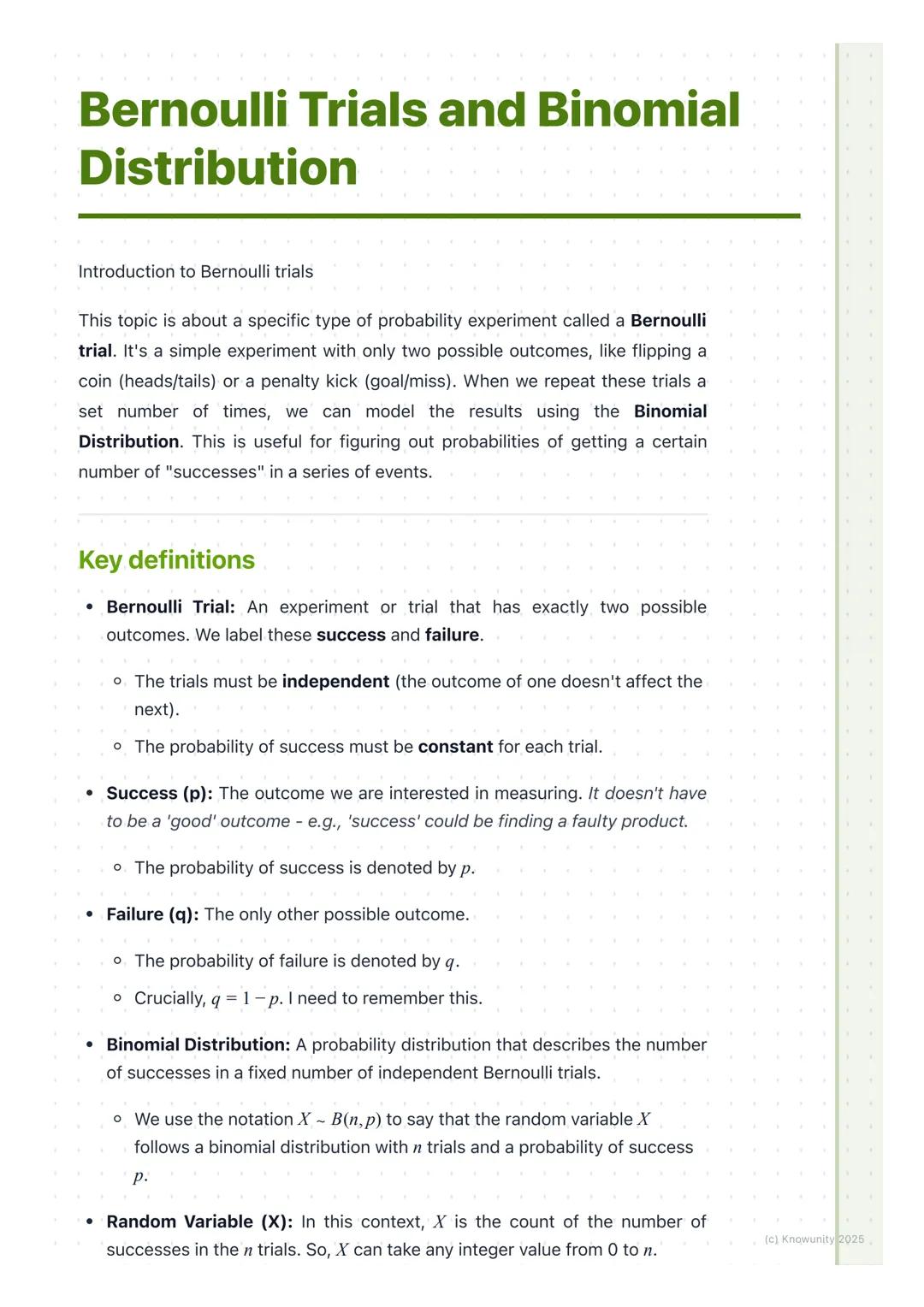
Introduction to Bernoulli Trials
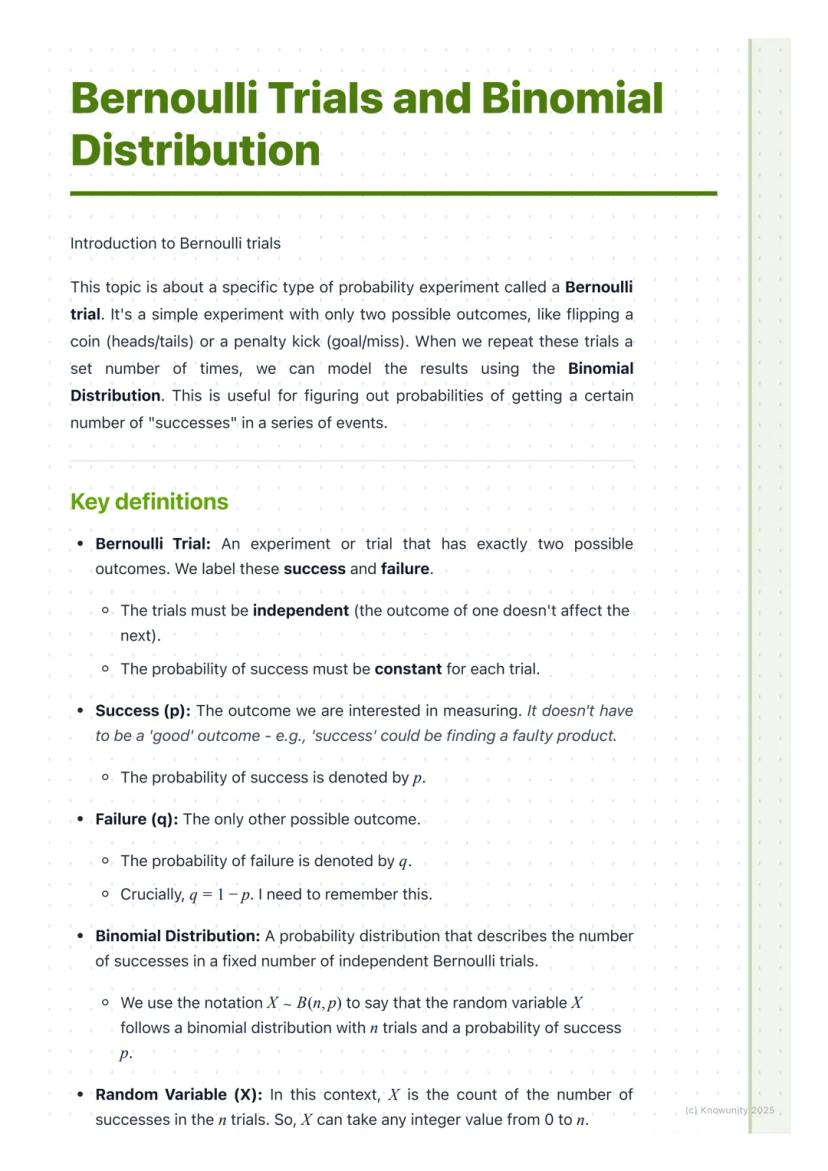
Think of any situation where there are only two possible outcomes - that's essentially what we're dealing with here. A Bernoulli trial is just a fancy name for an experiment with exactly two results: success or failure.
The beauty of this concept is its simplicity. Whether you're flipping coins, taking penalty kicks, or checking if products are faulty, the same mathematical principles apply. The key is that each trial must be independent (one result doesn't affect the next) and the probability of success stays constant throughout.
When we repeat these trials a fixed number of times, we can use the binomial distribution to work out probabilities. We write this as X ~ B(n,p), where n is the number of trials and p is the probability of success. Remember that the probability of failure is always q = 1-p - this formula shows up everywhere in exam questions.
Quick Tip: Success doesn't have to mean something good - it's just the outcome you're measuring. Finding a faulty product could be your 'success' in quality control!
2
of 5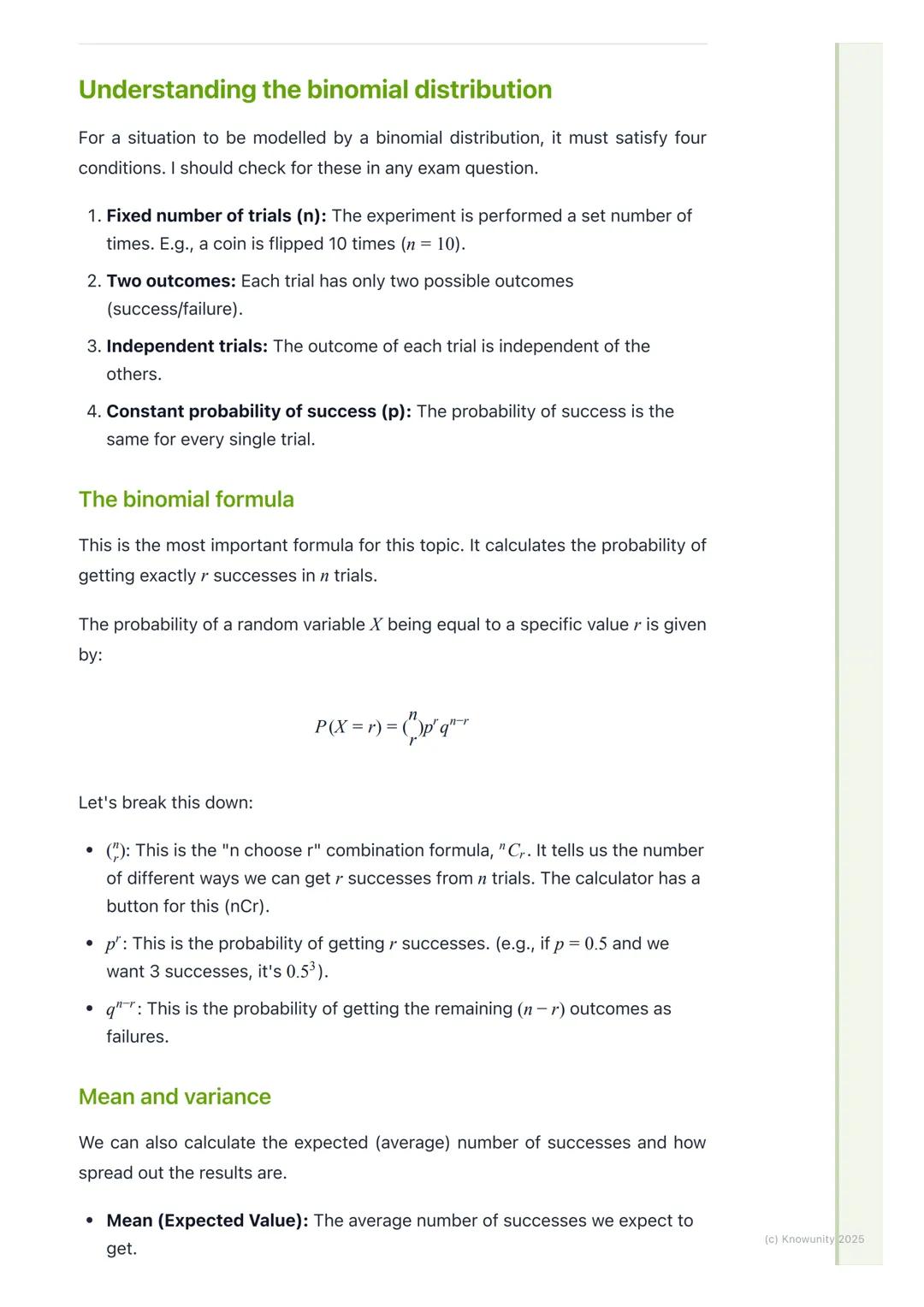
Understanding the Binomial Distribution
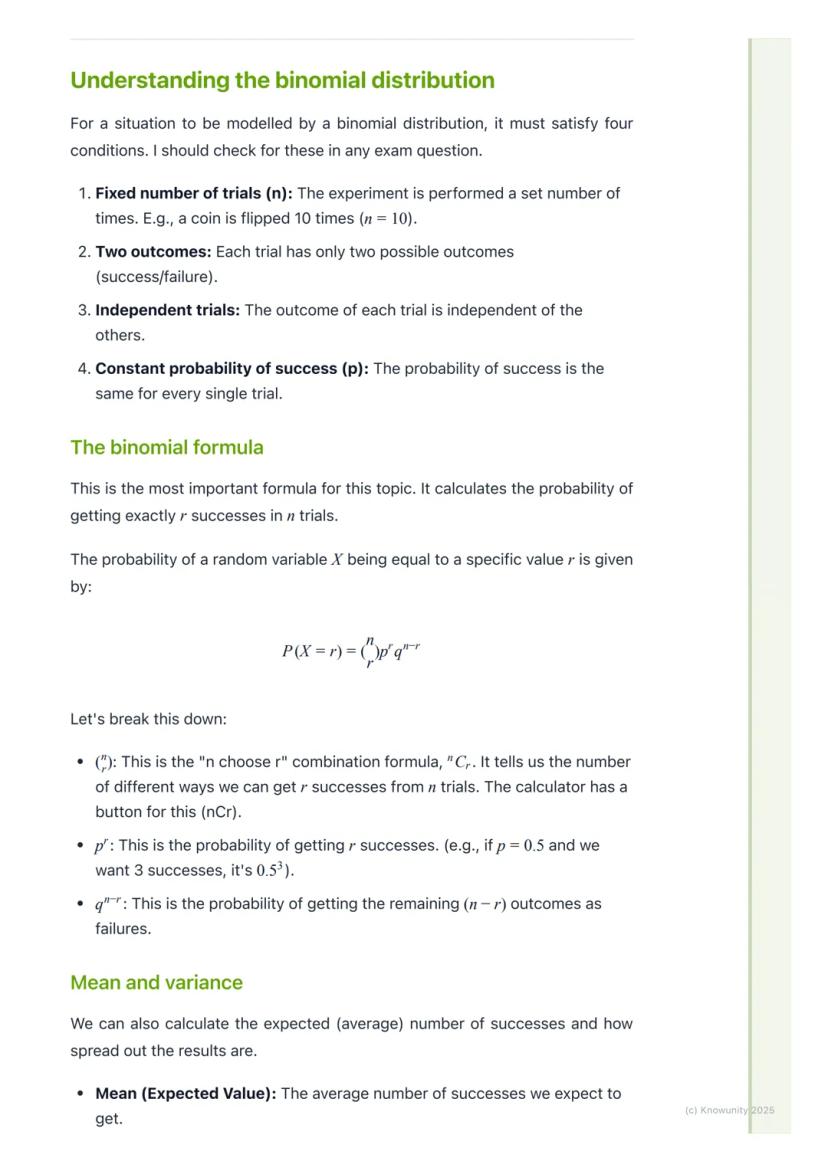
Before jumping into calculations, you need to check four essential conditions - think of them as your exam checklist. You need a fixed number of trials, exactly two possible outcomes, independent trials, and a constant probability of success.
The main formula you'll use is: P = (n choose r) × p^r × q^. This might look intimidating, but it breaks down logically. The combination part (n choose r) counts how many ways you can get r successes, whilst p^r gives the probability of those successes and q^ covers the remaining failures.
Your calculator will have an nCr button for combinations, making the maths much easier. The trickiest part is often interpreting the question correctly - make sure you understand what counts as 'success' before you start calculating.
Remember: Always verify all four conditions are met before using binomial distribution formulas - it's an easy way to lose marks if you skip this step!
3
of 5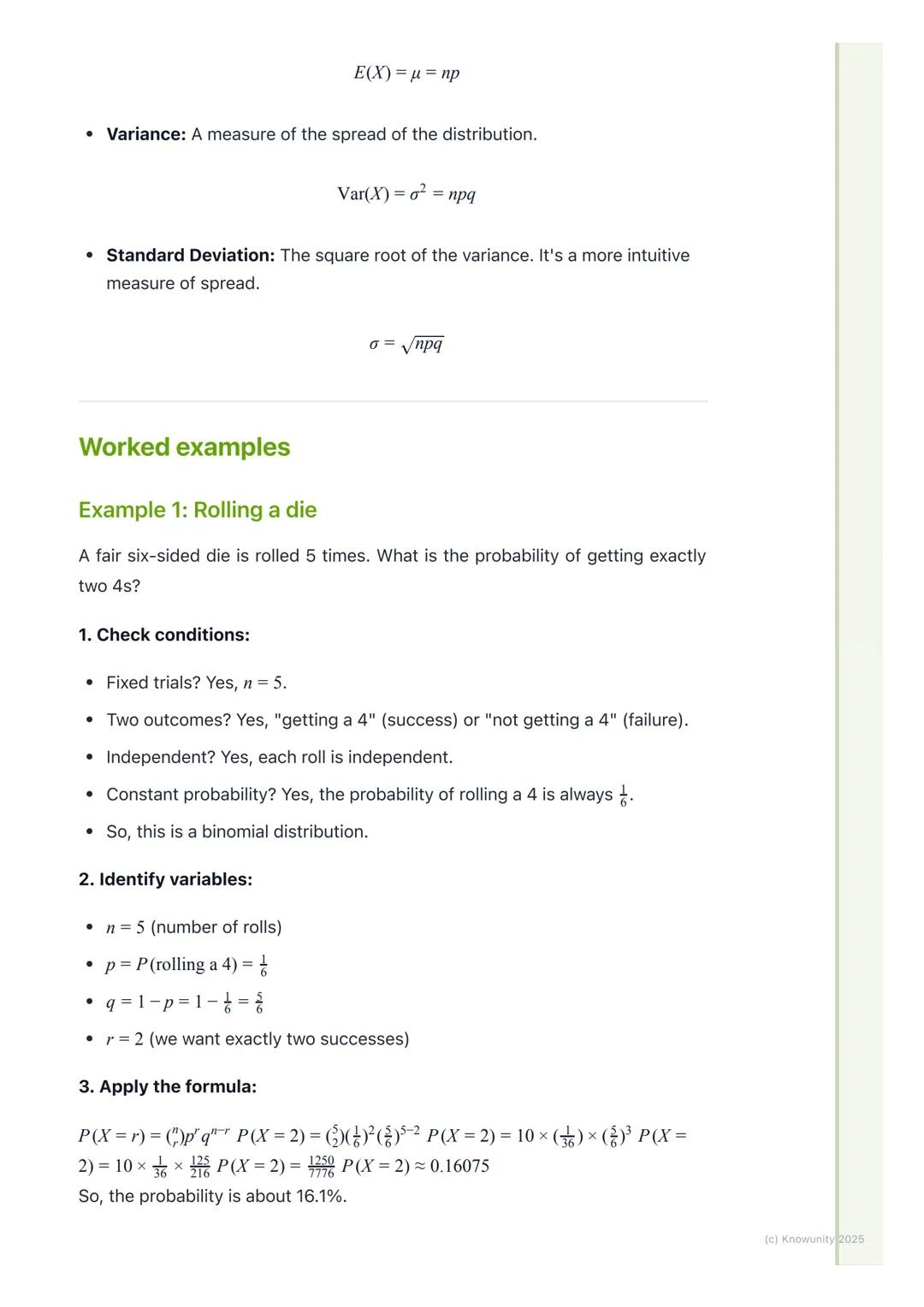
Mean, Variance and Worked Examples
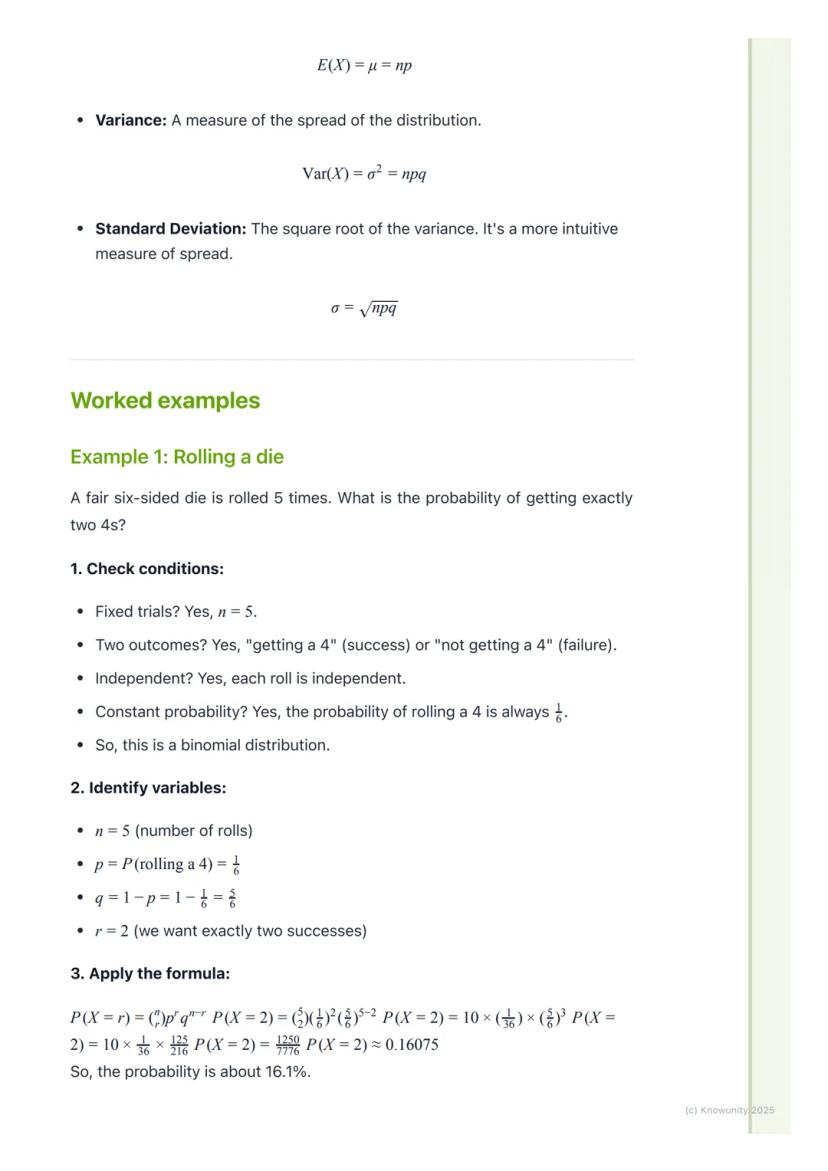
The expected value (mean) is simply E(X) = np, telling you the average number of successes you'd expect. The variance is npq, and taking its square root gives you the standard deviation - a measure of how spread out your results might be.
Let's work through a practical example. If you roll a die 5 times wanting exactly two 4s, you first check the conditions (all met), then identify your variables: n=5, p=1/6, q=5/6, r=2. Plugging into the formula gives you approximately 16.1%.
For more complex problems involving "at least" or "at most", you'll need to add up multiple probabilities. This is where careful reading becomes crucial - "at least 4" means P + P + P, whilst "fewer than 2" means P + P.
Pro Strategy: For questions like P(X≥2), sometimes it's quicker to calculate 1 - P(X<2), especially when n is large!
4
of 5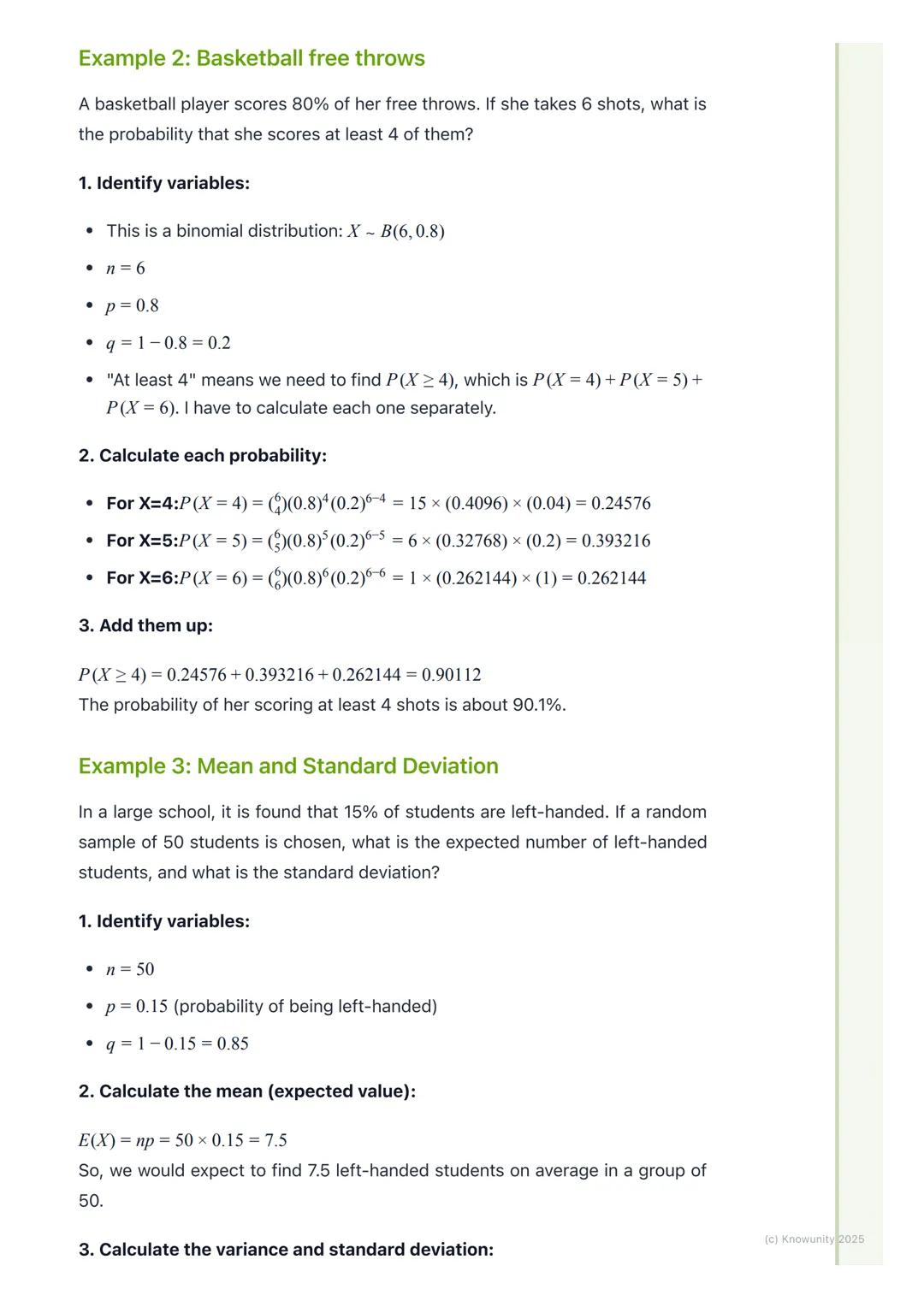
Basketball Free Throws Example
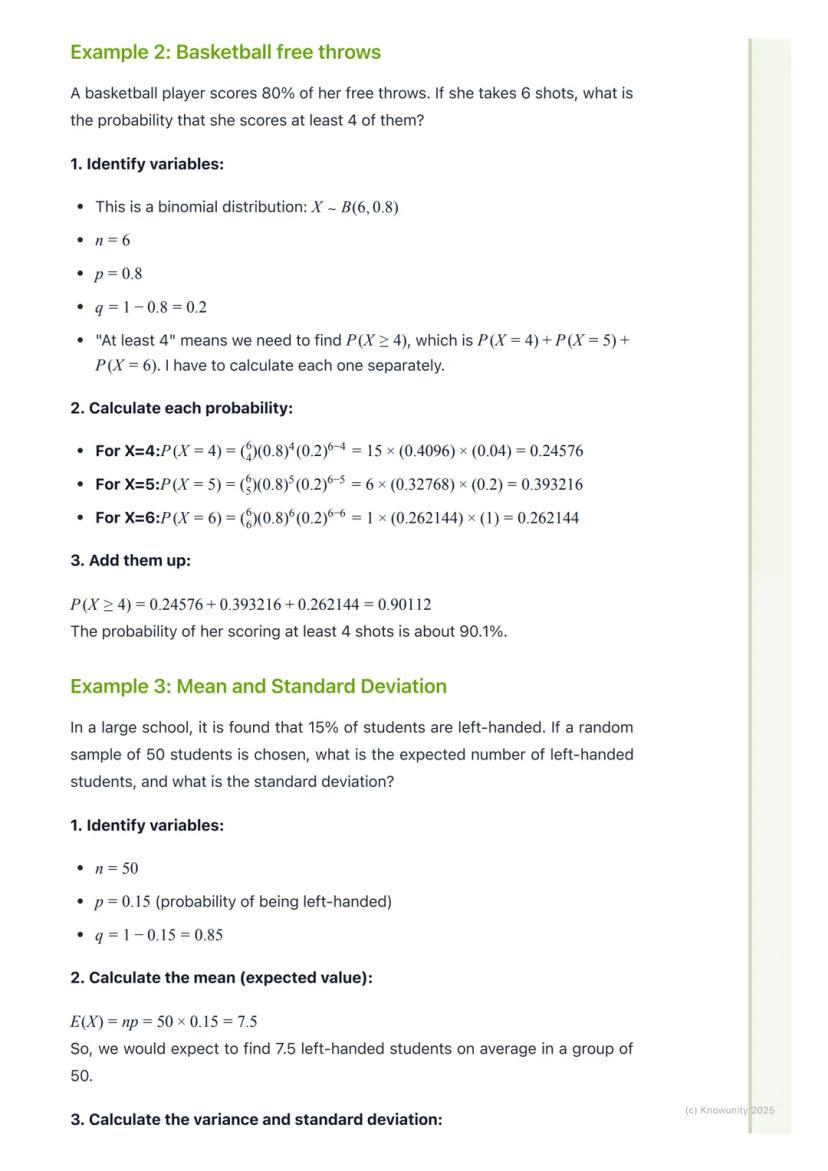
Here's a realistic scenario that shows how binomial distribution works in sports. A basketball player with an 80% success rate takes 6 shots - what's the probability she scores at least 4?
Setting up the problem: X ~ B(6, 0.8), so n=6, p=0.8, q=0.2. Since we want "at least 4", we calculate P + P + P separately. Each calculation follows the same pattern, just with different r values.
The results are P≈0.246, P≈0.393, and P≈0.262. Adding these gives approximately 90.1% - quite high odds for a skilled player.
This type of question often appears in exams because it tests multiple skills: recognising binomial conditions, handling "at least" language, and performing several calculations accurately.
Watch Out: Pay attention to words like "at least", "at most", "more than", and "fewer than" - they completely change which probabilities you need to calculate!
5
of 5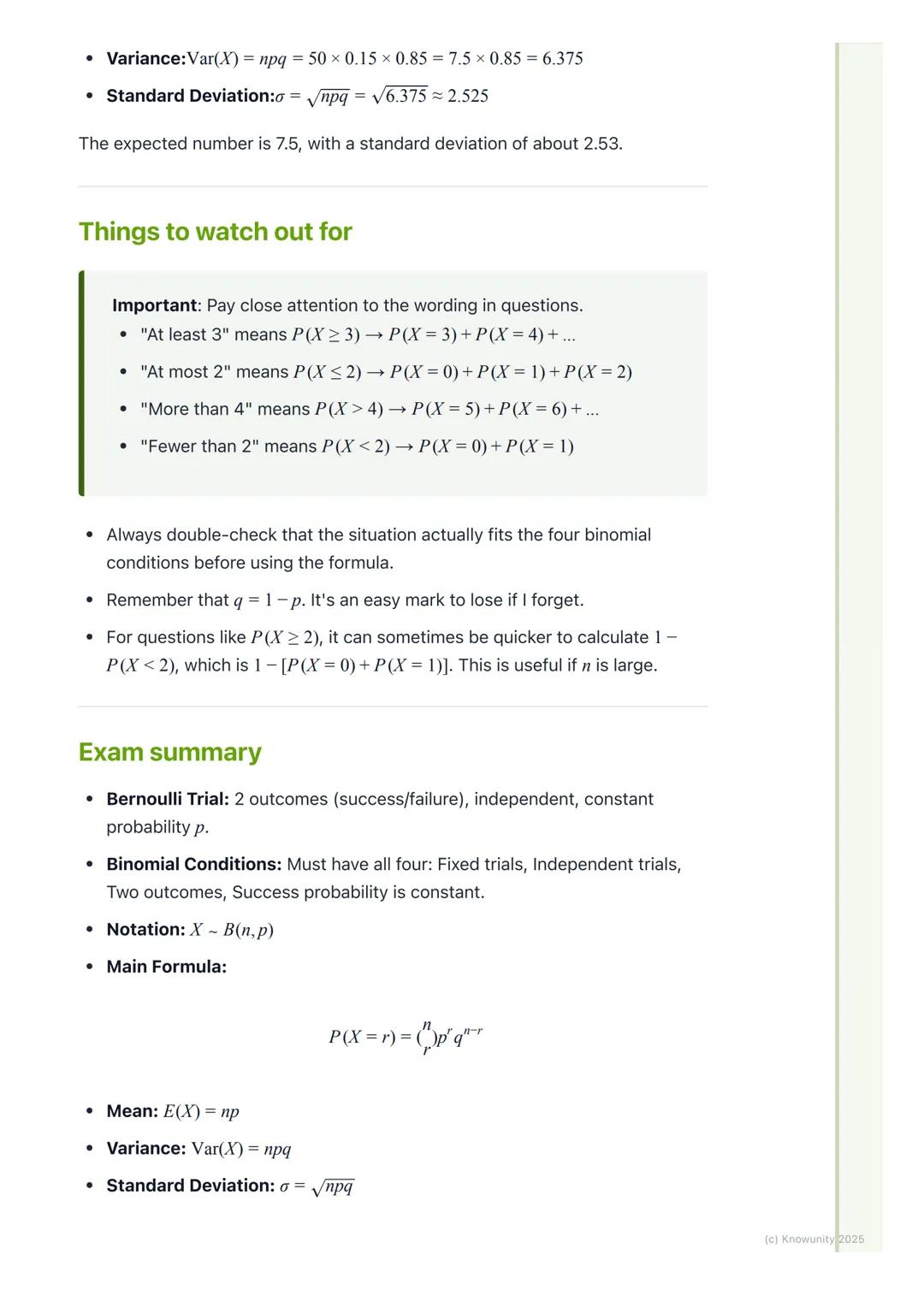
Calculating Expected Values and Exam Strategy
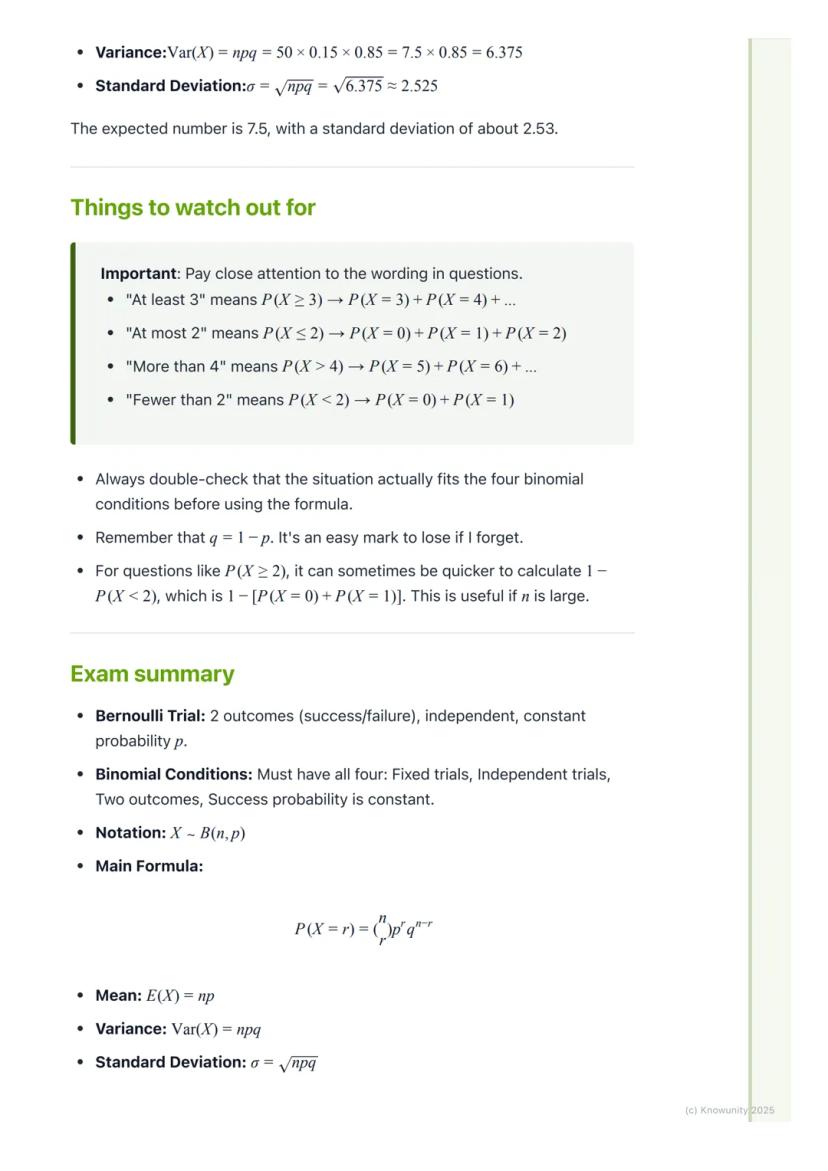
Let's tackle a mean and standard deviation problem to round out your understanding. With 50 students where 15% are left-handed, we expect E(X) = np = 7.5 left-handed students on average.
The variance is npq = 6.375, giving a standard deviation of approximately 2.53. These measures help you understand not just the average outcome, but how much variation you might see in practice.
For exam success, remember the key conditions and formulas. Always check that your situation fits all four binomial conditions before applying the formulas. Double-check that q = 1-p in your calculations, and be extra careful with probability language.
The essential formulas are: P = (n choose r) × p^r × q^, E(X) = np, Var(X) = npq, and σ = √(npq). Master these and you'll handle any binomial distribution question confidently.
Exam Success: Sometimes calculating 1 - P(X<k) is much faster than adding up many individual probabilities - always look for the most efficient approach!
We dachten al dat je dit zou vragen...
Wat is de Knowunity AI companion?
Onze AI Companion is een studentgerichte AI-tool die meer biedt dan alleen antwoorden. Gebouwd op miljoenen Knowunity bronnen, biedt het relevante informatie, gepersonaliseerde studieplannen, quizzes en inhoud direct in de chat, aangepast aan jouw individuele leertraject.
Waar kan ik de Knowunity-app downloaden?
Je kunt de app downloaden via Google Play Store en Apple App Store.
Is Knowunity echt gratis?
Dat klopt! Geniet van gratis toegang tot leerinhoud, maak contact met medestudenten en krijg directe hulp – alles binnen handbereik.
Populairste studiemateriaal voor Mathematics
8Populairste studiemateriaal
9Kan je niet vinden wat je zoekt? Ontdek andere vakken.
Studenten zijn dol op ons — en jij ook.
4.6/5App Store
4.7/5Google Play
De app is heel makkelijk te gebruiken en goed ontworpen. Ik heb tot nu toe alles kunnen vinden waar ik naar zocht en heb veel kunnen leren van de presentaties! Ik ga de app zeker gebruiken voor een schoolopdracht! En natuurlijk helpt het ook veel als inspiratie.
Stefan SiOS gebruiker
Deze app is echt geweldig. Er zijn zoveel aantekeningen en hulpmiddelen [...]. Mijn probleemvak is bijvoorbeeld Frans, en de app heeft zoveel opties voor hulp. Dankzij deze app ben ik beter geworden in Frans. Ik zou het iedereen aanraden.
Samantha KlichAndroid gebruiker
Wow, ik ben echt onder de indruk. Ik probeerde de app gewoon omdat ik hem vaak geadverteerd had gezien en was absoluut verbaasd. Deze app is DE HULP die je wilt voor school en bovenal biedt hij zoveel dingen, zoals oefeningen en factsheets, die mij persoonlijk HEEL erg hebben geholpen.
AnnaiOS gebruiker
Mathematics11 weergaven·Bijgewerkt May 24, 2026·5 pagina'sUnderstanding Bernoulli Trials and Binomial Distribution
Ever wondered how to predict the odds of making a certain number of free throws or getting heads in multiple coin flips? Bernoulli trials and the binomial distributiongive you the mathematical tools to solve these types of probability problems... Meer weergeven
1
of 5Meld je aan om de inhoud te zien. Het is gratis!
- Toegang tot alle documenten
- Verbeter je cijfers
- Sluit je aan bij miljoenen studenten
Introduction to Bernoulli Trials
Think of any situation where there are only two possible outcomes - that's essentially what we're dealing with here. A Bernoulli trial is just a fancy name for an experiment with exactly two results: success or failure.
The beauty of this concept is its simplicity. Whether you're flipping coins, taking penalty kicks, or checking if products are faulty, the same mathematical principles apply. The key is that each trial must be independent (one result doesn't affect the next) and the probability of success stays constant throughout.
When we repeat these trials a fixed number of times, we can use the binomial distribution to work out probabilities. We write this as X ~ B(n,p), where n is the number of trials and p is the probability of success. Remember that the probability of failure is always q = 1-p - this formula shows up everywhere in exam questions.
Quick Tip: Success doesn't have to mean something good - it's just the outcome you're measuring. Finding a faulty product could be your 'success' in quality control!
2
of 5Meld je aan om de inhoud te zien. Het is gratis!
- Toegang tot alle documenten
- Verbeter je cijfers
- Sluit je aan bij miljoenen studenten
Understanding the Binomial Distribution
Before jumping into calculations, you need to check four essential conditions - think of them as your exam checklist. You need a fixed number of trials, exactly two possible outcomes, independent trials, and a constant probability of success.
The main formula you'll use is: P = (n choose r) × p^r × q^. This might look intimidating, but it breaks down logically. The combination part (n choose r) counts how many ways you can get r successes, whilst p^r gives the probability of those successes and q^ covers the remaining failures.
Your calculator will have an nCr button for combinations, making the maths much easier. The trickiest part is often interpreting the question correctly - make sure you understand what counts as 'success' before you start calculating.
Remember: Always verify all four conditions are met before using binomial distribution formulas - it's an easy way to lose marks if you skip this step!
3
of 5Meld je aan om de inhoud te zien. Het is gratis!
- Toegang tot alle documenten
- Verbeter je cijfers
- Sluit je aan bij miljoenen studenten
Mean, Variance and Worked Examples
The expected value (mean) is simply E(X) = np, telling you the average number of successes you'd expect. The variance is npq, and taking its square root gives you the standard deviation - a measure of how spread out your results might be.
Let's work through a practical example. If you roll a die 5 times wanting exactly two 4s, you first check the conditions (all met), then identify your variables: n=5, p=1/6, q=5/6, r=2. Plugging into the formula gives you approximately 16.1%.
For more complex problems involving "at least" or "at most", you'll need to add up multiple probabilities. This is where careful reading becomes crucial - "at least 4" means P + P + P, whilst "fewer than 2" means P + P.
Pro Strategy: For questions like P(X≥2), sometimes it's quicker to calculate 1 - P(X<2), especially when n is large!
4
of 5Meld je aan om de inhoud te zien. Het is gratis!
- Toegang tot alle documenten
- Verbeter je cijfers
- Sluit je aan bij miljoenen studenten
Basketball Free Throws Example
Here's a realistic scenario that shows how binomial distribution works in sports. A basketball player with an 80% success rate takes 6 shots - what's the probability she scores at least 4?
Setting up the problem: X ~ B(6, 0.8), so n=6, p=0.8, q=0.2. Since we want "at least 4", we calculate P + P + P separately. Each calculation follows the same pattern, just with different r values.
The results are P≈0.246, P≈0.393, and P≈0.262. Adding these gives approximately 90.1% - quite high odds for a skilled player.
This type of question often appears in exams because it tests multiple skills: recognising binomial conditions, handling "at least" language, and performing several calculations accurately.
Watch Out: Pay attention to words like "at least", "at most", "more than", and "fewer than" - they completely change which probabilities you need to calculate!
5
of 5Meld je aan om de inhoud te zien. Het is gratis!
- Toegang tot alle documenten
- Verbeter je cijfers
- Sluit je aan bij miljoenen studenten
Calculating Expected Values and Exam Strategy
Let's tackle a mean and standard deviation problem to round out your understanding. With 50 students where 15% are left-handed, we expect E(X) = np = 7.5 left-handed students on average.
The variance is npq = 6.375, giving a standard deviation of approximately 2.53. These measures help you understand not just the average outcome, but how much variation you might see in practice.
For exam success, remember the key conditions and formulas. Always check that your situation fits all four binomial conditions before applying the formulas. Double-check that q = 1-p in your calculations, and be extra careful with probability language.
The essential formulas are: P = (n choose r) × p^r × q^, E(X) = np, Var(X) = npq, and σ = √(npq). Master these and you'll handle any binomial distribution question confidently.
Exam Success: Sometimes calculating 1 - P(X<k) is much faster than adding up many individual probabilities - always look for the most efficient approach!
We dachten al dat je dit zou vragen...
Wat is de Knowunity AI companion?
Onze AI Companion is een studentgerichte AI-tool die meer biedt dan alleen antwoorden. Gebouwd op miljoenen Knowunity bronnen, biedt het relevante informatie, gepersonaliseerde studieplannen, quizzes en inhoud direct in de chat, aangepast aan jouw individuele leertraject.
Waar kan ik de Knowunity-app downloaden?
Je kunt de app downloaden via Google Play Store en Apple App Store.
Is Knowunity echt gratis?
Dat klopt! Geniet van gratis toegang tot leerinhoud, maak contact met medestudenten en krijg directe hulp – alles binnen handbereik.
Populairste studiemateriaal voor Mathematics
8Populairste studiemateriaal
9Kan je niet vinden wat je zoekt? Ontdek andere vakken.
Studenten zijn dol op ons — en jij ook.
4.6/5App Store
4.7/5Google Play
De app is heel makkelijk te gebruiken en goed ontworpen. Ik heb tot nu toe alles kunnen vinden waar ik naar zocht en heb veel kunnen leren van de presentaties! Ik ga de app zeker gebruiken voor een schoolopdracht! En natuurlijk helpt het ook veel als inspiratie.
Stefan SiOS gebruiker
Deze app is echt geweldig. Er zijn zoveel aantekeningen en hulpmiddelen [...]. Mijn probleemvak is bijvoorbeeld Frans, en de app heeft zoveel opties voor hulp. Dankzij deze app ben ik beter geworden in Frans. Ik zou het iedereen aanraden.
Samantha KlichAndroid gebruiker
Wow, ik ben echt onder de indruk. Ik probeerde de app gewoon omdat ik hem vaak geadverteerd had gezien en was absoluut verbaasd. Deze app is DE HULP die je wilt voor school en bovenal biedt hij zoveel dingen, zoals oefeningen en factsheets, die mij persoonlijk HEEL erg hebben geholpen.
AnnaiOS gebruiker